AI search queries differ from traditional keyword searches because people can now type the full problem they're trying to solve, context, constraints, comparisons and follow-up questions included, instead of compressing that need into a few search terms. That's the core of the shift in AI search query behavior, and it changes what "matching a search" actually means.
The shift isn't from all keywords to all full sentences. It's a change in the mix. AI-oriented queries are getting longer, more conversational and more exploratory, while short, navigational searches still work fine on a regular results page. If you're trying to understand AI search vs keyword search as an either-or question, you're asking the wrong question. It's a shift in proportion, and it's a big enough shift that it changes what content needs to do.
From keywordese to the real question
Think about how you used to search for a restaurant. You'd type something like "restaurants New York." What you actually meant was closer to: I need a restaurant in a specific part of New York, for five people, one of whom is vegan, and I've got kids with me so it can't be too fancy or too loud.
Nobody typed all of that into a search box, because search boxes didn't reward it. You learned to strip your real question down to the terms a search engine was likely to understand. Google's own search leadership has a name for this habit: keywordese, the abbreviated, stripped-down language people learned to use because a plain, ordinary question didn't work as well as a compressed phrase.
AI search removes a lot of that pressure. You can type the actual sentence you'd say to a friend, constraints and all, and the system will work with it. Google has described this directly: instead of simplifying a query down to its bones, users are increasingly describing the whole problem. That's the real change behind AI search query behavior. It's not that people got wordier for no reason. It's that the interface finally lets them ask for what they mean.
This matters for anyone thinking about content, because a keyword phrase was always a compressed proxy for a richer need. When the compression isn't necessary anymore, a page built to match the compressed phrase is answering a smaller question than the one being asked.
AI queries carry more context
Google has published real numbers on this, and they're worth sitting with instead of skimming past. In its one-year U.S. report on AI Mode, covering the period from the May 2025 launch through April 2026, Google said the average AI Mode search query runs about three times the length of a traditional Search query. An earlier 2025 announcement had put that figure at roughly twice as long. Those aren't necessarily the same measurement repeated over time, since they come from different reports and periods, but both point the same direction: queries are getting longer as people ask AI Mode more of what's actually on their mind.
Length by itself isn't the interesting part. What's happening inside that extra length is. Google says AI Mode queries increasingly carry context, stated constraints and a clear task, not just a topic. The report also flags specific patterns in how people open these questions: common first words include "what," "how," "I," "is" and "can," and common keywords inside the query include "find," "information," "identify," "explain" and "summarize." Those aren't topic labels. They're instructions. A person asking a system to "explain" or "summarize" something is asking it to do cognitive work, not just retrieve a page.
Worth being precise here: Google also reports that both short and long queries are growing inside AI Mode, so the average getting longer doesn't mean every query is a paragraph now. Some searches are still quick and specific. The mix has shifted, not the whole population of queries.
Other sources point at the same pattern from different angles. A Similarweb comparison of prompt behavior put the average ChatGPT prompt at around 60 words, against roughly 3.4 words for an average Google search. That's a steep difference, and it's worth treating it for what it is: a reported comparison between two different kinds of input, a chat prompt and a search query, not a controlled study with detailed methodology behind it. Still, the direction lines up with everything else here. People type more when the system can use more.
AI search is conversational and exploratory
A traditional search session often looks like a sequence of narrowing guesses. Something like: "best running shoes," then "best running shoes flat feet," then "best running shoes flat feet women," then "running shoe reviews." Each search is really one attempt at getting the phrasing right, one step closer to what you actually wanted.
An AI-oriented session can start closer to the real question and then keep going conversationally. You might open with "I'm training for a half marathon, have flat feet and want a durable running shoe under $150, what should I consider," then follow with "which of those is best for wet weather," then "how does that compare with the previous model." Each later question depends on what came before it. That's a conversation, not a string of separate lookups.
Google's data backs this up directly: follow-up queries in AI Mode have grown by more than 40% on average per month in the United States. The company also reports fast growth in specific question types that signal planning and decision-making rather than simple lookup. Planning-related queries grew 80% faster than AI Mode queries overall over a recent six-month stretch. Queries beginning with "which," as in "which of" or "which one," grew 40% faster than AI Mode queries overall in that same window. Brainstorming-related searches grew 30% faster than the overall AI Mode growth rate since launch. Those are relative growth figures, not shares of total volume, but the pattern they describe is consistent: people are using these systems to compare, plan and decide, not only to find.
There's a useful distinction inside this that's easy to miss. Google's own search leadership has talked about a separate category of query it calls "browsy," meaning a search where the person wants to see a range of options, images and different takes rather than get one synthesized answer handed to them. Someone searching "best places to visit in Orlando" might not want a single recommendation. They want to scroll, compare, and pick something themselves. A browsy query can be short or long, and it often still favors a traditional results page over a single AI answer, because browsing is the point. Not every long or exploratory-sounding query is asking the system to decide for you. Some are asking it to show you the field.
The system still uses keywords underneath
Here's the part that's easy to get wrong: none of this means keywords have disappeared. They've moved.
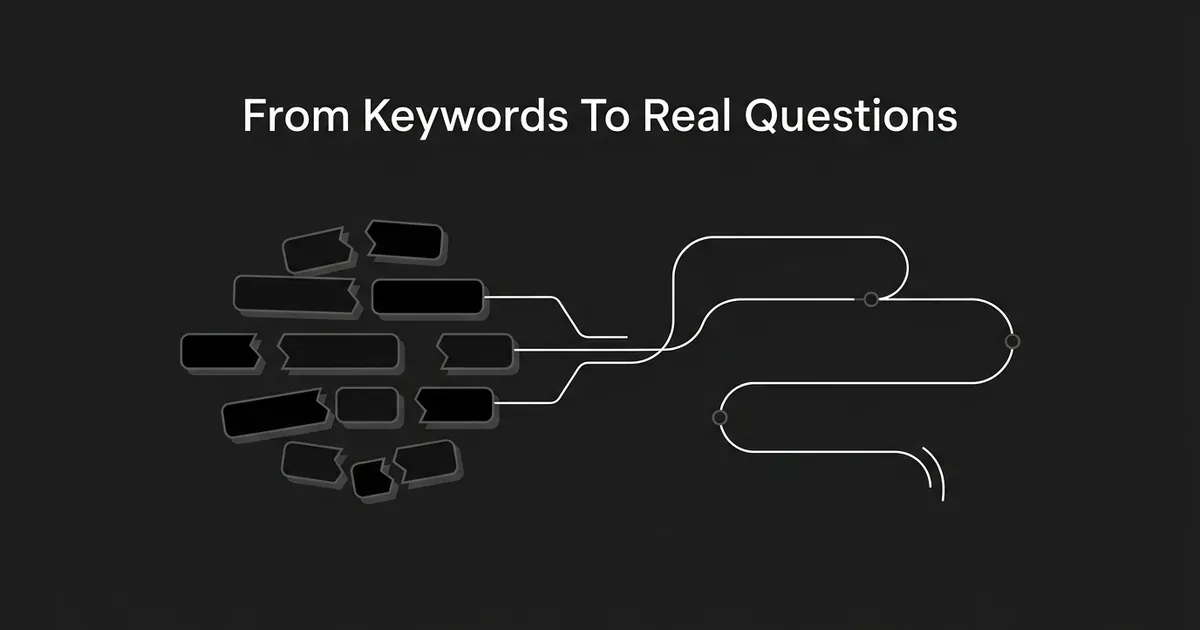
When you ask an AI system a full, natural-language question, that system often can't just match your sentence to a single page. It breaks your request apart into smaller pieces it can actually search for, a process sometimes called query fan-out, and retrieves information for each piece before pulling the answer together. Take a request like "I need a family-friendly, reasonably priced restaurant in New York for five people, including one vegan diner, near a particular neighborhood." Behind the scenes, that single natural-language ask can turn into several narrower searches: restaurants in that neighborhood, family-friendly restaurants, vegan-friendly menus, price range, and capacity for a group of five.

This is what keyword fragmentation actually describes: not people typing scattered, random terms, but a single complex need getting decomposed into several specific retrieval queries instead of staying as one stable keyword phrase. The user's side of the interaction has moved toward natural language search queries. The system's side, underneath, still leans on keyword-like matching to go find the pieces.
That distinction matters because it stops the conversation from swinging too far the other way. Keyword fragmentation doesn't mean keyword matching is gone, it means the matching moved. It changes where that matching happens and who has to do the translating. Used to be, you translated your need into keywords yourself before you ever hit search. Now the system does more of that translation for you, after you've stated the need in your own words.
What the data does and doesn't prove
It's worth being direct about the limits here, because the evidence, while strong, measures different things in different places, and mixing them up is an easy mistake.
Google's AI Mode figures are first-party data about one specific product during a specific period. They're the strongest direct evidence in this discussion, but they describe AI Mode in the United States, not every AI search experience everywhere. A separate analysis by Nectiv, reported by Search Engine Land in October 2025, looked at more than 8,500 ChatGPT prompts across nine industries and found that 31% triggered at least one external search, with ChatGPT running an average of 2.17 searches per prompt that searched at all, and those model-generated search queries averaging 5.48 words. That's genuinely useful, but it measures the searches ChatGPT generates behind the scenes to answer you, not the length of what you originally typed. It's a different unit from Google's query-length figures, and treating it as the same thing would overstate the case.
A 2026 academic study looked at nearly 235,000 real ChatGPT conversations and classified them by whether the input resembled something a traditional search engine could answer. It found 21% were classified as "searchable" and 79% were not, with the non-searchable share growing over time in the dataset. That's a striking split, but "non-searchable" here is a modeled classification covering everything from writing help to coding to open-ended discussion, not a direct measure of how many prompts are long natural-language search questions. It would be a mistake to read that 79% as "most AI search queries are conversational." A good share of it is people using the tool for things that were never search at all.
A separate academic study tracked a panel of 900 U.S. adults across a month of Google searches and found that roughly 18% of queries produced an AI Overview, with longer queries, question-worded queries and queries containing both a noun and a verb more likely to trigger one. That's a real correlation worth knowing, but it's an association observed during one specific month, not proof that writing a longer question causes an AI Overview to appear.
Put together, the honest summary is this: multiple independent sources, measuring different things in different ways, all point toward the same underlying shift. None of them, on its own, proves that keyword search is over or that every AI query looks the same. The evidence supports a real change in behavior. It doesn't support the more dramatic version of that claim.
What this means for your content
None of this is really about word count. The real change is that a single keyword phrase used to stand in for a much bigger need, and a lot of content got built around matching that phrase as closely as possible. When people can state the actual need instead of compressing it, a page that only answers the compressed version of the question is answering less than what's being asked.
That doesn't mean the keyword research you've already done is worthless, or that you should try to write a page for every possible way someone might phrase a question. Nobody can chase infinite phrasing, and a lot of that phrasing is genuinely one-off. What it does mean is that it's worth thinking about the range of questions, comparisons and follow-ups sitting behind a topic, not just the one phrase your keyword tool surfaced for it. If you're trying to understand where your own content shows up in these AI-driven answers and where it doesn't, that's a different kind of visibility question than a rankings report, and it's one more marketing teams are starting to ask.