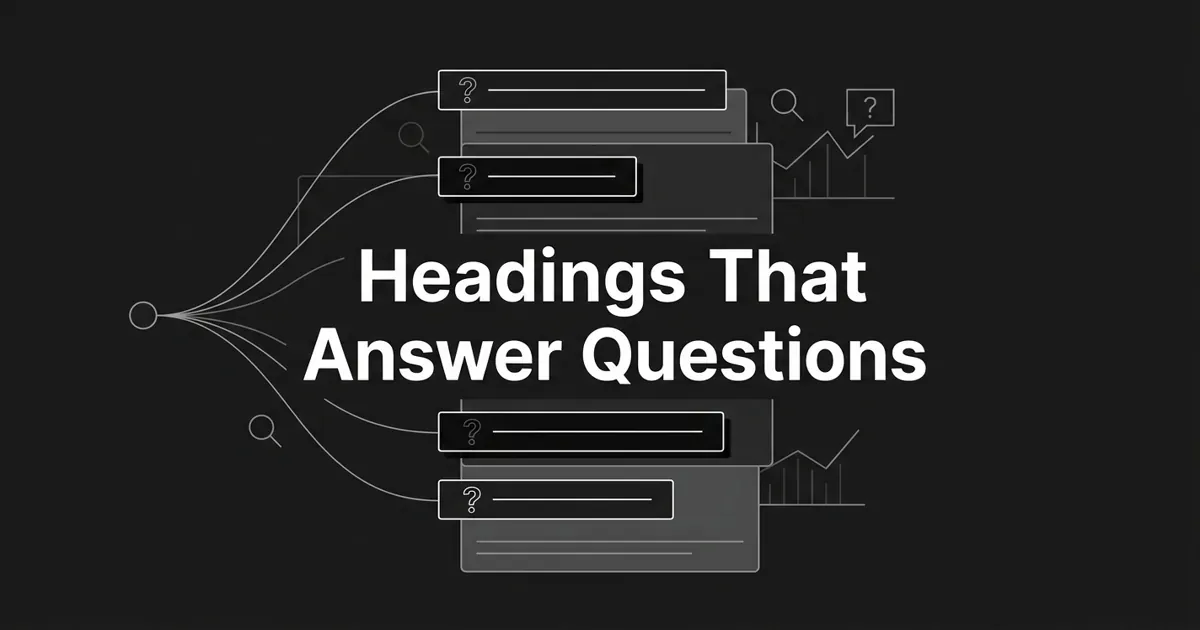
You already have an outline. The H2s are tidy, topical, and invisible to a retrieval engine: "Heading phrasing rules," "Overview," "Best practices." Those labels tell a human what a section covers. They tell ChatGPT, Perplexity, Gemini, Claude, and Google AI Mode almost nothing about which question that section answers. Getting heading structure for AI search right means rewriting those labels as the questions your buyers actually type, so every section becomes a self-labeled answer unit an engine can pull and attribute.
Good news: this is one of the cheapest AEO fixes you can make. The content underneath barely changes. The labels do. This guide walks that rewrite end to end, and you need one existing outline, a seed topic, access to a People Also Ask source, and about 90 minutes.
What a question in your heading actually does
Here's the mechanism in plain English, and then we'll get to work.
AI engines don't read your page top to bottom. They split it into chunks, and the most common chunk boundary is a heading plus the section beneath it. Each chunk becomes a vector, a kind of mathematical fingerprint of its meaning. When someone asks a question, the engine fingerprints the question too, then hunts for the chunks sitting closest to it.
See the problem with "Best practices"? A heading that already reads as a question is a near-perfect match for the prompt it came from. A topical label makes the engine infer the question first. Inference is where you lose.
That's the whole idea behind question based subheadings AEO: match the label to the query so the engine never has to guess.
It helps to picture the funnel you're trying to survive. Google's AI Overviews start from a large pool of candidate documents, a few hundred of them, and filter down through several stages to the handful that actually get cited. Every stage is a chance to be dropped. A heading that states the question your section answers is the cheapest way to stay in the pool, because it tells the filter exactly what the chunk is for.
The evidence points the same direction. Vendor analyses of cited pages keep finding that question-form H2s earn meaningfully more citations than statement-form ones, and that pages with clean, sequential heading levels get cited more often than pages with skipped levels. One controlled split test found that rephrasing product-page H2s into questions lifted organic traffic within a few weeks. Treat all of that as directional, not as a guarantee. These are single analyses, and correlation isn't causation: pages with tidy headings tend to be well-made pages in general. It's motivation to start, not a number to bank on.
One more thing worth holding onto before you start. Heading structure for AI search isn't the same job as heading structure for scanners. A human skimming your page uses headings to decide what to skip. An engine uses them to decide what your section is worth retrieving for. The same H2 has to do both, and when the two goals conflict, the question wins.
Step 1: Mine 30 to 80 real buyer questions
Don't touch your outline yet. First you need the raw phrasings, in your buyer's words, not yours.
Pull candidate questions from these sources, in this order:
- Google's People Also Ask boxes. Search your seed topic and expand every box. Each expansion reveals more. The tree runs three to five levels deep, and most people stop at the first one.
- Question-format keyword variants. Run the seed through a tool that returns who, what, when, where, why, and how variants.
- Reddit, Quora, niche forums, and review-site Q&A. This is where you find how buyers actually talk, mess and all.
- Sales call transcripts, support tickets, and your sales team's FAQ. Free, in-house, and criminally underused.
- Tracked AI prompts. The most precise source of all, because these are the questions buyers are already running on the engines.
That last one deserves a beat. Prompt tracking shows you the actual prompts people run in your category, which engines answer them, which sources those engines cite, and which prompts your competitors win that you don't. This is what DeepSmith's AEO Prompts view does: it checks a set of prompts you define on a schedule and reports mention rate, citation rate, and answer history for each one, across ChatGPT, Perplexity, Gemini, Claude, and Google AI Mode depending on your plan. If you're phrasing your H2 H3 as questions, these are the phrasings worth copying, because they're in-market by definition.
Why so many candidates? Because you're going to throw most of them away. Thirty to 80 gives you enough overlap to see which phrasings repeat across sources, and a phrasing that shows up in a PAA box, a Reddit thread, and a sales call is a phrasing worth building a section around.
Tag each question with its intent as you collect it: definition, process, comparison, troubleshooting, pricing. That tag decides which section it belongs to later, and it takes two seconds now versus twenty minutes of re-reading later.
How you know you're done: you have 30 to 80 candidate questions written out in the buyer's words, each tagged with its intent.
Where people go wrong: trusting keyword tools that hand back fragments like "heading structure SEO" instead of a full question like "does heading structure matter for AI search in 2026?" Retrieval matches whole question intent. Fragments don't carry any. Most question headings SEO advice stops right here, at the keyword list, which is exactly where the useful work starts. The other common miss is using only your team's vocabulary, which is always tidier than how real people ask.
Step 2: Cluster the questions and map them to your outline
Now bring the outline back. Group your candidates by topic and intent. Each cluster becomes one H2. If a cluster holds several distinct sub-questions, those become H3s underneath.
If a question doesn't fit a cluster, drop it. Not every phrasing deserves a heading, and forcing strays into your outline is how pages turn into rambling lists of thin sections.
Clustering by hand works fine for one page. Across a content program it gets slow, which is where tooling helps: DeepSmith's Content Ideas module groups question sets into topic clusters with search volume and difficulty attached, and surfaces clusters you aren't tracking yet, so an outline starts from data instead of a blank document.
How you know you're done: a two-level outline where every H2 is a buyer question and every H3 is a genuine sub-question. No H2 left as a topical label.
Where people go wrong: welding two questions into one H2. "What is heading structure and how does it work for AI?" splits the intent and dilutes both halves of the match. Ask one question per heading. The other trap is leaving "Overview" and "Background" in place. They're not retrievable units. Rewrite them or cut them.
Step 3: Rewrite each H2 in the buyer's exact phrasing
Take each cluster's primary phrasing and use it close to verbatim. A light grammatical fix is fine: add a helping verb, capitalize a proper noun. Resist the urge to polish it into marketing language.
Four rules hold up well:
- Start with a question word. What, how, why, when, where, which, should, can, do, is, are.
- Aim for 6 to 14 words. Long enough to carry the full question and its key noun phrase. Short enough to read like something a person would type.
- Mirror the buyer's nouns. "H2 headings," "AI search," "AI Overviews," "People Also Ask," "answer engine." Their words, not your internal ones.
- Ask one thing. One question, one heading, one answer.
PAA style headings work precisely because they borrow the phrasing straight from the box, where it has already been validated against real queries. You're not guessing at how someone might ask. You're copying how thousands already did.
Watch what changes when you apply the four rules. "Heading phrasing rules" becomes "How should I phrase my H2s for AI search?" Same section, same content underneath. One is a filing label. The other is a question someone typed this morning.
How you know you're done: every H2 reads as a natural question a person would type. Someone who sees only the heading and the first sentence under it can answer the question.
Where people go wrong: keyword stuffing the question. "How do H2 H3 question SEO AI Overviews headings work?" loses the reader and the retriever at the same time. Vague headings fail the same way. "What about headings?" matches no specific intent, so it matches nothing.
Step 4: Add H3 sub-questions only where they earn their place
Use an H3 only when a parent H2 genuinely contains more than one sub-question buyers ask. Write each one as a sub-question of its parent, in the same vocabulary.
Here's the shape:
- H2: How should I phrase my H2s for AI search?
- H3: What makes a question-form H2 work for retrieval?
- H3: Which question word should I use for each section?
- H3: How long should a question-form H2 be?
Notice the H3s reuse the parent's language. That consistency helps a parser keep the family together.
Restraint is the skill here. Writing your H2 H3 as questions is not a mandate to turn everything into a question. Every heading you add divides the page's weight, and a section too thin to answer anything won't get retrieved no matter how well you phrased its label.
How you know you're done: no H2 carries more than four or five H3s, and no H3 floats without a clear parent question.
Where people go wrong: promoting every bullet to an H3. You end up with dozens of tiny sections, each too thin to be worth citing. Writing H3s as statements breaks the question rhythm you just built. And skipping levels, jumping H1 to H3, or reaching for an H4 before any H3 exists, breaks the hierarchy parsers expect.
Common mistake: writing a perfect question-form H2 and then burying the answer three paragraphs below it. The extractor pulls the first sentence under the heading. If that sentence is a transition, you lose the citation even though the heading was right.
Step 5: Put the answer in the first sentence under the heading
Your heading asks. The next sentence answers. That's the contract.
Under every H2 and every H3, the first one or two sentences should answer the heading's question directly, in plain prose. Lead with the claim. Roughly 15 to 25 words for the direct answer, then a qualifier, then your evidence and detail.
The test is simple. Copy the heading and the first sentence beneath it into a blank document. Does the pair answer the question on its own? That's what a retrieval extractor sees.
How you know you're done: every heading-plus-first-sentence pair stands alone.
Where people go wrong: opening with a transition, an anecdote, or "in this section, we'll look at..." The extractor takes the lead, not the setup. Restating the heading is the subtler failure. "Question-form headings are headings that are questions" answers nothing.
The craft of writing those answer paragraphs is a bigger subject than this guide covers. Here, the point is placement: the answer goes first, right under the question you just asked.
Step 6: Validate each heading against real prompts
Don't publish on instinct. Run every H2 through four checks.
- Search the exact H2 in Google. Could your page plausibly satisfy the PAA box that appears? If the box shows nothing close to your heading, you've drifted from the phrasings PAA style headings are supposed to borrow.
- Paste the H2 into the engines themselves. Try ChatGPT, Perplexity, Gemini, and Claude in turn. If none return anything resembling your page's territory, your phrasing is off the in-market query.
- Cross-check against your prompt tracker. If a tracked prompt already cites a competitor for that question and your H2 doesn't match its phrasing, rewrite the heading.
- Check the mechanics. Six to 14 words, starts with a question word, one question only.
After publishing, the loop closes with attribution. DeepSmith's Pages view shows which of your pages each engine actually cites and which prompts drove those citations, so you can tell whether the outline you rewrote is winning the prompts you aimed at, and which page deserves the next pass.
How you know you're done: each H2 maps to a real buyer prompt, matches a PAA or PAA-adjacent question, and has a self-contained answer beneath it.
Where people go wrong: validating on Google alone and assuming every engine retrieves the same way. They don't. Perplexity leans hard on recency and cleanly extractable passages, and it doesn't simply match keywords and hand back links: it builds an answer from sources it can extract from and attribute cleanly, which is why headings that mirror the user's language help. Google AI Overviews mostly draw from pages already ranking in the top 10, so if you're nowhere near that pool, headings alone won't rescue the page. ChatGPT rewards clean hierarchy and extractable answer blocks.
The engines also favor different kinds of sources. Blogs do well across all of them, while some lean more on encyclopedic references and others on news and forums. You can't control that mix. You can control whether your section is the cleanest available answer to the question, which is the part that travels across every engine. One outline pattern serves all three, and the differences live mostly in the surrounding signals.
Step 7: Keep the outline alive
Phrasings drift. A page that wins citations in month one can quietly lose them by month six, because the way people ask changed and your heading didn't.
Give the outline a review cadence. Quarterly is reasonable. Each time you add or update a page, re-run your PAA source against the seed to catch new phrasings, fold in questions from support and sales, refresh the page so freshness signals stay current, and re-run your Step 6 validation.
How you know you're done: the review is on a calendar, and every new article starts from this sourcing-and-clustering workflow rather than a blank page.
Where people go wrong: set and forget. A close second is letting writers quietly reintroduce statement headings, because topical labels are easier to write than real questions.
Which headings should stay statements
Not every H2 should be a question, and this is where question headings SEO advice tends to overcorrect.
Question form earns its keep where retrieval is the goal: definitions, processes, comparisons, troubleshooting. For navigational sections, a statement is better. "Pricing," "What you'll need," and "Quick reference" are labels a reader scans for, not questions anyone types.
Ask yourself which job the section does. Retrieval or navigation? Phrase it accordingly.
That judgment call is the difference between question based subheadings AEO done well and a page that reads like an interrogation. The goal was never a page full of question marks. It's a page where every section that answers something says so in its heading.
What to do next
Pick one page. Ideally the one with strong organic traffic and weak AI citations, because that's where the gap between ranking and getting quoted is widest.
Run it through steps 1 to 6 this week. Then take your top five pages by impressions and do the same. Question-form outlines compound, and the second one takes half as long as the first.
If the hard part is knowing which questions to target, that's a visibility problem before it's a writing problem. DeepSmith tracks the prompts buyers run across ChatGPT, Perplexity, Gemini, Claude, and Google AI Mode, shows which pages each engine cites, and surfaces the prompts where competitors are winning and you're absent. You can start a 7-day free trial and see your real prompt data before you rewrite a single heading.
You're closer than you think. Most outlines only need the labels swapped for questions.