SaaS AEO is the work of helping AI search systems understand, trust, cite, and recommend your software product when buyers ask conversational questions about solutions. If you run a SaaS company, this matters because buyers now ask ChatGPT, Perplexity, or Google's AI Mode questions like "which CRM works best for a 30-person sales team" and get back a shortlist before they ever land on your pricing page. Answer engine optimization for SaaS is about making sure your product is on that shortlist, and that it's described accurately when it gets there.
This piece is an explainer, not a tactics playbook. You'll finish it knowing what SaaS AEO actually means, how AI search ranks software once it decides what to evaluate, and where SaaS AI search optimization genuinely differs from the SaaS SEO work you're probably already doing.
What Is SaaS AEO?
SaaS AEO is the practice of making a software company clear, credible, retrievable, and recommendable when AI systems answer buyers' questions about software. If the broader idea of answer engine optimization is new to you, that piece covers the concept from the ground up. It's also called AI search optimization, and you'll sometimes see it called generative engine optimization (GEO) in industry writing. The terms overlap and aren't fully standardized yet. AEO tends to focus on being included in an answer, while GEO leans toward describing generative systems more broadly. For a plain-language breakdown of that second term, DeepSmith's guide to generative engine optimization is a good next stop.
The useful way to think about SaaS AEO is that it covers three separate outcomes, and they are not the same thing.
A mention means your brand shows up in the generated answer. That's recognition, not necessarily endorsement. You could be mentioned as an example, an alternative, a direct competitor to the product being discussed, or even as a poor fit for what the buyer asked.
A citation means the system links to or names one of your pages, your documentation, a review, or some other source as the origin of a claim in its answer. A citation tells you the source contributed evidence. It doesn't automatically mean the product got recommended, or that the citation sent you any traffic.
A recommendation is the strongest outcome of the three. The system moves from "these products exist" to "this product fits your situation." That takes real matching between what your product does and what the buyer specifically asked for, plus enough confidence in the underlying information to commit to an answer.
Here's why that distinction matters in practice: a SaaS company can be mentioned without being recommended, cited without being recommended, and recommended with the citation pointing to a review site instead of the company's own website. If you're only tracking whether your name shows up anywhere, you're missing which of these three things is actually happening. DeepSmith's breakdown of what AI visibility means and how it's measured goes deeper into separating these outcomes, and its visibility metrics guide covers how mention rate, citation rate, and share of voice get tracked once you're ready to measure them.
Software buying is unusually well suited to this kind of conversational query. Buyers routinely need to weigh several things at once: company size, industry, required integrations, deployment model, security requirements, budget, and how the tool fits their existing workflow. A keyword like "CRM software" only expresses a category. A prompt like "give me CRM solutions for a large gym that work on iPads" expresses category, audience, environment, and constraints all together, and an AI system can return a shortlist before the buyer visits a single vendor site. That doesn't mean traditional search has gone away. It means AI answers are now an additional discovery surface, and one that's especially active for comparison-heavy software research.
How Does AI Search Find and Rank Software?
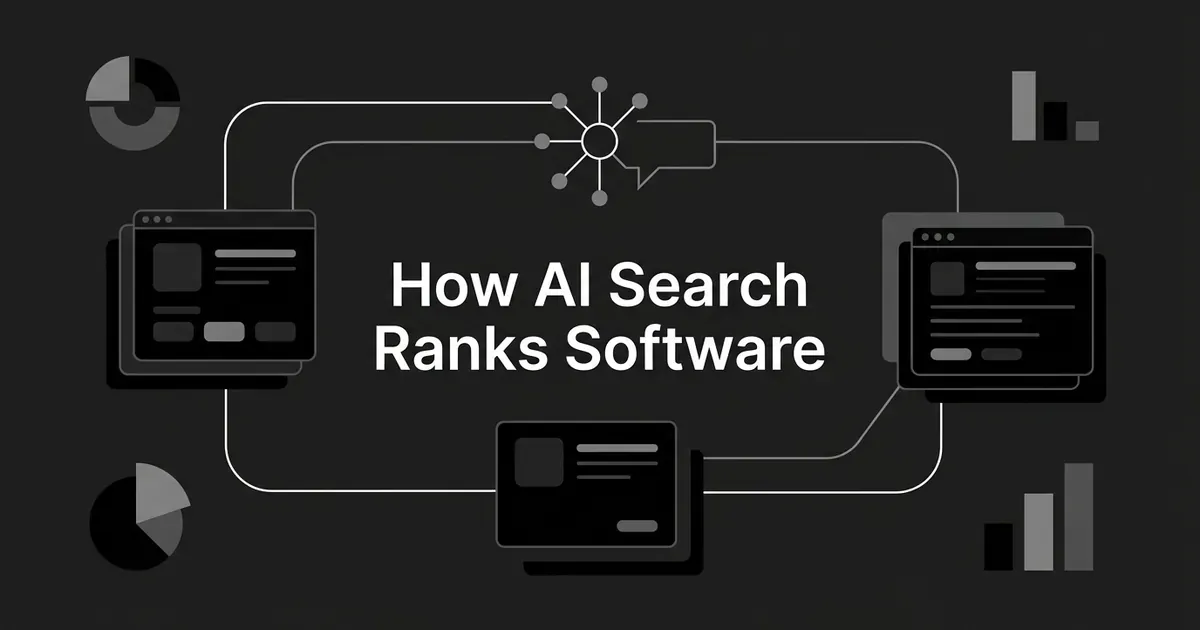
The exact mechanics differ by engine, but the broad pattern is a retrieval-and-generation system, not a simple list of ranked pages.
First, the system interprets what the buyer actually wants. "What is customer relationship management" is a definition question. "Which CRM should a 30-person sales team use" is a decision question. The system tries to infer the underlying job, not just match the literal words.
Second, some engines expand the question into related searches. Google says AI Overviews and AI Mode may use what it calls query fan-out, running multiple related searches across subtopics to build a more complete answer. For a software recommendation, those related searches might cover the category, common alternatives, pricing, integrations, and reviews. The exact number of subqueries and how they're weighted isn't public, so treat this as a useful mental model rather than a fixed formula.
Third, the system retrieves candidate sources. Google has said a page needs to be indexed and eligible to appear in ordinary Search with a snippet before it's eligible as a supporting link in AI Overviews or AI Mode. OpenAI introduced ChatGPT search specifically to provide timely answers with links to relevant web sources, and Perplexity describes its own approach as searching the web in real time, breaking a question into smaller steps, and returning clickable citations. The pool of sources an engine can draw from is wider than your own site: documentation, review platforms, comparison articles, community discussions, and analyst coverage can all feed an answer.
Fourth, the system extracts facts and passages rather than treating a page as one indivisible block. It might pull your product's capabilities from a doc page, your positioning from the homepage, and your reputation from a third-party review, then stitch those pieces together. This is why a page can be technically discoverable but still hard for an AI system to use, if the claims on it are vague, buried in navigation, or expressed only through marketing language a machine can't easily parse into facts.
Fifth, the system compares and synthesizes across whatever it retrieved, producing a response that might summarize what a product does, weigh it against alternatives, or map it to the buyer's stated requirements. A product showing up in the sources behind an answer doesn't mean every claim about it in that answer traces back to a single page; a synthesized answer often draws different statements from different sources.
There is no publicly documented, universal formula for how AI search ranks software across engines, and you should be skeptical of anyone who claims otherwise. Google says outright that AI Overviews and AI Mode may use different models and techniques, so responses and the links behind them can vary. What the available evidence supports instead is a set of recurring factors that make a product easier to retrieve and use correctly: whether it actually fits the query's constraints, whether the system can tell what the company and product are, whether there are concrete facts available (what it does, who it serves, what it costs, what it integrates with), and whether independent sources describe it consistently with how it describes itself. None of these guarantee a result on their own, and none of them are the whole story, but they're the pattern that shows up across how these systems are documented to work.
What Makes a SaaS Product Recommendable?
Being findable and being recommendable aren't the same thing, and this is where a lot of SaaS teams stop too early.
Relevance to the actual question matters more than general popularity. A broadly known product can still be a poor answer for a buyer with a specific industry or integration requirement, so a well-known brand name isn't a substitute for matching the query's actual constraints.
Entity clarity is about whether the system can tell what your company and product are. Clear, boring descriptions of your category, your audience, your use cases, and your capabilities make you easier to classify correctly. This overlaps with the kind of authority-building work covered in DeepSmith's guide to building topical authority for AI answer engines, which is really about making a system confident it understands your category expertise.
Verifiable product facts are the raw material an AI system needs: what the product does, which users it serves, what it costs if pricing is public, what it integrates with, and where its limitations sit.
Consistency across sources is bigger than it sounds. If your own site calls you an enterprise platform, a partner page calls you a small-business tool, and a review site puts you in a different category altogether, you've handed the system a harder classification problem. Multiple credible sources describing your product in compatible ways is what industry coverage sometimes calls consensus, and it's a practical reason contradictory positioning creates uncertainty, not a claim that any engine is literally counting mentions.
External credibility fills in what your own claims can't. Reviews, independent comparisons, community discussion, and analyst coverage help a system understand how your product is actually perceived and used. More mentions isn't automatically better here; a handful of specific, credible references beats a pile of low-quality ones. DeepSmith's guide to E-E-A-T for AI search goes further into how these systems weigh trust signals.
Content accessibility and structure help too, in an unglamorous way: clear headings, organized pages, and readable product information help any retrieval system do its job. Google's own guidance is direct about this one: there are no special technical requirements or special schema markup needed for inclusion in AI Overviews or AI Mode. Ordinary crawlability and clear content still carry the weight. If you want the full technical picture on schema specifically, DeepSmith's schema markup guide for AI search covers what actually helps versus what's a myth.
Freshness matters differently depending on the engine. Systems that retrieve live results can pick up a new page or a pricing change quickly. Systems that rely more on training data update on a different, less predictable schedule. There's no reliable universal timeline for how long it takes a change to show up everywhere.
And finally, fit and sentiment together decide the recommendation itself. A product can be well liked and still get excluded from an answer because it's missing a required integration or serves a different customer segment. Positive sentiment alone isn't enough if the fit isn't there.
AEO vs SaaS SEO: What's Actually Different?
SaaS SEO and SaaS AEO overlap, but they're optimizing for different outcomes.
| Dimension | SaaS SEO | SaaS AEO |
|---|---|---|
| Primary surface | Traditional search results | AI-generated answers and conversational recommendations |
| Main objective | Rankings and clicks | Accurate mentions, citations, and recommendations |
| Typical query | Keyword-oriented category query | Conversational, constraint-rich question |
| Core unit | The page's ability to rank | The product or claim's ability to be retrieved and used |
| Output | A list of links the user evaluates | A synthesized answer that may evaluate options first |
| Key metrics | Rankings, impressions, sessions, click-through rate | Mention rate, citation rate, recommendation rate, share of voice |
The short version: SEO helps a SaaS company get found in search results. AEO helps an AI system understand the company well enough to include, cite, compare, or recommend it in an answer. That's not an argument that AEO replaces SEO. Google's own documentation says existing SEO fundamentals remain relevant for its AI features, and pages still have to be crawlable, indexed, and eligible to appear in ordinary Search. DeepSmith's piece on whether SEO fundamentals still matter for AI search walks through exactly what carries over and what doesn't, and the broader AEO vs SEO comparison is worth reading if you want the general version of this distinction beyond the SaaS-specific angle here.
The real difference behind AEO vs SaaS SEO is about outcome and information environment, not a separate technical internet you have to build. Your SaaS company still needs the search foundations. It also needs its product identity and its claims to hold up and make sense everywhere an AI system might go looking for evidence about it, not just on the pages you control.
Where AI Search Can Mislead Buyers
A few misconceptions about AI search visibility are common enough to name directly.
AEO is not a secret replacement for SEO. Crawlability, indexing, and search eligibility still matter, and AEO describes an additional outcome layered on top, not a swap.
There is no special AI markup that guarantees inclusion. Google is explicit that no special AI file or special schema is required for AI Overviews or AI Mode.
A mention does not mean a recommendation. As covered above, these are genuinely different outcomes, and treating them as interchangeable will give you a false read on how you're actually doing.
A citation does not guarantee traffic. Citations can point to third-party pages instead of yours, can be easy for a reader to miss, and don't reliably translate into visits.
Ranking well in Google does not guarantee a recommendation from ChatGPT or Perplexity. Strong search performance helps with general discovery, but each engine has its own retrieval system, sources, and update schedule.
More content does not automatically create more AI visibility. Publishing volume by itself doesn't prove a system understands or trusts your product. Accuracy, clarity, and corroboration from other sources matter more than raw output.
And AI-generated answers are not always current or accurate. Live retrieval helps with freshness, but answers can still contain errors, stale information, or comparisons that leave something important out. An academic evaluation of generative search engines, published on arXiv, measured how often statements in AI answers were actually backed by their citations and found real gaps between citation presence and citation accuracy. Worth remembering the next time an AI answer about your category looks suspiciously tidy.
It's also worth being honest about how much buyer behavior has actually shifted. A 2025 G2 survey of more than 1,000 B2B software buyers found that 87% said AI tools like ChatGPT, Perplexity, and Gemini were changing how they researched software. That's a real signal about buyer behavior, not proof that AI has replaced search or that this changes every category equally.
What SaaS Founders Should Understand Now
Search visibility gets your company into the information environment in the first place. Answer engine optimization for SaaS is about whether AI systems can accurately use that information once they're forming an answer or a shortlist. You need both, and they're not interchangeable projects.
If you're just starting to think about this, the practical starting point is understanding what these systems can already say about you before you try to change anything. That means checking whether your product shows up for the questions your actual buyers ask, whether the description they get back is accurate, and whether your positioning is consistent across your own site, your docs, and the third-party pages that mention you. DeepSmith tracks how a brand shows up across those tracked prompts, measuring mentions, citations, share of voice, and sentiment trends over time, and pairs that with content production so the gaps it finds can actually get closed. That's a description of the category of work, not a claim that any single tool controls what an AI engine decides to say.
What matters most at this stage is not chasing a specific ranking factor. Good SaaS AI search optimization work is making sure the basic facts about your product exist somewhere, are stated clearly, and agree with each other wherever an AI system might go looking.