You ran your draft through a detector. It came back 92% AI. Your stomach dropped.
Take a breath. That number is not the thing standing between you and a citation in ChatGPT or Google's AI answers.
So, do AI detectors matter? For editorial policy or a client contract, sometimes yes. For AI search visibility, the public guidance from the companies that actually run these systems does not name an AI detector score as a signal at all. Not for ranking. Not for indexing. Not for whether a model mentions your brand or links to your page.
Here's what you'll get in the next few minutes: what a detector score really measures, what search systems say they reward instead, the four signals worth your editing time, and why score chasing can quietly cost you visibility. No humanizing tricks, no detector shootout. Just the decision: should that number drive your edits?
Let's work through it together.
So, do AI detectors matter for AI search visibility?
Short answer: not as a visibility lever. A detector score is not a documented input to ranking, eligibility, retrieval, mention, or citation in any of the official guidance available to us.
That's a narrow claim, and narrow is the honest version. It does not mean no system anywhere has an opinion about machine-written text. It means the companies publishing guidance for marketers have not told you to lower a number, and they have told you plenty of other things.
Google's position is the clearest of the bunch. Appropriate use of AI or automation is not against its Search guidelines. Using AI gives content no special ranking gains either. Google's own summary is basically three words: it's just content. If it's useful, helpful, original, and shows real expertise and trustworthiness, it might do well. If it isn't, it might not.
Notice what the line is actually drawn between. When people ask about AI detection and ranking, they assume the split is human-written versus AI-written. It isn't. It's helpful, original, people-first content versus content made mainly to game a search system.
There is one more thing worth separating. A detector score can be a legitimate internal requirement. Maybe your legal team wants a disclosure trail. Maybe a client's contract specifies one. Maybe you work in academia. Those are real reasons to run a check. They just aren't visibility reasons, and mixing the two is how a policy checkbox quietly turns into a publishing gate.
Your action this week: find where the detector score lives in your workflow, and write down which policy requires it. If you can't name one, it's a habit, not a requirement.
What does an AI detector score actually measure?
A detector is a classifier. It estimates whether a piece of text resembles writing that machines tend to produce. That's it.
Read that back and notice everything it doesn't measure. It doesn't know whether your claims are true. It doesn't know whether your page is indexed. It doesn't know whether a crawler can reach you, whether your author has credentials, or whether anyone would want to cite you. It measures apparent style, not substance.
The accuracy question deserves one honest caveat, and then we'll move on, because this article isn't a detector test. OpenAI shut down its own AI classifier on July 20, 2023, citing its low rate of accuracy. When the company building the models pulls its own detector for being unreliable, that's a good reason to treat any single percentage as a soft signal rather than a verdict.
So please don't read a detector percentage as a probability that a specific person or tool wrote something. It isn't that. And a low AI detector score proves nothing about quality. A carefully hand-written page can score high. A sloppy, unchecked, fact-free page can score low. Neither number tells you if the page deserves a citation.
Your action this week: stop treating the number as a grade. If it flags something, ask what's actually weak about the passage. Vague? Unsourced? Generic? Fix that. The score is a prompt to look, not an answer.
What do search systems say they reward instead?
They reward pages that are useful, original, accessible, and clearly organized. That's the whole answer, and the documentation is surprisingly plain about it.
Start with Google's guidance for its AI features. It says existing SEO best practices still apply. There are no additional requirements to appear in AI Overviews or AI Mode. No special AI optimization. No new schema type, no special AI text file, no secret markup. Your page needs to be indexed and eligible to appear in Search with a snippet, and that's the technical bar.
Google is equally direct about what it doesn't require. There's no ideal page length. No need to chop your content into tiny chunks. No need to build a page for every long-tail phrasing. If you've been told AI search demands a whole new format, that advice runs ahead of what the guidance says.
The people-first checklist is where the substance sits. Provide original information, reporting, research, or analysis. Add real completeness instead of repeating what everyone knows. Show first-hand experience where experience matters. Make it clear who created the content, with a byline and honest context about how it was produced. Use clear sourcing. Build trust, which Google calls the most important part of E-E-A-T. Organize the page with paragraphs, sections, and headings a reader can navigate.
Now for the counterweight, because "detector scores don't matter" is not a license to publish unchecked output. Google's spam policies define scaled content abuse as generating lots of pages mainly to manipulate rankings rather than help people. The examples include using generative tools to spin up many pages that add no value, scraping and synonymizing, stitching pages together, and creating pages that make little sense to readers but carry the keywords. Google specifically warns against making a separate page for every query variation, including fan-out variations, when the goal is to game rankings or generative responses. More pages do not make a site more relevant.
So the AI detector SEO impact you should worry about isn't a classifier. It's whether your process produces something original and checked, or a pile of unedited output at volume. One of those is fine. The other is a policy problem no amount of rewriting for a detector will fix.
Your action this week: read Google's people-first checklist next to your last published article and mark the lines you can't honestly claim. That list is your real edit queue.
Which four signals should you optimize instead?
Four things are worth your editing budget: accuracy and trust, structure and answer clarity, authority and original value, and extractability with technical access. Work them in that order and you'll optimize AI content visibility far more than any rewrite aimed at a classifier.
1. Accuracy and trust
Make the page dependable before you make it sound less machine-generated.
That means verifying dates, platform names, product names, and every number. It means separating what's documented from what's your inference and what's your advice. Support material claims with real sources in the published piece. Add a byline and enough author context that a reader knows why you're qualified. When you report a test or a benchmark, explain the method. When a platform's behavior might change, say so.
Accuracy also means saying what the evidence doesn't show. Notice how this article does that. It doesn't claim detectors never affect any system anywhere. It claims the reviewed public guidance doesn't document detector scores as a visibility signal, so they shouldn't drive your editing decisions. That's smaller, and it's defensible.
2. Structure and answer clarity
Put the answer, the entities, and the evidence where a reader and a machine can both find them fast.
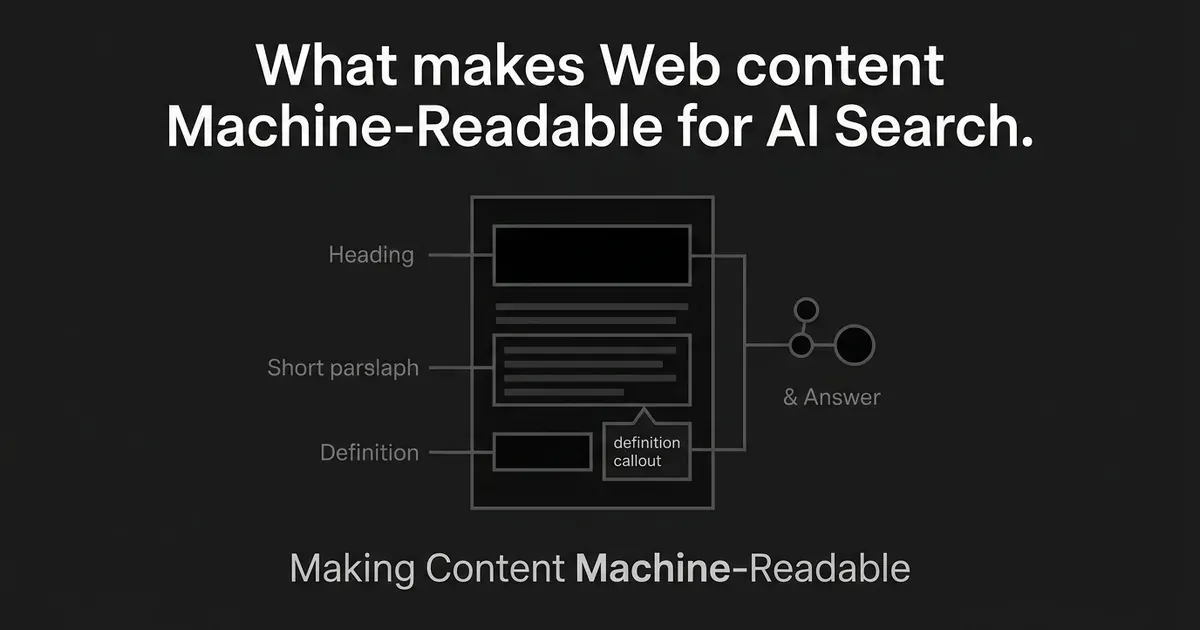
Use a title that matches the question. Open with the direct answer. Run roughly four to seven meaningful H2 sections, with one takeaway in each section's first paragraph. Write headings that state the subject plainly. Define your terms before you compare them. Use lists and tables where they clarify a distinction. Keep every qualification next to the claim it limits, not buried three paragraphs later.
One warning. Structure does not mean choppy, robotic prose. Google recommends well-written pages with clear paragraphs, sections, and headings. The goal is faster comprehension, not detector-evasion style.
3. Authority and original value
Give the page a reason to be cited instead of being another interchangeable summary.
What earns that? A clear point of view on the decision your reader has to make. Original synthesis rather than a restatement. Specific definitions, real caveats, and an operational checklist a generic summary would skip. An identifiable author with actual expertise. Clear attribution to primary documentation. Coverage of the decision, its limits, and the workflow, instead of stopping at a slogan.
The empirical research points the same way, with limits worth stating. The GEO paper built a benchmark of 10,000 queries, split roughly 80% informational, 10% transactional, and 10% navigational, spanning 25 domains and nine query types, using cleaned text from the top five Google results. It reports that its methods improved visibility in generative-engine responses by up to 40%, and its tested interventions included adding citations and source support, adding quotations and statistics, improving fluency, and using a more authoritative style. Treat that as benchmark-specific experimental evidence, not a forecast for your site. The direction is what's useful: changes that add evidence, specificity, and readability sit closer to the visibility problem than changes aimed at a classifier.
4. Extractability and technical availability
A page can't be cited if the system can't reach it, index it, or read it.
Here's the checklist worth running before you touch a single sentence:
- Confirm the page returns a successful response and contains indexable content.
- Confirm Googlebot and the AI-search crawlers you care about aren't blocked by robots controls, CDN rules, hosting settings, or a WAF.
- Confirm the page is indexed and eligible to appear with a snippet.
- Make the important claims available in visible text, not only in an image, a widget, or a script.
- Link the page from relevant pages on your site so it's findable.
- Keep structured data accurate and consistent with what's visible.
- Review snippet controls, since restrictive no-snippet or no-index settings limit how your content can show up in AI experiences.
- Use Search Console and server logs to diagnose access and indexing.
Crawler access is where a surprising number of visibility problems actually live, and each platform handles it differently. OpenAI's OAI-SearchBot is what surfaces sites in ChatGPT search, and opting out of it means your site won't be shown in those answers, though it may still appear as a navigational link. Its GPTBot control is a separate decision. Perplexity says PerplexityBot exists to surface and link sites rather than to train foundation models, and recommends allowing it, while Perplexity-User fetches a page when a user asks and generally ignores robots rules because the fetch was requested. Both OpenAI and Perplexity note that robots changes can take around 24 hours to take effect, and WAF rules may need explicit allowlisting.
Make those calls on purpose. Blanket-allowing or blanket-blocking every bot is a decision too, just an accidental one.
A word of caution on all four signals. None of them is a guaranteed lever. Google says meeting its technical requirements and best practices does not guarantee crawling, indexing, or serving. What you can control is whether the page is true, useful, distinct, clear, and reachable. What you can't control is what any given model returns on any given day.

Why can chasing an AI detector score hurt?
Because the edits it drives often trade away the things that actually earn a citation. This is opportunity cost and quality regression, not a documented penalty, and that distinction matters.
Six ways it goes wrong:
- It optimizes the wrong variable. The score describes how your text resembles a class of writing. It says nothing about whether the claim is true or the page is indexed.
- It eats your review time. An extra editing cycle spent lowering a number is a cycle not spent on source checking, internal links, author context, or the missing answer near the top.
- It trades away clarity. Score-driven rewrites tend to soften a crisp definition, break a useful heading, bury a qualification, or swap precise terms for vague variation.
- It deletes your evidence. Citations, statistics, quotations, and first-hand details can read as formulaic to a classifier. Those are exactly the elements that make a page useful and citable.
- It creates strange incentives. Rewriting prose to satisfy a classifier is not the same work as adding expertise, original analysis, or a better reader experience. It just looks like work.
- It builds false confidence. A low score doesn't verify a single fact, establish authority, or make your page crawlable. A high score doesn't prove the page is bad.
Here's a failure mode you may recognize. An editor rewrites every sentence because the tool flagged the draft, adds awkward variation, cuts a concise definition, pushes the answer below a longer introduction, removes the source links, and treats the lower number as proof of improvement. Nothing about that page got more accurate, more original, or more accessible. It just got harder to read.
So use this rule, and it makes the decision simple. Keep an edit if it improved truth, usefulness, distinctiveness, structure, or access. Reject it if its only benefit was a lower number.
Your action this week: pick one recent draft you rewrote for a detector and check whether anything substantive left the page. If evidence went missing, put it back.
How should you actually measure AI search visibility?
Measure mentions and citations against a defined set of buyer questions, over time. That's the scoreboard. A detector percentage isn't on it.
Start with the questions your buyers actually ask, not with a detector target. Build a prompt set across awareness, consideration, and decision stages. For each check, record the prompt, the platform, the date, the answer, whether your brand was mentioned, which page was cited, which competitors showed up, and the buying intent behind the question.
Then baseline the numbers that matter. Mention rate, which is how often a system names you. Citation rate, which is how often it links to your pages as a source. Which specific pages earn those citations. Which competitors get cited instead. Your share of voice and its trend. And the downstream engagement, because visibility is a means, not the goal.
Two cautions on reading that data. One answer on one day is not a trend, since AI responses vary by platform, query, model, and time. And a citation isn't a click. Bing's own AI Performance documentation is unusually direct here: citation share doesn't represent rankings, traffic, or a quality score, its data is aggregated rather than a complete log, and trends are observational rather than automatically attributable to one cause.
The order of work matters too. Fix access before you rewrite prose. Then run the accuracy and authority review, asking of every important claim whether it's true, what the evidence is, whether it's sourced, and what original perspective this page adds. Then restructure for comprehension. Then publish, watch a defined prompt set over a defined window, and improve the answer, the evidence, the structure, or the access. Attribute gains cautiously, because your changes and the models' changes overlap.
This is the part most teams skip, usually because it's tedious by hand. Tracking prompts across engines, logging which page earned each citation, and watching a competitor leaderboard is exactly the kind of repetitive work that falls off a busy week. It's also what DeepSmith's AI Visibility module is built to run on a schedule: per-prompt mention and citation rates, page-level attribution, competitor citations, and share of voice across the engines your plan covers. No tool can make an engine cite you. What a tool can do is show you whether it did.
And if the bottleneck is production rather than measurement, the same idea applies one step downstream. Deep IQ stores your company, product, persona, voice, and content-type context, and Content Studio writes from it with research, internal and external links, and metadata built into the draft rather than bolted on. That doesn't manufacture authority. It gives your editing time back so you can spend it on the four signals above.
Your action this week: write down ten questions your buyers ask, run five of them in one AI engine, and record what you see. That's a baseline, and you now have one more than you did yesterday.
The takeaway
The goal was never to make your content look less machine-generated. It's to make the page more accurate, more original, clearer, more trustworthy, and actually reachable by the systems that might cite it.
If you only change one thing this month, make it this: take the detector out of your publishing gate and put a source check, an author byline, and a crawler-access check in its place. Keep the detector only if a specific policy asks for it. Every hour you free up there is an hour you can spend on the work that does optimize AI content visibility.
You're closer than you think. Most teams already have the expertise. It's just getting rewritten out of the draft by an editing pass aimed at the wrong target.
Want to see which prompts your buyers ask and which pages AI actually cites? Start a free DeepSmith trial and get a real baseline before you edit another word.
FAQ: AI detection and ranking
Do AI detectors affect SEO?
No documented detector-score lever appears in the public guidance from search platforms, so the AI detector SEO impact most teams fear isn't the one that shows up in the documentation. AI-assisted content can perform well when it's useful, original, reliable, and inside Search policies. Run a detector if an editorial or disclosure policy needs it, and keep it off your SEO scorecard.
Will a 0% AI detector score make ChatGPT or Google cite my page?
There's no evidence for that promise. What moves the needle is crawler access, indexability, visible text, clear structure, real evidence, authority, and how well the page fits the exact question asked. Then measure actual mentions and citations rather than the score.
Is AI-generated content penalized automatically?
No. Google says appropriate use of AI or automation is not against its guidelines. What can violate spam policies is content created mainly to manipulate rankings, especially large volumes of unoriginal, low-value pages, and that's true whether people or automation produced it.
Should we stop using AI detectors entirely?
Not necessarily. Keep one if a specific policy needs a secondary signal. Just take it off the visibility scorecard and out of the publishing gate. The primary review should ask whether the page is true, useful, original, trustworthy, clearly structured, technically reachable, and measurable in real AI answers.