
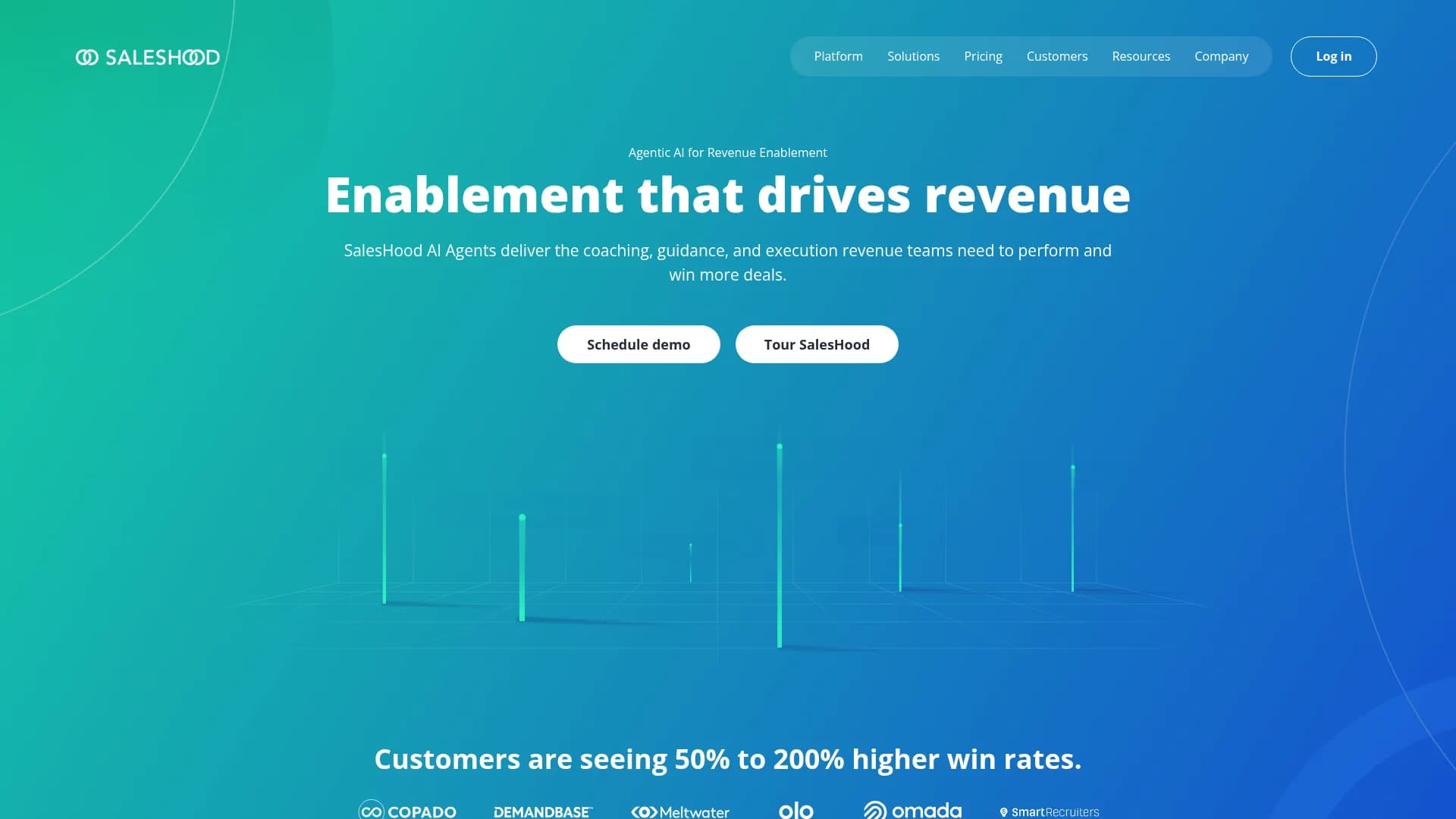
Summary
SalesHood drives 2,867 monthly organic visits by running a franchise-led content library of 440 indexable pages built around two flagship formats: a 176-post Blog/Editorial library (40% of pages) and a 100-URL Webinars & Events program (22.7%). The two formats combined account for 62.7% of every page SalesHood publishes, with named franchises stacked across both (MEDDICC, AI Coaching Agents, SKO, Buyer Engagement). 30.3% of SalesHood's 710 ranking positions sit in the top 10 across 45 indexed (location, language) combinations, with another 26.5% in positions 11-20 representing a sizeable optimization layer. The architecture reads as a challenger play built on cross-format topic clusters rather than library scale.
Key facts:
- Library size: 440 indexable pages organized into 3 topic clusters; 40% blog/editorial, 22.7% events/webinars
- Largest cluster: Sales Enablement Editorial (183 URLs, 41.6% of library), ahead of Product, Customer Stories & Resource Library (151 URLs, 34.3%) and Webinars & Live Events (106 URLs, 24.1%)
- Flagship content asset: The MEDDICC franchise runs across three formats simultaneously: blog posts inside the Sales Methodology & Process micro, 15 dedicated webinars, and downloadable MEDDICC guides, plus a dedicated MEDDICC product surface
- Search performance: 2.9K monthly visits across 710 ranking positions; 30.3% in top 10, with ~7 visits per page
- Notable gap: Only 4 Glossary URLs and 6 Comparison Pages across a 440-page library, definitional and competitive-defense content is thin for a positioning that explicitly competes with Highspot and Seismic
Company Overview
SalesHood at a Glance
| Company | SalesHood, Inc. |
| Founded | 2013 · San Francisco, CA |
| Category | Sales Enablement / Revenue Enablement |
| What They Do | SalesHood is an AI-driven sales enablement and revenue enablement platform that unifies sales training, coaching, content management, sales playbooks, and digital sales rooms (Client Sites) into a single system. The audience is mid-market and enterprise B2B sales, enablement, RevOps, marketing, and CS teams at high-growth software companies running global enablement programs. Named customers include Copado, SmartRecruiters, Omada Health, DISQO, KPA, and StarCompliance. |
| Funding | $1.8M raised; last round Series A (May 2017, $1.8M, led by TeleSoft Partners and FounderPartners). Note: Getlatka lists SalesHood as bootstrapped, while Crunchbase documents a specific Series A funding event, so the Crunchbase figure is treated as the source of truth here. |
| Headcount | 51-200 (LinkedIn band) |
| Monthly Organic Visits | Traffic Value (PPC equiv.) | Ranking Positions |
|---|---|---|
| 2.9K | $38.9K | 710 |
Ranking positions reflect total positions across 45 indexed (location, language) combinations, not unique keywords.
SalesHood's content operation is compact and franchise-led across 440 indexable pages. Two formats (Blog/Editorial and Webinars) together account for 62.7% of the library, with named methodology and product franchises (MEDDICC, AI Coaching Agents, SKO, Digital Sales Rooms) running in parallel across both formats. There is no podcast in the sitemap, no public technical documentation, and only 6 competitor comparison pages, suggesting SalesHood invests in editorial-plus-webinar cadence rather than library breadth or aggressive comparison-page coverage.
Content Architecture
What Does SalesHood's Content Engine Look Like?
SalesHood's main website hosts 440 indexable pages organized into 3 topic clusters. The architecture is franchise-led: two flagship formats (blog and webinars) anchor the library, with the remaining 37% spread across product pages, customer stories, gated downloads, and a short-form video library.
Content Type Distribution
| Content Type | Count | Share | Notes |
|---|---|---|---|
| Blog / Editorial | 176 | 40.0% | The dominant editorial surface; covers the full Sales Enablement Editorial cluster |
| Events / Webinars / Sessions | 100 | 22.7% | Unusually large for a 440-page library; second flagship format |
| Product & Feature Pages | 74 | 16.8% | Product surfaces, solution-by-team pages, demo/trial requests |
| Other | 39 | 8.9% | Locale roots, taxonomy pages, thank-you confirmations, legal |
| Case Studies / Customer Stories | 20 | 4.5% | 16 enterprise stories plus 4 short-form testimonials |
| Guides & Resources | 15 | 3.4% | Gated ebooks, templates, and download guides |
| Comparison Pages | 6 | 1.4% | Highspot Alternative, Seismic Alternative, and direct vs-pages |
| Glossary / Definitions | 4 | 0.9% | Thin definitional coverage |
| Research / Reports | 4 | 0.9% | Including the State of AI Sales Coaching Agents report |
| Free Tools | 2 | 0.5% | DSR evaluation tool, Enablement Performance Check |
| Podcast / Audio Series | 0 | 0.0% | Not present in sitemap |
| Documentation | 0 | 0.0% | Not present in sitemap |
Key finding: Two formats account for 62.7% of every page SalesHood publishes. Blog/Editorial (40%) and Events/Webinars/Sessions (22.7%) together form the franchise structure, with the remaining 37% spread across product pages and conversion-stage assets. The absence of a podcast is notable for a sales enablement vendor in 2026, since peers like Highspot run multi-hundred-episode programs as a leadership-relationship channel.
Content Strategy Archetype
SalesHood operates a franchise-led, two-pillar content engine. The primary surface is a long-running blog covering enablement strategy, methodology, AI, and coaching. The secondary surface is a webinar program with 100 URLs spanning recurring MEDDICC info sessions, AI launches, enablement leadership sessions, customer-led webinars, and the annual Multipliers customer conference. Most of SalesHood's named topic franchises (MEDDICC, AI Coaching Agents, SKO, Buyer Engagement) appear in both formats simultaneously, which means the same topic gets covered through written explainers and live or recorded sessions. The cross-format reinforcement is the architecture's defining choice.
Search Performance Quality
Where SalesHood Ranks
The DataForSEO domain rank overview shows SalesHood ranking in 710 positions across 45 locales. The distribution is bottom-heavy compared to category leaders, with a substantial layer of positions sitting just outside the top 10.
| Position | Count | Share |
|---|---|---|
| #1 | 16 | 2.3% |
| #2–3 | 39 | 5.5% |
| #4–10 | 160 | 22.5% |
| #11–20 | 188 | 26.5% |
| #21–50 | 230 | 32.4% |
| #51–100 | 77 | 10.8% |
30.3% of SalesHood's ranking positions are in the top 10, meaningfully lower than category leader Highspot at 55.7% and Showpad at 41.7%, and roughly in line with Mindtickle (23.8%) and Seismic (23.3%). The 188 positions in 11-20 are the most actionable optimization slot: these are pages already on Google's first or second screen that could be pushed into top-10 visibility through targeted refresh, internal linking, or supporting content. Another 230 positions sit in 21-50, a deeper recovery surface that compounds the upside.
Per-URL traffic efficiency is low at ~7 visits per page, suggesting that library scale runs ahead of per-page authority. Half the published URLs are not pulling material organic traffic, which is the natural shape of a younger, smaller-domain content engine where the long tail hasn't yet earned its rankings.
Content Deep Dive
What Is SalesHood Actually Publishing, and How?
SalesHood's content organizes around 3 primary topic clusters. Each cluster is described below with content-type composition, the micro-topics inside it, and concrete example URLs. Cluster and micro-topic groupings reflect a per-URL classification of the full sitemap, so counts are exact rather than approximate.
1. Sales Enablement Editorial
Pages: 183 · Share of library: 41.6%
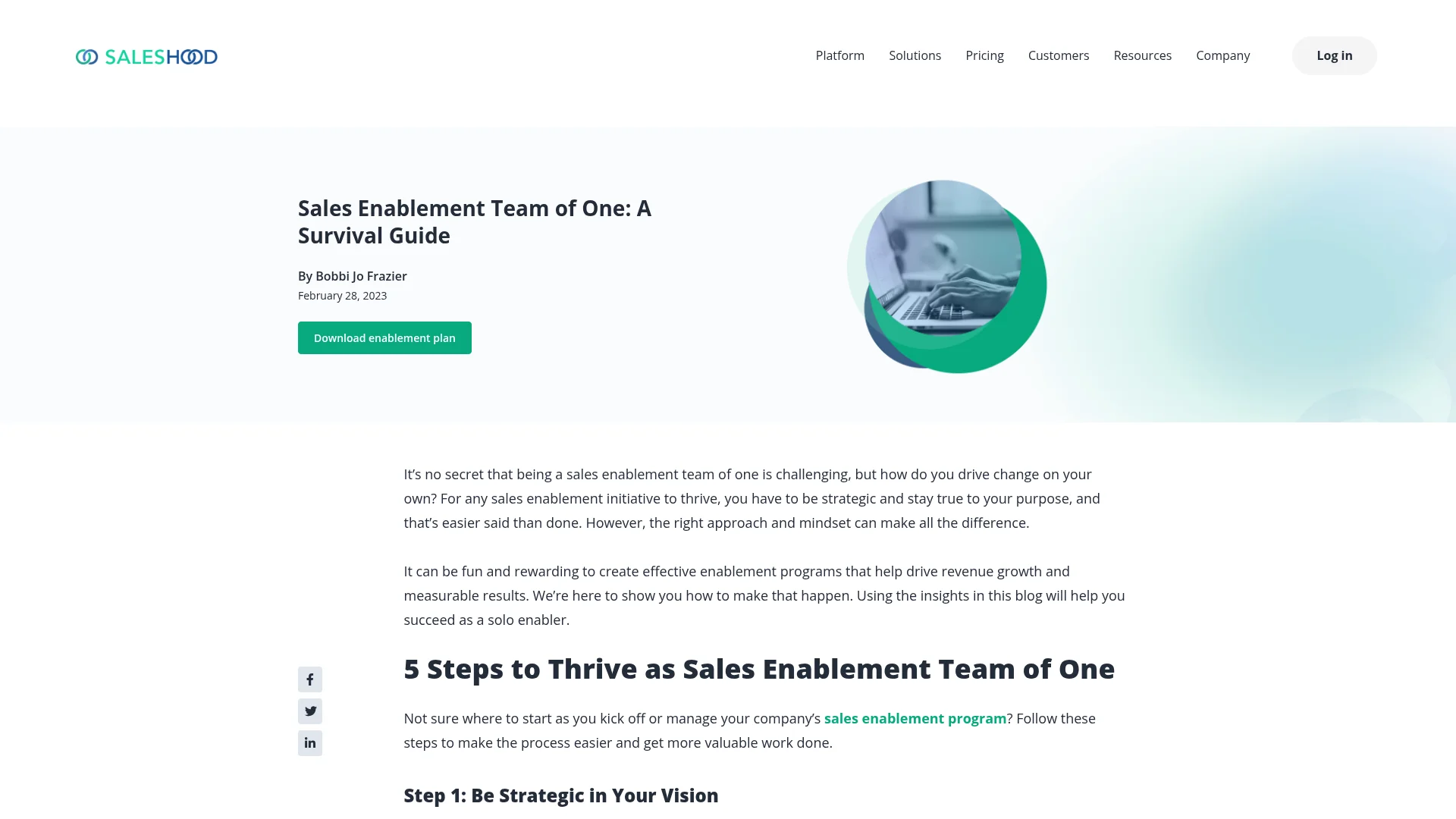
The largest cluster in the library and the surface that does most of the discovery work. A long-running blog and glossary library covering enablement strategy, methodology, AI, coaching, and buyer engagement. This is where SalesHood positions itself as an authority on the enablement discipline rather than a tool vendor, with most posts arguing for programs, sharing frameworks, profiling leaders, or examining industry trends. The cluster spans both perennial fundamentals (what is enablement, KPIs, business case content) and the more recent AI and agentic-selling editorial that anchors the company's current positioning.
Content-type mix: Blog/Editorial 96.2% · Glossary/Definitions 2.2% · Other 1.6%
Micro-topics within this cluster
Enablement Strategy & Programs (~65 Pages)
The thickest editorial vein on the site. Strategy frameworks, KPIs, team-of-one survival guides, org design, business case building, profession spotlights, and broader essays about what good enablement looks like. The framing language across these posts (pillars, principles, health diagnostics, "WOW the C-suite," "year of sales attainment") matches consultant-style vocabulary and targets the practitioner audience that defines, runs, and measures enablement programs. The Profession & Careers strand inside this micro (women in enablement, leader spotlights, annual recognition lists) doubles as a relationship-building surface that SalesHood's named leaders share themselves.
Sample pages:
- Sales Enablement Team of One: A Survival Guide
/blog/sales-enablement-team-of-one/ - Diagnose The Health Of Your Sales Enablement Strategy
/blog/sales-enablement-health/ - Sales Enablement Metrics: The 10 Most Important Sales KPIs to Measure
/blog/sales-enablement-metrics/ - Inspiring Women Leaders in Sales Enablement
/blog/women-in-sales-enablement/ - Creating Organizational Buy-In For Sales Enablement Initiatives
/blog/organizational-buy-in/
Sales Methodology & Process (~47 Pages)
The cluster's methodology layer, anchored by MEDDICC and extended through SPIN, Challenger, and the broader process-execution editorial: qualification, discovery, account planning, pitching, closing, competitive loss reviews, and pipeline mechanics. MEDDICC sits at the center of gravity here, and the rest of the methodology coverage stays deliberately light. SalesHood owns MEDDICC as the editorial flag and treats other methodologies as connective TOF surface rather than franchises to compete on directly. The Closing & Deal Strategy thread is the most distinctive editorially: competitive-loss-review content acknowledges the reality that more deals get lost than won, which is a frame most enablement vendors avoid.
Sample pages:
- How MEDDICC helps sellers drive urgency in B2B SaaS sales
/blog/meddicc-sales-methodology/ - Boost Sales with Mutual Action Plans: Essential for the MEDDICC Framework
/blog/meddicc-mutual-action-plans/ - How To Run Competitive Loss Reviews
/blog/competitive-loss-reviews/ - Sales Methodology Guide | Decide Which is Right
/blog/sales-methodology-guide-choosing-the-right-one-for-your-business/ - Account Planning Process and Template
/blog/account-planning-process/
Sales Coaching & Training (~24 Pages)
Manager coaching practices, sales training program design, rep skills development, and sales-management leadership editorial. The format is heavy on manager-facing content rather than rep-facing, which matches how enablement platforms actually get bought: a director of enablement needs to equip first-line managers, not reps directly. The Sales Manager Manifesto and end-of-year inspirational memo posts are unusually warm for B2B SaaS content, which reads as a deliberate brand choice. Sales management is a job that wears people down, and editorial that acknowledges the emotional shape of the work builds a different kind of brand loyalty than tactical playbooks do.
Sample pages:
- Coaching Best Practices for Sales Managers
/blog/coaching-best-practices-for-sales-managers/ - Implementing a Data-Driven Sales Coaching Strategy
/blog/data-driven-sales-coaching-strategy/ - The Ultimate Sales Coaching Guide: Strategies, Tools & Best Practices
/blog/sales-coaching-guide/ - The Sales Manager Manifesto
/blog/the-sales-manager-manifesto/ - The Evolution of Sales Enablement with Hybrid Work
/blog/hybrid-sales-enablement-evolution/
AI & the Future of Selling (~31 Pages)
AI role play, AI coaching agents, AI content management, generative AI for sales, ChatGPT for sales, AI sales agents, and forward-looking essays on agentic selling. The cluster maps directly to SalesHood's current positioning ("Agentic AI for Revenue Enablement") and is the company's most active recent content area. The interesting move is how the editorial connects high-volume TOF AI search intent (ChatGPT for sales, AI tools roundups) into specific product-adjacent depth (AI Coaching Agent prompts, the Turing case study on a team-of-one using agentic AI). The Seismic-Highspot deal post is a positioning move bigger players rarely make about category consolidation.
Sample pages:
- Top 25 AI Coaching Agent Prompts Examples
/blog/ai-coaching-agent-prompt-examples/ - How a Team of One Uses Agentic AI to Transform Revenue Enablement
/blog/turing-agentic-ai-enablement-story/ - AI Role Play for Sales | Sales Coaching & Training with AI
/blog/ai-role-play-for-sales/ - Seismic-Highspot Signals Revenue Enablement Shift
/blog/seismic-highspot-deal/ - ChatGPT for sales: A guide to improving sales
/blog/chatgpt-for-sales/
Buyer Engagement & Virtual Selling (~16 Pages)
Digital sales rooms (SalesHood calls them Client Sites), buyer enablement, modern buyer journeys, virtual and remote selling, video in selling, mutual action plans, and the SKO and onboarding editorial that lives alongside the buyer-readiness theme. Virtual selling dominates this micro, partly because SalesHood hasn't pruned the 2020-2021 remote-work back catalog. That's the right call. Virtual selling is now permanent infrastructure, not a temporary adaptation, and the dated posts still match current search intent. The DSR coverage is light at this layer, with only a handful of dedicated explainers, but the product anchor sits in the Product, Customer Stories & Resource Library cluster.
Sample pages:
- What Is a Digital Sales Room? Benefits, Examples & Best Practices
/blog/what-is-a-digital-sales-room/ - Real Reviews of Digital Sales Rooms: What Sales Pros Are Saying
/blog/real-reviews-digital-sales-rooms/ - The Ultimate Guide to Sales Kickoffs in 2026
/blog/ultimate-guide-to-sales-kickoffs/ - Modern Buyer's Journey: 13 Ways To Use Video In Digital Deal Rooms
/blog/buyer-journey-13-ways-to-use-video/ - Step-by-Step Guide to Evaluate Digital Sales Room Software
/blog/evaluate-digital-sales-rooms/
Strategy insight: This is the cluster that carries the most editorial weight in the library, but the cluster's depth disguises a coverage trade-off. MEDDICC is the methodology flag and gets the franchise treatment across all three of SalesHood's content layers, while non-MEDDICC methodology stays light. The Buyer Engagement & Virtual Selling micro is the smallest at 16 URLs, which is conspicuous for a vendor whose product anchors include Client Sites. A deeper layer here ("DSR templates," "DSR for SaaS sales cycles," "DSR vs proposal software") would extend an already strong methodology-and-coaching surface into the buyer-side conversation where SalesHood's product differentiation actually sits. The thin Glossary footprint across the whole library (only 4 URLs) is also most acutely missed here: high-volume terms like "what is agentic AI," "what is AI role play," and "what is an AI coaching agent" are searches SalesHood has the editorial authority to win.
2. Webinars & Live Events
Pages: 106 · Share of library: 24.1%
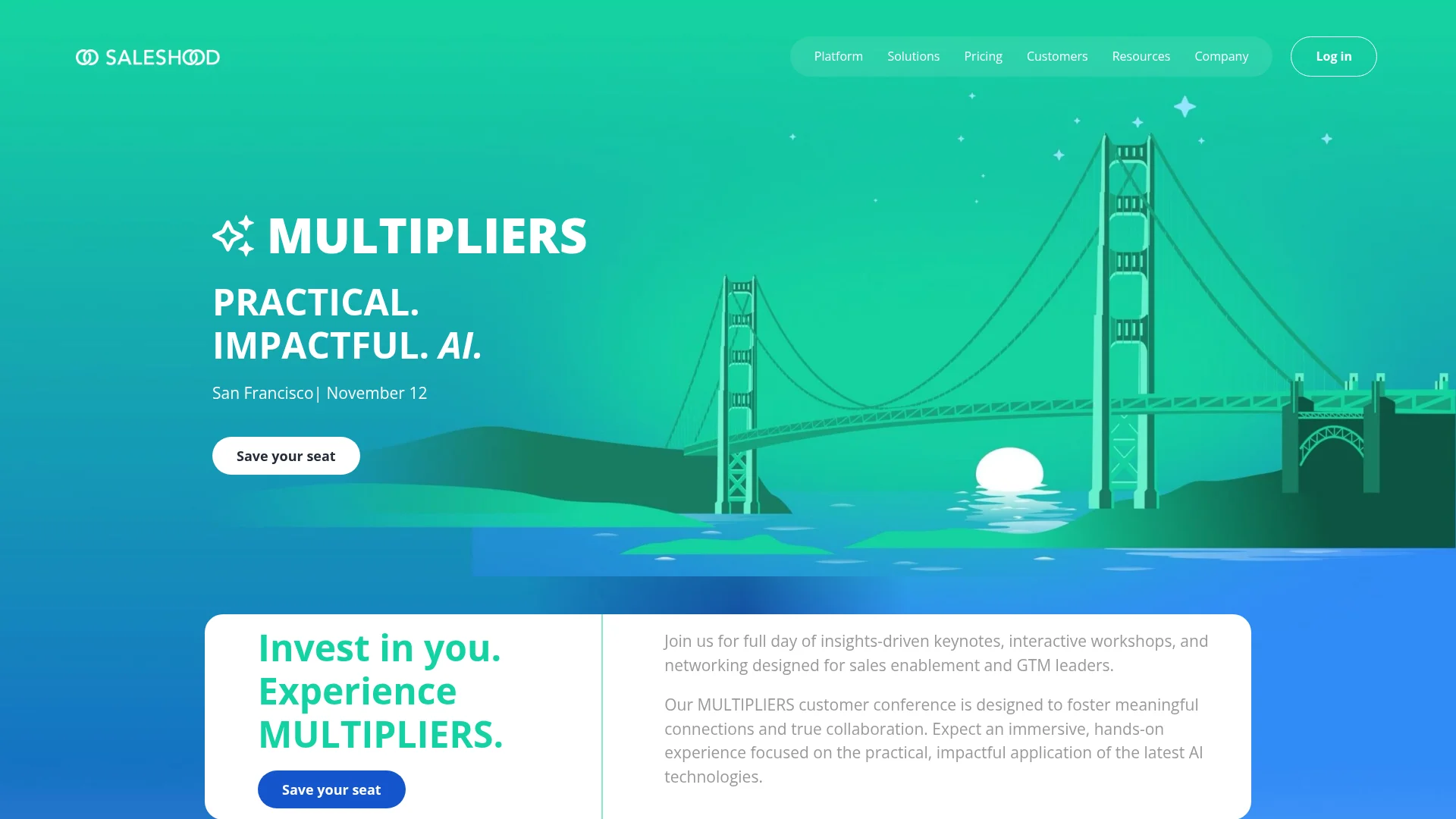
A recurring top-of-funnel format with steady cadence and the cluster that most distinguishes SalesHood's content architecture from typical SaaS-vendor patterns. The cluster spans MEDDICC info sessions, AI product launches, enablement leadership webinars, buyer engagement sessions, customer-led webinars, the annual Multipliers customer conference, and Sales Productivity Tour stops. Webinars are nearly equal in weight to all product pages combined, which is a deliberate architectural bet on live discussion as a primary selling and category-vocabulary channel rather than a secondary distribution surface.
Content-type mix: Events/Webinars/Sessions 94.3% · Other 2.8% · Product & Feature Pages 2.8%
Micro-topics within this cluster
Enablement Leadership, SKO & Events (~56 Pages)
The largest webinar group, covering sessions on building enablement teams, CRO pillars, evolving enablement leadership, super-reps-to-super-coaches transitions, post-SKO momentum, annual kickoff guides, and the in-person Multipliers conference and Sales Productivity Tour stops. Strategic-level webinars target a specific audience and a specific buying motion: senior leaders evaluating platforms attend webinars where peers discuss enablement architecture, not where vendors pitch features. The volume here suggests SalesHood treats webinar-as-thought-leadership as its primary peer-validation channel, and the in-person Multipliers conference extends that investment into the kind of community-building moment that creates relationships paid acquisition can't.
Sample pages:
- MULTIPLIERS '25 - SalesHood Customer Conference
/multipliers-2025/ - Sales Productivity Tour 2023 | Austin, TX
/sales-productivity-tour-austin-2023/ - Webinar Replay - Building Your Sales Enablement Team
/building-your-sales-enablement-team-replay/ - Elevate Your Enablement Career
/webinars/elevating-your-enablement-career/ - The CRO's 6 Pillars For Revenue Growth
/cro-6-pillars-for-revenue-growth/
AI & Product Launch Webinars (~20 Pages)
Sessions tied to AI role play launches, AI coaching agent launches, agentic AI use cases, generative AI for revenue enablement, and customer-aligned AI readiness stories. The AI webinar program is dense for a 31-post AI editorial vein, which inverts the usual blog-leads-webinar ratio. The launch-event format ("AI Role Play launch," "Agentic AI Coaching launch," "MEDDICC AI launch") creates moments around new product surface that pull traffic in ways evergreen editorial doesn't. Co-presenting with named customers (Copado's AI readiness story is a current example) lets SalesHood frame AI adoption as a real-customer journey rather than a vendor-led pitch.
Sample pages:
- SalesHood AI Role Play Launch
/events/ai-role-play-launch/ - Sales Coaching Reimagined with Agentic AI
/webinars/agentic-ai-coaching-launch/ - AI Coaching Agents: Insights, Use Cases and Impacts
/webinars/ai-coaching-agents/ - Webinar - Generative AI for Revenue Enablement
/webinars/generative-ai/ - Webinar Replay - Copado AI Readiness Story
/webinars/copado-generative-ai/replay/
Buyer Engagement & Customer Webinars (~15 Pages)
Webinars on digital sales rooms, mastering buyer engagement, modern buyer journeys, and customer-led sessions featuring named accounts like SmartRecruiters, Federato, Instructure, Copado, KPA, and Tufin. This micro is the live-format counterpart to the editorial Buyer Engagement strand, and it carries roughly the same URL count, which inverts the typical editorial-leads-webinar relationship. The implication: buyer engagement is positioned more as a live-discussion topic than a written-explainer one, possibly because the format suits interactive demos of the actual Client Sites product. Customer-led webinars are dual-purpose by design, serving as editorial assets for SalesHood and credibility moments for the customer presenters.
Sample pages:
- Webinar Replay - Mastering Digital Buyer Engagement
/mastering-digital-buyer-engagement-replay/ - Webinar Replay - Activating Buyer-Centric Enablement
/activating-buyer-centric-enablement-replay/ - From Strategy to Execution with Instructure
/instructure-sales-methodology-transformation-webinar/ - SmartRecruiters Webinar
/webinars/smartrecruiters-digital-selling/ - The Buyer Insights Sales Leaders Rely on To Win (Federato)
/webinars/federato-buyer-insights/
MEDDICC Webinars (~15 Pages)
MEDDICC and MEDDPICC info sessions, launch replays, "Make Your Number with MEDDICC" sessions, and the MEDDICC AI launch. MEDDICC webinars run on a recurring cadence: info sessions repeat across years, replays accumulate as evergreen URLs, and the MEDDICC AI launch in particular bridges the methodology franchise into the AI franchise. Fifteen MEDDICC webinars against a smaller block of MEDDICC blog posts and a pair of ebook downloads reverses the usual content-pillar pattern. MEDDICC is more of a webinar topic at SalesHood than a written-content topic, which is consistent with how qualification training tends to be taught in practice (manager-led, scenario-based, hard to do justice in a blog post).
Sample pages:
- MEDDICC sales training info session
/meddicc-info-session/ - Replay - MEDDICC by SalesHood Launch Webinar
/meddpicc-by-saleshood-launch-replay/ - Webinar Replay - Make Your Number with MEDDICC
/webinar-replay-meddpicc-2023/ - MEDDICC AI launch
/webinars/meddicc-ai-launch/ - Webinar Replay - MEDDICC AI
/webinars/meddicc-ai/replay/
Strategy insight: The webinar program is the architectural choice that sets SalesHood apart. At 106 URLs (24.1% of the library), the cluster is comparable in weight to all product pages combined and bigger than the customer stories and downloadable resources combined. The cross-format franchise pattern is clearest here. MEDDICC webinars plus MEDDICC editorial plus MEDDICC downloads means a single methodology generates a coordinated multi-format presence rather than a single asset that has to do all the work. The AI webinar density similarly suggests SalesHood treats live discussion as the primary AI selling channel. For any vendor with a fast-moving product surface, this is a useful pattern to study: webinars work harder than blog posts at communicating capability changes, and they build the kind of peer-led validation that text content can't replicate.
3. Product, Customer Stories & Resource Library
Pages: 151 · Share of library: 34.3%
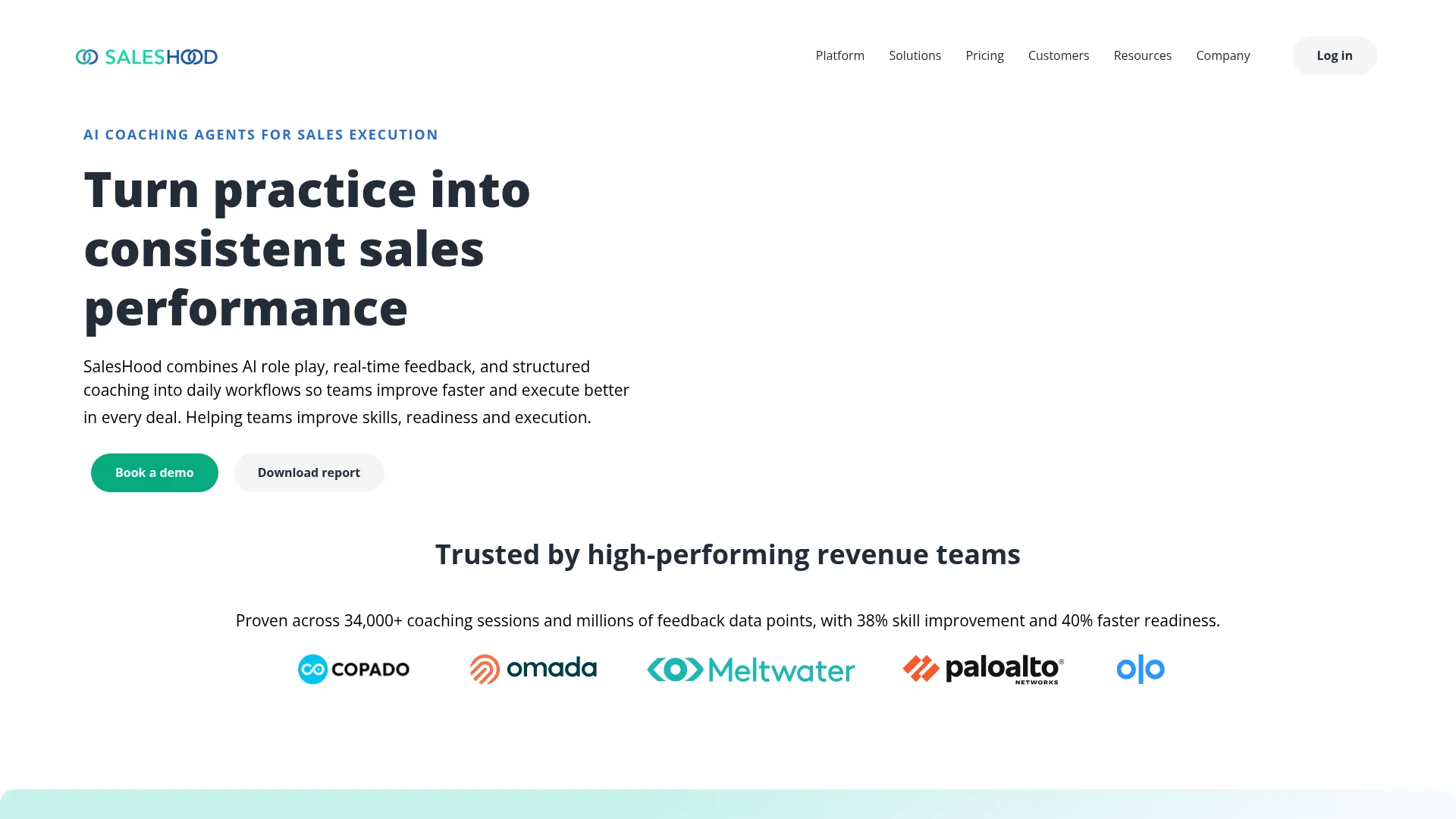
The bottom-of-funnel surface combining the pages that describe what SalesHood sells with the proof assets, downloads, and standalone videos that convert intent into pipeline. Product and platform pages, solution-by-team pages, pricing and trial flows, head-to-head comparisons, customer success stories from named accounts, gated downloadable guides and reports, and a short-form video library on the /sales-enablement-videos/ path. The cluster mixes formats deliberately. Buyers researching a platform move fluidly between product feature pages, comparison-page reads, customer-story scans, and downloaded ebooks within a single session.
Content-type mix: Product & Feature Pages 47.0% · Other 21.9% · Case Studies/Customer Stories 13.3% · Guides & Resources 9.9% · Comparison Pages 4.0% · Research/Reports 2.6% · Free Tools 1.3%
Micro-topics within this cluster
Product & Platform Pages (~48 Pages)
Platform overview pages plus dedicated feature pages for sales coaching, learning management, content management, digital sales rooms, AI role play, AI assistant, AI coaching agents, MEDDICC tool, sales kickoff solution, mutual action plans, pipeline builder, and sales process activation. The product surface lives across multiple URL paths rather than a single /product/ folder, which reflects SalesHood's breadth (training, coaching, content, DSR, AI, methodology) and the framing choice to give each module its own URL and SEO surface. The homepage title leads with "Agentic AI Sales Enablement Platform," which front-loads the AI vocabulary as the primary positioning frame. The Revenue Enablement Maturity Model page in this micro is a particularly strategic asset, since branded maturity models are the kind of artifact procurement teams use to internally justify a vendor evaluation.
Sample pages:
- SalesHood: Agentic AI Sales Enablement Platform (homepage)
/ - AI Coaching Agents
/ai-coaching-agents/ - AI Role Play for Sales Teams
/ai-role-play/ - Digital Sales Rooms
/digital-sales-rooms/ - Platform: Sales Coaching
/sales-coaching/
Solutions, Pricing & Company (~43 Pages)
Team-targeted solution pages (enablement, sales leaders, marketing, revenue operations, customer success), pricing and trial pages, head-to-head comparisons (Highspot, Seismic), alternative pages, demo and tour landing pages, and the company furniture (about, careers, legal, news, archives). The five-persona solutions architecture is standard B2B SaaS shape, but the inclusion of customer success as its own solutions page is a meaningful choice. Most sales enablement vendors treat CS as a secondary audience, while SalesHood explicitly addresses it, which is consistent with the broader revenue-enablement positioning where post-sale execution is part of the surface area. The competitor-comparison footprint at 6 URLs is the most actionable gap in this micro, since search intent around "SalesHood alternatives" extends well beyond the two head-to-heads currently covered.
Sample pages:
- SalesHood Pricing Editions
/pricing/ - Highspot vs SalesHood: The Definitive Comparison
/highspot-vs-saleshood/ - Seismic vs SalesHood: The Definitive Comparison
/seismic-vs-saleshood/ - Highspot Alternative: Why Teams Are Switching
/highspot-alternative/ - Solutions by Team: Enablement
/enablement/
Customer Success Stories (~21 Pages)
Long-form customer case studies and short-form testimonials from named accounts including Copado, SmartRecruiters, Omada Health, RingCentral, DataEndure, Ewing-Foley, DISQO, Federato, KPA, StarCompliance, and Planview. The roster skews mid-market SaaS, which matches SalesHood's commercial positioning. Customer-story URLs use the customer name as the path slug (/copado/, /omada-health/), which is clean architecture but doesn't carry outcome metadata in the URL the way Highspot's outcome-led titling does. Twenty-one customer stories is a credible roster for a mid-market enablement vendor, though the library scale lags category leaders by an order of magnitude (Highspot 343, Seismic and Mindtickle in the hundreds). Every named-customer addition compounds the proof library, and SalesHood's customer-story-plus-customer-webinar pairing means roughly 40% of named customers also appear in live formats.
Sample pages:
- Copado Success Story
/customer-stories/copado/ - SmartRecruiters Success Story
/customer-stories/smartrecruiters/ - Omada Health Success Story
/customer-stories/omada-health/ - DISQO Success Story
/customer-stories/disqo/ - KPA Success Story
/customer-stories/kpa/
Downloadable Guides & Reports (~25 Pages)
Gated ebooks (manager effectiveness, modern sales learning, digital selling, onboarding, hypergrowth playbook, virtual buyer engagement, enablement mastery), templates (sales plan, territory plan, content principles), MEDDICC downloads, and original research reports (2025 Sales Kickoff Industry Report, State of AI Sales Coaching Agents, Definitive Guide to AI Role Playing). The cluster covers the same topics as the editorial library, but in a deeper format with lead-capture gating. The most strategically interesting assets sit here: the State of AI Sales Coaching Agents report is the seed of a research franchise (the same compounding pattern Highspot uses with its State of Sales Enablement report), and the Enablement Performance Check assessment is a high-intent self-evaluation tool that targets a specific buyer moment.
Sample pages:
- 2025 Sales Kickoff Industry Report
/ebooks/2025-sales-kickoff-report/ - The State of AI Sales Coaching Agents in Revenue Enablement
/ebooks/ai-coaching-agents-report-2/ - The Definitive Guide To AI Role Playing in Sales Enablement
/ebooks/ai-role-play/ - Sales Enablement Plan Template
/ebooks/sales-enablement-plan-template/ - MEDDICC deal scoring guide
/ebooks/meddicc-deal-scoring-guide/
Standalone Video Library (~14 Pages)
Short-form sales enablement videos on a dedicated /sales-enablement-videos/ path, separate from full-length webinar replays. Topics cover the four pillars of enablement, peer-to-peer learning, manager coaching, stakeholder alignment, pitch process, virtual SKO tips, and remote onboarding. Foundation-level content that pairs with the editorial Enablement Strategy & Programs micro: same TOF intent, video format. Useful for embeddable distribution because a video explaining "the four pillars of sales enablement" travels better through LinkedIn shares than a 1,500-word blog post. The flipped-classroom video is a distinctive choice, since flipped-classroom learning design is rare in B2B SaaS content but core to how SalesHood actually trains, which makes the video a soft demo of methodology.
Sample pages:
- Four Pillars of Sales Enablement
/sales-enablement-videos/four-pillars-of-sales-enablement/ - What Great Sales Enablement Looks Like
/sales-enablement-videos/great-sales-enablement/ - Scale High Impact Sales Coaching for Managers
/sales-enablement-videos/manager-coaching/ - The Peer to Peer Learning Revenue Multiplier
/sales-enablement-videos/peer-to-peer/ - 10-Step Pitch Process
/sales-enablement-videos/10-step-pitch-process/
Strategy insight: This cluster is where SalesHood's conversion architecture lives, and the mix is unusually broad for a single grouping. Product pages, comparisons, customer stories, ebooks, research reports, and videos all sit alongside each other because they share a buyer-journey job: they answer the questions a serious evaluator asks. The two most actionable expansion areas are the Comparison sub-surface (currently 6 URLs against an explicit Highspot-and-Seismic positioning) and the research-franchise opportunity. SalesHood has the seed of an annual report cadence in the State of AI Sales Coaching Agents report and the 2025 Sales Kickoff Industry Report. Extending that into a State of Sales Coaching report or a State of MEDDICC Adoption study would deepen the citation surface and create a category-shaping asset that's hard for newer competitors to replicate. The Standalone Video Library is the format-diversification bet, and the 14-URL footprint feels light for a vendor whose product surface includes video coaching and pitch practice.
Key Observations
What Stands Out About SalesHood's Content Strategy
The library runs on a franchise-led two-pillar structure, not a traditional blog play
Blog/Editorial (40%) and Events/Webinars/Sessions (22.7%) together account for 62.7% of every page SalesHood publishes, with 276 URLs across two formats. The interesting move is the cross-format reinforcement: anchor topics like MEDDICC, AI Coaching Agents, SKO, and Buyer Engagement each appear in both formats, with a third leg in the Downloadable Guides & Reports micro. The MEDDICC franchise alone spans MEDDICC editorial inside the Sales Methodology & Process micro, 15 dedicated webinars, multiple ebook downloads, and a dedicated MEDDICC product surface. This is content as cross-format topic infrastructure, not as a blog-leads-webinar funnel.
Library concentration sits in two flagship clusters
Two clusters account for 75.9% of the library: Sales Enablement Editorial (183 URLs, 41.6%) and Product, Customer Stories & Resource Library (151 URLs, 34.3%). The Webinars & Live Events cluster covers the remaining 24.1% (106 URLs). The concentration matches the franchise-led posture: depth over breadth, with editorial and product-plus-proof carrying most of the load. The Customer Success Stories micro inside the product cluster is a compounding evidence asset, since every new named-customer story adds to the moat and new entrants without comparable customer relationships cannot match the footprint in a short timeframe.
Webinar volume (100 URLs) is unusually high for a 440-page library
At 22.7% of the library, webinars are nearly equal in weight to all product pages combined (16.8%) and meaningfully larger than the editorial coaching, methodology, AI, and buyer-engagement micros combined. The AI & Product Launch Webinars micro alone carries 20 URLs against 31 AI editorial blog posts, which inverts the usual editorial-leads-webinar ratio. The implication: SalesHood treats live discussion as a primary selling and category-vocabulary channel, not a secondary distribution surface. The Multipliers customer conference and Sales Productivity Tour roadshow extend the live-format investment into in-person community-building.
Per-URL traffic efficiency is low at ~7 visits per page
2,867 monthly visits across 440 pages is roughly half what category peers like Highspot (~18 visits/URL) and Trainual (~34 visits/URL) generate per published page. The 188 ranking positions in 11-20 plus 230 in 21-50 represent a material optimization layer: pages already on Google's first or second page that could be lifted into top-10 visibility through refresh, internal linking improvements, or supporting content. The shape suggests a younger-domain content engine where library scale runs ahead of per-page authority, and where optimizing existing inventory likely yields more upside than publishing new pages.
Comparison-page footprint is light for an explicit challenger positioning
6 comparison URLs (1.4% of library) cover Highspot Alternative, Seismic Alternative, the Highspot-vs-SalesHood matchup, Seismic-vs-SalesHood, and a Highspot-vs-Seismic narrator page. SalesHood publishes editorial that explicitly comments on the Seismic-Highspot deal as a category signal, so the strategic positioning is clearly competitor-aware, but the URL surface is modest for a vendor running a challenger play against the two largest players. Adding comparison coverage against Allego, Mindtickle, Showpad, and longer-tail "SalesHood alternatives" search terms would close the most actionable defensive gap, and the same playbook would apply across the content gap in glossary and free-tool surfaces.
First-party research franchise is present but narrow
The State of AI Sales Coaching Agents in Revenue Enablement and the Definitive Guide to AI Role Playing anchor a 4-URL Research/Reports footprint, alongside the 2025 Sales Kickoff Industry Report. All three sit in the Downloadable Guides & Reports micro as gated downloads. The "State of" naming pattern signals an annual or periodic refresh cadence, which is the same compounding pattern Highspot uses with its State of Sales Enablement report. SalesHood has the seed of a research franchise but hasn't extended it across topics beyond AI and SKO. Expanding into a State of Sales Coaching report or a State of MEDDICC Adoption study would deepen the citation surface and create the kind of category-shaping artifact that's hard for newer competitors to replicate.
The /blog URL path is overloaded with mixed content types
190 URLs share the /blog path prefix, spanning 6 different content types and all 3 topic clusters. Glossary URLs, customer testimonials, and one webinar URL all sit alongside the editorial blog posts on the same path. The pattern dilutes section-level authority signals to search engines: Google's understanding of "what is /blog about" gets fuzzier when the path hosts multiple distinct content types. Splitting the path into dedicated prefixes for /blog, /glossary, /testimonials, and so on would clarify section authority and make the URL structure more legible for analytics, internal linking, and AEO citation paths.
Definitional Glossary content is structurally under-invested
4 Glossary URLs across 440 pages, with the AI editorial vein carrying zero dedicated definitional content despite anchoring the company's current positioning. High-volume "what is" searches like what is sales enablement, what is buyer enablement, what is a digital sales room, what is an AI coaching agent, and what is MEDDICC are exactly the searches AI answer engines pull from. A library of 30-50 structured "what is X" pages would be both a traditional-SEO and an AEO play, and the editorial authority to win those searches is already present in the existing content.
More analyses in Sales Enablement
Seismic
How Seismic uses 1,483 blog posts, a 492-term glossary, and 281 research reports to drive 76K monthly visits in sales enablement. 3,954 pages, 10 clusters.
Showpad
How Showpad uses 398 blog posts, 457 expert profiles, and 61 case studies to drive 25K monthly visits in sales enablement. 1,511 pages, 7 clusters.
Allego
How Allego uses 590 blog posts, 297 guides, and a 71-episode podcast to drive 11K monthly visits in sales enablement. 1,261 pages, 7 clusters.
Bigtincan
How Bigtincan uses 276 blog posts, a 23-episode podcast, and a GenieAI editorial line to drive 15K monthly visits in sales enablement. 850 pages, 6 clusters.
Methodology: This analysis is based on SalesHood's full public sitemap (440 URLs, sourced from robots.txt), enriched with each URL's title and meta description. URLs were classified into a 12-bucket content type taxonomy and grouped into 3 topic clusters with 14 micro-topics using LLM-assisted classification. Company facts came from public web research across Crunchbase, LinkedIn, Getlatka, and the company's own About and blog pages. Traffic metrics (monthly organic visits, traffic value, ranking positions, position distribution) came from DataForSEO's domain rank overview, aggregated globally across 45 locale combinations. All counts reflect the SalesHood sitemap as of 2026-05-26.