
Summary
Seismic drives 76,362 monthly organic visits by running a breadth-play content library: 3,954 indexable pages spread across 10 topic clusters, with no two clusters combining to exceed 41% of the library and no single content type exceeding 38% share. The architecture is anchored by two compounding evidence assets, a 281-URL Research Reports & Analyst Recognition cluster (Forrester Wave, IDC MarketScape, G2 Grid, plus Seismic-authored studies including the State of AI in Enablement report) and a 267-URL Customer Success Stories library featuring Oracle, IBM, Ameriprise, Experian, Illumina, and Salesloft. 23.3% of Seismic's 4,939 ranking positions sit in the top 10 across 94 indexed (location, language) combinations, with another 831 positions in 11-20 representing the most actionable optimization slot. The library carries two distinct legacy footprints: the original sales content management story Seismic was founded on, and the Lessonly-inherited training, coaching, and customer service enablement content that broadens the editorial surface into adjacent categories.
Key facts:
- Library size: 3,954 indexable pages organized into 10 topic clusters; 37.5% Blog / Editorial, balanced-mix archetype
- Largest cluster: Sales Enablement Foundations (799 URLs, 20.2% of library)
- Flagship content asset: A 281-URL Research Reports & Analyst Recognition cluster combining original Seismic studies (State of AI in Enablement, Generation Enablement Report, HBR Pulse) with third-party analyst placements (Forrester Wave, IDC MarketScape, G2 Grid)
- Search performance: 76.4K monthly visits across 4,939 ranking positions; 23.3% in top 10 (~19 visits per page)
- Notable gap: Only 8 Comparison Pages and 24 Podcast / Audio Series URLs across the 3,954-page library, both below the threshold for a category-leading footprint
Company Overview
Seismic at a Glance
| Company | Seismic (Seismic Software, Inc.) |
| Founded | 2010 · San Diego, CA, USA |
| Category | Sales Enablement / Revenue Enablement |
| What They Do | An AI-powered sales enablement platform (the Seismic Enablement Cloud) covering content management, learning and coaching, buyer engagement, program strategy, meeting intelligence, and digital sales rooms. Sold to enterprise revenue, sales enablement, marketing, and customer-facing teams. Named customers include Oracle, IBM, Deliveroo, Ameriprise Financial, Experian, Illumina, and Salesloft, with notable strength in financial services, technology, manufacturing, and life sciences. |
| Funding | $440M raised across multiple rounds, plus a $500M conventional debt round in June 2024. Key investors include Permira, Lightspeed Venture Partners, General Atlantic, and T. Rowe Price. Reported ARR of approximately $425M at a $3B valuation (secondary sources, 2024). |
| Headcount | 1,000-5,000 (LinkedIn band) |
| Monthly Organic Visits | Traffic Value (PPC equiv.) | Ranking Positions |
|---|---|---|
| 76.4K | $562K | 4.9K |
Ranking positions reflect total positions across 94 indexed (location, language) combinations, not unique keywords. A keyword ranking in en-US and de-DE counts twice.
Seismic's content operation is structurally a breadth-play. 3,954 indexable pages spread across 10 topic clusters, with no single cluster exceeding 21% of the library and no two clusters combining above 41%. Documentation does not appear in the main www sitemap, a deliberate choice for a buyer-targeted enterprise platform where developer material lives elsewhere. The library carries two distinct legacy footprints. The original sales content management story, the category Seismic was founded on in 2010. And a substantial training, coaching, and customer service enablement footprint inherited from the 2021 Lessonly acquisition, now folded into the second-largest cluster.
Content Architecture
What Does Seismic's Content Engine Look Like?
Seismic's main website hosts 3,954 indexable pages organized into 10 topic clusters. The architecture is a balanced mix of formats with no single content type dominating, a structural posture distinct from the editorial-led or documentation-led libraries common among adjacent peers.
Content Type Distribution
| Content Type | Count | Share | Notes |
|---|---|---|---|
| Blog / Editorial | 1,483 | 37.5% | Largest type but well below the 50%+ share editorial-led libraries show |
| Guides & Resources | 526 | 13.3% | Substantial gated-asset footprint anchored in /resource/ and /resources/ paths |
| Other | 510 | 12.9% | Legal, locale roots, navigation hubs, careers, demo conversion pages |
| Glossary / Definitions | 492 | 12.4% | A large definitional footprint, anchored in the /enablement-explainers/ path |
| Research / Reports | 281 | 7.1% | Original Seismic research + Forrester, IDC, G2, Aragon analyst placements |
| Case Studies / Customer Stories | 267 | 6.8% | Named-customer library spanning Oracle, IBM, Ameriprise, Illumina, Salesloft |
| Product & Feature Pages | 203 | 5.1% | Platform, product modules, solutions, partner pages |
| Events / Webinars / Sessions | 105 | 2.7% | Includes the annual Seismic Shift conference plus on-demand webinar library |
| Free Tools | 55 | 1.4% | Interactive apps, the Changemaker Quiz, calculators |
| Podcast / Audio Series | 24 | 0.6% | Two podcast series: Go-to-Market Magic and standalone enablement episodes |
| Comparison Pages | 8 | 0.2% | Bigtincan and Showpad alternative pages, mirrored across locales |
| Documentation | 0 | 0.0% | Not present in www sitemap |
Key finding: No content type exceeds 38% of the library. Blog / Editorial leads at 37.5%, followed by Guides & Resources at 13.3% and Glossary / Definitions at 12.4%. This is a breadth-of-formats strategy rather than a single-asset bet, the posture of a category leader that has accumulated multiple distinct content franchises across 15 years of operation rather than a challenger concentrating effort around one wedge format.
Content Strategy Archetype
Seismic operates a balanced-mix, breadth-play library. The architecture spreads investment across many formats and many topics: 10 topic clusters, 30 micro-topics, 11 distinct content types. The strongest single asset is the Research Reports & Analyst Recognition cluster (281 URLs), combining first-party Seismic research with a steady stream of third-party analyst placements. The second flagship is the Customer Success Stories library at 267 URLs, a compounding evidence asset built from named-customer logos across 15 years. This archetype is what category leaders look like at maturity. Rather than betting on one anchor format, the engine produces enough content across enough surfaces to keep the brand present in every reasonable search the buyer might run.
Locale & Translation Strategy
How Seismic Publishes Across Markets
Seismic publishes content across three locales: an English root, French, and German. The split materially shapes the URL count and skews per-locale traffic interpretations.
| Locale | URLs | Share |
|---|---|---|
| en-US (root) | 2,028 | 51.3% |
| fr | 966 | 24.4% |
| de | 960 | 24.3% |
The German and French libraries are roughly symmetrical (within 0.1% of each other), and together they account for nearly half of all indexable pages. Both locales appear to mirror a substantial portion of the en-US root content rather than functioning as smaller curated selections, suggesting Seismic treats DACH and French-speaking Europe as anchor commercial markets that justify near-full library translation. The /uk path also hosts 995 URLs spanning the same set of clusters, which appears to be a regional English variant rather than a true fourth locale (the locale analysis groups it under root).
DataForSEO's 94 indexed (location, language) combinations confirm the wide footprint, but the headline ranking-position count (4,939) reflects total positions across those combinations rather than unique keywords. The same article ranking in three locales counts three times.
Strategy insight: Locale duplication roughly 1.9 times the apparent library size. Of the 3,954 total pages, only 2,028 are unique en-US root URLs (51.3%); the remaining 1,926 are translations or regional variants. For benchmarking against single-locale peers like Dock, Mindtickle, or SalesHood, the practical comparison base is closer to the en-US figure. The strategic question for Seismic is whether the full French and German mirroring produces enough incremental organic visibility in those markets to justify the production overhead, or whether selective translation of high-intent pillars would deliver similar local discoverability at a fraction of the cost.
Search Performance Quality
Where Seismic Ranks
The DataForSEO domain rank overview shows Seismic ranking in 4,939 positions across 94 locales. The position distribution skews toward the long tail rather than top-of-page, with a notable cluster in the recovery zone (11-50).
| Position | Count | Share |
|---|---|---|
| #1 | 236 | 4.8% |
| #2–3 | 210 | 4.3% |
| #4–10 | 704 | 14.3% |
| #11–20 | 831 | 16.8% |
| #21–50 | 1,693 | 34.3% |
| #51–100 | 1,265 | 25.6% |
23.3% of Seismic's ranking positions are in the top 10, meaningfully lower than category leader Highspot at 55.7% and second-strongest peer Showpad at 41.7%. Another 16.8% sit in positions 11-20, the most actionable optimization slot. That is content already on Google's first or second page that focused work could push into top-10 visibility. The 1,693 positions in 21-50 represent a deeper recovery opportunity, content drifting below page 2 that may need refresh, consolidation, or retirement. The long tail (1,265 positions in 51-100 alone) reflects the breadth of a 3,954-page library where many pages exist primarily to occupy long-tail surfaces rather than to compete for high-intent head terms.
Per-URL traffic efficiency is moderate at 19 visits per page across 3,954 URLs, consistent with category-leader-scale libraries where total traffic comes from volume more than from per-page authority. Single-locale challengers in the peer set show higher efficiency (Dock at 37 visits/page, Trainual at 34), reflecting tighter libraries rather than weaker domain authority on Seismic's side.
Content Deep Dive
What Is Seismic Actually Publishing, and How?
Seismic's content organizes around 10 primary topic clusters. Each cluster is described below with content-type composition, the micro-topics inside it, and concrete example URLs. Cluster and micro-topic groupings reflect a per-URL classification of the full sitemap; counts are exact, not approximate.
1. Sales Enablement Foundations
Pages: 799 (all locales) · Share of library: 20.2%
Editorial content on what sales enablement is, how to build a program, KPIs, ROI, performance, and the function's evolution into revenue enablement. The category Seismic helped define and the single largest editorial axis across the blog and explainers. This cluster does triple duty as the brand-authority anchor: pillar definitional pages, leadership-perspective posts, tactical performance content, and the recurring product-release blog cadence all live here.
Content-type mix: Blog / Editorial 82.2% · Glossary / Definitions 17.8%
Micro-topics within this cluster
Enablement Strategy & Program Design (~488 Pages) Strategic playbooks and best-practice posts on standing up and scaling enablement programs. The largest sub-theme in the cluster by a wide margin, and the cluster's commercial bridge: what a head of enablement reads when they have moved past "what is this" and are looking for an operating model. The volume here gives Seismic deep evergreen coverage on every reasonable variant of "how to build a sales enablement program," with formats ranging from numbered lists ("10 tips") to longer strategic essays.
Sample pages:
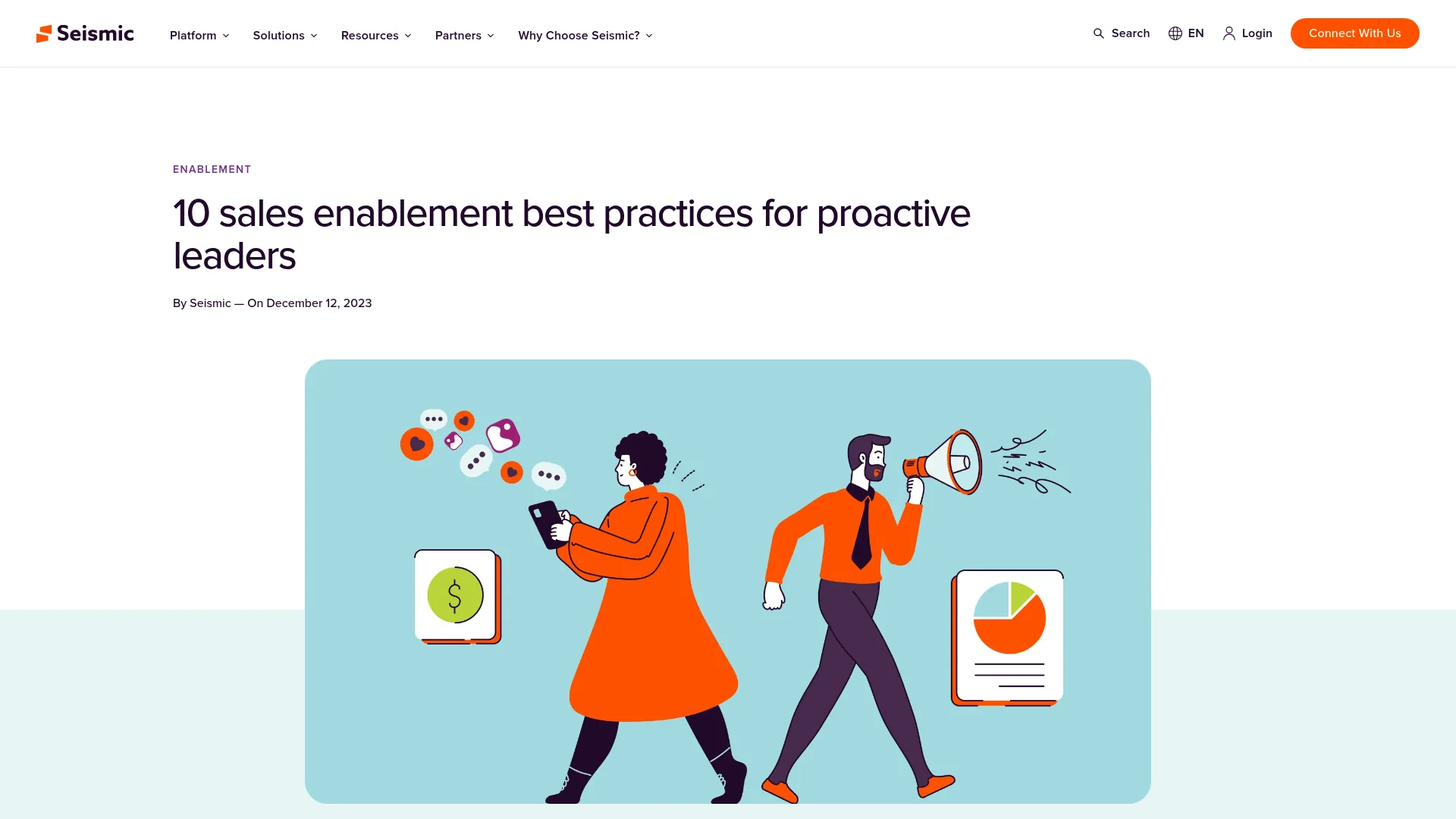
- 10 sales enablement best practices for proactive leaders
/blog/10-sales-enablement-best-practices-for-proactive-leaders/ - 10 tips for building your sales enablement strategy | Seismic
/blog/10-tips-for-building-your-sales-enablement-strategy/ - 10 Ways to Drive World-Class Sales Enablement
/blog/10-tips-to-drive-world-class-sales-enablement/ - 2024 is the Year to Invest in Enablement Tools | Seismic
/blog/2024-is-the-year-to-invest-in-enablement-software/
Enablement Definitions & Fundamentals (~142 Pages) Glossary-style "what is enablement" content and intro-level explainers anchored in the /enablement-explainers/ path. This is the AEO surface of the cluster: definitional content engineered to rank for "what is" head terms and to be cited verbatim by AI answer engines. The 142-URL footprint here is sizable for a single sub-theme, signaling that Seismic treats definitional coverage as a foundational SEO play rather than an afterthought.
Sample pages:
- What is the difference between sales enablement and sales operations?
/blog/difference-between-sales-enablement-and-sales-operations/ - Why account-based marketing (ABM) and sales enablement are better together
/blog/what-is-account-based-marketing-and-how-does-it-relate-to-sales-enablement/ - What is Sales Collateral? Examples of Sales Content | Seismic
/blog/what-is-sales-collateral-examples-of-sales-collateral-for-sales-enablement/ - Helpful sales enablement resources | Seismic
/enablement-explainers/helpful-sales-enablement-resources/
Sales Performance, Trends & Releases (~169 Pages) Tactical posts on sales productivity, seller efficiency, sales tech stack choices, enablement KPIs and ROI, maturity models, revenue-enablement repositioning, and Seismic's quarterly product-release coverage (Spring, Summer, Fall, Winter). The 169-URL footprint reflects multiple distinct strands woven into one supporting layer: rep-level performance tactics that broaden the cluster's reachable audience into individual contributors, measurement content that surfaces in renewal and procurement conversations, named frameworks like the Enablement Maturity Growth Framework that function as category-shaping vocabulary, and the recurring branded release cadence that mirrors how enterprise vendors like Atlassian and Salesforce announce updates.
Sample pages:
- 5 Proven Strategies to Improve Sales Performance | Seismic
/blog/5-proven-strategies-to-improve-sales-performance/ - 5 Strategies to Evaluate Sales Performance | Seismic
/blog/5-strategies-to-evaluate-sales-performance/ - 7 Alarming Sales Performance Stats | Seismic
/blog/7-alarming-sales-performance-stats/ - A beginner's guide to knowledge management | Seismic
/blog/a-beginners-guide-to-knowledge-management/
Strategy insight: This cluster does triple duty. Pillar pages chase category-defining keywords, the editorial cadence builds practitioner brand familiarity, and the named frameworks (Enablement Maturity Growth Framework, Revenue Enablement repositioning, the Aura AI naming visible in the AI cluster) function as category-shaping vocabulary. The 142-URL definitional layer is unusually deep for an editorial cluster, signaling that Seismic treats AEO definitional coverage as foundational rather than supplementary. The product-release content inside the supporting micro-topic is the kind of branded cadence competitors cannot manufacture quickly. It requires multi-year product execution to feed the editorial calendar.
2. Training, Coaching & Service Enablement
Pages: 569 (all locales) · Share of library: 14.4%
Content on sales training programs, coaching techniques, onboarding, learning design, skills development, sales readiness, and customer service / contact-center training. Second-largest editorial theme, and the cluster that most visibly reflects the 2021 Lessonly acquisition: a substantial portion of the training, coaching, learning, and contact-center material here was inherited from Lessonly's blog rather than originated under the Seismic brand.
Content-type mix: Blog / Editorial 52.9% · Glossary / Definitions 47.1%
Micro-topics within this cluster
Sales Training Program Design & Software (~284 Pages) Designing and scaling sales training programs alongside software-evaluation content on LMS, authoring tools, and training platforms. The largest sub-theme in the cluster, combining program-design playbooks with the LMS-and-tool comparison content that targets nearly the same audience. The volume reflects two things: Lessonly's editorial back-catalog (most of the older training and LMS-evaluation posts) and Seismic's ongoing investment in training as a product pillar. Format mix leans heavily on listicle ("20 sales kickoff ideas," "10 TED Talks") and how-to formats, the kind of evergreen surfaces that age well in search and intersect with high-intent software-evaluation queries when LMS and authoring-tool decisions are being made.
Sample pages:
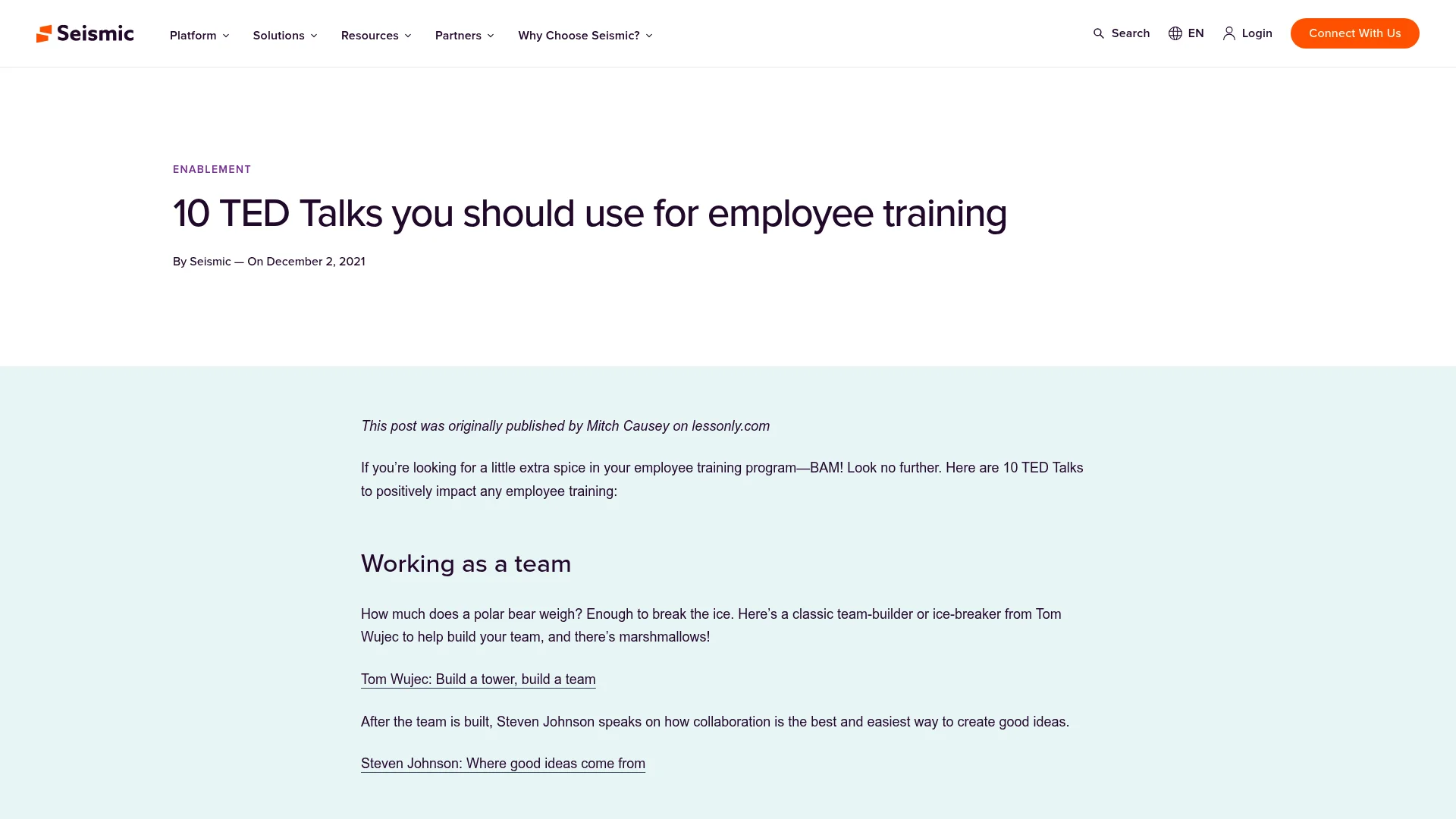
- 10 TED Talks you should use for employee training | Seismic
/blog/10-ted-talks-you-should-use-for-employee-training/ - 20 Sales Kickoff Ideas to Create the Best Virtual SKO - Seismic
/blog/20-sales-kickoff-ideas-to-create-the-best-virtual-sko/ - What's the Importance of Reviewing Training and Development? - Seismic
/blog/3-answers-to-1-question-what-is-the-importance-of-reviewing-your-training-and-development/ - 3 ways to create an engaging sales training program | Seismic
/blog/3-ways-to-create-an-engaging-sales-training-program/
Coaching, Onboarding & Readiness (~183 Pages) Manager coaching frameworks, sales onboarding and ramp programs, sales readiness, and the underlying adult-learning and L&D theory inherited from Lessonly. The leader-and-manager skills layer of the training cluster, distinct from program design and tooling. The sub-theme increasingly intersects with the AI cluster as AI-assisted coaching becomes a product surface, and the L&D theory material (learning styles, blended learning, peer-to-peer training) is the most visible editorial fingerprint of the acquisition. Pure L&D theory rarely appears in sales-enablement libraries, but here it occupies its own corner of the architecture alongside the more conventional coaching and onboarding content.
Sample pages:
- 10 Sales Coaching Tips to Elevate your Impact | Seismic
/blog/10-sales-coaching-tips-to-elevate-your-impact/ - 10 secrets of effective and engaging sales coaching | Seismic
/blog/10-secrets-of-effective-and-engaging-sales-coaching/ - 5 characteristics of great skills coaching | Seismic
/blog/5-characteristics-of-great-skills-coaching/ - 5 Tips for Amazing Sales Onboarding | Seismic
/blog/5-tips-for-amazing-sales-onboarding/
Customer Service & Call Center Training (~102 Pages) Training customer service reps and contact-center agents, call-center onboarding and quality assurance, and CS soft skills. Lessonly-inherited contact-center content targeting an audience distinct from Seismic's primary sales enablement ICP. The 102-URL footprint covers everything from customer-service training manuals to call-center QA frameworks to skills-focused posts on empathy and authentic engagement, and the audience here (customer service team leads, contact-center managers) is one Seismic does not actively market to in its current GTM motion. That makes this content a long-tail SEO surface that does not feed direct demand.
Sample pages:
- 10 topics to include in every customer service training manual | Seismic
/blog/10-topics-to-include-in-every-customer-service-training-manual/ - 3 customer service skills that create authentic and engaging experiences | Seismic
/blog/3-customer-service-skills-that-create-authentic-and-engaging-experiences/ - 3 ideas for customer service training activities | Seismic
/blog/3-ideas-for-customer-service-training-activities/ - 4 ways to empower customer service reps | Seismic
/blog/4-ways-to-empower-customer-service-reps/
Strategy insight: This cluster is the visible editorial residue of the 2021 Lessonly acquisition. The 268 Glossary / Definitions URLs, the L&D theory content inside the coaching micro-topic, and the entire customer-service sub-theme are not the kind of content a pure sales enablement platform produces from scratch. They reflect inherited Lessonly editorial DNA now operating under the Seismic domain. Strategically, that preserves back-link equity and historical authority. Tactically, the question is whether the legacy L&D and contact-center content still pulls qualified traffic for Seismic's GTM motion or whether some of it is back-catalog drag worth pruning to lift overall per-URL efficiency.
3. Buyer Engagement, Content & GTM Alignment
Pages: 216 (all locales) · Share of library: 5.5%
Content on buyer experience and digital sales rooms, sales content management and personalization, and sales-marketing alignment plus broader GTM strategy. The middle of Seismic's product narrative: how content gets used in the field, with buyers, and across the sales-marketing handoff.
Content-type mix: Blog / Editorial 72.2% · Glossary / Definitions 27.8%
Micro-topics within this cluster
Buyer Engagement & Digital Sales Rooms (~84 Pages) Buyer-experience strategy, digital sales rooms, meeting intelligence and prep, and buyer-engagement explainers. The buyer-facing surface of Seismic's platform, covering both editorial framing and the named product categories Seismic helped popularize. The framing inside this micro-topic spans conceptual (personalizing content for buyers, modern buyer expectations) and product-adjacent (how to use a digital sales room, what metrics to track, why meeting intelligence belongs in the platform). Each strand pairs with a Seismic product surface, which makes the sub-theme a tight editorial-to-product mapping rather than open-ended thought leadership.
Sample pages:
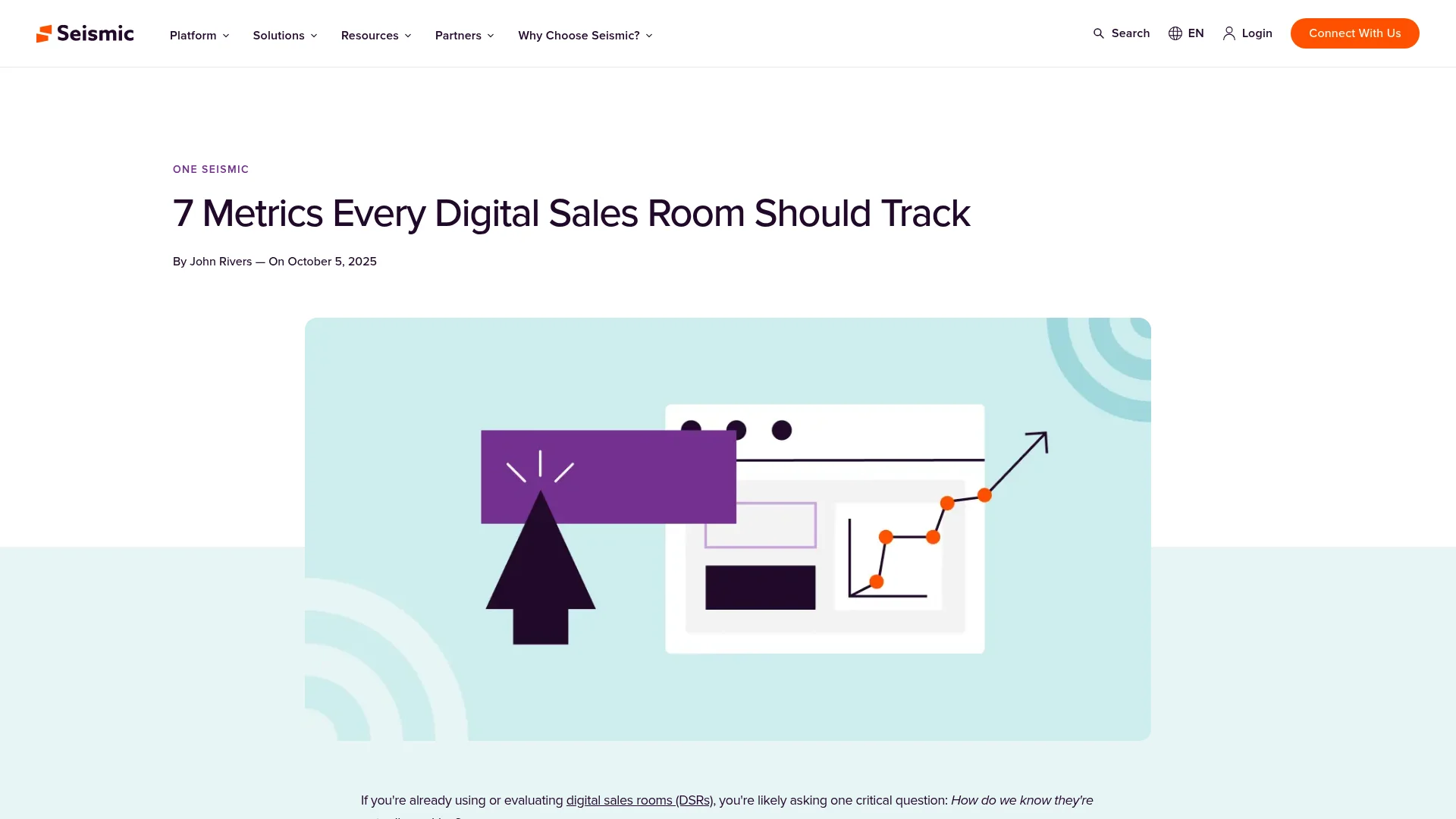
- 7 AI-Driven Metrics Every Digital Sales Room Must Track | Seismic
/blog/7-metrics-every-digital-sales-room-should-track/ - Conversational Intelligence: The Missing Piece to Meetings | Seismic
/blog/conversational-intelligence-what-sales-meetings-have-been-missing/ - Fall 2021 Release: Rewriting the rules of buyer engagement | Seismic
/blog/fall-release-rewriting-the-rules-of-buyer-engagement/ - How to Drive better buyer experiences through GTM Alignment
/blog/gtm-alignment-for-better-buyer-experience/
Sales Content Management & Personalization (~52 Pages) Managing, governing, personalizing, and measuring sales collateral, the original category Seismic was founded on. Founding-product content that now occupies a modest editorial footprint as the brand's center of gravity has shifted toward enablement and AI. The 52-URL footprint covers content management platforms and software evaluation, content personalization and dynamic-content automation, content analytics and ROI measurement, and content governance and compliance. The analytics and personalization strands map directly to LiveDoc and the broader Seismic personalization surfaces, which makes this small sub-theme a procurement-stage bridge for buyers comparing point tools to platforms.
Sample pages:
- 3 ways to unlock the power of a sales content management system | Seismic
/blog/3-ways-to-unlock-the-power-of-a-sales-content-management-system/ - 4 Tips for Packaging Sales Content to Increase Usage | Seismic
/blog/4-tips-for-packaging-sales-content-to-increase-usage-rates/ - 5 reasons to use sales content management software | Seismic
/blog/5-reasons-to-use-sales-content-management-software/ - 5 tips to guarantee sellers use the freshest sales content | Seismic
/blog/5-tips-to-guarantee-sellers-use-the-freshest-sales-content/
Sales-Marketing Alignment & GTM Strategy (~80 Pages) Frameworks for aligning sales and marketing functions, broader go-to-market strategy and execution, marketing content built for sales use, and consultative and social-selling methods. The cross-functional revenue surface, sitting between the buyer-engagement narrative and the broader revenue-enablement repositioning. The "smarketing" vocabulary signals the audience is the practitioner one (mid-funnel readers comfortable with the term) rather than the executive one, and the GTM strand connects the alignment story to the larger revenue-enablement frame. Consultative and social-selling content here runs adjacent to the financial services vertical material, where trusted-advisor vocabulary is most common.
Sample pages:
- 3 examples of social selling done right | Seismic
/blog/3-examples-of-social-selling-done-right/ - 3 tips for boosting social selling efforts | Seismic
/blog/3-tips-for-boosting-social-selling-efforts/ - 5 tips to perfect consultative selling | Seismic
/blog/5-tips-to-perfect-consultative-selling/ - Five takeaways from the first five episodes of Go-to-Market Magic | Seismic
/blog/five-takeaways-from-the-first-five-episodes-of-go-to-market-magic/
Strategy insight: At 216 URLs (5.5% of library), this cluster carries the part of Seismic's product story most directly tied to in-field execution, and the buyer-engagement sub-theme at 84 URLs is materially smaller than the footprint a category-defining platform might be expected to carry. Seismic positions itself as the leader in digital sales rooms (which it helped popularize), yet the editorial coverage is calibrated rather than dominant. The sales content management strand at 52 URLs is modest for the category Seismic was founded on, signaling either that CMS is treated as a settled product story not requiring continued editorial investment, or that the cluster has been quietly de-prioritized as Seismic re-orients around the revenue-enablement frame. Either way, both sub-themes are among the clearer expansion opportunities in the library.
4. Industry & Vertical Content
Pages: 174 (all locales) · Share of library: 4.4%
Editorial and solution content tailored to specific verticals: financial services, manufacturing, healthcare and life sciences, and technology. Including industry-specific solutions and reports.
Content-type mix: Blog / Editorial 81.6% · Product & Feature Pages 13.8% · Glossary / Definitions 4.6%
Micro-topics within this cluster
Financial Services Enablement (~126 Pages) Enablement, content, and training content for financial services firms. The largest vertical theme by a wide margin: banks, asset managers, insurance, and wealth advisors. The 126-URL footprint reflects Seismic's deepest vertical customer book (Ameriprise, AllianceBernstein, BBH Private Banking, plus the dedicated /fs/ vertical landing experience). Financial services is also a vertical where regulatory and compliance content has high search volume, making editorial investment here double as both top-of-funnel content and procurement-stage proof.
Sample pages:
- fs
/fs/ - Two Types of Content in Sales Asset Management
/blog/2-types-content-sales-asset-management/ - 3 Steps to Becoming a Trusted Advisor
/blog/3-steps-to-becoming-a-trusted-advisor/ - Accelerate new client acquisition with enablement technology | Seismic
/blog/accelerate-new-client-acquisition-with-enablement-technology/
Manufacturing Enablement (~32 Pages) Sales enablement, training, and content material for manufacturing companies. Dedicated manufacturing vertical content and reports, including the 2026 Manufacturing GTM Outlook Report. Manufacturing is where Seismic's vertical investment is most visible in cluster terms (a dedicated industry report franchise) even though it lags financial services in absolute URL count.
Sample pages:
- 5 reasons why manufacturers need to leverage online learning | Seismic
/blog/5-reasons-why-manufacturers-need-to-leverage-online-learning/ - Bridging the Gap Between Digital Manufacturing and Digital Transformation | Seismic
/blog/bridging-the-gap-between-digital-manufacturing-and-digital-transformation/ - Manufacturing Sales Shift: Buyers Decide Before You Sell
/blog/how-manufacturing-sales-must-adapt-to-win-earlier/ - Manufacturing GTM Trends: Engage Buyers & Drive Growth
/blog/key-gtm-insights-shaping-manufacturing/
Healthcare, Technology & Other Verticals (~16 Pages) Enablement content for healthcare, pharma, and life sciences GTM teams alongside content tailored to technology and SaaS sales organizations. Smaller vertical surfaces grouped together: each carries vertical landing pages plus a handful of locale-mirrored blog posts. The thinness is striking given that technology is Seismic's second-deepest vertical by customer count (62 case studies versus 66 financial services), suggesting vertical content production has lagged vertical customer acquisition. Healthcare follows a similar shape, with most of the URLs here being locale variants of a single KPI post plus a vertical landing page.
Sample pages:
- 10 KPIs Every Healthcare Marketer Needs | Seismic Blog
/blog/10-kpis-every-healthcare-marketer-needs/ - How to build a business case for sales enablement in telecom | Seismic
/blog/5-steps-for-building-a-business-case-for-sales-enablement-in-telecom/ - 10 KPIs Every Healthcare Marketer Needs | Seismic Blog
/de/blog/10-kpis-every-healthcare-marketer-needs/ - How to build a business case for sales enablement in telecom | Seismic
/de/blog/5-steps-for-building-a-business-case-for-sales-enablement-in-telecom/
Strategy insight: Financial services receives 72% of the cluster's URL volume despite being only the largest of four named verticals, matching where Seismic's deepest customer book sits. The mismatch between technology vertical depth (62 customer stories) and technology vertical editorial volume (within the combined 16-URL Healthcare, Technology & Other Verticals micro-topic) is the most actionable gap: a tech-vertical editorial expansion would feed both case-study discovery and category-defining searches in Seismic's second-biggest vertical. The dedicated /fs/ landing surface is also unusual: most peers route financial services through solutions pages rather than a dedicated path, suggesting Seismic is comfortable treating the vertical as a near-second-brand commercial bet.
5. AI in Enablement
Pages: 141 (all locales) · Share of library: 3.6%
Editorial content, reports, and product narratives focused on AI's role in sales enablement, GTM, and revenue operations. Covering generative AI, agentic AI, and AI assistants. A dominant 2024-2026 theme that has accumulated to standalone cluster scale across blog posts, reports, press releases, and product pages.
Content-type mix: Blog / Editorial 90.1% · Glossary / Definitions 9.9%
Micro-topics within this cluster
Generative AI for Sales & Coaching (~112 Pages) Generative AI use cases across selling, content generation, and AI-assisted coaching, role-play, and training automation. The largest AI sub-theme by a wide margin, covering both seller-facing and manager-facing AI use cases. The 112-URL volume signals that Seismic has been steadily publishing AI-applied-to-sales and AI-applied-to-coaching content since the 2023 generative inflection point, building category vocabulary alongside the product narrative. Merging the seller-facing and coaching-facing strands into one micro-topic also reflects how the product roadmap is moving: AI surfaces increasingly sit across both audiences rather than splitting cleanly between them.
Sample pages:
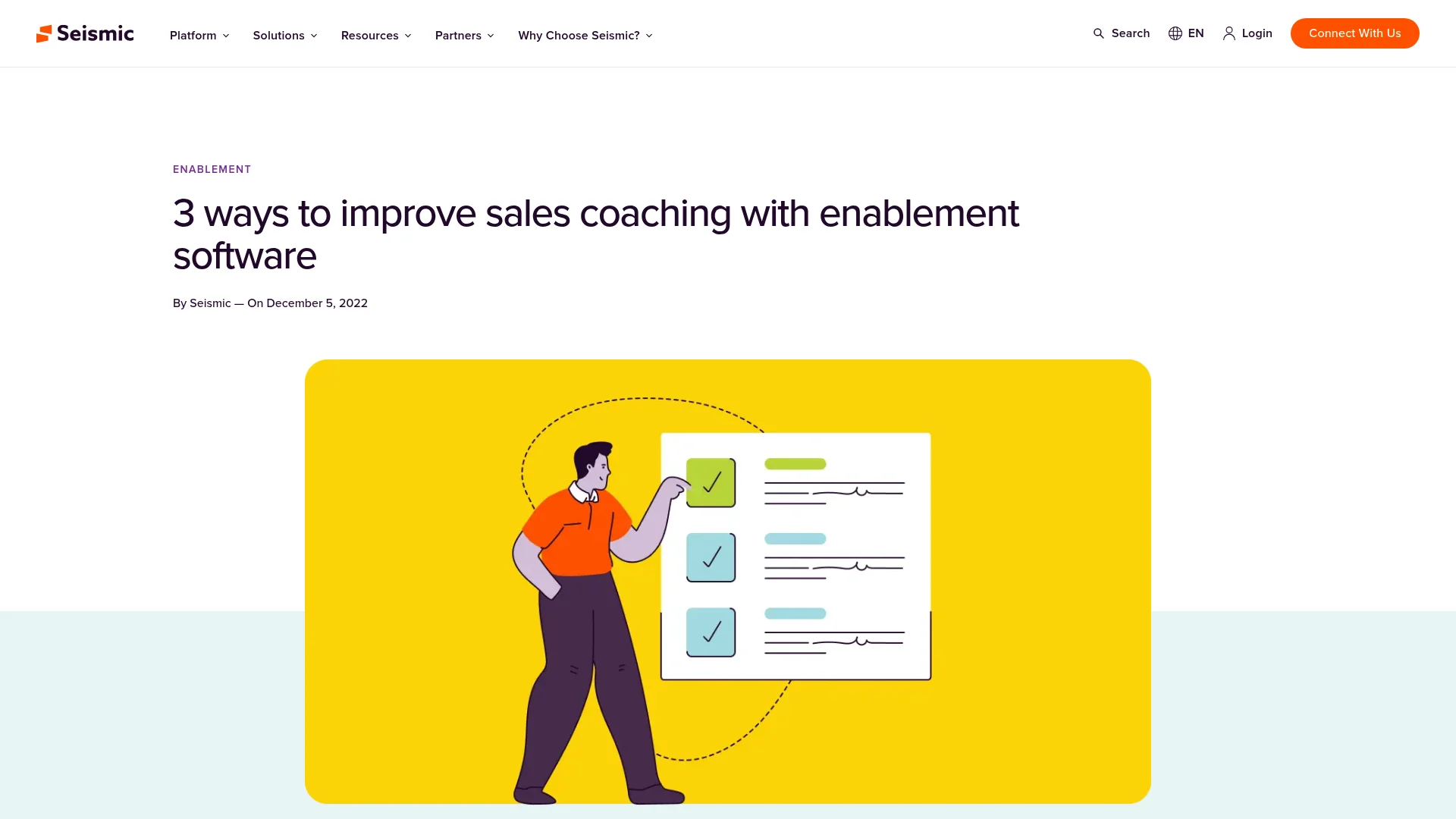
- 3 ways to improve sales coaching with enablement software | Seismic
/blog/3-ways-to-improve-sales-coaching-with-enablement-software/ - 4 Ways to Unlock Sales Success with Sales Readiness | Seismic
/blog/4-ways-to-unlock-sales-success-with-sales-readiness/ - 5 reasons why sales training and coaching is a smart investment | Seismic
/blog/5-reasons-why-sales-training-and-coaching-is-a-smart-investment/ - 5 Strategies to Drive Sales Productivity
/blog/5-strategies-to-drive-sales-productivity/
Agentic AI & Autonomous Workflows (~10 Pages) Agentic AI, AI agents, autonomous revenue workflows, and the agentic GTM stack. A late-stage, increasingly distinct narrative as Seismic positions for the agentic era. Only 10 URLs today, but the angle (agentic AI as autonomous workflow operator, not assistant) is the conceptual frontier where the category vocabulary is still being settled, and the editorial volume here is what determines whether Seismic shapes the term or follows competitors who stake it first. The "agentic revenue organization" frame is the most explicit category-shaping move inside this micro-topic.
Sample pages:
- What Skills Do Sellers Need in the Agentic AI Era?
/blog/agentic-ai-era-sales-skills/ - Execution Gap in Revenue Teams: Why It Happens | Seismic
/blog/why-revenue-teams-fail-execution/ - Agentic AI for Sales: From Automation to Execution | Seismic
/enablement-explainers/what-is-agentic-ai-for-sales/ - What Is an Agentic Revenue Organization | Seismic
/enablement-explainers/what-is-agentic-revenue-organization/
AI Product Launches & Research (~19 Pages) Press releases and product pages announcing Aura AI and AI-powered Seismic features, plus the State of AI in Enablement reports and other AI-specific research output. The product-and-research evidence layer behind the editorial AI argument. The Aura branding is the wedge: a named AI surface that competitors then have to position against, the same vocabulary-staking move visible in the Revenue Enablement repositioning content. The State of AI in Enablement research franchise extends the brand authority across years, with each new edition making the back-catalog more citable and harder to dislodge.
Sample pages:
- Seismic Aura | Specialized AI Agents for your GTM Teams
/blog/aura-ai-agents-for-gtm-teams/ - Seismic Aura | Spezialisierte KI-Agenten für Ihre GTM-Teams
/de/blog/aura-ai-agents-for-gtm-teams/ - Seismic Aura | Des agents IA spécialisés pour vos équipes en charge de la commercialisation
/fr/blog/aura-ai-agents-for-gtm-teams/ - Seismic unveils next generation of AI-powered enablement
/newsroom/press-releases/ai-enablement-innovation/
Strategy insight: AI sits at 141 URLs (3.6% of library), a meaningful but not dominant footprint. The strategic posture is publication-heavy on generative AI applied to both sellers and coaches (112 URLs combined) with a lean but pointed bet on agentic AI (10 URLs) where the category vocabulary is still up for grabs. The Aura AI product branding is the most explicit category-shaping move, creating a named AI surface competitors then have to position against. The narrowest gap is the AI definitional layer: only 14 Glossary URLs across 141 AI pages, with terms like "agentic AI for sales" and "agentic revenue organization" only just appearing in /enablement-explainers/. A deeper structured definitional library would convert AEO citation traffic that the current explainer footprint cannot fully capture.
6. Customer Success Stories
Pages: 267 (all locales) · Share of library: 6.8%
Named customer case studies showing how organizations use Seismic to drive sales, training, and content outcomes. A self-contained, format-defined asset library: every URL is a named-customer story, and the cluster is 100% Case Studies / Customer Stories format-pure.
Content-type mix: Case Studies / Customer Stories 100%
Micro-topics within this cluster
Financial Services Customer Stories (~66 Pages) Case studies featuring banks, asset managers, insurers, and wealth advisors, including AllianceBernstein, Ameriprise Financial, and BBH Private Banking. Seismic's deepest vertical, with many of the highest-profile stories. Financial services case studies are a particularly valuable artifact: regulated-industry buyers consistently cite peer adoption as the leading procurement signal, which makes named financial-services proof the single hardest competitive asset to displace.
Sample pages:
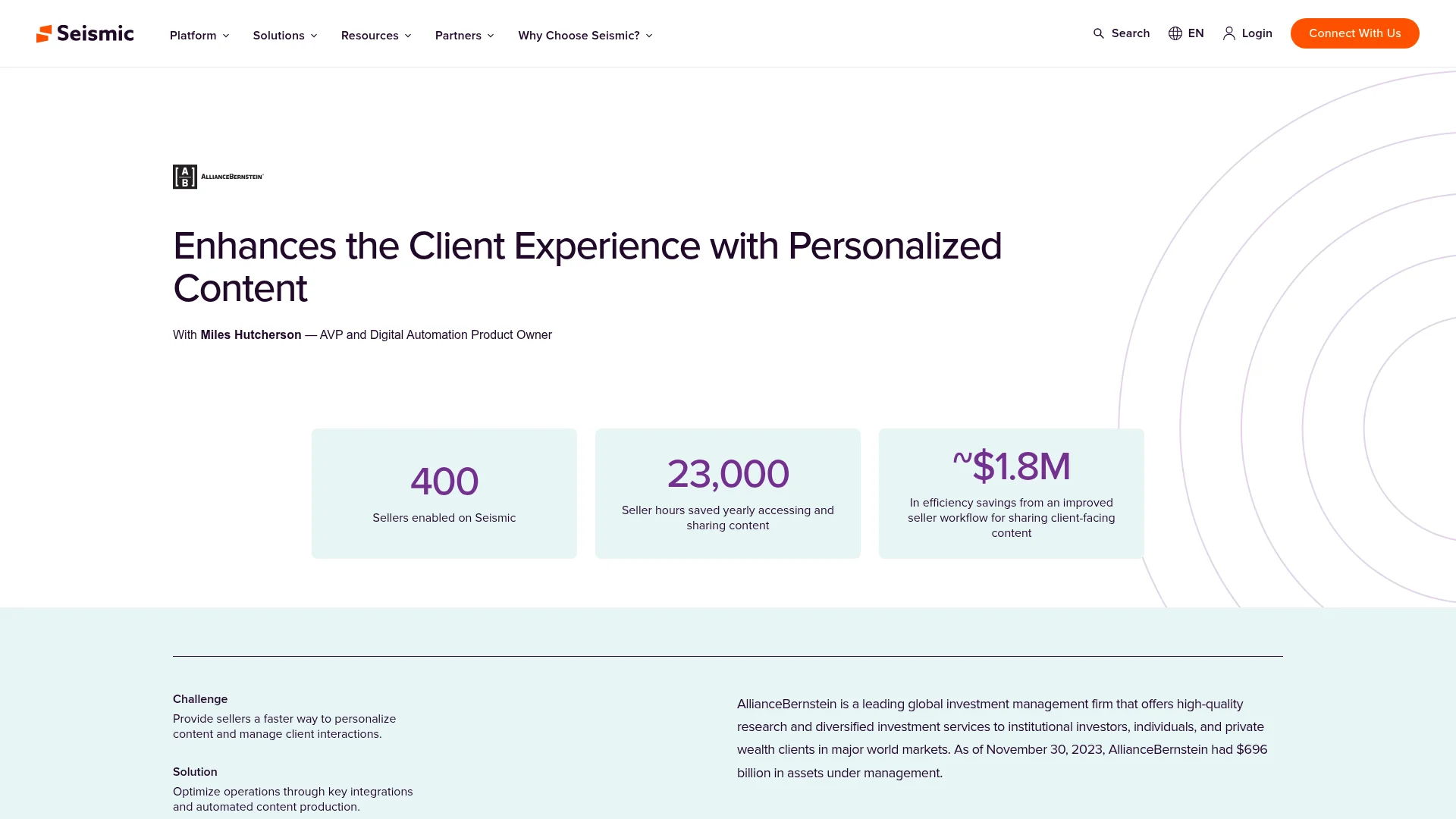
- AllianceBernstein Enhances the Client Experience with Personalized Content | Seismic
/customer-stories/alliancebernstein/ - Ameriprise Financial Delivers a Better Client Experience | Seismic
/customer-stories/ameriprise-financial-2/ - Ameriprise Financial creates a seamless advisor recruitment experience | Seismic
/customer-stories/ameriprise-financial/ - BBH Private Banking Revolutionizes Content Production and Increases Efficiency | Seismic
/customer-stories/bbh-private-banking/
Technology & SaaS Customer Stories (~62 Pages) Case studies featuring software and technology companies. A strong second vertical for customer logos, with named accounts including Alteryx, Armis, Autodesk, and Blackbaud. The volume nearly matches financial services (62 vs 66), confirming that technology is the second commercial pillar of Seismic's enterprise GTM.
Sample pages:
- Alteryx Accelerates Sales with Enablement | Seismic
/customer-stories/alteryx/ - Enables a rising sales force and drives exponential growth | Seismic
/customer-stories/armis/ - Autodesk Transforms Skill Enablement with Seismic | Seismic
/customer-stories/autodesk/ - Blackbaud increases sales pipeline 33% by closing deals faster | Seismic
/customer-stories/blackbaud/
Cross-Vertical & Industrial Stories (~139 Pages) Customer stories from companies in retail, media, education, professional services, and other industries, plus manufacturing and healthcare/life sciences accounts (Illumina, Aerogen, Regal Rexnord, Applied Systems). The largest sub-theme by URL count, reflecting Seismic's broad customer base across industries beyond the two deepest verticals. The cluster's index page (/customer-stories/) lives here as the navigational anchor, and the most quantitatively specific case-study titles in the entire library sit inside this micro-topic ("Illumina saves sellers 6,650+ hours", "Aerogen reduces sales cycles by 56%"), the kind of numeric proof CFOs and procurement teams cite in renewal conversations.
Sample pages:
- Sales Enablement Customer Success Stories | Seismic
/customer-stories/ - Aerogen Reduces Sales Cycles by 56% with Seismic | Seismic
/customer-stories/aerogen/ - Alera Group Transforms Employee Onboarding and Development | Seismic
/customer-stories/alera-group/ - Applied Systems reallocates 100 hours per week | Seismic
/customer-stories/applied-systems/
Strategy insight: 267 named-customer case studies is a compounding evidence asset that newer entrants cannot replicate quickly. The vertical concentration (66 financial services + 62 technology = 48% of all case studies) maps almost exactly to Seismic's two deepest commercial GTM bets. The gap worth flagging: the combined Healthcare, Technology & Other Verticals editorial micro-topic carries 16 URLs against 62 technology case studies, an imbalance suggesting that vertical editorial production runs on a slower cycle than vertical customer acquisition. The cluster also contains zero outcome-organized navigation (the /customer-stories/ index is alphabetical rather than filterable by win-rate, adoption, or deal-size outcome), which is a discoverability gap relative to how peers like Highspot structure outcome-organized case-study browsing.
7. Research Reports & Analyst Recognition
Pages: 281 (all locales) · Share of library: 7.1%
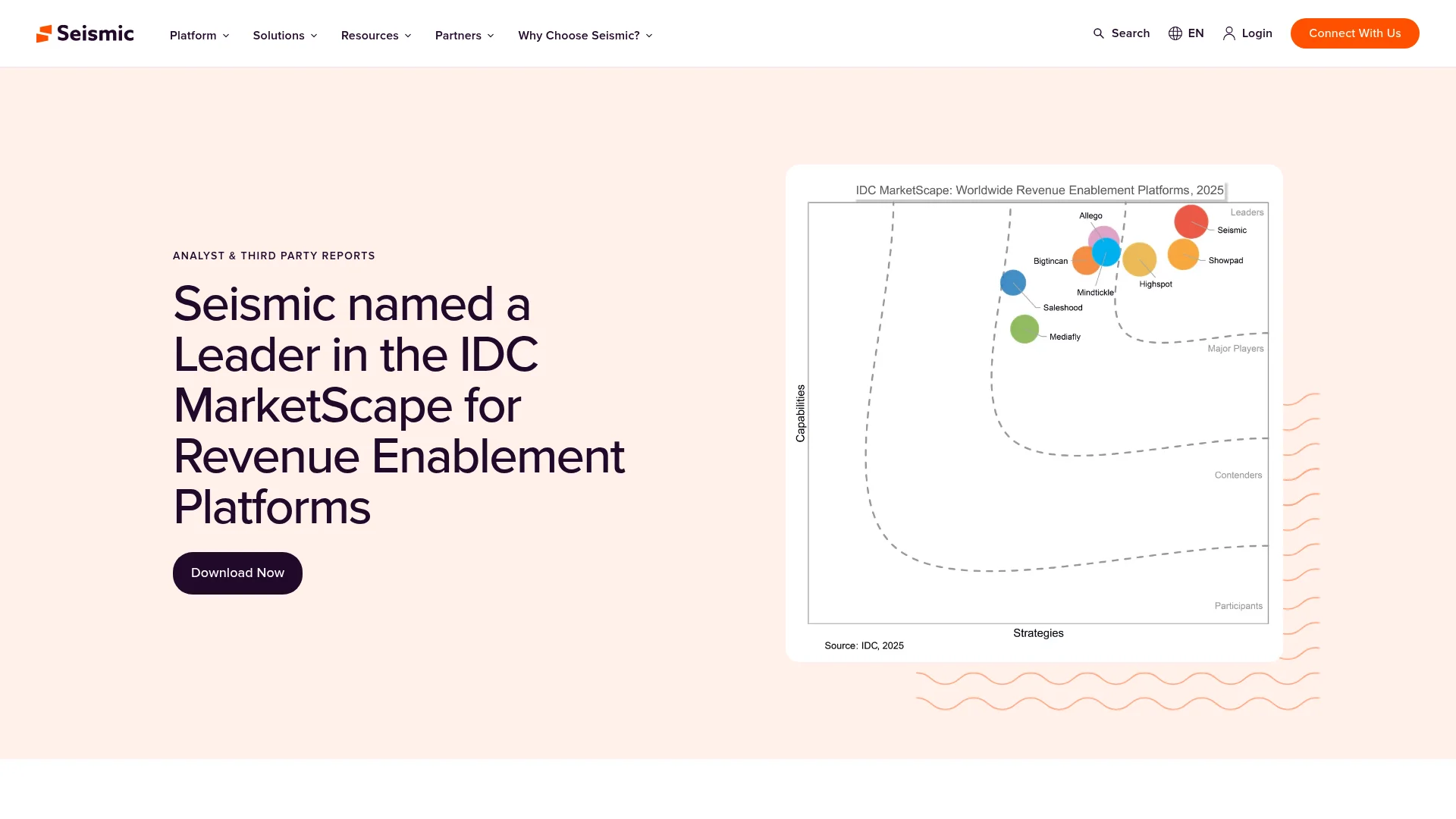
Original research reports (HBR Pulse, Generation Enablement Report, State of AI in Enablement) and third-party analyst recognition (Forrester Wave, G2 Grid, IDC MarketScape, Aragon Research Globe). A clear category of credibility-building content combining Seismic-authored research and analyst placements.
Content-type mix: Research / Reports 100%
Micro-topics within this cluster
Analyst Firm Reports & G2 Grids (~174 Pages) Forrester Wave, IDC MarketScape, Aragon Research Globe, and other analyst recognitions, plus the recurring quarterly G2 Grid placements for sales enablement software. The largest sub-theme in the cluster, anchored by the analyst-recognition hub at /resources/analyst-third-party-reports/. Analyst content does double duty: it captures branded analyst searches (a buyer comparing tools through Forrester's lens) and provides procurement-stage third-party validation that internal champions can forward to their committees. The G2 Grid cadence (Spring, Summer, Fall, Winter Grids, plus enterprise and EMEA variants) gives Seismic a steady drip of branded credibility content tied to a recognizable category benchmark.
Sample pages:
- Sales Enablement Analyst & Third Party Reports | Seismic
/resources/analyst-third-party-reports/ - Sales Enablement-Analystenberichte & externe Studien | Seismic
/de/resource/analyst-third-party-reports/ - Sales Enablement-Analystenberichte & externe Studien | Seismic
/de/resources/analyst-third-party-reports/ - Rapports d'analystes et de tiers | Seismic
/fr/resource/analyst-third-party-reports/
Seismic Original Research (~91 Pages) Generation Enablement Report, HBR Pulse Report, State of AI in Enablement, and other Seismic-authored research projects. Original research Seismic publishes under its own brand. A first-party research franchise that compounds across years: each new edition extends back-link equity and citation authority that competitors cannot replicate by buying ads. The named editions function as procurement-stage proof and as recurring brand authority anchors that AI answer engines increasingly cite when summarizing the category.
Sample pages:
- Seismic
/resource/reports/ - Seismic
/resources/reports/ - Harvard Business Review Analytic Services: Accelerating Growth Through Revenue Enablement
/resources/reports/accelerating-growth-through-revenue-enablement-fs/ - Harvard Business Review Pulse Report: Accelerating Growth Through Revenue Enablement
/resources/reports/accelerating-growth-through-revenue-enablement/
Industry Vertical Reports (~16 Pages) Industry-specific research reports for manufacturing GTM, financial services, and healthcare. Vertical-specific original-research output that pairs with the Industry & Vertical Content cluster's editorial layer. The 2026 Manufacturing GTM Outlook Report is the most visible recent addition, extending the manufacturing-vertical investment beyond editorial into proprietary data.
Sample pages:
- Seismic Report: Revenue Enablement in Financial Services
/resources/reports/revenue-enablement-financial-services/ - 2026 Manufacturing GTM Outlook Report | Seismic
/resources/whitepapers/2026-manufacturing-gtm-outlook-report/ - Seismic Report: Revenue Enablement in Financial Services
/de/resources/reports/revenue-enablement-financial-services/ - 2026 Manufacturing GTM Outlook Report | Seismic
/de/resources/whitepapers/2026-manufacturing-gtm-outlook-report/
Strategy insight: This is one of Seismic's two compounding-asset flagships (the other being Customer Success Stories). 281 URLs combining original research and analyst placement is structural moat content: brand recognition and editorial cadence accumulate across years, making the cluster harder to dislodge than a single high-ranking blog post. The G2 Grid presence inside the analyst micro-topic is particularly efficient: each quarterly Grid placement is essentially branded boilerplate (with new dates and small numerical updates) that produces a steady search surface around "best sales enablement software" head terms. Original Seismic research at 91 URLs is the harder-to-replicate layer, with named franchises (Generation Enablement Report, State of AI in Enablement, HBR Pulse) that competitors cannot replace by spending more on content.
8. Events, Webinars & Podcasts
Pages: 136 (all locales) · Share of library: 3.4%

Live events, on-demand webinar recordings, Seismic's flagship Seismic Shift annual conference, and the two podcast series (Go-to-Market Magic and the standalone Enablement Podcast). A defined content format covering everything Seismic publishes outside text and gated assets.
Content-type mix: Events / Webinars / Sessions 77.2% · Podcast / Audio Series 17.6% · Other 5.1%
Micro-topics within this cluster
On-Demand Webinars (~93 Pages) Recorded webinar sessions available on demand under /resources/on-demand/. A library of 93 recorded sessions with consistent format. Webinar replay libraries at this scale function as long-tail SEO surfaces and as gated-asset capture mechanisms for buyers who prefer video to long-form text, and Seismic's webinar program runs as an ongoing demand-capture asset rather than a one-off content investment.
Sample pages:
- Seismic
/resources/on-demand/ - Apply a Digital-Driven Strategy for Sales Success | Seismic
/resources/on-demand/apply-a-digital-driven-strategy-for-sales-success/ - How to Change Sales & Marketing Behavior | Seismic
/resources/on-demand/chaos-to-command-how-to-change-sales-marketing-behavior-at-scale/ - Customise content effortlessly- Thankyou | Seismic
/resources/on-demand/customise-content-effortlessly/
Podcast Series & Episodes (~30 Pages) Episodes of the Go-to-Market Magic podcast and the standalone Enablement Podcast, plus podcast home, about, and index pages. Two distinct branded podcast series, each interviewing revenue, enablement, or GTM leaders. The Go-to-Market Magic naming (not Sales Enablement Magic) signals the broader revenue audience Seismic is courting with this asset, which sits closer to the GTM execution narrative than to the legacy enablement frame. Running two podcast series at 14 and 10 episodes respectively rather than concentrating effort on one is the breadth-play pattern visible across the rest of the library, applied to audio.
Sample pages:
- 3 Revolutionary Ways to Support Your Enablement Team with Dave Lichtman
/podcast/go-to-market-magic/3-revolutionary-ways-to-support-your-enablement-team-with-dave-lichtman/ - AI and the Expanding Scope of Enablement at Enterprises and Startups Alike
/podcast/go-to-market-magic/ai-the-expanding-scope-of-enablement-seismic/ - AI and Enablement Unleashed with Jonathan Kvarfordt, Founder of GTM AI Academy
/podcast/episodes/ai-and-enablement-unleashed-with-jonathan-kvarfordt-founder-of-gtm-ai-academy/ - Crafting a Winning Enablement Structure with Jen Bullock
/podcast/episodes/crafting-a-winning-enablement-structure-with-jen-bullock/
Live Events & Conference Hubs (~13 Pages) Pages covering the Seismic Shift annual customer conference and the events/webinars hub landing pages. Customer conferences function as recruiting moats and renewal-stage credibility builders: a customer who attends Seismic Shift is materially more likely to renew, and the editorial coverage of the event extends the brand surface across the year. Seismic Shift itself gets minimal editorial expansion in the sitemap (5 dedicated URLs for a flagship annual conference), suggesting most of the event's content surface lives off-site (event pages, video platforms, social channels) rather than feeding the indexable library.
Sample pages:
- event
/event/ - Seismic Shift 2025 | Event Highlights & AI Powered Enablement
/event/seismic-shift-2025/ - Sales Enablement Webinars & Events | Seismic
/resource/events-and-webinars/ - Sales Enablement Webinars & Events | Seismic
/resources/events-and-webinars/
Strategy insight: Combining events, webinars, and podcasts into one cluster surfaces a strategic tension. 93 on-demand webinars is a substantial back-catalog doing ongoing demand-capture work, but 24 podcast episodes across two series is below the 30-URL threshold for a category-leading podcast footprint, and the conference itself gets minimal editorial expansion (5 URLs for the flagship Seismic Shift). The choice between expanding the podcast versus staying small is the strategic call here, because the episode topics overlap heavily with the editorial Sales Enablement Foundations cluster. A larger podcast investment would either need to deliver content the blog cannot (named-guest credibility transfer at scale, like Highspot's Win-Win series does with 208 episodes) or expand into territory where Seismic's editorial coverage is thin. A bigger archival expansion of Seismic Shift session recordings would also convert more of the conference investment into evergreen organic discovery.
9. Guides, Ebooks & Toolkits
Pages: 581 (all locales) · Share of library: 14.7%
Long-form gated assets: practitioner guides, ebooks, checklists, toolkits, and whitepapers covering enablement strategy, KPIs, RFPs, and implementation. The largest non-utility cluster by URL count, distinct from blog and explainer formats by length and gating model.
Content-type mix: Guides & Resources 90.5% · Free Tools 9.5%
Micro-topics within this cluster
Ebooks, Whitepapers & Strategy Guides (~447 Pages) Long-form ebooks, whitepapers, and strategic playbooks on building, scaling, and running enablement programs, anchored by the /resources/ebooks/ and /resources/guides/ hubs. The largest sub-theme by a wide margin, doing direct demand-capture work as gated lead assets that convert qualified traffic into known leads. Most of these pages exist primarily to capture demand, not to do SEO work, which makes this micro-topic the engine's primary lead-capture surface. The combined ebook-and-guide footprint also functions as the natural bridge between editorial blog content and procurement-stage proof: longer than a blog post, more accessible than an enterprise RFP package.
Sample pages:
- ebooks
/resource/ebooks/ - Seismic
/resource/guides/ - Tomorrow's Enablement for Today's Leaders | Seismic
/resource/tomorrow-enablement-for-todays-leaders/ - Seismic
/resources/ebooks/
Checklists, RFP Templates & Buyer Toolkits (~79 Pages) Implementation checklists, readiness checklists, RFP question banks, evaluation templates, and downloadable buyer-engagement toolkits including the Meeting Prep Formula. Procurement-stage utility assets that signal active evaluation when downloaded. A buyer downloading the Enablement Readiness Checklist or the RFP question bank is signaling active evaluation, which makes this 79-URL footprint a procurement-stage capture layer with materially higher purchase intent than the broader ebook library. The buyer-engagement toolkits in this micro-topic pair with the buyer-engagement sub-theme over in cluster 3 as the gated counterparts to the editorial framing.
Sample pages:
- The Meeting Prep Formula That Builds Buyer Confidence and Moves Deals
/resource/guides/the-meeting-prep-formula-that-builds-buyer-confidence-and-moves-deals/ - Buyer Engagement Toolkit | Seismic
/resources/guides/buyer-engagement-toolkit/ - Seismic | Sales Enablement Global Leader
/resources/guides/checklist-the-enablement-implementation-timeline/ - Checklist: The Enablement Readiness Checklist | Seismic
/resources/guides/guide-checklist-sales-enablement-readiness/
Interactive Apps & Quizzes (~55 Pages) Interactive content experiences, quizzes (Changemaker Quiz with the Challenger, Connector, and other named personas), and GPT-style tools. Format-distinct interactive assets within the resource library. The Changemaker Quiz franchise (with its named persona pages: Challenger, Connector, and others) is the most distinctive interactive surface, designed to produce shareable personalized results that double as lead capture and as social-distribution content.
Sample pages:
- Changemaker Quiz
/resources/change-maker-quiz/ - Seismic
/resources/interactive-apps/ - Challenger
/resources/change-maker-quiz/challenger/ - Connector
/resources/change-maker-quiz/connector/
Strategy insight: At 581 URLs, this is the most underrated cluster in Seismic's architecture. It is bigger than the AI cluster (141), nearly as big as the entire Training, Coaching & Service Enablement cluster (569), and more than twice the Customer Success Stories cluster (267). The gated-asset volume is doing significant demand-capture work that the editorial volume cannot do alone, and the named utility assets (Changemaker Quiz, RFP templates, Enablement Readiness Checklist) are the procurement-stage artifacts that move warm leads into evaluation. The split between /resource/ and /resources/ paths (visible in the sample URLs) is a sitemap-hygiene flag worth investigating: serving the same content under two URL families dilutes link equity and may confuse search engines about canonical placement.
10. Product, Company & Newsroom
Pages: 790 (all locales) · Share of library: 20.0%
Product, platform, solution, partner, careers, legal, contact, and navigation pages describing Seismic's offering and corporate footprint, plus the press-release archive covering product launches, executive hires, awards, and corporate milestones. The conversion-and-utility surface of the architecture, second-largest cluster overall.
Content-type mix: Other 63.7% · Product & Feature Pages 22.7% · Blog / Editorial 12.7% · Comparison Pages 1.0%
Micro-topics within this cluster
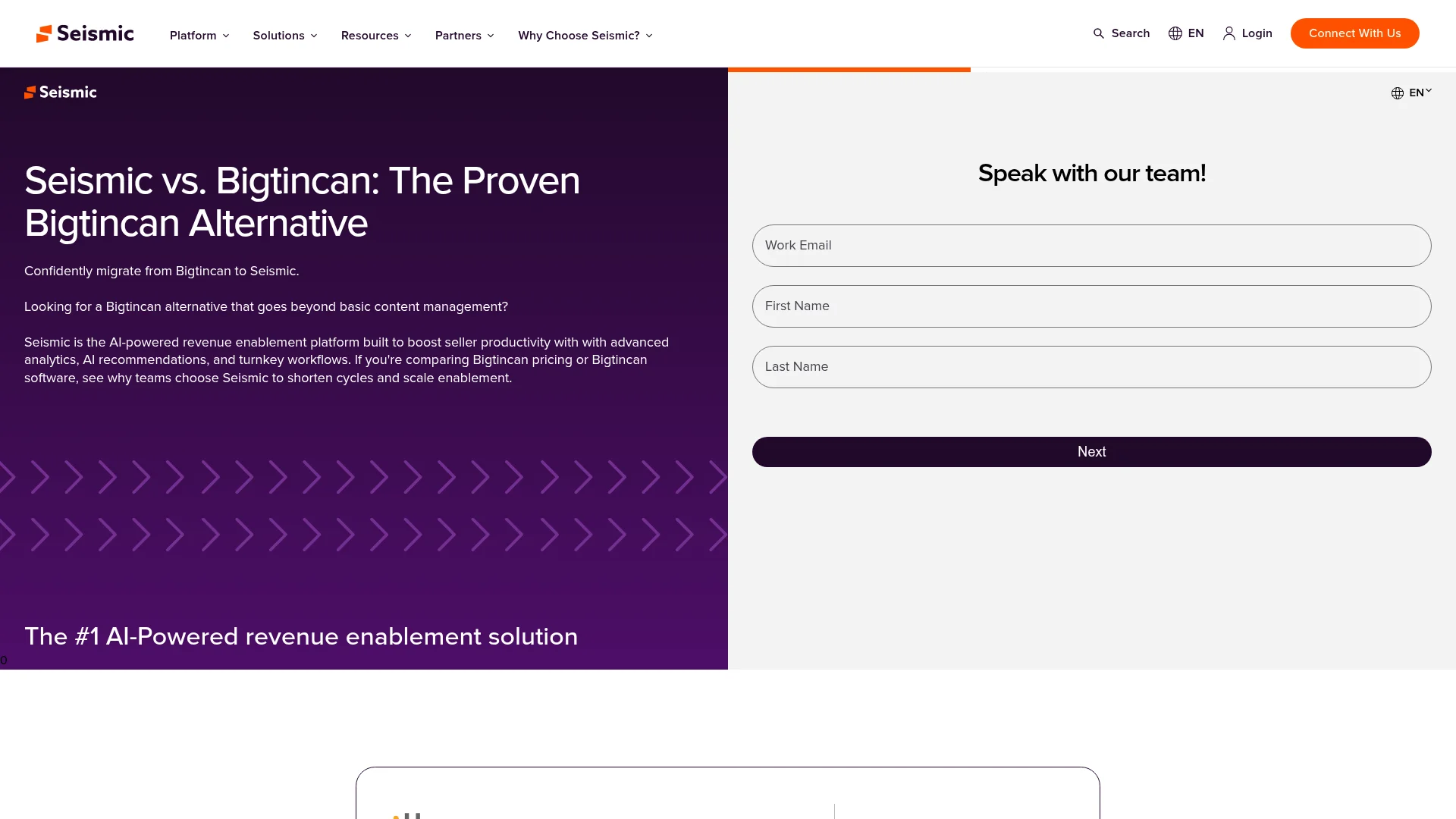
Platform, Products & Solutions (~237 Pages) Platform overview, product modules, feature pages, solution pages by team and use case, demo and contact pages, partner program pages, and the small set of competitor-alternative pages (Bigtincan, Showpad). The conversion-stage product surface that buyers reach after the editorial and gated-asset funnels do their work. Page titles consistently lead with "AI-Powered" framing, applying the same vocabulary-staking move visible in the editorial AI cluster to the conversion-stage product surfaces. The presence of multiple demo URLs (book-a-demo, exchange-demo, get-a-demo) suggests A/B-tested entry points rather than path consolidation, and the comparison footprint is notably small for a category leader (only 8 URLs across two canonical comparisons).
Sample pages:
- Bigtincan Alternative for Modern Sales Teams | Seismic
/bigtincan-alternative/ - Get your Personalized Demo | Seismic
/book-a-demo/ - Contact Us | Seismic Sales Enablement
/contact/ - Get your Personalized Demo | Seismic
/exchange-demo/
Press Releases & Corporate News (~108 Pages) Press releases covering quarterly product launches, executive hires and leadership changes, awards and analyst recognition (Forbes Cloud 100, G2 Best Software), and corporate milestones including the Seismic-Highspot merger announcement. The PR layer of activity that originates elsewhere (product launches, analyst recognitions, executive hires). The exception is the Seismic-Highspot merger announcement, which signals the most material competitive event in the sales enablement category in this cycle. Each executive hire announcement also functions as a recruiting-brand signal: prospective senior hires read these pages when researching the leadership team.
Sample pages:
- Seismic Press Releases, Media Coverage & Media Kit | Seismic
/newsroom/ - Seismic Pressemitteilungen, Medienberichte & Media Kit
/de/newsroom/ - Communiqués de presse, mentions médias et kit de communication Seismic | Seismic
/fr/newsroom/ - Press Releases
/newsroom/press-releases/
Company Pages, Legal & Navigation (~445 Pages) About, leadership team, founding-story, trust, careers, legal agreements, terms, privacy, and top-level navigation hubs and index pages. Required corporate documentation, recruiting surface, and navigation infrastructure for a multi-locale enterprise platform operating across jurisdictions. The volume (445 URLs) reflects the multi-locale and multi-product-line legal surface area enterprise SaaS requires, along with the navigation hubs and stray utility pages that accumulate inside a 3,954-page site.
Sample pages:
- #1 Global Sales Enablement Platform | Seismic
/
Strategy insight: This is the largest non-foundations cluster by URL count (790) and the most utility-heavy: 64% Other content type. The competitive comparison pages footprint stands out as the most actionable gap: only two canonical comparison pages (Bigtincan, Showpad) for a category-leading library. Direct peers run displacement campaigns against Seismic using "Seismic alternatives" and "Seismic vs X" terms, and owning a wider set of canonical comparison pages would be a low-effort defensive move. The Seismic-Highspot merger announcement inside the press-release micro-topic is also the most consequential single page in the cluster: combining Seismic's content footprint (3,954 URLs, 10 clusters, 3 locales) with Highspot's would materially reshape the competitive set's scale comparisons.
Key Observations
What Stands Out About Seismic's Content Strategy
The library is a breadth-play, not a flagship-led bet
Seismic operates 10 topic clusters with no single cluster exceeding 21% of the library and no two clusters combining to exceed 41%. Blog / Editorial leads the format mix at 37.5%, but no content type reaches 40% share. This is the architecture of a mature category leader. Rather than concentrating around one wedge format or one flagship asset, the engine produces enough content across enough surfaces to occupy every reasonable search the buyer might run. The trade-off shows up in per-page authority. The same posture that captures breadth also dilutes the focus that would drive per-URL traffic efficiency above the moderate 19 visits per page Seismic currently shows.
Two compounding evidence assets carry the structural moat
Research Reports & Analyst Recognition (281 URLs) and Customer Success Stories (267 URLs) together account for 548 URLs that newer entrants cannot replicate quickly. The Research cluster combines first-party franchises (State of AI in Enablement, Generation Enablement Report, HBR Pulse) with third-party placements (Forrester Wave, IDC MarketScape, quarterly G2 Grids), while the Customer Stories cluster names Oracle, IBM, Ameriprise Financial, Experian, Illumina, and Salesloft. Brand recognition, analyst relationships, and named customer logos compound across years in a way that content velocity alone cannot, which is what gives this library its real competitive durability.
The Lessonly acquisition still defines the second-biggest cluster
The 569-URL Training, Coaching & Service Enablement cluster carries the visible editorial residue of the 2021 Lessonly deal: 268 Glossary / Definitions URLs spread across program design, coaching, and L&D theory, plus a 102-URL customer service and call-center training sub-theme that targets an audience distinct from Seismic's primary sales enablement ICP. Strategically, this is back-link equity and historical authority preserved. Tactically, the question is whether the legacy training and contact-center content still pulls qualified traffic for Seismic's revenue enablement story, or whether some portion functions as inherited drag worth pruning to lift overall per-URL efficiency.
Comparison-page investment is light for a category leader
Only 8 comparison pages exist across the 3,954-URL library: two canonical comparisons (Bigtincan, Showpad) mirrored across four locales. For a market leader of this scale, that is a modest defensive footprint. Direct peers run displacement campaigns against Seismic using "Seismic alternatives" and "Seismic vs X" terms, and the long-tail surface that ranking for those queries would defend is wider than the two-comparison footprint currently covers. A canonical comparison library against the full peer set (Highspot, Mindtickle, Showpad, Allego, Bigtincan, Guru) would be a low-effort, high-impact defensive expansion.
23.3% top-10 share signals an actionable authority gap
Seismic's 4,939 ranking positions skew toward the long tail: only 23.3% sit in the top 10, materially lower than category leader Highspot at 55.7% or second-strongest peer Showpad at 41.7%. The most actionable layer is the 831 positions in 11-20, the optimization sweet spot where content already on Google's first or second page could be pushed onto page one with focused work. The deeper 1,693 positions in 21-50 represent a refresh-or-retire decision. A position-by-position content audit of the 831 page-2 URLs would likely surface 100-200 pages where targeted optimization could deliver outsized traffic lift relative to producing new content.
AI is being treated as a category-shaping editorial bet, not just product copy
141 dedicated AI pages (90% editorial) make AI a deliberately structured content category rather than scattered product messaging. The agentic-AI sub-theme is still small at 10 URLs, but the conceptual frontier (agentic AI as autonomous workflow operator, the agentic revenue organization frame) is where Seismic is trying to stake vocabulary before competitors settle on it. The most actionable gap inside the cluster is the AI definitional layer: only 14 Glossary URLs cover terms like "what is agentic AI for sales" and "what is an agentic revenue organization," AEO surfaces where Seismic has the authority to win but currently has only minimal structured definitional coverage.
Locale duplication nearly doubles the apparent library size
Of the 3,954 total pages, only 2,028 are unique en-US root URLs (51.3%); the remaining 1,926 are translations or regional variants. For benchmarking against single-locale peers like Dock, Mindtickle, or SalesHood, the practical comparison base is closer to the en-US figure. The German and French libraries are roughly symmetrical (within 0.1% of each other) and together account for nearly half of all indexable pages, both appearing to mirror a substantial portion of the en-US root content rather than functioning as smaller curated selections. The strategic question is whether the full mirroring justifies the production overhead, or whether selective translation of high-intent pillars would deliver similar local discoverability at a fraction of the cost.
The /uk and /resources URL prefixes carry path-overload sitemap issues
995 URLs sit under /uk spanning 10 different content types and all 10 clusters. Another 240 URLs sit under /resources spanning 6 content types across 4 clusters. Stacking different content jobs (blog posts, guides, research reports, events, glossary) under the same path namespace dilutes search engines' understanding of section authority and complicates URL-based crawl prioritization. Splitting these into dedicated paths (/uk/blog/, /uk/guides/, /uk/case-studies/, and so on) would be a sitemap-clarity improvement that lifts how cleanly authority signals propagate within each section.
More analyses in Sales Enablement
Showpad
How Showpad uses 398 blog posts, 457 expert profiles, and 61 case studies to drive 25K monthly visits in sales enablement. 1,511 pages, 7 clusters.
Allego
How Allego uses 590 blog posts, 297 guides, and a 71-episode podcast to drive 11K monthly visits in sales enablement. 1,261 pages, 7 clusters.
Bigtincan
How Bigtincan uses 276 blog posts, a 23-episode podcast, and a GenieAI editorial line to drive 15K monthly visits in sales enablement. 850 pages, 6 clusters.
Dock
How Dock uses a 514-URL Grow & Tell podcast and a curated sales-collateral library to drive 45K monthly visits in revenue enablement. 1,203 pages, 6 clusters.
Methodology: This analysis is based on Seismic's full public sitemap (3,954 URLs, sourced from robots.txt), enriched with each URL's title and meta description via lightweight HTTPS fetches. URLs were classified into a 12-bucket content type taxonomy and grouped into 10 topic clusters with 30 micro-topics using LLM-assisted classification. Company facts came from public web research across Crunchbase, LinkedIn, Tracxn, and the company's own About, newsroom, and blog pages. Traffic metrics (monthly organic visits, traffic value, ranking positions, position distribution) came from DataForSEO's domain rank overview, aggregated globally across 94 locale combinations. All counts reflect the Seismic sitemap as of 2026-05-22.