
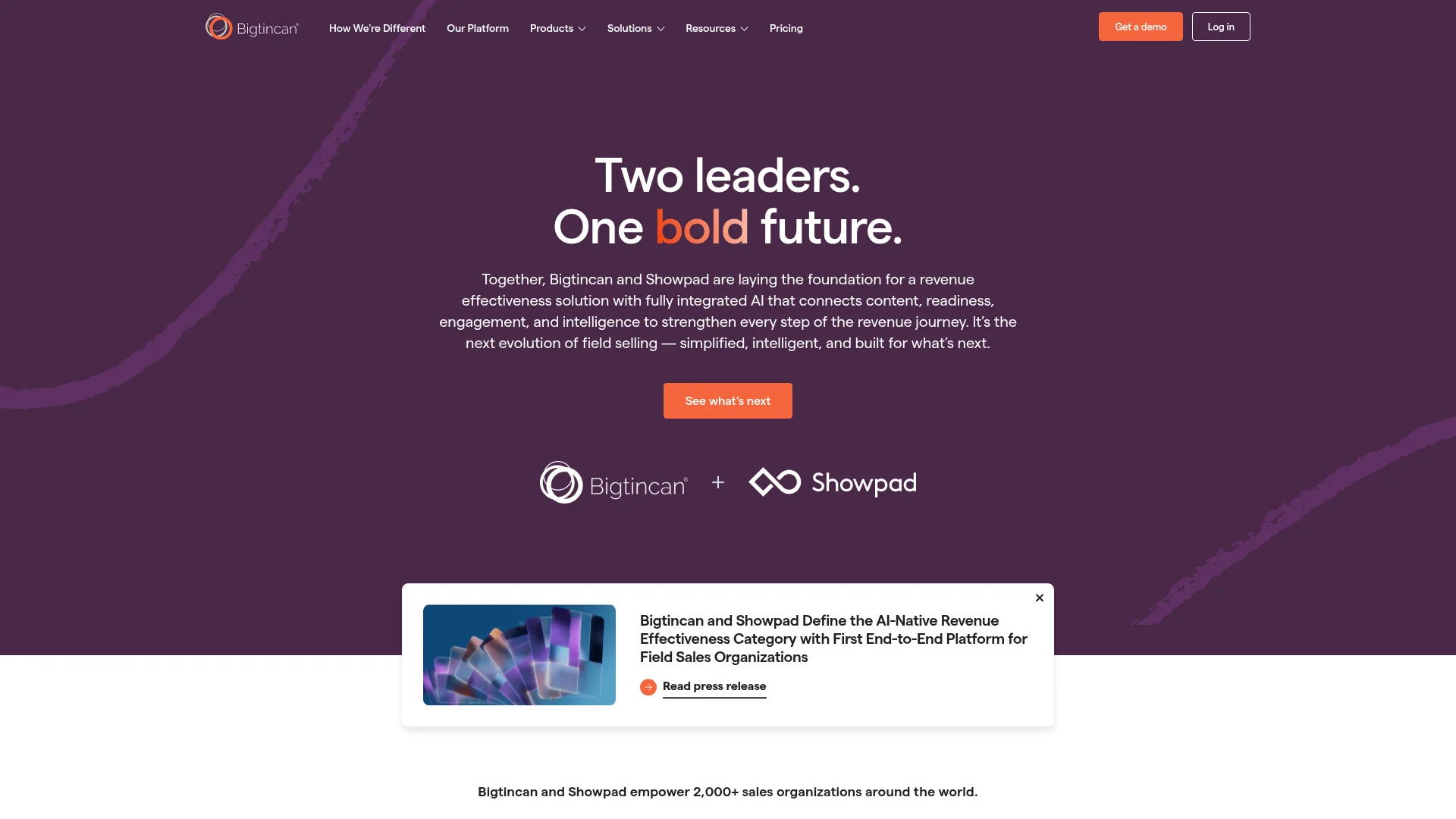
Summary
Bigtincan drives 15,476 monthly organic visits from a library structured around operational infrastructure rather than a flagship editorial franchise. 850 indexable pages split into 6 topic clusters under a tightened taxonomy. The two largest clusters (Sales Content, Engagement & Verticals at 20.0% and AI, Readiness, Training & Podcast at 19.5%) together account for 39.5% of every URL, leaving the structural backbone distributed across an Integration Partners & Channel Network catalog (152 URLs), the Product Pages, Stories & Operations footprint (144 URLs), and a sizable press archive split between first-party releases (106 URLs) and external recognition (112 URLs). Per-URL efficiency at ~18 visits per page matches Highspot's despite a library one-fifth the size.
Key facts:
- Library size: 850 indexable pages organized into 6 topic clusters; 40.4% Other (utility/structural), 32.5% Blog/Editorial
- Largest cluster: Sales Content, Engagement & Verticals (170 URLs, 20.0% of library)
- Flagship content asset: Enablement Uncanned Podcast, 23 numbered episodes on sales enablement practice, plus the GenieAI editorial line covering five named AI sub-products (Genie Assistant, RolePlayAI, SearchAI, AuthoringAI, CoachingAI)
- Search performance: 15.5K monthly visits across 1,401 ranking positions; 28.3% in top 10 (vs Highspot's 55.7% category-leader benchmark); ~18 visits per URL
- Notable gap: Zero Free Tools, only 2 Guides & Resources, 6 Research/Reports with no detected annual-series marker. Utility, lead-magnet, and compounding-research surfaces are all under-invested
Company Overview
Bigtincan at a Glance
| Company | Bigtincan (Bigtincan Holdings Limited) |
| Founded | 2011 · Boston, MA, USA (originated in Sydney, Australia) |
| Category | Sales Enablement / Revenue Enablement |
| What They Do | Bigtincan is a SaaS revenue enablement platform spanning three product pillars (Readiness, Content, Engagement) plus the GenieAI suite for AI-driven assistance, coaching, and content authoring. Their audience covers mid-market and enterprise customer-facing teams in regulated and field-selling industries. Named customers include Nike, AT&T, Merck, Prudential, Thermo Fisher Scientific, and Guess. |
| Funding | $49.2M raised across public-market rounds while listed on the ASX; acquired by Vector Capital in April 2025 for A$183M (~$117M USD), taking the company private |
| Headcount | 300-500 (LinkedIn band) |
| Monthly Organic Visits | Traffic Value (PPC equiv.) | Ranking Positions |
|---|---|---|
| 15.5K | $57,574 | 1.4K |
Ranking positions reflect total positions across 55 indexed (location, language) combinations, not unique keywords.
Bigtincan's content operation is structurally balanced rather than editorially-led. 850 indexable pages distribute across an integration partner and channel catalog (152 URLs), a product and operational footprint (144 URLs), two press clusters (218 URLs combined between first-party releases and external recognition), and two editorial clusters that carry most of the search-intent content. The library reflects a company that has focused on ecosystem breadth, with 53 software integration pages, 26 device and identity integration pages, 23 technology alliance pages, 26 consulting and sales training partner pages, and a 24-URL reseller and distributor network. The April 2025 acquisition by Vector Capital is the most recent strategic context. The company is now private, and the publishing patterns visible in the sitemap reflect the pre-acquisition cadence.
Content Architecture
What Does Bigtincan's Content Engine Look Like?
Bigtincan's main website hosts 850 indexable pages organized into six topic clusters. The architecture is a balanced-mix library where no single content type dominates above 40%, and where no two clusters together exceed 40% of the library either.
Content Type Distribution
| Content Type | Count | Share | Notes |
|---|---|---|---|
| Other | 343 | 40.4% | Partner pages, integrations, legal, utility. The structural backbone |
| Blog / Editorial | 276 | 32.5% | Bulk of the editorial layer; concentrated in /resources/ |
| Product & Feature Pages | 120 | 14.1% | Product, solutions, "Why Bigtincan," and industry landing pages |
| Events / Webinars / Sessions | 29 | 3.4% | Conference and event-specific landing pages |
| Podcast / Audio Series | 23 | 2.7% | Enablement Uncanned podcast episodes |
| Case Studies / Customer Stories | 22 | 2.6% | Named customer success pages |
| Glossary / Definitions | 16 | 1.9% | "What is X" definitional content. Thin for a category-leading library |
| Comparison Pages | 13 | 1.5% | Direct vs and alternatives content. Thin coverage |
| Research / Reports | 6 | 0.7% | No detected annual-series marker (no State-of-X franchise) |
| Guides & Resources | 2 | 0.2% | Materially under-invested at 2 URLs |
| Free Tools | 0 | 0.0% | Not present in sitemap. No calculators, templates, or interactive utilities |
| Documentation | 0 | 0.0% | Not present in main sitemap (developer/support docs live off-site) |
Key finding: The library follows a breadth-play pattern. The top two clusters (Sales Content, Engagement & Verticals at 20.0% and AI, Readiness, Training & Podcast at 19.5%) jointly carry 39.5% of URLs, with the remaining four clusters (Integration Partners & Channel Network, Product Pages, Stories & Operations, Press Releases & Corporate News, External Recognition & Media Coverage) carrying 60.5%. Investment is spread across many topics rather than concentrated in a single flagship.
Content Strategy Archetype
Bigtincan operates a product-anchored, press-archived library with a layered editorial supplement. The primary structural surfaces are the Integration Partners & Channel Network catalog (152 URLs), the Product Pages, Stories & Operations footprint (144 URLs), and two press clusters (Press Releases & Corporate News at 106 URLs plus External Recognition & Media Coverage at 112 URLs). On top of that sits a focused editorial layer organized around two clusters: Sales Content, Engagement & Verticals (170 URLs, anchored by the /what-is-X/ definitional pillars) and AI, Readiness, Training & Podcast (166 URLs, including the GenieAI editorial line, the coaching and training content, the LMS-era readiness layer, and the Enablement Uncanned podcast). The archetype favors ecosystem signal and corporate continuity over the editorial-cadence pattern visible at Highspot (53% editorial) or Mindtickle (58% editorial).
Search Performance Quality
Where Bigtincan Ranks
The DataForSEO domain rank overview shows Bigtincan ranking in 1,401 positions across 55 locale combinations. The distribution is broad-and-shallow rather than top-heavy, with a long tail in positions 21-100.
| Position | Count | Share |
|---|---|---|
| #1 | 53 | 3.8% |
| #2–3 | 87 | 6.2% |
| #4–10 | 256 | 18.3% |
| #11–20 | 286 | 20.4% |
| #21–50 | 479 | 34.2% |
| #51–100 | 240 | 17.1% |
28.3% of Bigtincan's ranking positions are in the top 10, meaningfully lower than category leader Highspot at 55.7%, closer to mid-pack peers like Mindtickle (23.8%) and Seismic (23.3%). The interesting figure is the 286 positions sitting in ranks 11-20. That's 20.4% of the library on page two of Google, the highest-leverage optimization slot. Focused work on those URLs (refreshing titles, deepening content, adding internal links) could push a meaningful share into top-10 visibility.
Per-URL traffic efficiency is moderate at ~18 visits per page, identical to Highspot's despite a library one-fifth the size. Total traffic comes from steady per-page performance across a smaller library rather than from a thin-but-broad ranking footprint or a few breakout assets.
Content Deep Dive
What Is Bigtincan Actually Publishing, and How?
Bigtincan's content organizes around six primary topic clusters. Each cluster is described below with content-type composition, the micro-topics inside it, and concrete example URLs drawn from the bigtincan.com sitemap. Cluster and micro-topic groupings reflect a per-URL classification of the full sitemap. Counts are exact, not approximate.
1. Integration Partners & Channel Network
Pages: 152 · Share of library: 17.9%
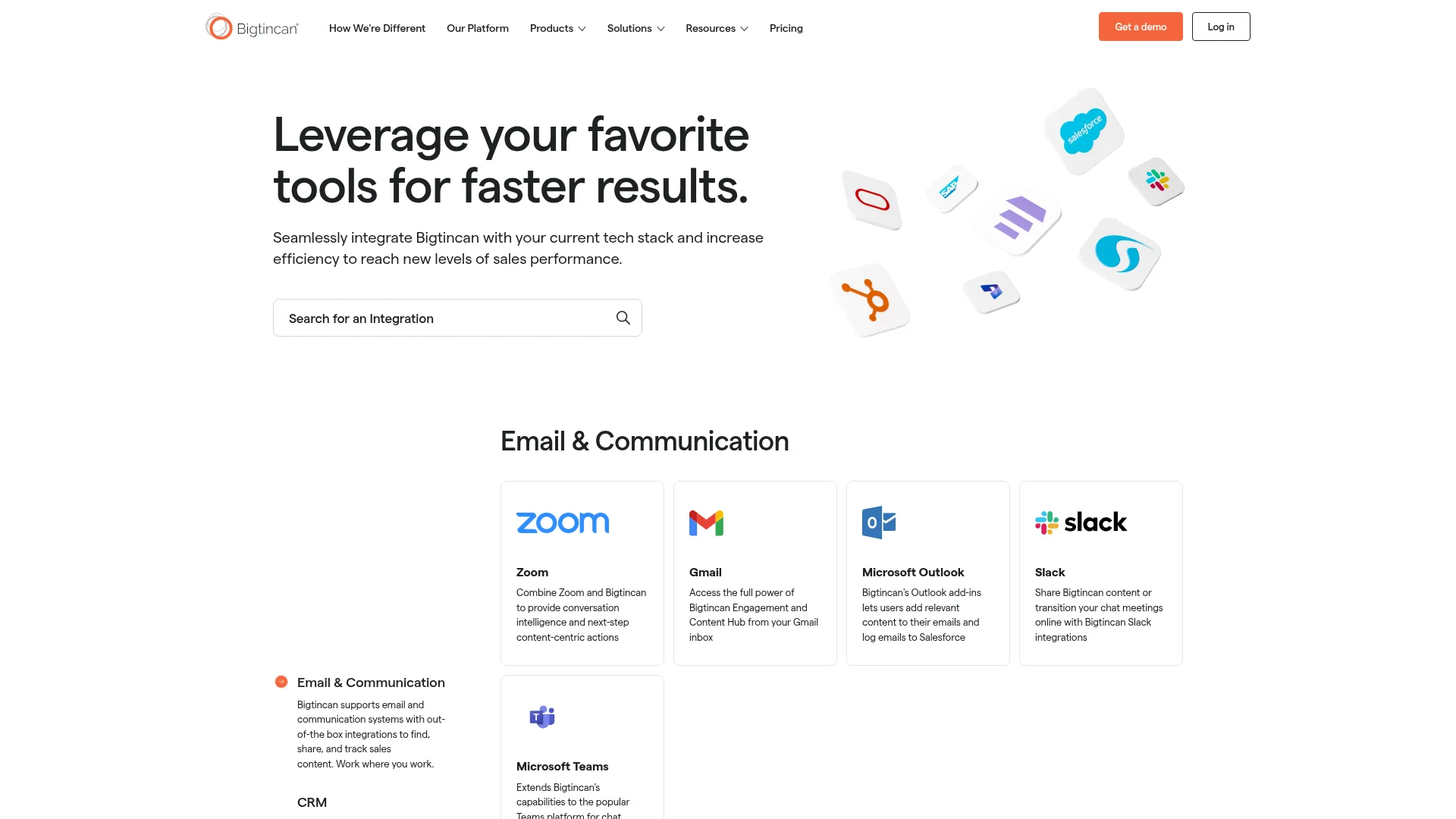
Page-per-partner catalog covering software integrations and the channel reseller, technology alliance, and consulting partner directories. Bigtincan publishes 152 dedicated partner pages, the structural ecosystem signal that anchors how enterprise procurement evaluates platform breadth. The cluster splits roughly evenly between software integrations (79 URLs across /integrations/) and the channel partner directory (73 URLs across /company/partners/). Each integration and each partner gets its own URL rather than being collapsed into a single page, which gives every named partner its own ranking surface and signals ecosystem depth to evaluators.
Content-type mix: Product & Feature Pages 52% · Other 48%
Micro-topics within this cluster
Integrations – Software & SaaS Tools (~53 Pages) Integration partner pages for sales, productivity, and content systems including Salesforce, HubSpot, Outreach, Salesloft, Gong, SAP, Oracle, Microsoft 365, Google Workspace, Zoom, Slack, Box, Dropbox, and the Adobe suite. The page-per-vendor architecture turns every well-known SaaS brand name into its own ranking surface. Evaluators searching "[vendor] sales enablement integration" can land on a Bigtincan-owned page rather than a third-party listing, and the breadth signals that Bigtincan slots into whatever stack a buyer already runs.
Sample pages:
- Industry-Leading Sales Enablement Integrations /integrations/
- Salesforce | Bigtincan /integrations/salesforce/
- Adobe Acrobat | Bigtincan /integrations/adobe-acrobat/
- Zoom | Bigtincan /integrations/zoom/
Integrations – Device, Identity & Learning (~26 Pages) Integration pages covering mobile device management, identity providers, operating systems, and learning management systems. Examples include Jamf, Intune, SimpleMDM, Hexnode, Okta, Ping Identity, Microsoft Active Directory, iOS, Android, and Cornerstone. This is an enterprise IT readiness sub-catalog, distinct from the sales and productivity integrations above. Publishing dedicated pages for MDM and identity providers signals that Bigtincan operates in regulated and field-selling environments where device governance and identity controls matter as much as the sales features.
Sample pages:
- Microsoft Intune | Bigtincan /integrations/microsoft-intune/
- Azure Active Directory | Bigtincan /integrations/active-directory/
- Jamf | Bigtincan /integrations/jamf/
- Okta | Bigtincan /integrations/okta/
Technology Alliance Partners (~23 Pages) Partner profile pages for technology vendors and platform alliances including Microsoft, Salesforce, AWS, Apple, IBM, Adobe, Oracle, SAP, Citrix, Samsung, VMware, Marketo, Gong, HubSpot, Salesloft, and Matterport. These are named co-selling and co-marketing relationships, separate from the integrations catalog because they reflect joint go-to-market rather than just a technical hook. The /company/partners/[vendor] pattern doubles as a credibility signal for procurement evaluators reviewing platform-alliance depth.
Sample pages:
- Adobe | Bigtincan /company/partners/adobe/
- AWS | Bigtincan /company/partners/aws/
- IBM | Bigtincan /company/partners/ibm/
- Microsoft | Bigtincan /company/partners/microsoft/
Consulting & Sales Training Partners (~26 Pages) Implementation, consulting, and sales training partner profiles including Accenture, Force Management, Challenger, Sandler, Baker Communications, DSG, 2Win, Ashfield, and several boutique enablement consultancies. The directory underscores a consulting-led implementation motion: large platforms ship faster when systems integrators carry the deployment work, and named sales-training methodologies (Challenger, Sandler, Force Management) embedded as partners means Bigtincan can plug into the methodology layer rather than competing with it.
Sample pages:
- Accenture | Bigtincan /company/partners/accenture/
- Challenger | Bigtincan /company/partners/challenger/
- Sandler | Bigtincan /company/partners/sandler/
- Force Management | Bigtincan /company/partners/force-management/
Reseller & Distributor Network (~24 Pages) Telco, distributor, and reseller partner profiles including AT&T, Verizon, Optus, Singtel, Telefonica, FedEx, Stratix, CDW, Insight, and Connection. A global reseller footprint historically tied to Bigtincan's mobile-first roots: distributors and telcos carried Bigtincan into enterprise field-sales accounts during its early Sydney years and continue to anchor non-US enterprise distribution. Few sales enablement competitors publish a directory at this depth on the channel side, and the structural choice reads as a legacy of carrier-driven enterprise mobility distribution.
Sample pages:
- World-Class Sales Enablement Partner Network /company/partners/
- AT&T | Bigtincan /company/partners/att/
- Optus | Bigtincan /company/partners/optus/
- Singtel | Bigtincan /company/partners/singtel/
Strategy insight: The cluster's structural weight (152 URLs, 17.9% of library) is explained by Bigtincan's choice to keep ecosystem signals visible at the page level rather than collapsing them into a single overview. Page per integration, page per technology alliance, page per consulting partner, page per reseller. The pattern shows up in the press archive as well, where the "Bigtincan Exceeds 100 Technology Integrations" release is the marketing claim and this 152-URL catalog is the on-site proof. Few category competitors carry a partner directory this deep, which makes it one of Bigtincan's most defensible architectural moats. The natural extension would be a comparable depth on the comparison pages side: each named partner is one ranking surface, and each named competitor could be another.
2. Product Pages, Stories & Operations
Pages: 144 · Share of library: 16.9%
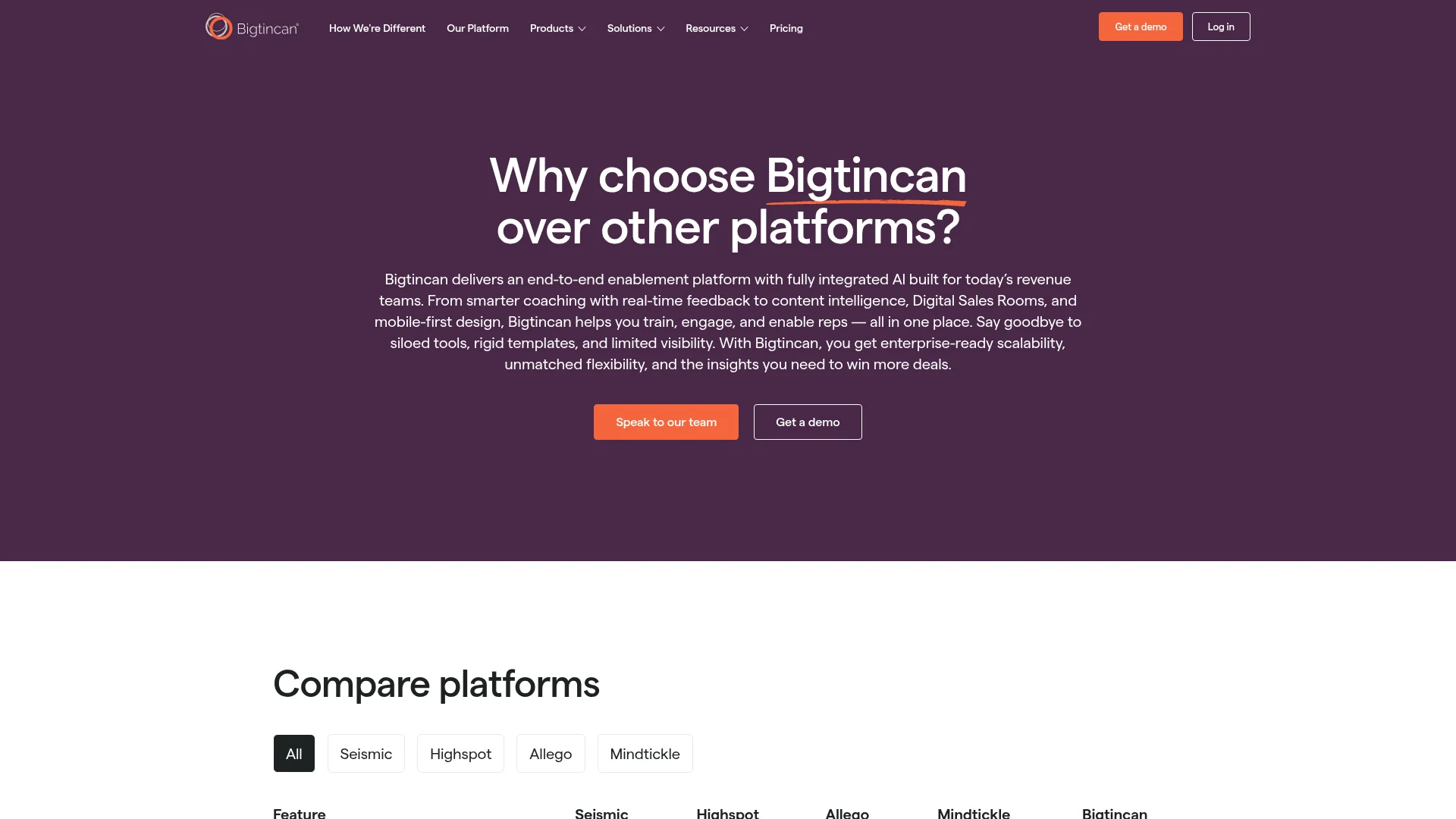
Core product, solution, and "Why Bigtincan" pages alongside customer stories, industry landing pages, event landing pages, and the legal and corporate footprint. This is the operational and conversion-funnel backbone of bigtincan.com, what every visitor and every evaluator lands on outside the resource library and outside the press archive.
Content-type mix: Other 36% · Product & Feature Pages 28% · Events 20% · Case Studies 15%
Micro-topics within this cluster
Product & Feature Pages (~42 Pages) Core product, platform, feature, "Why Bigtincan," and industry-vertical landing pages including the homepage, /compare/, /content/, /difference/, /why-bigtincan/, /solutions/, and the /industries/ directory across eight named verticals. The product surface area is bounded and clean: each of the three product pillars (Readiness, Content, Engagement) has its own page-tree, and the /difference/ page anchors the differentiation argument. The /industries/ directory adds nine industry landing pages covering financial, energy, government, retail, manufacturing, life sciences, and contact-center use cases.
Sample pages:
- Industry Leading Sales Enablement Solutions /
- Compare | Bigtincan /compare/
- Modern Sales Content Management Software /content/
- How We're Different /difference/
Customer Stories & Case Studies (~22 Pages) Named customer success pages under /customer-stories/, covering enterprise wins across pharma, manufacturing, financial services, and field-selling verticals. Bigtincan's case-study library is mid-pack for the category, meaningfully smaller than Highspot's 343-URL or Seismic's 267-URL case-study franchises, but larger than smaller peers like SalesHood (20) or Allego (17). The mid-tier volume reflects the company's enterprise-vertical positioning: case studies are produced for named-brand wins but not industrialized into a templated case-study factory.
Sample pages:
- Sales Enablement Case Studies - All Industries /customer-stories/
- AFCO | Bigtincan /customer-stories/afco/
- Jasper Engines | Bigtincan /customer-stories/jasper-engines/
- Peterson Manufacturing | Bigtincan /customer-stories/peterson-manufacturing/
Events & Conferences (~29 Pages) Event landing pages for Forrester B2B Summit (multiple years, multiple versions), NRF, and other conference appearances, plus on-demand webinar pages. The duplicated event pages (2023 and 2024 versions of the Forrester B2B Summit) suggest the same event gets new URLs each year rather than the existing page being refreshed in place. That generates URL accumulation over time but means individual event pages lose freshness signal between years.
Sample pages:
- Forrester B2B Summit - 2023 /forrester-b2b-summit-2023/
- Forrester B2B Summit - 2024 /forrester-b2b-summit-2024/
- On-Demand: Busting the Empowered Buyer Myth: Gain Your ContentRev Advantage /resources/on-demand-busting-the-empowered-buyer-myth-gain-your-contentrev-advantage/
- On-Demand: Strategies for Getting to the Ultimate Decision Maker /resources/on-demand-strategies-for-getting-to-the-ultimate-decision-maker/
Legal, Policy & Corporate Pages (~51 Pages) Privacy, terms, EULA, security, AI governance, contact, pricing, careers, investor, and newsroom-index pages. Standard B2B SaaS footprint with one distinctive entry: the Artificial Intelligence Governance Charter at /artificial-intelligence-governance-charter/. Few sales enablement platforms publish a standalone AI governance document; doing so signals to enterprise procurement teams that AI use is structurally governed rather than ad-hoc. The /company/investors/ URL is a holdover from the pre-2025 ASX-listed era; with the company now private (Vector Capital, April 2025), this page's purpose has likely shifted from investor relations to historical disclosure.
Sample pages:
- Artificial Intelligence Governance Charter /artificial-intelligence-governance-charter/
- Acceptable Use Policy /acceptable-use-policy/
- About Us /company/
- Newsroom /company/newsroom/
Strategy insight: The cluster's 144 URLs do conversion-funnel work rather than search-traffic work. Product pages, case studies, and event landing pages are designed for evaluators already comparing platforms; they don't carry editorial-stage search intent the way the /resources/ and /what-is-X/ surfaces do. The Artificial Intelligence Governance Charter is a distinctive procurement-trust signal that most competitors don't publish at all, and it sits inside the legal footprint rather than the editorial AI cluster. That placement is deliberate: a governance charter alongside the privacy policy and acceptable use policy reads as a binding internal commitment, not a marketing post about AI safety.
3. Press Releases & Corporate News
Pages: 106 · Share of library: 12.5%
First-party press releases announcing product launches, partnerships, customer wins, acquisitions, executive hires, financial results, and corporate milestones. A 14-year archive of own-narrative press content accumulated across an ASX-listed era and a string of six named acquisitions (Brainshark, ClearSlide, Agnitio, AsdeqLabs, FatStax, Contondo).
Content-type mix: Other 100%
Micro-topics within this cluster
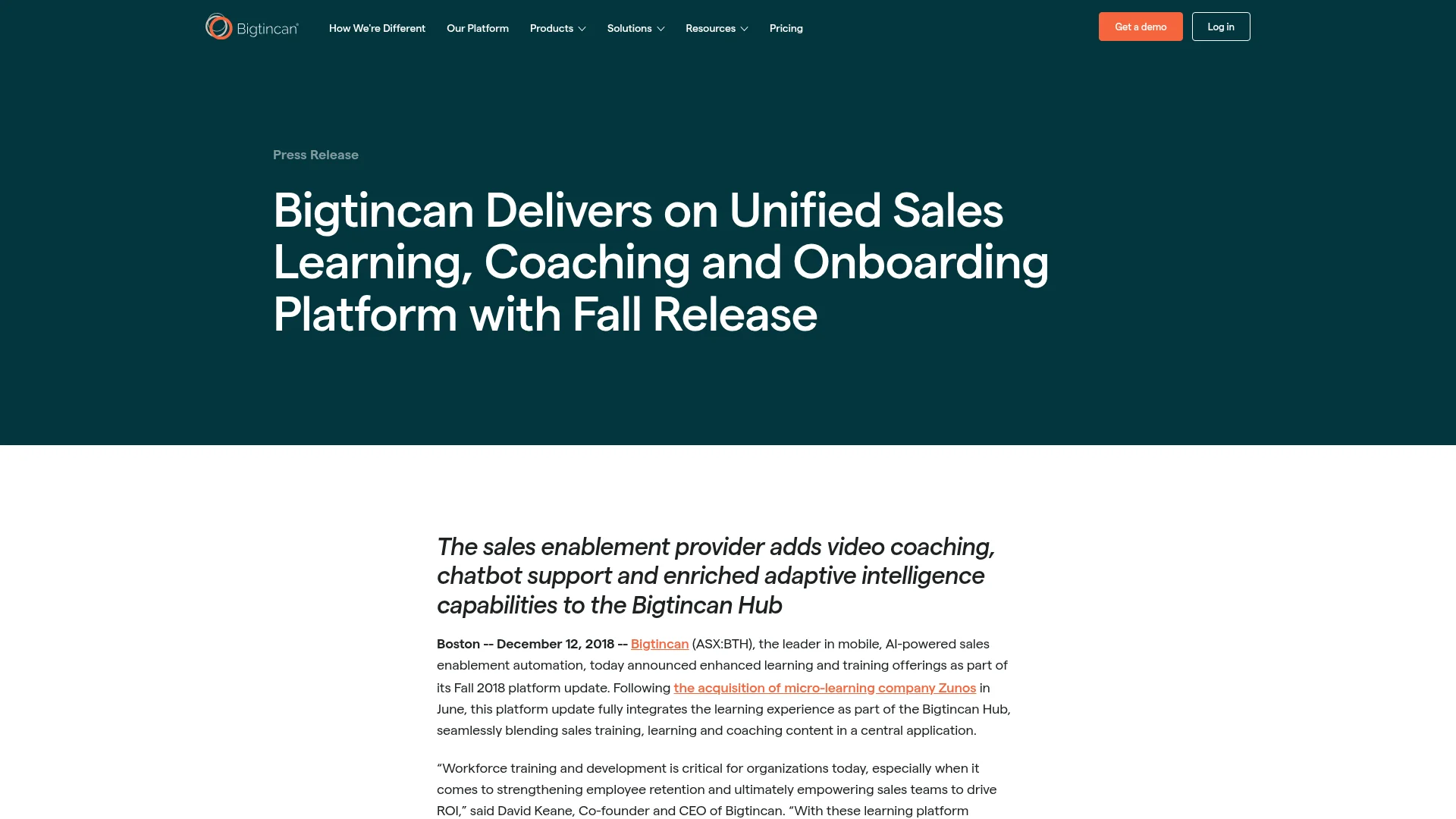
Product Launch Press Releases (~29 Pages) Announcements of platform updates, GenieAI releases, seasonal Spring and Fall releases, and new feature debuts. Titles include "Bigtincan Delivers on Unified Sales Learning, Coaching and Onboarding Platform with Fall Release," "Bigtincan Unveils Next Generation Enterprise Content Solution for Mobile Devices," and "Bigtincan Unveils New App for Microsoft SharePoint." The seasonal release-cadence pattern (Spring Release, Fall Release) is the same publication-style rhythm visible at large enterprise vendors. Each release also doubles as integration-keyword SEO for the named technologies.
Sample pages:
- Bigtincan Delivers on Unified Sales Learning, Coaching and Onboarding Platform with Fall Release /company/press-releases/2018-bigtincan-fall-release/
- Bigtincan Announces Acquisition of Sales AI Technology Innovator Contondo /company/press-releases/bigtincan-acquisition-innovator-contondo/
- Bigtincan Unveils Next Generation Enterprise Content Solution for Mobile Devices /company/press-releases/bigtincan-solution-mobile-devices/
- Press Releases /company/press-releases/
Partnership & Customer Announcements (~18 Pages) Announcements of new partnerships, integration milestones, channel deals, customer wins, and acquisition-driven product additions. Titles include "Bigtincan Exceeds 100 Technology Integrations," "Bigtincan Secures $5 Million in Series A Funding," and "Bigtincan Signs Definitive Agreement to Acquire Brainshark." Funding and acquisition announcements sit alongside customer wins (Telefonica, Hologic, ReachLocal) and partner deals (Aruba WorkSpace). The partnership archive traces Bigtincan's six-acquisition history and is the layer of the press archive that carries the M&A narrative.
Sample pages:
- Bigtincan Exceeds 100 Technology Integrations, with Popular Products Being Used Across the Enterprise /company/press-releases/bigtincan-100-technology-integrations/
- Bigtincan Signs Definitive Agreement to Acquire Brainshark /company/press-releases/bigtincan-acquires-brainshark/
- Telefonica Selects Bigtincan hub to Boost Field Force's Productivity /company/press-releases/telefonica-selects-bigtincan-hub-to-boost-field-forces-productivity/
- Hologic Selects bigtincan to Fuel Productivity of Growing Sales Force /company/press-releases/hologic-bigtincan-productivity-growing-sales/
Corporate & Financial Announcements (~18 Pages) Executive hires, financial results, capital raises, going-private milestones, and ASX-era investor communications. Bigtincan was ASX-listed until April 2025, so the corporate-news archive is unusually deep for a private SaaS peer set. The acquisition trail is particularly visible here: ClearSlide, FatStax, AsdeqLabs, Agnitio. Each acquisition typically generates 2-3 press URLs (the announcement, the close, the integration milestone).
Sample pages:
- Bigtincan Acquires ClearSlide to Create Industry's Only End-to-End Sales Enablement and Engagement SaaS Offering /company/press-releases/bigtincan-acquires-clearslide/
- Bigtincan Acquires FatStax to Create New Platform to Tie Sales Enablement and Salesforce.com Data together /company/press-releases/bigtincan-acquires-fatstax-sales-enablement/
- Bigtincan Takes Aim at Revenue Enablement with AsdeqLabs Acquisition /company/press-releases/asdeqlabs-acquisition/
- Bigtincan Acquires Agnitio Adding e-Detailing and Compliant Digital Sales Room Capabilities /company/press-releases/bigtincan-acquires-agnitio/
Corporate Press Release Archive (~41 Pages) Older partnership news, customer-interaction milestones, content-usage milestones, and naming announcements that pre-date the current release cadence. Includes the early Series A funding release, the Box partnership announcement, the 10-million-content-interactions milestone, and country-specific expansion releases (Scotland, Japan). Press URLs accumulate over a 14-year corporate history. Older pieces are kept indexed rather than removed to preserve back-link equity from years of media pickup and analyst citation.
Sample pages:
- Acorda Prescribes bigtincan hub to Field Sales Team to Enhance Content Control and Administration /company/press-releases/acorda-bigtincan-enhance-content/
- Announcing Bigtincan hub for Box /company/press-releases/announcing-bigtincan-hub-for-box/
- Bigtincan hub Powers More Than 10 Million Content Interactions in 2015 /company/press-releases/bigtincan-10-million-interactions-2015/
- Bigtincan Develops Presence in Japan /company/press-releases/bigtincan-develops-presence-in-japan/
Strategy insight: First-party press at 106 URLs (12.5% of library) is unusually deep for a private SaaS peer set. The depth comes from three structural factors: a 14-year corporate history, the ASX-listed years that required regulatory disclosure for material announcements, and an acquisition cadence (six named acquisitions visible in this cluster alone) that generates multiple press URLs per deal. The April 2025 Vector Capital acquisition will likely add a new release wave to this cluster over time. The press archive is essentially write-once-decay-slowly; its purpose is to preserve corporate-history evidence and back-link equity rather than to capture fresh search intent.
4. External Recognition & Media Coverage
Pages: 112 · Share of library: 13.2%
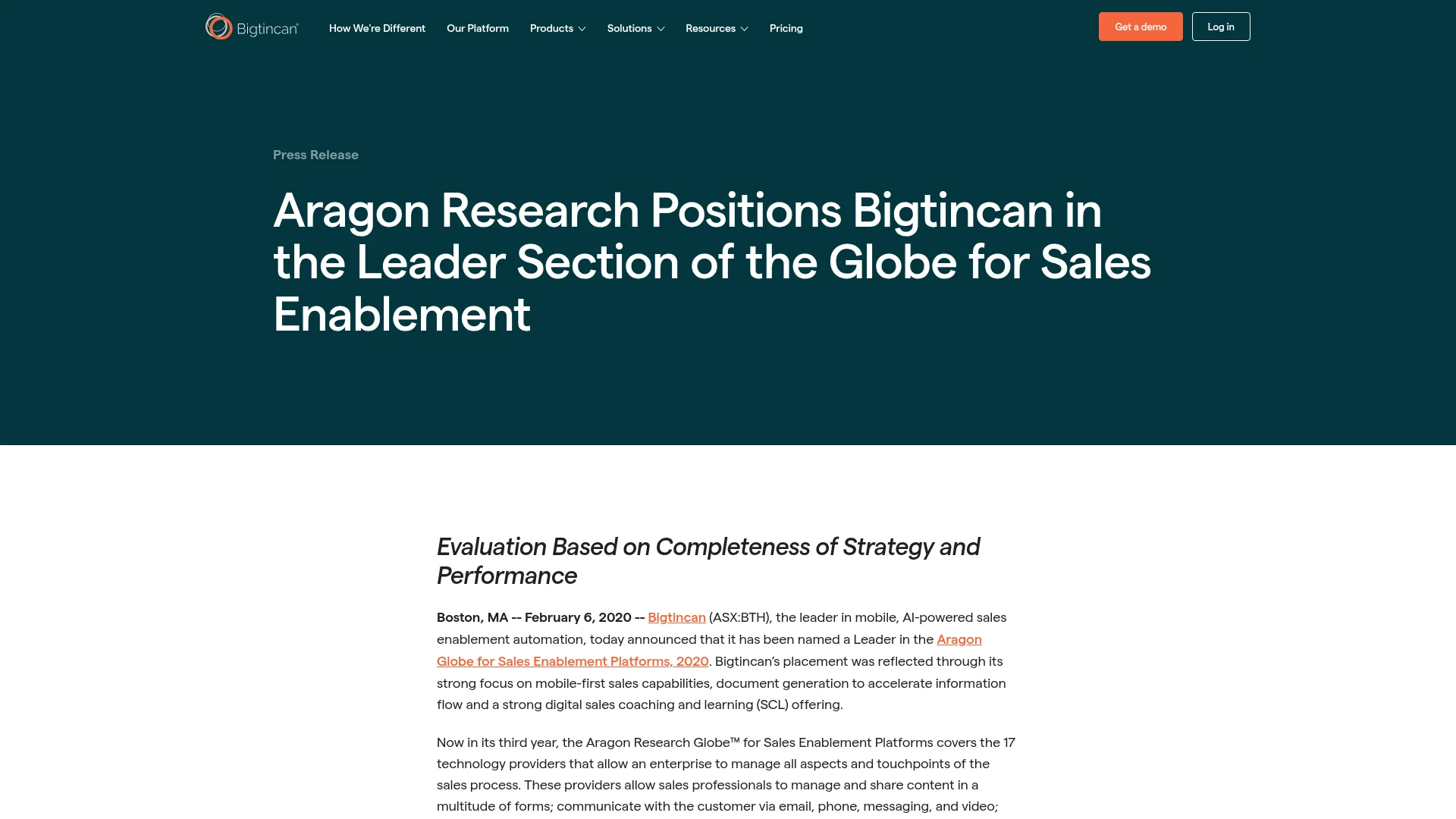
Analyst recognition, industry awards, third-party media coverage, and external feature articles that build procurement-stage credibility. A layered third-party validation record that procurement teams reference when shortlisting enterprise sales enablement platforms. Distinct from the first-party press cluster because the validation comes from outside Bigtincan, even when the announcement is written as a Bigtincan-owned press release.
Content-type mix: Other 100%
Micro-topics within this cluster
Analyst Recognition & Industry Awards (~63 Pages) Press releases announcing recognition from Aragon Research, Gartner, Forrester, and industry award programs across multiple years. Titles include "Aragon Research Positions Bigtincan in the Leader Section of the Globe for Sales Enablement," "Bigtincan Recognized in Seven of Analyst Firm's Hype Cycle Reports," "Bigtincan hub named 'Best of 2014' in the Mobile Star Awards," and "Bigtincan Recognized by CRN as a 2014 Emerging Vendor." Awards content compounds in a specific way: each one becomes a permanent third-party validation signal that survives competitive cycles. Bigtincan's analyst-recognition strategy is particularly heavy. Aragon, Gartner, and Forrester references repeat across years, building a layered analyst-validation record that procurement teams can lean on.
Sample pages:
- Aragon Research Positions Bigtincan in the Leader Section of the Globe for Sales Enablement /company/press-releases/aragon-positions-bigtincan-leader-section-globe-sales-enablement/
- Bigtincan Recognized in Seven of Analyst Firm's Hype Cycle Reports /company/press-releases/bigtincan-recognized-in-seven-of-analyst-firms-hype-cycle-reports/
- Bigtincan hub named "Best of 2014" in the Mobile Star Awards /company/press-releases/bigtincan-2014-mobile-star-awards/
- Bigtincan Recognized by CRN as a 2014 Emerging Vendor /company/press-releases/bigtincan-recognized-crn-emerging-vendor/
Third-Party Media Coverage (~49 Pages) Aggregated external press features and interviews collected under /company/in-the-news/. These pages tend to have minimal on-page content (most are titled simply "Bigtincan" with no descriptive headline) and serve primarily as link-equity preservation for external coverage. The volume of 49 distinct in-the-news URLs suggests Bigtincan has historically focused on maintaining an indexed record of press mentions, which is more common at public companies (Bigtincan was ASX-listed until April 2025) than at private peers.
Sample pages:
- In The News (Hub) /company/in-the-news/
- 4 ways to connect with customers in the metaverse /company/in-the-news/4-ways-to-connect-with-customers-in-the-metaverse/
- AI used as a training tool to help improve employees' pitches /company/in-the-news/ai-used-as-a-training-tool-to-help-improve-employees-pitches/
- Automation tools for sales teams /company/in-the-news/automation-tools-for-sales-teams/
Strategy insight: External Recognition & Media Coverage at 112 URLs (13.2% of library) functions as the procurement-trust layer. Awards and analyst recognition are the most durable content Bigtincan publishes because they don't decay with editorial freshness cycles; a 2018 Gartner mention still helps a 2026 procurement evaluation. The 63-URL awards collection is the strongest signal in this cluster, with Aragon, Gartner, and Forrester references repeating across years to build the kind of layered analyst-validation record that maps cleanly to E-E-A-T signals for AI-engine citation. The 49 in-the-news URLs are less searchable on their own but preserve the link equity from years of media pickup, particularly during Bigtincan's ASX-listed period when material coverage was a disclosure obligation.
5. Sales Content, Engagement & Verticals
Pages: 170 · Share of library: 20.0%
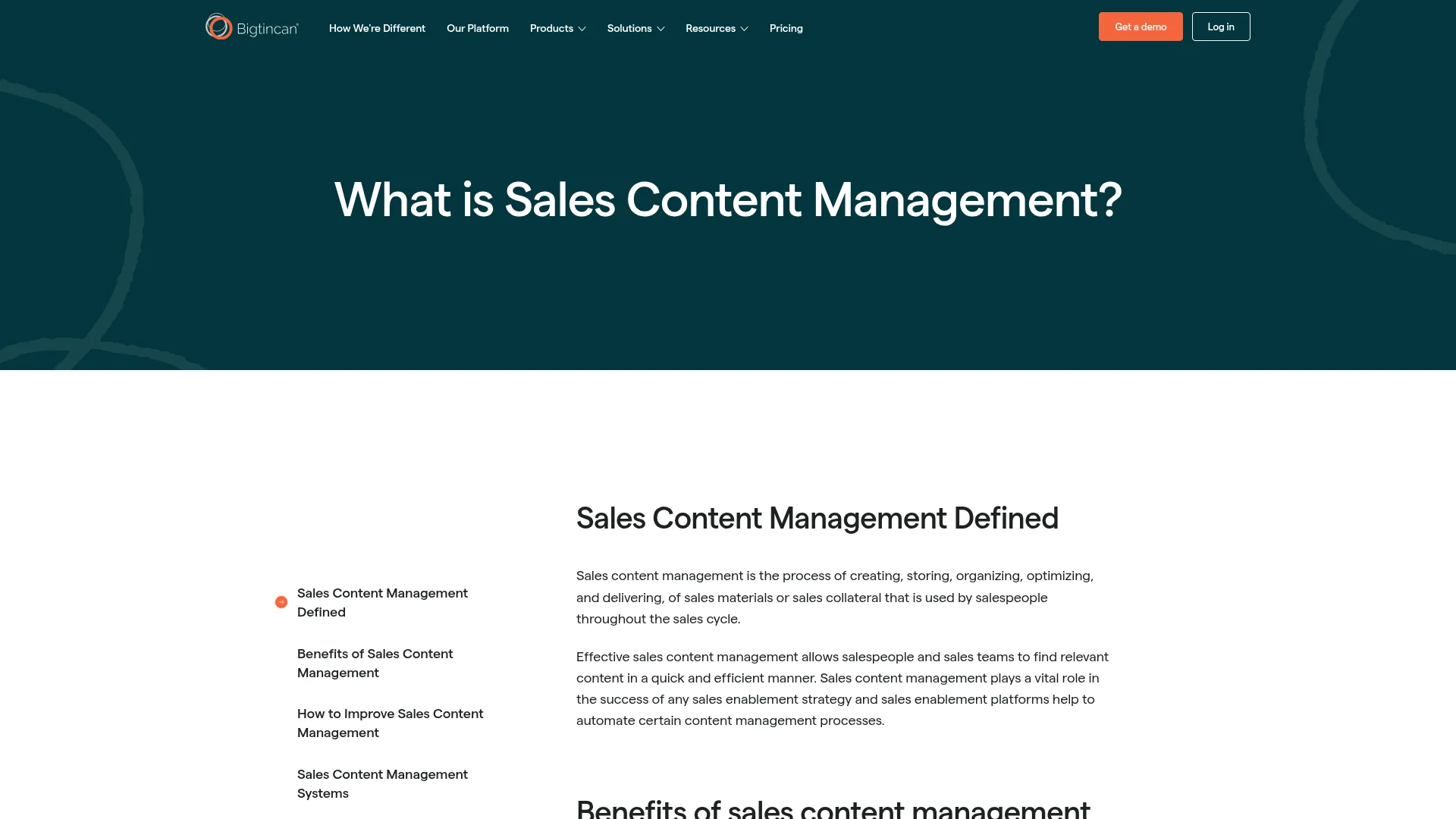
Editorial content on sales content management, buyer engagement, digital sales rooms, sales–marketing alignment, vertical industry plays, and competitor comparisons. The largest cluster and the editorial heart of the resource library, covering the content and engagement product pillars, the eight verticals Bigtincan targets, and the competitive comparison surface.
Content-type mix: Blog/Editorial 85% · Comparison Pages 8% · Glossary 6% · Guides & Resources 1%
Micro-topics within this cluster
Sales Content Management Strategy (~62 Pages) The cluster's largest sub-theme. Content governance, content ops, findability, content analytics, and the /what-is-X/ definitional pillars on revenue enablement, sales content management, sales enablement software, and channel sales enablement. The "/what-is-X/" URL pattern is the strongest AEO surface in the library: each page targets a definitional query that AI engines (ChatGPT, Perplexity, Google AI Overviews) frequently pull from. With 62 URLs covering the definitional layer for content-management-adjacent terms, this is the sub-theme Bigtincan is most clearly trying to win on traditional search.
Sample pages:
- What is sales content management? A complete overview /what-is-sales-content-management/
- What is revenue enablement? Definition, KPIs, Best Practices /what-is-revenue-enablement/
- What is Sales Enablement software? A complete overview [2024] /what-is-sales-enablement-software/
- What is Channel Sales Enablement? A Complete Guide [2023] /what-is-channel-sales-enablement/
Content Ops & Sales–Marketing Alignment (~36 Pages) Document automation, presentation management, sales–marketing alignment plays, and content-operations how-tos for revenue teams. Includes "4 Areas Where Sales and Marketing Can Work in Harmony," "Content Curation Between Sales and Marketing: The Missing Link," and CMO-targeted insights on proving marketing value. The "insight to action" naming pattern repeats across multiple posts, suggesting an editorial series structure. The CMO-targeted framing widens TOF capture by reaching marketing-leader search alongside the cluster's primarily sales-leader audience. Also home to legacy sports-metaphor and current-events posts ("Apple Launches New Hardware") that don't ladder into a named product narrative but accumulated across earlier editorial cycles.
Sample pages:
- 4 Areas Where Sales and Marketing Can Work in Harmony /resources/4-areas-where-sales-and-marketing-can-work-in-harmony-ng/
- What is Document Automation? A Complete Overview /what-is-document-automation/
- Sales Presentations: How Much Control Should Marketing Give? /resources/sales-presentations-how-much-control-should-marketing-give/
- Apple Launches New Hardware – What it Means for Business /resources/apple-launches-new-hardware-what-it-means-for-business/
Buyer Engagement & Digital Sales Rooms (~19 Pages) Buyer journey content, digital sales room playbooks, prospect engagement, and extended-reality immersive selling experiences. Titles include "What is Remote Selling?", "The best sales touchpoints to improve your buyer's journey," "Best digital sales rooms for 2025," "8 Digital Sales Room best practices to turn browsers into buyers," and a string of AR/VR/XR posts about immersive buying experiences. The XR content reflects Bigtincan's earlier strategic positioning around mobile-first, immersive selling experiences inherited from its Sydney mobile-app roots; keeping it indexed preserves the surface area without active investment. The DSR sub-theme is structurally light despite being a topical-authority opportunity, particularly compared to Dock's 1,200+ URL library built around DSR vocabulary.
Sample pages:
- What is Remote Selling? /what-is-remote-selling/
- 8 Digital Sales Room best practices to turn browsers into buyers /resources/digital-sales-room-best-practices/
- The best sales touchpoints to improve your buyer's journey /resources/best-sales-touchpoints-to-improve-buyers-journey/
- Augmented and Virtual Reality is Taking the Buying Experience of the Future to the Next Level /resources/augmented-virtual-reality-taking-the-buying-experience-of-future-to-next-level-ng/
Vertical & Industry Content (~30 Pages) Industry-specific editorial across Life Sciences and pharma e-detailing, retail enablement, manufacturing and channel sales, financial services, and contact-center use cases. Examples include "What is e-detailing?", "10 things better pharma digital communication can improve for HCPs," "Building digital engagement skills in pharma," "Augmented reality in manufacturing has become serious business," "Retail Secrets to Training and Retaining a Multigenerational Workforce," and "Transforming the In-branch Banking Experience with Sales Enablement." The Life Sciences vertical is materially better-represented than any other industry, reflecting Bigtincan's historical strength in pharma (the Agnitio acquisition added e-detailing and compliant DSR capabilities specifically for this vertical). The e-detailing content is particularly distinctive; most general sales enablement platforms don't go that deep into compliance-driven HCP engagement vocabulary.
Sample pages:
- What is e-detailing? Advantages for Pharma Marketers /what-is-e-detailing/
- How Abbott prepares, upskills, and continuously improves their customer-facing teams /resources/how-abbott-prepares-upskills-continuously-improves-customer-facing-teams/
- Retail Secrets to Training and Retaining a Multigenerational Workforce /resources/retail-secrets-training-retaining-multigenerational-workforce/
- Transforming the In-branch Banking Experience with Sales Enablement /resources/transforming-in-branch-banking-experience-with-sales-enablement/
Comparisons, Alternatives & Tool Reviews (~23 Pages) Direct competitor vs pages, alternatives listicles, sales tech roundups, and concept-vs-concept explainers. Includes "Bigtincan Learning vs MindTickle vs Allego," "Bigtincan Engagement Hub vs Outreach vs Salesloft," "Gong vs Chorus vs VoiceVibes," and "Lessonly vs Saleshood vs Bigtincan Learning vs Brainshark." The three-way comparison format (rather than 1:1) is the dominant pattern, which is unusual. Most comparison-page strategies in sales enablement use direct head-to-head pages because they target cleaner "X vs Y" search queries. The three-way format trades search-intent precision for editorial credibility; "here's how three tools compare" reads as more balanced than "here's why we beat them." Also includes alternatives-listicle plays against general-purpose storage tools (Dropbox, Google Drive) that target buyers whose current setup is file-storage-plus-email rather than a sales enablement platform.
Sample pages:
- Bigtincan Learning (Previously Zunos) vs MindTickle vs Allego: An In-Depth Sales Readiness Platform Comparison /resources/bigtincan-learning-vs-mindtickle-vs-allego/
- Gong vs. Chorus vs. VoiceVibes - How conversational intelligence tools benefit Bigtincan customers /resources/gong-vs-chorus-how-conversational-intelligence-tools-benefit-bigtincans-customers/
- 5 best Dropbox alternatives for enterprise teams in 2025 /resources/dropbox-alternatives/
- 5 Leading Enterprise File Sync and Share Providers /resources/enterprise-file-sync-and-share/
Strategy insight: The Sales Content Management Strategy sub-theme (62 URLs, including the /what-is-X/ definitional pillars) is the cluster's commercial anchor and the most search-intent-aligned content surface in the library. The Life Sciences vertical content is the strongest defensible position underneath it, with e-detailing and HCP-engagement vocabulary specialist enough that few general enablement competitors can match it. The 23-URL Comparisons sub-theme is the cluster's weakest layer, sitting well under the 30-URL threshold for a category-leading comparison library. Trainual (45 comparison pages) and Dock (38) both invest more heavily despite being smaller or newer companies. The three-way vs-page format is the most distinctive structural choice; it trades brand-vs-brand search precision for editorial fairness, but it leaves direct displacement queries undefended.
6. AI, Readiness, Training & Podcast
Pages: 166 · Share of library: 19.5%
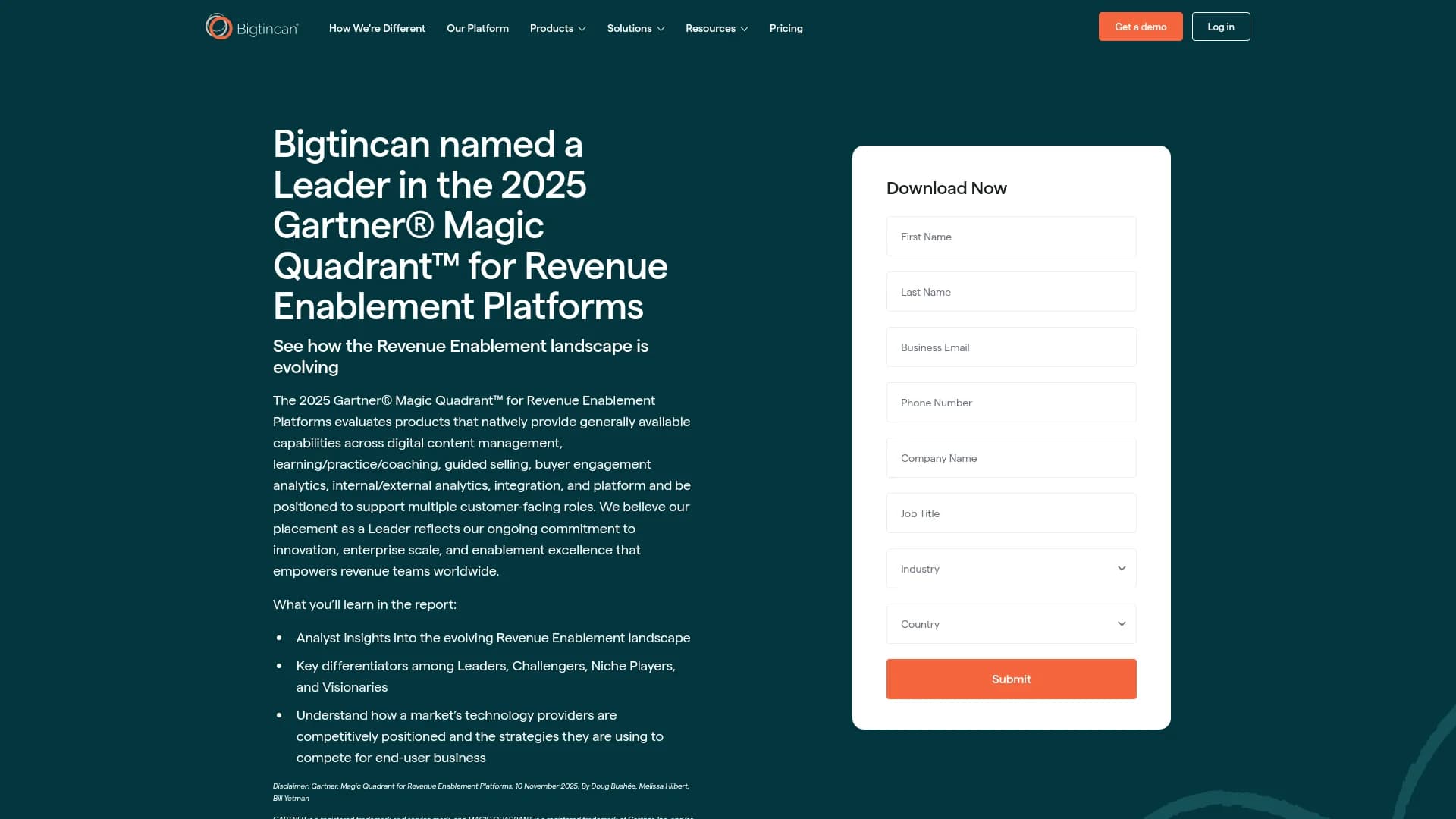
Editorial and product-anchored content on GenieAI sub-products, sales coaching and training, onboarding and learning platforms, AI-augmented readiness, and the Enablement Uncanned podcast. Bigtincan's combined readiness pillar and AI editorial layer, the post-2023 content investment that ties product capability (RolePlayAI, CoachingAI, AuthoringAI) to enablement practice. The second-largest cluster and the editorial layer where Bigtincan is most clearly trying to claim category vocabulary before competitors settle on it.
Content-type mix: Blog/Editorial 79% · Podcast 14% · Glossary 4% · Research/Reports 4%
Micro-topics within this cluster
GenieAI Product Family Content (~38 Pages) Editorial content on Genie Assistant, SearchAI, AuthoringAI, and the broader GenieAI suite, plus analyst-aligned positioning content including Gartner Magic Quadrant and Aragon Research Globe coverage and definitional pieces on enablement AI. Bigtincan uses product-launch content to define each GenieAI sub-product as a separate addressable surface, mirroring how enterprise software vendors structure their AI announcements. The analyst-aligned content (Gartner, Aragon) does dual work: building procurement-stage credibility for evaluators who require third-party validation, while also providing back-link bait that compounds over multiple analyst-citation cycles. The naming consistency (every sub-product gets the "Genie" prefix) creates branded search volume competitors can't compete for directly.
Sample pages:
- 2025 Gartner® Magic Quadrant™ for Revenue Enablement Platforms /resources/2025-gartner-magic-quadrant-revenue-enablement-platforms/
- What is sales enablement AI? /resources/what-is-sales-enablement-ai/
- AI for customer success teams: How to use GenieAI to improve your CSMs' performance /resources/ai-for-customer-success-teams/
- AI content authoring software: a guide for overworked revenue enablement teams /resources/ai-content-authoring-software/
AI Prompts & Persona Playbooks (~24 Pages) Persona-segmented "AI prompts for [role]" series for enablement managers, marketers, sellers, and contact-center agents. Titles include "10 AI prompts for enablement managers," "10 AI prompts for marketers," "7 AI content creation tools every marketer needs to try in 2025," and posts on contact-center AI use cases. The "AI prompts for [persona]" format is a deliberate top-of-funnel SEO play targeting practitioners searching for tactical AI guidance, with each post serving as both keyword bait and a lead-into-product narrative. Splitting the audience by function (enablement vs marketing vs sales vs contact-center) doubles the keyword surface without doubling the production overhead.
Sample pages:
- 10 AI prompts for enablement managers that help boost and prove enablement ROI /resources/ai-prompts-for-enablement-managers/
- 7 AI content creation tools every marketer needs to try in 2025 /resources/ai-content-creation-tools-for-marketers/
- Using generative AI in sales /resources/using-generative-ai-in-sales/
- Different types of AI tools for sales and marketing teams /resources/ai-tools-for-sales-and-marketing/
Coaching, Training & AI-Augmented Readiness (~63 Pages) The cluster's largest sub-theme. Sales coaching practice, training program design, RolePlayAI and CoachingAI use cases, Scorecards-driven coaching, role-play exercises, and Brainshark-branded readiness content. Includes "Coaching Effectiveness Across an Organization," "Introducing Actions for Scorecards," "How Readiness Scorecards put your data in coachable context," "Coaching AI: How this virtual teammate upgrades sales training at scale," "5 Ways Sales Readiness is Critical to Growth | Brainshark | Bigtincan," and "6 sales role play exercises to try with your reps." The recurring Scorecards emphasis is product-adjacent (Bigtincan ships a Scorecards feature inside Readiness) and the editorial drumbeat is calibrated to reinforce the product narrative. The Brainshark name still appears in many titles even though the product has merged into Bigtincan Readiness; that's an intentional choice to preserve back-link equity from years of Brainshark-branded content rather than 301-redirecting it all into rebranded equivalents.
Sample pages:
- 5 Ways Sales Readiness is Critical to Growth /resources/5-ways-sales-readiness-critical-growth/
- The Business Case and Playbook for Data-Driven Sales Coaching /resources/data-driven-sales-coaching-ebook/
- Introducing Actions for Scorecards: Automate learning paths and follow-up while keeping content fresh /resources/actions-for-scorecards/
- 6 sales role play exercises to try with your reps /resources/6-sales-role-play-exercises-try-your-reps/
Onboarding, Ramp & Learning Platforms (~18 Pages) New-seller onboarding, time-to-competency, ramp reduction, enterprise LMS content, microlearning, and Brainshark-era learning-platform positioning. Titles include "The Blueprint for Better Sales Onboarding," "Time to competency in sales onboarding," "Sales Onboarding: What to do When it's Not Working," "18 Indicators you could benefit from a modern sales learning platform," and "5 ways enablement teams can use Bigtincan every day." The LMS-positioning content extends the Brainshark learning-platform footprint into territory adjacent to but distinct from sales enablement, which means Bigtincan competes for evaluators comparing learning platforms separately from enablement platforms.
Sample pages:
- The Blueprint for Better Sales Onboarding /resources/blueprint-for-better-sales-onboarding/
- Sales Onboarding: What to do When it's Not Working /resources/sales-onboarding-what-to-do-when-its-not-working/
- 18 Indicators you could benefit from a modern sales learning platform /resources/18-indicators-you-could-benefit-from-a-modern-sales-learning-platform/
- 5 ways enablement teams can use Bigtincan every day to save time and get better results /resources/bigtincan-features-for-enablement-managers/
Enablement Uncanned Podcast Episodes (~23 Pages) Numbered episodes of the Enablement Uncanned interview podcast on sales enablement practice with practitioners and leaders. Each episode lives on its own URL under /resources/. The episodes are numbered rather than themed in their URL slugs (episode-one, episode-eight, episode-eighteen, episode-fifteen), suggesting a chronological release pattern rather than a thematic taxonomy. 23 episodes is a modest serialized investment, substantially smaller than Highspot's 208-episode Win-Win Podcast or Dock's 533-URL Grow & Tell Podcast cluster.
Sample pages:
- Enablement Uncanned - Episode One /resources/enablement-uncanned-episode-one/
- Enablement Uncanned - Episode Eight /resources/enablement-uncanned-episode-eight/
- Enablement Uncanned - Episode Eleven /resources/enablement-uncanned-episode-eleven/
- Enablement Uncanned - Episode Eighteen /resources/enablement-uncanned-episode-eighteen/
Strategy insight: AI, Readiness, Training & Podcast at 166 URLs (19.5% of library) reads as a deliberate land-grab for category vocabulary while the broader market is still figuring out terminology. GenieAI is treated as a content category and a product family at the same time, with each sub-product (Genie Assistant, RolePlayAI, SearchAI, AuthoringAI, CoachingAI) anchoring its own content surface. The strongest pattern is the persona-segmented "AI prompts for [role]" series, a TOF SEO surface that doubles as product-trial bait, and the 38-URL GenieAI sub-theme that bundles analyst-validation content alongside the product-launch and definitional layers. The structural weakness underneath the cluster is the still-thin definitional layer for AI-enablement terms; at 166 cluster pages, Bigtincan has the editorial authority to anchor a deeper content audit of "what is X" pages on AI-enablement vocabulary, but the current count of definitional URLs sits well below what the editorial volume could support. The Enablement Uncanned podcast at 23 episodes is the cluster's modest serialized asset, with the numbered (rather than themed) URL pattern making individual episodes harder to discover via search than peers running larger audio franchises.
Key Observations
What Stands Out About Bigtincan's Content Strategy
The library is breadth-played, not flagship-led
Bigtincan's top two clusters (Sales Content, Engagement & Verticals at 20.0% and AI, Readiness, Training & Podcast at 19.5%) together carry 39.5% of URLs. No single cluster passes 20.1%, and no two clusters jointly exceed 40%. Investment is spread across many topics rather than concentrated in flagships. Most peers in the category (Highspot, Mindtickle, Seismic) lead with a single dominant editorial cluster or a research franchise. Bigtincan instead distributes weight evenly across an ecosystem catalog, a product/operations footprint, two press archives, and two editorial clusters.
Integration and partner catalog at 152 URLs is the structural differentiation
53 software integrations, 26 device and identity integrations, 23 technology alliance partners, 26 consulting and sales training partners, and 24 reseller and distributor profiles. The 152-URL catalog is page-per-partner architecture rather than collapsed ecosystem content, which gives every named partner its own ranking surface and signals depth to procurement teams. The "Bigtincan Exceeds 100 Technology Integrations" press release is the marketing claim; this 152-URL catalog is the on-site proof. Few sales enablement competitors carry a partner directory at this depth, which makes it one of Bigtincan's most defensible architectural moats.
Per-URL traffic efficiency matches the category leader despite a 5x smaller library
At ~18 visits per page across 850 URLs, Bigtincan's per-URL efficiency matches Highspot exactly (18 visits/page across 4,752 URLs). Both companies have similar single-page authority. Highspot's 5x traffic lead comes from library volume, not per-page performance. This means Bigtincan's individual content investments compete on equal footing. The gap is volume, not quality. Doubling library size at the current efficiency would produce ~30K monthly visits.
The optimization sweet spot is 286 positions in ranks 11-20
20.4% of Bigtincan's 1,401 ranking positions sit on the second page of Google (ranks 11-20). Focused work on those URLs (refreshing titles, deepening content, adding internal links) is the highest-leverage move available because page-two-to-page-one is where each rank gained delivers the largest traffic increase. Compared to the 28.3% already in top-10, this is a ~1.7x amplification opportunity that doesn't require new content production.
No annual research franchise, a missing compounding asset
6 URLs classified as Research/Reports, with no detected annual-series marker. Bigtincan does not publish a State-of-Sales-Enablement, Generative-AI-in-Sales-Benchmark, or comparable annual research franchise. Category leaders use these multi-year research assets as backlink magnets, sales-team ammunition, and editorial-cluster anchors. Highspot's State of Sales Enablement runs back to 2017; Seismic publishes a Generative AI in Enablement Benchmark. Bigtincan has the customer base (Nike, AT&T, Merck) to produce a defensible annual research piece. The absence is a strategic gap rather than a capability gap.
GenieAI is treated as a category-capture move
The AI, Readiness, Training & Podcast cluster's GenieAI sub-theme (38 URLs) bundles product-launch content, analyst-aligned positioning, and definitional pieces under five named sub-products: Genie Assistant, RolePlayAI, SearchAI, AuthoringAI, CoachingAI. Each gets its own editorial micro-topic, which builds branded search volume Bigtincan owns by definition. The naming consistency (every product gets the "Genie" or "AI" suffix) is the structural play. Competitors can't compete for "GenieAI" or "RolePlayAI" search terms. 166 total URLs across the broader AI/readiness cluster reads as a deliberate land-grab for category vocabulary while the broader market is still figuring out AI-enablement terminology.
Comparison-page coverage is thin for a category challenger
13 comparison pages (1.5% of library, classified into the Comparisons sub-theme of the Sales Content cluster) is below the 30-URL threshold for a defensive comparison posture. Trainual (45 comparison pages), Dock (38), and Highspot (30 across all locales) all invest more heavily despite Trainual being a smaller company and Dock being a much newer entrant. The three-way vs format Bigtincan uses ("Bigtincan vs MindTickle vs Allego") trades search-intent precision for editorial credibility, but it leaves 1:1 head-to-head queries undefended. Direct competitors running displacement campaigns against Bigtincan on long-tail "Bigtincan alternatives" or "Bigtincan vs X" terms have a wider longer-tail surface than Bigtincan has chosen to defend.
The /resources path carries three clusters at once
/resources hosts 375 URLs spanning 9 different content types (Blog/Editorial, Other, Podcast, Events, Comparison Pages, Glossary, Research, Guides, Product) and three distinct topic clusters (AI/Readiness/Training/Podcast at 166 URLs, Sales Content/Engagement/Verticals at 161 URLs, and Product Pages/Stories/Operations at 48 URLs). One URL prefix carries the bulk of the editorial library plus a sizable chunk of the on-demand event archive. Splitting into dedicated paths (for example /resources/blog, /resources/podcast, /resources/guides) would be a sitemap-clarity improvement that helps search engines understand section authority and makes URL-based architecture easier to reason about.
More analyses in Sales Enablement
Dock
How Dock uses a 514-URL Grow & Tell podcast and a curated sales-collateral library to drive 45K monthly visits in revenue enablement. 1,203 pages, 6 clusters.
GTM Buddy
How GTM Buddy uses a 46-URL Revenue Activation manifesto and 79 blog posts to drive 500 monthly visits in sales enablement. 137 pages, 1 cluster.
Highspot
How Highspot uses 2,530 blog posts, a 208-episode podcast, and 338 case studies to drive 86K monthly visits in sales enablement. 4,752 pages, 7 clusters.
Mindtickle
How Mindtickle uses 457 blog posts and a 102-URL AI Role Play franchise to drive 15K monthly visits in sales enablement. 787 pages, 6 clusters.
Methodology: This analysis is based on Bigtincan's full public sitemap (850 URLs, sourced from robots.txt), enriched with each URL's title and meta description. URLs were classified into a 12-bucket content type taxonomy and grouped into 6 topic clusters with 25 micro-topics using LLM-assisted classification. Company facts came from public web research across Crunchbase, LinkedIn, and the company's own About and blog pages. Traffic metrics (monthly organic visits, traffic value, ranking positions, position distribution) came from DataForSEO's domain rank overview, aggregated globally across 55 locale combinations. All counts reflect the Bigtincan sitemap as of 2026-05-26.