You searched your own core topic in ChatGPT last week, and a competitor came up instead of you. That stings. The good news is that most common AEO mistakes are small, fixable, and hiding in plain sight, and you can start clearing them today.
Here is the thing to hold onto. Ranking on Google does not automatically mean being named or cited inside ChatGPT, Perplexity, Gemini, Claude, or Google AI Mode. Those engines lift passages, check signals, and pick sources in their own way. When your content never shows up, it is rarely a mystery about "the algorithm." It is usually one of ten recognizable patterns.
This is your AEO mistakes checklist. For each one, you get the tell that shows you are making it, the fix, and how to know the fix landed. Read it once, mark the two or three that sound like you, and start there. You do not need to fix all ten this week. You need to fix the first one.
None of these are exotic. They are the same handful of AEO errors hurting AI visibility for team after team, and each has a concrete counter-move. So take a breath. By the end of this AEO mistakes checklist you will know exactly which fix to reach for first.
1. You are blocking the AI crawlers without knowing it
If you have solid content that ranks fine on Google but never appears in AI answers, start here. This is the most brutal of the common AEO mistakes because everything else you do is wasted if the engines cannot read the page at all.
Open your /robots.txt and look for rules that disallow bots like GPTBot, OAI-SearchBot, ClaudeBot, PerplexityBot, or Google-Extended. If any AI user-agent is blocked, that engine is shut out. The block often comes from a security-focused template, a cautious plugin, or a WAF or CDN rule (Cloudflare, Akamai, Fastly) that treats an unfamiliar bot as a threat.
The fix is direct. Audit robots.txt and allow every AI bot you want to be cited from. Check your CDN and security plugin for the same blanket rules. Then test it: send a request using the bot's user-agent and confirm the server returns the full page, not a block notice.
How do you know it is done? A live user-agent test returns complete HTML with your content visible. Where people slip: they allow some bots and forget others, and Google-Extended is the one everyone misses.
2. You are burying the answer three scrolls down
Does your page open with a long anecdote and save the actual answer for the bottom? That is a fast way to get skipped. AI engines extract passages, not whole pages, and they do not scroll patiently. If the answer is not in the first 40 to 80 words of a section, that section rarely gets cited.
This one is close to the heart of why AI ignores my content for a lot of teams. The writing is good. It is just arranged for a reader who has all day, not for an extractor that reads the top and moves on. When people ask why AI ignores my content and the crawlers are clearly allowed in, buried answers are the next place to look.
Fix it by leading with the answer. Open every key section with a 40 to 80 word paragraph that states the definition, number, or verdict up front, then follow with the evidence and detail. Phrase your subheadings as the question a real person would ask. Front-load names, dates, and figures in the first sentence.
You will know it worked when reading only the first sentence under each heading gives someone the answer without scrolling. The trap: treating answer-first structure as an optional journalism style. In AEO it does real work.
3. Your pages read as anonymous, with no author or credentials
Well-written but anonymous pages struggle to earn AI citations. No visible author, no bio, no About page, no Organization schema. To an engine weighing trust, that page looks like content without a person or a company behind it.
Here is the fix, one step at a time. Add a real author byline and bio to every substantive piece, with credentials and a link to a fuller author page. Add an About page, an editorial policy, and real contact details. Then connect the identity: use sameAs links in your author and Organization schema pointing to LinkedIn, Crunchbase, or Wikidata, and keep the names and details matching everywhere.
You know it is done when a search for the author surfaces a consistent identity across at least three properties and your Organization schema validates cleanly.
Common mistake: a byline with no author page, or an author page with no schema, or schema with no real person behind it. Pick all three, not one.
4. Your content only exists after JavaScript runs
Your page looks perfect in a browser. Then you check View Source, or fetch it as a bot, and the main copy is gone. If your core content lives inside a React, Vue, or Angular mount that needs JavaScript to appear, many AI extractors never see it. No visible text means no citation.
Try this quick test: View Source on your top pages. If the answer paragraph is missing from the raw HTML, the page is invisible to non-rendering fetchers, and that is a big share of them.
The fix is to put the content in the HTML. Adopt server-side rendering or pre-rendering so the first HTML payload already contains your main copy. Add clean structured data (Article, FAQPage, HowTo, Organization) and validate it. If you need a single-page-app pattern, use a static renderer like Next.js or Astro for the content surface. Google's own guidance on optimizing for AI features backs this up.
Done looks like a bot-user-agent fetch returning full HTML with the answer visible and schema that parses without errors. The trap: adding schema to a page whose content is not in the static HTML. Schema with nothing behind it is wasted markup, and controlled testing shows schema alone is hygiene, not a citation lever.
5. Your pages are walls of prose with no structural cues
If your article is one long essay with no subheadings, no bullets, no tables, and no FAQ, extractors have nothing to grab. They segment text using structure. Unstructured prose is hard to ground and rarely lifted word for word.
The fix is to give the page a skeleton. Phrase every H2 as a question or a task. Turn procedures into numbered lists, definitions into bullets, and comparisons into tables. Add a short FAQ near the end using real questions from People Also Ask, Reddit, and your sales calls, each answered in 40 to 80 words. Many of these formatting mistakes that block AI citations are quick to fix once you can see them.
You will know it is done when skimming only the headings, bullets, and table cells still tells the whole story. Where people go wrong: adding empty lists that do not hold the actual data, or stuffing an FAQ schema that is not visible on the page. Both fail integrity checks.
6. Your content is generic, with nothing only you could say
Read your last pillar post next to three competitors. Does yours contribute anything the others do not? No proprietary number, no survey, no benchmark, no named example, no first-hand screenshot? AI engines de-duplicate, and they favor sources that add something new. Thin, interchangeable pages get passed over.
The fix is to add one thing that did not exist anywhere else on the results page. Run a small survey, a log analysis, or a quick experiment. Even 30 to 100 rows of public data you organized counts. State a clear position and say why you reject the alternatives. Show your work with screenshots, sample output, and before-and-after. Some original research is exactly what earns AI trust. And thin content is a documented reason pages get ignored.
Done means a reader can point to at least one thing on the page that is genuinely yours. The honest trap: dressing up someone else's data as "original research." Be straight about where numbers come from.
7. You are invisible everywhere except your own site
Your site is polished, but your brand has no footprint where AI engines actually look. No Reddit presence, no Wikidata entry, no YouTube explainers, no reviews on G2 or Capterra, no third-party coverage. Engines pull heavily from the open web and lean on a handful of specific platforms. If you live only on your own domain, you are missing most of the corpus.
The fix takes patience, and that is normal. Show up on Reddit authentically by answering questions in your niche, value first and link only when it truly helps. Earn reviews on the sites that matter in your category. Build a few YouTube explainers with transcripts. Pursue third-party coverage through digital PR. Third-party web mentions correlate with AI visibility more strongly than most on-page signals. This off-site work compounds as you build AI search authority.
You know it is working when a brand-name search across Reddit, YouTube, Wikipedia, and major review sites returns substantive content on at least four of five. The trap: treating Reddit like a billboard. It punishes overt promotion, so the rule is value first, always.
8. You are watching Google and ignoring every other engine
Is your whole visibility strategy still Google-only? No measurement of how ChatGPT, Perplexity, Gemini, or AI Mode describe you, no prompt-level tracking, no competitive benchmark? That is single-engine tunnel vision, and it is one of the quietest AEO errors hurting AI visibility, because you cannot fix what you never see.
The fix is to measure across engines on a schedule. Track a fixed list of 25 to 50 prompts your buyers actually ask. Log mentions, citations, and which URLs each engine surfaces, across at least four surfaces monthly. Benchmark against the two or three rivals you lose to most. Then close the loop: when an engine says something wrong or stale, fix the source page so the next crawl sees the correction.
This is manual and slow to do by hand, and it is exactly the kind of thing DeepSmith automates. Its AI Visibility module tracks mention rate, citation rate, and share of voice across ChatGPT, Perplexity, Gemini, Claude, and Google AI Mode, shows which of your pages get cited, and surfaces the competitor pages winning your prompts. You get the picture in one place instead of running searches by hand. That is how you measure AI search citations without it eating your week.
You know it is done when, in one meeting, you can say what each engine currently says about you, the trend, and what you changed last month. The trap: treating this as a one-time audit. Engines re-index on their own cycles, so monthly is the floor.
9. You write for humans but never for the extractor
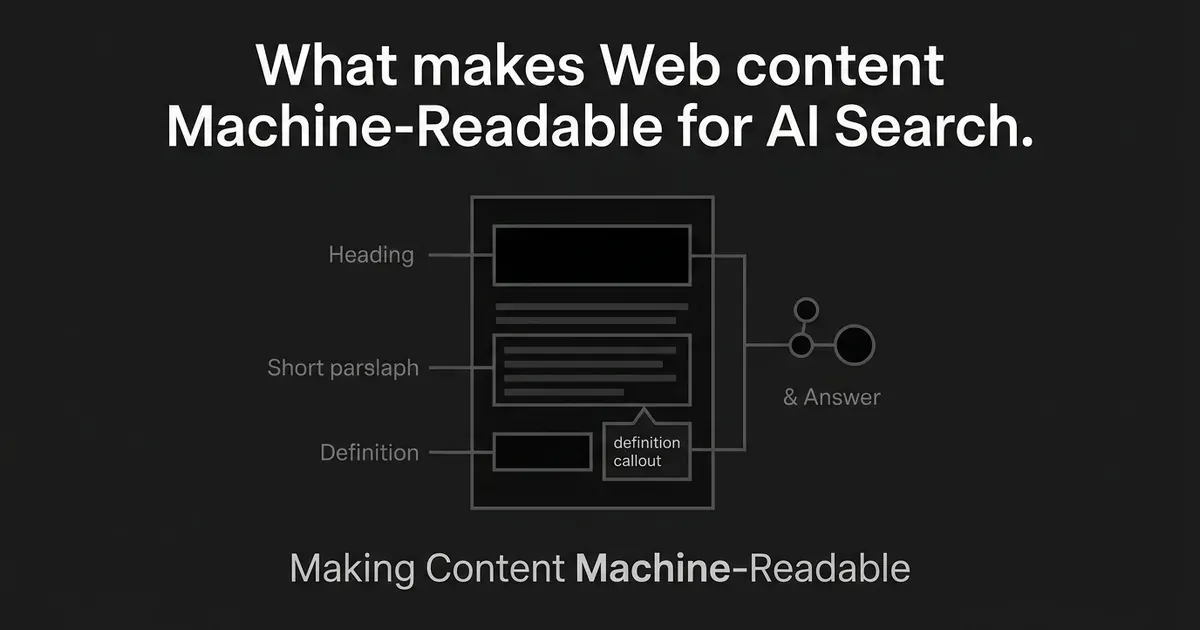
Your prose flows, the tone is on-brand, and readability is high, yet the page still gets skipped. The missing piece is the patterns extractors rely on: a summary block, a definition line, declarative fact sentences, clean numbered steps. Writing for extractors is not keyword stuffing. It is the opposite: short, factual sentences that survive being lifted out of context.
Fix it by adding the extractable scaffolding. Put a 40 to 80 word TL;DR right under your H1. Add a definition block that says "X is Y because Z" in plain, quotable English. Keep entities, dates, and numbers declarative ("Our tool launched in March 2024" beats "we recently launched"). Use numbered steps for process and tables for comparisons. The goal is self-contained passages an engine can quote whole.
This is also where a production system helps. Because DeepSmith writes with your brand context built in, it produces answer-first structure, clean headings, and citation-ready formatting during creation, not as a cleanup pass afterward. You review for judgment, not for whether every section leads with the answer.
Done means any pull-quote from your page is a complete, factual sentence that stands on its own. The trap: mistaking this for writing robotically. Clear and declarative still reads well to people.
10. You have no machine-readable map of your site
Great content, but nothing tells an engine what your site is, what it offers, or where your most important pages live. Your best pages sit five clicks from the homepage. There is no llms.txt at the root. You are asking retrievers to reconstruct your site from scratch every time.
Here is the fix, and a caveat to keep you honest. Create an /llms.txt at your site root following the Answer.AI spec: a title, a one-paragraph summary, then sections linking to your most important URLs with short notes. Keep it current, since a stale file signals stale intent. And separately, get your highest-intent pages within one or two clicks of the homepage, because a good site structure for AI search matters more than the file itself.
You know it is done when loading /llms.txt returns clean Markdown with a clear summary and a curated list of key links. The honest caveat: llms.txt is not yet consumed as a ranking signal by OpenAI, Anthropic, Google, or Perplexity. Treat it as a tidy signpost for the future, not a guaranteed citation boost. Do not over-invest here before you have fixed the first nine.
Start with one, not ten
Feeling like you have a lot to fix? Take a breath. You do not need to do all ten this month. Go back through the list, mark the two or three tells that sounded most like you, and pick the single one with the biggest gap between effort and payoff. For most teams that is unblocking crawlers or leading with the answer, because both are fast and both are foundational.
Fix that one this week. Measure it. Then come back for the next. Momentum matters more than perfection here, and you are almost certainly closer than you think.
Keep this AEO mistakes checklist somewhere you will see it, and treat it as a loop rather than a to-do you finish once. Engines change, your pages change, and a quick pass through these ten every quarter keeps small regressions from quietly erasing you again. Each pass gets faster, because you already know your weak spots.
If running these checks and rewrites by hand sounds like more hours than you have, that is fair. A platform that tracks where you show up across AI engines and produces citation-ready content to close the gaps can turn this checklist from a project into a routine. You can see your real data and real drafts before you pay by starting a free DeepSmith trial.