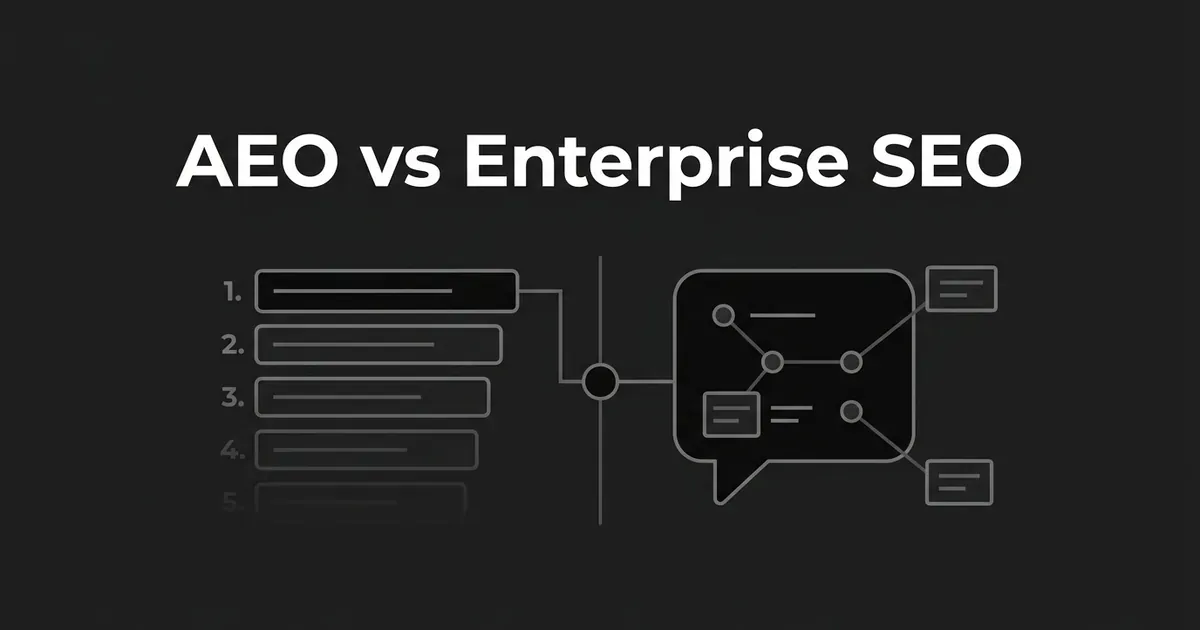
If you run content for a large organization, you are not really choosing between AEO vs enterprise SEO. You are adding a second surface to watch, one with a different output and a different set of things to measure. Traditional enterprise SEO still wins when the goal is organic rankings, qualified search traffic, or a direct visit to your site. AEO becomes necessary once a meaningful share of your buyers ask an AI system to explain a category, compare options, or recommend a fit, because that is a place your traditional metrics cannot see.
Here is the short version before the detail.
| Operating axis | Traditional enterprise SEO | AEO and AI search operations |
|---|---|---|
| Primary outcome | Ranking, impression, click, session | Mention, citation, or recommendation inside an answer |
| Demand unit | Keyword, topic, search intent | Prompt, buyer question, comparison, use case |
| Authority model | Links, domain strength, technical quality | Those plus entity clarity, consistent third-party description, reviews |
| Measurement unit | Position, CTR, sessions, conversions | Mention rate, citation rate, share of voice, sentiment |
| Workflow | Research, brief, write, optimize, publish, track rank | The same stages plus prompt monitoring and answer review |
| Who is involved | SEO, content, web, analytics | The same teams plus product marketing, comms, and subject experts |
The rest of this piece works through what each row actually means for a content operation that has to run both at scale, and where the line between AI search vs traditional SEO operations really sits. Moving from enterprise SEO to AEO is less about switching disciplines and more about adding one on top of the other, and the sections below walk through exactly what that addition changes.
What traditional enterprise SEO still covers
Enterprise SEO is the management of organic search visibility for a large or structurally complex site. The goal is to get more pages ranking for the right queries, then turn that visibility into qualified traffic and business outcomes. At the scale most enterprise teams operate, this covers keyword research and clustering, content planning tied to funnel stage, technical work like crawling, indexation, and canonicalization, internal linking and site architecture, on-page optimization and structured data, link acquisition, and governance across business units, countries, and product lines.
The unit that everything else hangs off is the page-query relationship. For any given query, the question is which page should rank, in which market, at what position, and whether the resulting impression turns into a click. Most of the reporting, most of the tooling, and most of the team structure in a mature SEO operation is built around answering that one question at scale.
What AEO adds to the picture
Answer engine optimization, or AEO, is the practice of structuring content and strengthening a brand's information footprint so AI systems can find it, understand it, and surface it as a direct answer, a cited source, or a recommendation. You will also see related terms like AI search optimization and generative engine optimization used for roughly the same thing. None of these are single standardized disciplines yet, so it is worth defining the term rather than assuming everyone means the same thing by it.
The unit AEO cares about is the prompt-answer relationship. When someone asks an AI system a natural-language question, does your brand show up, is one of your pages cited, is the description accurate, and are you recommended when you actually fit the request. That is a different question than "do we rank," and it needs a different kind of observation to answer.
Traditional enterprise SEO gets the right page into the right search result and earns the click. AEO gets your brand, its facts, and its supporting pages into the generated answer itself. This is a shift in the primary output, not a sign that the SEO fundamentals underneath it have gone away.
From rankings to citations, mentions, and recommendations
The first real difference in how AEO changes content operations is that "visibility" splits into three separate outcomes instead of one ranking number.
A brand mention is when the AI answer names your company or product. It shows the system recognizes you as relevant to the topic, but it says nothing about whether that recognition is positive. You can be mentioned as an example, a category participant, or a poor fit for the request.
A citation is a link or reference to one of your pages used to support the answer. Citations matter because they show which of your pages an engine is treating as evidence, and they can offer a path back to your site. But a footnote-style citation can be less visible than a mention in the prose, a cited page does not guarantee brand awareness, and you can be cited in an answer that ends up recommending a competitor.
A recommendation is the AI system explicitly suggesting you as a good fit for the request. This is the most commercially useful of the three, and it is distinct from the other two. A page can be cited while a different brand gets recommended, and a brand can be mentioned without ever being presented as a good choice.
One widely cited example makes the gap concrete. In a Google AI Mode dataset that Martech summarized, Zapier was reported as the most-cited domain in its software category, showing up in roughly 21% of analyzed prompts, while ranking 44th on brand mentions. Treat that as one reported dataset rather than a universal rule, but the point still holds. Being a trusted source and being a recognized, recommended brand are not the same outcome, and an operation that tracks only one of them is missing something a competitor might be picking up.

From keywords to prompts and buyer questions
Traditional enterprise SEO organizes demand around keywords, clusters, and search volume. AI search is more conversational. A buyer might ask for the best option for a company of a certain size, describe a technical constraint, or ask directly for a recommendation instead of a definition. A prompt is not just a longer keyword: it can carry a use case, a role, a comparison, a budget constraint, or a request for a recommendation, all in one question.
This changes what content intelligence has to look like. Covering a topic is no longer enough if your pages never answer the actual buyer questions that shape a shortlist. The old awareness, consideration, and decision buckets stay useful, but they now have to map to conversational scenarios rather than keyword lists. And because AI answers can shift across engines, dates, and even repeated runs of the same prompt, a one-time manual check is not a stable way to know where you stand; you need a tracked sample observed over time. One workable pattern from the industry is running 20 to 30 buyer-style prompts across a few AI engines on a weekly cadence for a month, treated as an example of a repeatable test design rather than a fixed rule everyone should copy.
From link authority to a broader authority signal
Links have not stopped mattering, and traditional SEO was never blind to entities or content quality. What changes is that AI visibility gets discussed as a wider evidence ecosystem rather than a page-by-page relevance score. Industry guidance points to structured product documentation, clear product pages, schema markup, consistent brand descriptions across third-party sources, review-platform data, and analyst coverage as things that help an AI system build a coherent, corroborated understanding of a company.
This is one of the areas where the AI search vs traditional SEO operations gap shows up fastest, because authority work used to sit almost entirely with the SEO team and now touches brand and product marketing too. A useful shorthand for this is entity authority. Traditional SEO asks whether a page has enough relevance and authority to rank. AEO adds the question of whether the wider web gives a consistent, trustworthy account of what your company actually does. For a large content operation, this means product documentation, blog content, customer proof, analyst coverage, and reviews stop being separate silos that different teams own in isolation, because contradictions between them make the brand harder for a system to describe accurately. It does not mean manufacturing third-party mentions or turning every page into a product page. It means clearer terminology, evidence-backed claims, and editorial review that checks facts, not just grammar.
From one result set to an answer assembled from many sources
Google's own documentation describes AI Overviews and AI Mode as sometimes using a query fan-out technique, where one request triggers several related searches across subtopics before the system assembles an answer from a wider and more diverse set of supporting pages. That matters for content teams because a complex prompt may not map cleanly to a single page or a single keyword. One of your pages might establish what you do, another might explain a specific capability, and a third might supply proof or a comparison, with each contributing a different part of the final answer.
The practical takeaway is to think in terms of a connected set of pages that together tell a coherent story, rather than a pile of isolated posts each fighting for its own ranking. That said, Google describes this behavior at a high level; it is not a public scoring formula, and the exact mix will vary by engine and by surface, since a result that shows up in Google AI Mode may not appear at all in ChatGPT, Perplexity, or Copilot.
From a single workflow to a dual-surface content workflow
The core production stages do not disappear: research, briefing, writing, editing, publishing, internal linking, distribution, measurement. What changes is the review question layered onto each one. A traditional brief asks which keyword and related terms a page should target. An AEO-aware brief also asks which natural-language questions buyers actually put to an AI system, and what facts an answer engine would need in order to describe you correctly.
Editing gains a second lens too. Beyond relevance, structure, and keyword coverage, an editor now checks whether the direct answer is easy to extract, whether the entity and product details stay consistent with everything else published, and whether the page actually answers the question instead of leaving the reader, or the model, to infer the conclusion. None of this replaces the technical basics. Google is explicit that pages still need to be indexed and eligible for a normal search snippet before they can act as a supporting link inside AI Overviews or AI Mode, so a page an engine cannot access or trust is not going to be rescued by anything AEO adds on top. The shift, overall, is from "publish and check rank" toward "publish, watch how systems describe you, then fix the underlying information," which is a change in what the workflow watches for, not a new set of stages bolted onto the old one.
From SEO-only roles to broader information governance
AEO does not require inventing a new job title on its own. What it does require is more coordination around the information AI systems draw on to describe a company. Enterprise SEO already works across content, web, analytics, and digital PR. AI search operations lean harder on product marketing to keep positioning accurate, subject-matter experts to validate technical claims, brand and communications to keep descriptions consistent, and customer marketing or review programs, because buyer-facing proof shapes how a product gets understood by these systems too.
The honest way to frame this is that responsibility becomes more cross-functional, not that governance work automatically becomes a confirmed ranking factor for any given engine. The safer claim, and the one the evidence actually supports, is that a large enterprise simply has more sources and more representations of itself to keep accurate and aligned.
From familiar SEO KPIs to a new measurement layer
Traditional enterprise SEO reporting centers on keyword rankings, impressions, organic sessions, click-through rate, conversions, crawl health, and backlinks. None of that goes away. AEO adds a layer on top: mention rate, citation rate, recommendation rate, share of voice against a defined competitor set, prompt coverage, which pages contribute most of your citations, and sentiment or accuracy in how you get described. Watching share of voice matters here too, since it is the one number that puts your visibility next to a competitor's on the same scale. Platform-level detail matters here too, since visibility on Google's AI features can look nothing like visibility on ChatGPT or Perplexity for the same set of questions.
Attribution gets harder in this world, not easier. A buyer can read a generated answer, form an impression of your brand, and never click through to a page, which means last-click analytics will systematically undercount AI-influenced demand. CRM tagging and assisted-conversion analysis can help close some of that gap, but no measurement setup should pretend to offer perfect attribution here.
This measurement layer is probably the clearest single example of how AEO changes content operations day to day: the reporting meeting gains a second set of numbers that did not exist before, and someone has to own reading them. A few data points are worth knowing as you build this case internally. G2 reported in October 2025 that 87% of more than 1,000 B2B software buyers said AI tools were changing how they research software, and a later G2 report put the share of buyers starting their research with an AI chatbot at 51% as of April 2026, up from 29% a year earlier. Separately, an Ahrefs study covering 15,000 prompts across ChatGPT, Gemini, and Copilot found that on average only 12% of the links those systems cited also appeared in Google's top ten for the same query. None of these numbers prove that rankings stopped mattering or that AI visibility directly drives revenue, but together they explain why an enterprise operation cannot infer its AI visibility from its existing rank tracker.
Whatever your monitoring setup, working through it the way an AEO audit checklist would, defining the prompt set, the platforms, and the time period you are measuring against, is what makes any of these numbers interpretable month over month. This is also where a platform that already tracks mention and citation rates across the major engines and feeds what it finds back into what gets written next earns its place: DeepSmith pairs AI search visibility tracking with the content production side, so a gap the tracking finds becomes a brief rather than a separate spreadsheet someone has to remember to act on.
What stays exactly the same
It is worth being direct about this, because the framing above can make it sound like everything shifted. Google's own guidance says the best practices for SEO remain relevant to AI Overviews and AI Mode, that there are no special technical requirements or extra schema.org markup needed specifically for these features, and that the usual fundamentals, being helpful, reliable, crawlable, and easy to navigate, still hold. A technically sound, indexable site, clear information architecture, useful and accurate content, real subject-matter expertise, good page quality, and content governance all remain load-bearing in both models. AEO is best understood as an additional visibility and content-intelligence layer sitting on top of enterprise SEO, not a replacement for it.
When each one wins
Prioritize traditional enterprise SEO when the immediate objective is organic rankings, qualified search traffic, or a direct site visit; that is still the discipline built for those outcomes, and nothing about AI search changes the mechanics of crawling, indexing, or on-page optimization. Add AEO measurement and workflow changes once a meaningful share of your buyers are using AI systems to explore a category, build a shortlist, or ask for a direct recommendation, because that is a surface your rank tracker cannot see into at all. Most large organizations end up needing both, run and measured separately, since collapsing them into one dashboard tends to hide exactly the gaps you are trying to find. That is the AI search operations difference in practice: not one system replacing another, but two measurement layers that have to be read side by side.
The comparison here is deliberately kept at the level of what changes, not how to build the program. If you want the AEO vs enterprise SEO question settled at the level of a step-by-step build, that is a separate piece of work from this one.
If you are looking for where to take this next, a tactical playbook for building an enterprise AEO program covers the how. A closer look at platform-specific AEO at enterprise scale covers the operating detail. Either is a reasonable next stop once this comparison is clear in your head.