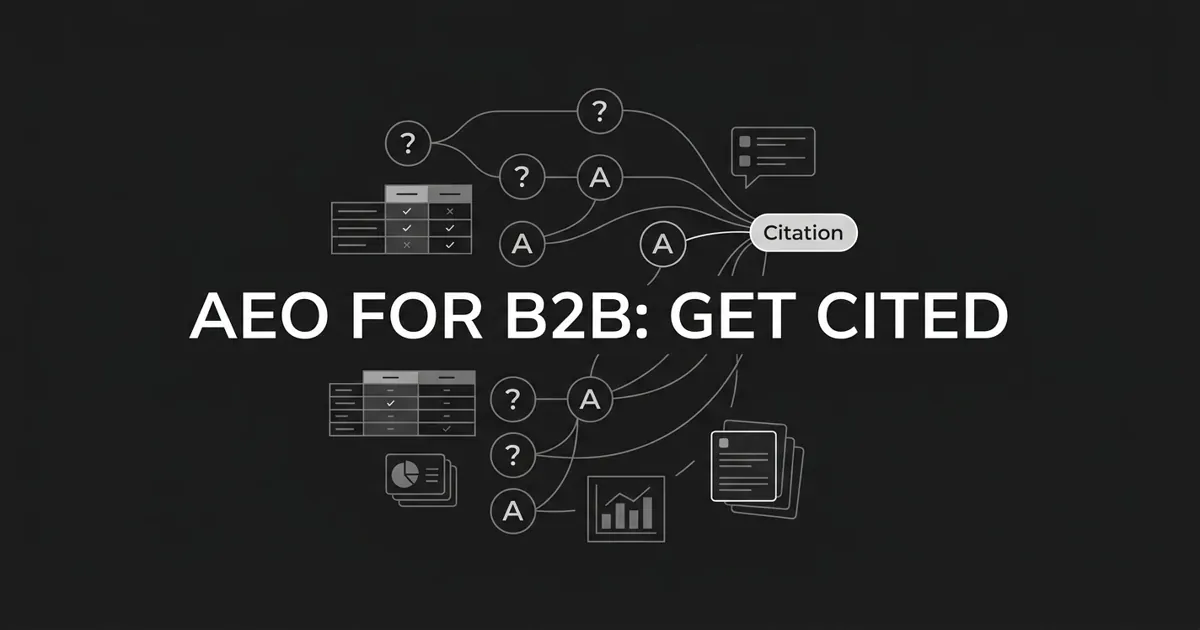
Your buyers are already asking AI about your category. The problem is that only about 11% of companies show up when they do, even though 94% of B2B buyers now use AI somewhere in their purchase. That gap is your opening, and this is the playbook for closing it. By the end, you will know how to win citations on the specific, high-intent questions a buying committee asks before they ever fill out a form.
AEO for B2B is not the same job as consumer AI search, and treating it like one is where most teams lose. A consumer decides in an afternoon. Your buyer decides across weeks or quarters, with a committee, and every person on that committee runs their own searches. So let's build for that reality, one step at a time.
What makes B2B answer engine optimization different?
Three things separate a B2B answer engine optimization program from the consumer version, and each one changes your tactics.
First, the buyer is a committee, not a person. The average B2B purchase now pulls in 10 to 13 stakeholders: the practitioner, their manager, an executive, finance, IT, and often security. Each one types a different kind of question, and 75% of them now prefer to research without talking to a rep. That means your content has to answer for all of them, not just the economic buyer.
Second, the cycle is longer because the questions are late and specific. Consumer AI search mostly captures broad "what is the best X" prompts. Your buyers ask narrower ones: "X vs Y," "alternatives to X," "is X right for a team of 50 on Azure," "does X integrate with Salesforce," "is X SOC 2 compliant." Those are the moments that decide a shortlist. Roughly 86% of B2B purchases stall somewhere in the process, so every clear answer that removes friction is worth real pipeline.
Third, third-party validation carries more weight. Earned media (analyst notes, trade press, review sites) gets cited far more than your own blog. Owned brand content is cited at a much lower rate than third-party editorial, so you cannot carry a B2B program on owned pages alone.
There is also a newer shift worth naming, because it reshapes what you write. AI search is collapsing the funnel. Buyers now ask situational questions that used to require a sales conversation ("how can a small B2B firm automate lead nurturing without a big budget," "when should a team like ours switch"). One person on the committee is comparing products in ChatGPT while another runs the same question through a private Microsoft Copilot instance for procurement. Your job is to have a clear, citable answer waiting at each of those moments, in the exact shape the question takes.
Here is the good news. You do not need to boil the ocean. You need to win a short list of buyer questions that actually move deals. That is the whole aim: get cited AI answers B2B buyers act on, then let those citations compound. The five steps below get you there.
Step 1: Map the buyer prompts your committee actually asks
Start with a prompt list, not a keyword list. This is the single most important shift in a b2b ai search strategy, and it is the step most teams skip.
What to do. Pull real questions from five places: sales call recordings and objection notes, customer and discovery-call transcripts, the queries your domain already appears for in Search Console, the questions your team fields on RFPs and demos, and the phrases AI engines auto-complete for your category. Then layer each prompt two ways: by buyer stage (top, middle, bottom) and by stakeholder (practitioner, manager, executive, finance, IT). For each one, tag the intent: comparison, alternatives, technical validation, ROI, category-fit, implementation, or contextual.
The high-value classes for B2B are comparison ("X vs Y"), alternatives ("alternatives to X"), and category-fit ("best CRM for a 50-person SaaS team on HubSpot"). Lean into those, then round out the deep-funnel classes each stakeholder owns. The engineer asks technical-validation prompts ("does X support SSO with Okta," "what data residency options exist for EU customers"). The executive asks ROI prompts ("what is the ROI of X for a company like mine," "how long until we see value"). Finance and IT ask about implementation timing and switching cost. Each of those is a question your sales team currently absorbs, and each one an AI answer can now field for you. If you want a repeatable method for sourcing and scoring these, our guide on how to map and prioritize the prompts that drive AI discovery walks through it.
How to tell it is done. You have a documented list of at least 50 prompts, each tagged by stage and stakeholder, and you can see which questions have no answer on your domain (or worse, a competitor's answer).
Common mistake. Building the list from keyword volume. B2B queries are often tiny, maybe 10 to 30 searches a month, but each one is committee research that leads to a real deal. Optimize for intent-class coverage, not volume. A "best X for a 50-person team" prompt with almost no volume can still decide a six-figure contract.
Step 2: Audit where you get cited today, and where competitors win
You cannot fix what you have not measured. Before you write a word, find out who owns each prompt right now.
What to do. Run every prompt from Step 1 against the AI engines your buyers use: ChatGPT, Perplexity, Gemini, Claude, and Google AI Mode. For each, record four things: Does your brand appear? Does a competitor appear? What specific page is cited? How authoritative is that source? Then build a simple grid: prompt by engine by cited brand by cited page. That grid is your gap list, and it tells you exactly where to aim.
If you want a structured method, our step-by-step approach to auditing your brand's presence in AI answers gives you the repeatable process, and it is worth doing across engines rather than one.
How to tell it is done. You have a citation gap grid where every cell shows win, lose, or absent, broken out by stage and stakeholder. Now your priorities are obvious instead of guesswork.
Common mistake. Auditing on one engine. Different engines favor different sources. ChatGPT leans on Wikipedia and high-authority editorial, while Perplexity cites Reddit far more heavily and rewards freshness. Your committee is spread across all of them, so single-engine tracking will lie to you.
This is the point where a platform earns its keep. DeepSmith tracks mention rate and citation rate across ChatGPT, Gemini, Perplexity, Claude, and Google AI Mode, with per-prompt rates and page-level attribution, so the run-and-record work that eats hours per audit cycle happens on a schedule instead of by hand. Its competitor view shows which competitor pages win which prompts on which engine, which is exactly the gap list Step 2 is trying to build.
Step 3: Build one focused answer page per prompt intent
Now you fill the gaps. The tempting move is one big pillar page that covers everything. Resist it. AI engines extract narrow passages, so the play is a tightly scoped page per high-intent prompt.
What to do. Match the page format to the intent class:
- Comparison prompts get a "vs" page: an 8 to 12 row feature table, three to five real differentiators, an honest "when to choose the competitor" section, and five to seven FAQs.
- Alternatives prompts get an alternatives page that names your solution first among several, then lists three to five others with overview, ideal customer, and pricing posture, plus a decision framework.
- Category-fit prompts get a use-case listicle ("best X for [specific vertical or size]").
- Technical validation prompts get standalone FAQ or docs pages that answer the engineer, IT, and security reviewer directly. These are the pages that keep a deal from stalling at the validator.
- ROI prompts get a calculator or framework, not a marketing essay.
- Implementation prompts get a timeline page with phases and prerequisites.
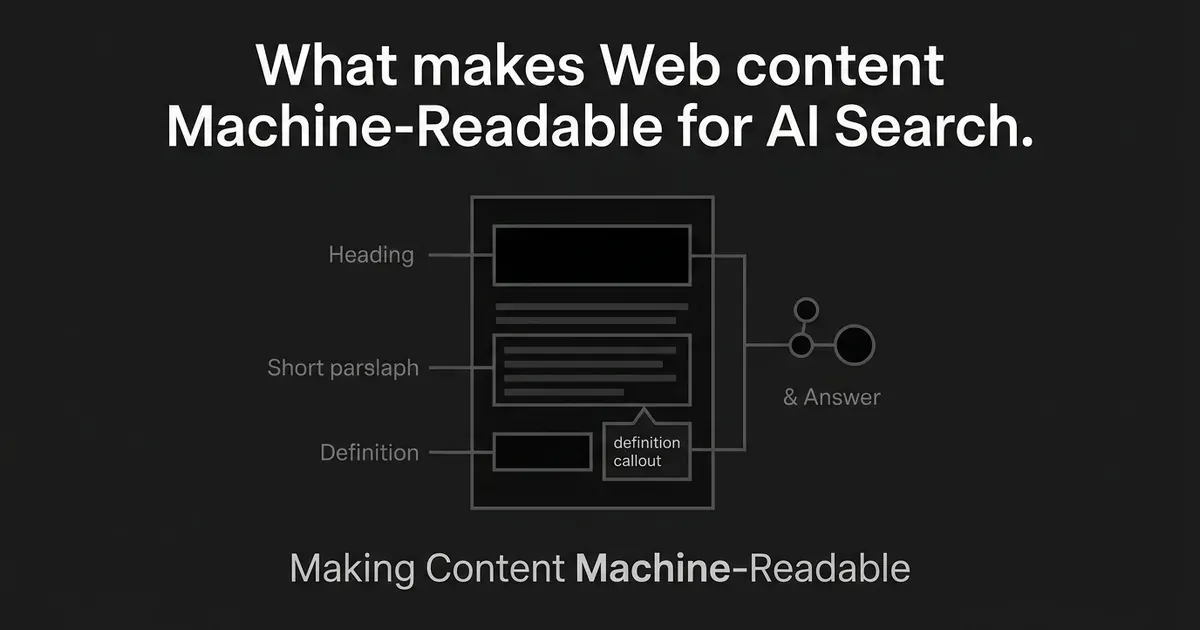
Whatever the format, structure it for extraction: a crisp 30 to 80 word answer at the top of each section, declarative paragraphs, tables where they help, a visible last-updated date, and a named author. Long, substance-dense pages earn more citations, and entity-dense content (specific names, numbers, dates) is cited far more than generic copy. Our breakdown of the content formats that consistently get cited goes deeper on the structure. So does our guide to making comparison pages citation-friendly while they stay conversion-focused.
How to tell it is done. Every gap prompt has a matching page published or scheduled, each one carries the trust and structure signals above, and related pages link to each other (comparison to alternatives, contextual to technical validation).
Pro tip. Write for the sentence AI selects, not the page a human scrolls. A block-structured answer that a retrieval system can lift cleanly beats a beautiful essay it has to summarize.
This is the other place a production engine matters. DeepSmith's Content Studio turns a planned prompt into a publish-ready article, grounded in your stored brand context (product, persona, voice, content type) through Deep IQ, with internal links pulled from your sitemap, a cover image, and metadata built in during creation. That removes the manual cross-referencing and formatting that usually stands between a gap and a filled page. It produces publish-ready output; you still review and publish on your terms.
Step 4: Earn third-party validation in parallel
Owned pages alone will not carry you, because your own content is cited at a much lower rate than independent editorial. So run an earned-media track alongside your content, aimed at the same buyer prompts.
What to do. Build presence where B2B engines already pull: tier-1 editorial and trade press in your vertical, analyst mentions, and review sites like G2, Capterra, and TrustRadius, where each "best X" prompt lives. Add community surfaces too. Perplexity cites Reddit heavily, so category-relevant subreddits and forums matter, and so do YouTube transcripts. The key discipline is alignment: your PR placement only helps AEO if its headline and structure match the buyer prompt an engine will be asked. For regulated categories where the validator is a security or compliance reviewer, our guide on brand authority in regulated or low-trust industries covers the extra trust signals you need. For smaller brands, our playbook on building AI search authority without a strong backlink profile shows how to compete.
How to tell it is done. Across your top 30 prompts, at least one third-party source cites you or is winnable. No cell in the gap grid is completely empty.
Common mistake. Treating earned media as a brand-awareness project instead of an AEO one. A tier-1 article that does not match a real buyer question is nice for the trophy case and useless for citations.
Pro tip. Reverse-engineer the leader. Pick the competitor winning your most valuable buyer prompt, then look at which pages and which third-party sources the engines cite them from. Produce a more tightly scoped answer to the same question, and pursue the same review sites and publications. You are not guessing at what earns a citation in your category, you are copying a pattern that already works and doing it one notch better.
DeepSmith helps here by detecting new competitor pages as they ship and letting you Remix a competitor page that is winning a buyer prompt into ready-to-use idea titles for your own queue. You close the gap with action, not just awareness.
Step 5: Measure, refresh, and distribute on a fixed cadence
AEO is not a launch, it is a loop. Citation positions drift month to month, so a program that goes quiet loses ground.
What to do. Re-audit the same prompt list on a monthly rhythm and track the numbers that move a b2b ai search strategy: mention rate (how often you are named), citation rate (how often you are linked as a source), share of voice against competitors, and page-level attribution (which of your pages earn the citations, and for which prompts). Watch the trend over time, not a single snapshot. Refresh your high-intent pages on a schedule, because recency is a real signal: content updated recently earns notably more citations, especially on Perplexity. Our guide to which pages gain most from content refreshes helps you prioritize what to update. Our framework for measuring whether AI search is actually citing your brand keeps the reporting honest. Then distribute every published piece to the channels your buyers actually read, as a standard step, not an afterthought.
How to tell it is done. You have a named owner and a fixed cadence (monthly re-audit, quarterly page refresh), citation rates on your priority grid trend up over 90 days, and each article ships with distribution ready to send.
Common mistake. Updating the date without updating the substance. Engines weight semantic freshness, not timestamps, so a hollow refresh fools no one. Change the content, then change the date.
Distribution is where DeepSmith closes the loop: every finished article arrives with social posts ready, and the Apps Library adapts one piece into channel-native versions for LinkedIn, X, Medium, Substack, newsletter and nurture email, Reddit, and more, so the follow-up work does not fall off your plate.
A quick word on AEO versus SEO
One trap is worth naming before you start. AEO is not rebranded SEO. Ranking on Google and getting cited in an AI answer are different outcomes with different signals. Only about 12% of AI citations overlap with Google's top 10 results, which means your content can be cited by AI without ranking on page one, and a page-one ranking is no guarantee of a citation. If you have pages that rank but stay invisible in AI answers, our explanation of why high-ranking pages still miss AI citations shows what to fix. Build for extraction and trust, not just position.
What to do next
You do not need all five steps live this week. Start with Step 1 and Step 2: build a real prompt list from sales, then audit who gets cited today. That alone will tell you where your ai search for saas buyers is leaking. From there, fill the two or three highest-intent gaps and add an earned-media touch on each. Momentum matters more than perfection here.
If you would rather run the whole loop in one place, DeepSmith puts the tracking and the production side by side, so the gaps you find turn straight into publish-ready pages. You can start a free trial and work from your own prompts and your own data before you commit to anything.