You are looking at a new AI tool, and it wants access to your CRM, your CDP, or a spreadsheet full of customer records. Before you click connect, it helps to know what you're actually agreeing to. AI data governance marketing teams put in place before that first connection is what keeps a fast pilot from turning into a slow-motion mess of unclear access, retained logs, and questions nobody can answer six months later.
This guide is not about whether your AI-written content sounds right or matches your brand voice. That's a separate job, content governance for AI-produced content, covered elsewhere. This one is about the data itself: what enters the tool, who can see it, what the vendor does with it, and how you get it back out. Marketing data governance, in this sense, is a small set of habits, not a compliance department. By the end, you'll have a working checklist you can run before you approve any tool that touches customer or campaign data.
Name an owner and register the use case
Before anyone connects a tool, write down who owns the decision. Not "the marketing team," a specific person with a business reason and a specific person who understands the technical side. Create a simple use-case register and fill in, for every tool: the marketing objective, the exact workflow it supports, the vendor and model involved, what data sources feed it, and whether it receives raw records, pseudonymous IDs, aggregated numbers, or free text.
Also record what the tool keeps. Does it store inputs, outputs, prompts, logs, or backups? Who reviews the output before it's used? Who can shut the connection off, and how fast?
You'll know this step is done when a reviewer, reading only that one record, can answer who approved the use, what data goes in, why it goes in, who can access it, what the vendor does with it, and how you'd stop it. If you can't name the data owner or the person who can revoke access, the use case isn't approved yet, no matter how useful the tool looks in a demo. The NIST generative AI profile recommends this same kind of inventory, including systems embedded inside application software you already pay for.
A common mistake here is assuming an AI feature bundled inside a tool you already use, your CRM's new AI summary field, your ad platform's suggested audiences, is automatically covered by an existing vendor agreement. It usually isn't, and the same is true the moment you start connecting AI agents to your stack rather than using a single point tool. Each feature is its own use case with its own data flow, and it needs its own entry in the register. Another one: letting a pilot run with no end date. "It's just a test" doesn't make the risk go away. A pilot can still copy real customer data into logs and start a vendor relationship that's hard to unwind later.
Map the data flow before you approve the purpose
Once you know who owns the decision, trace the whole path the data takes. Start at the source system, your CRM, CDP, email platform, ad platform, or data warehouse, and follow it through extraction, into the AI tool, through whatever the tool does with it (a prompt, a file upload, an API call, an embedding, a cache), and out the other side into wherever the output lands: a dashboard, a campaign system, a sales tool.
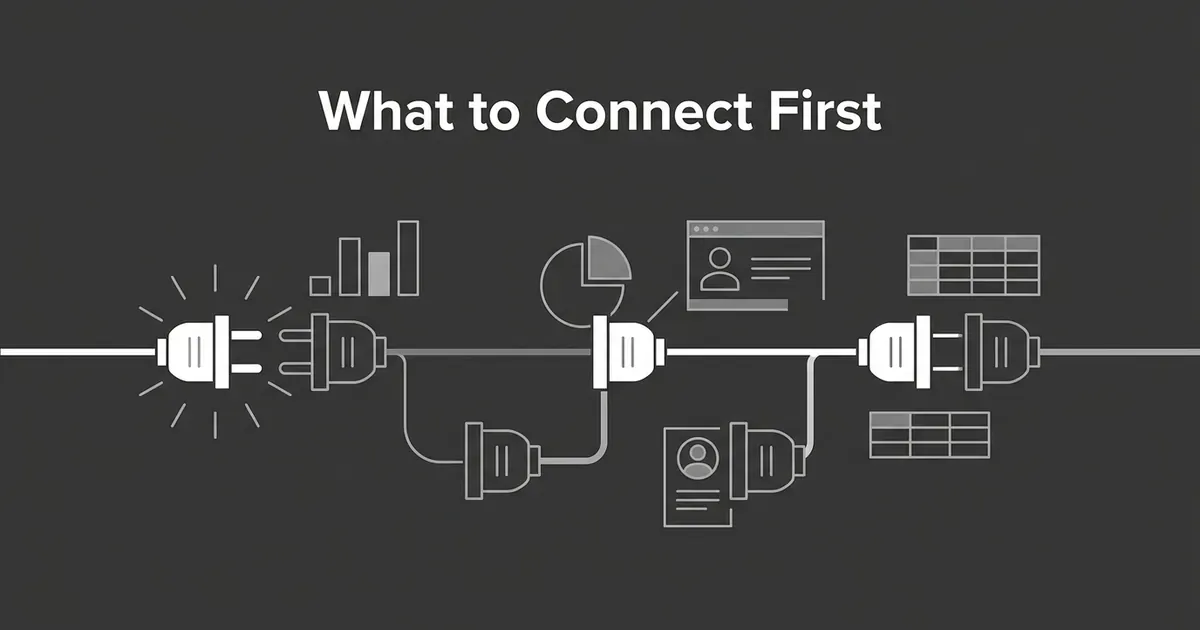
For every field that makes that trip, write down the reason it was originally collected and the reason it's now going into an AI tool. Ask whether those two reasons actually line up. A field collected so you could send a receipt isn't automatically fair game for an AI model to use for audience prediction, even if the tool can technically ingest it. Choosing data sources to connect first is a decision worth making deliberately rather than letting whichever integration is easiest to wire up decide it for you.
This step is done when you have a data-flow diagram or table with a named owner for every handoff, and when a single test record could, in principle, be traced from the source system through the AI tool to every place a copy of it now lives, including backups. You should be able to answer, in writing, why the tool needs each specific field and what would break if you removed it.
Teams usually go wrong here by describing the purpose too loosely. "Personalization" or "analytics" isn't a purpose, it's a category. Name the actual processing activity. It also helps to remember that prompts, uploaded spreadsheets, support tickets, and generated exports are all part of the data flow too, not just the fields you deliberately mapped into the tool.
Confirm you have a lawful basis to use the data this way
Once you know what's moving and why, get your privacy and legal owners to confirm you're allowed to do it. Every processing purpose needs an applicable legal basis, whether that's consent, a legitimate interest properly balanced, or something else specific to the jurisdiction. If the answer is consent, check that the consent someone already gave, to receive your emails, say, actually covers this new AI use. It often doesn't. The same discipline applies to editorial output: teams that already route drafts through compliance and brand gates tend to find this step familiar rather than foreign.
Update your privacy notice language if the new use isn't already described there. Make sure you have a working way for people to access, correct, delete, or object to how their data is used, and confirm that request actually reaches the AI vendor, not just your own database. A deletion that stops at your CRM but leaves a copy sitting in a vendor's logs isn't a deletion.
Decide, and write down the decision, on whether this use needs a data protection impact assessment. Not every AI use triggers one, but the decision itself should be documented rather than assumed. If you have marketing audiences in the UK, the ICO's guidance on direct marketing by email covers consent, identity, and unsubscribe requirements that AI doesn't get to skip. If you have a California audience, check your obligations under the California Consumer Privacy Act separately, since those rights around access, deletion, and opting out of sale or sharing apply on their own terms.
You'll know this step is done when your approval file has a purpose and legal-basis decision for each use, updated notice language (or a documented reason the existing notice already covers it), a working rights-request process, and a recorded DPIA decision. A common mistake is treating a vendor's general "we comply with data protection law" statement as if it answered these questions. It doesn't. That's your organization's assessment to make, not the vendor's to assert on your behalf.
Minimize the data and check its quality before it goes anywhere
Now build an approved list of exactly which fields the tool is allowed to receive, and treat it as an allowlist rather than a blocklist. A blocklist asks your team to remember every field that must never go out, which fails quietly the first time someone adds a new field to the CRM. An allowlist makes anything unapproved fail closed by default.
Start with the smallest dataset that actually does the job. If aggregated campaign statistics or cohort-level data will answer the question, use those instead of individual customer records. Strip out direct identifiers, free-text notes, and unrelated history that the use case doesn't need. A hashed email address isn't automatically safe to send just because it isn't in plain text: if your organization can still reconnect it to a person, it's still personal data and still needs governance.
Before anything moves, run basic quality checks. Confirm required fields are actually filled in, check for stale or duplicate records, and make sure suppression and unsubscribe flags are current before they reach the tool. Feeding a model contradictory or outdated consent data creates problems that show up as "the AI got it wrong," when the real issue was the data it was given.
This step is done when you have a written, approved field list, and when a sample of what actually gets sent comes with a data dictionary, a timestamp, a record of what transformations were applied, and a count that reconciles against the source. The NIST Privacy Framework covers this same ground: origin, lineage, and minimum data quality as things to manage on purpose, not clean up after the fact. A pro tip worth acting on: assign one person to own remediation when a quality check fails. A rule with no owner behind it gets skipped the first time someone's in a hurry.
Set up access controls before you flip the integration on
This is where AI data access controls actually get built, and it's worth doing in layers rather than one blanket setting. On the human side, use named accounts with single sign-on and multi-factor authentication where you can, assign permissions by role, and separate who can create connections from who can just view a report. Review access whenever someone joins, changes roles, or leaves.
On the system side, use narrowly scoped API keys or service accounts rather than one all-access credential, and give read-only access wherever write access isn't actually required. Keep your development data separate from production, and have a habit of rotating credentials and revoking the ones nobody's using anymore.
On the data side itself, filter at the field level before anything gets transmitted, and don't let people route around the approved connector with a manual export just because it's faster. Log who touches the source data, the AI workspace, the prompts, and the outputs.
Last, build a kill switch you've actually tested, not just one you assume works. Know who has the authority to suspend a connection the moment something looks wrong, and confirm that switching it off doesn't leave uncontrolled copies sitting in the vendor's caches, logs, or backups.
You'll know this is working when someone with ordinary campaign permissions can't pull raw customer data unless their job requires it, and when a person who leaves the team loses access immediately, not at the next quarterly review. A common mistake is treating a vendor's "enterprise security" badge as proof that your own settings are configured correctly. The badge describes what the vendor can do. It doesn't describe what you turned on.
Get straight answers from the vendor before you send real data
Before customer data reaches a vendor, get written answers, not marketing language, to a specific set of questions. Is the vendor acting as your processor, your controller for this activity, or something else? Is your data used to train, fine-tune, or improve their models? What gets retained: inputs, outputs, prompts, logs, backups, support tickets? Can retention be shortened or turned off? What subprocessors touch the data, and where are they located? What happens to your data if you cancel or migrate away?
A "we don't train on your data" answer sounds reassuring but only covers one question out of many. It says nothing about logs, support access, backups, or subprocessors, all of which can retain a copy long after the prompt is gone. It's the same instinct behind evaluating an AI platform's factual accuracy rather than trusting a demo: ask for evidence, not reassurance.
Put the real answers into a contract, not just an email thread: what the vendor is allowed to do with the data, how long they keep it, how deletion requests get honored across backups and derived copies, what security commitments apply, and what audit or evidence rights you have. This step is done when the vendor has passed an actual review, the contract is signed, subprocessors are documented, and the technical settings in the product match what the contract says. Skipping this due diligence is one of the hidden costs of free AI tools that only shows up after something goes wrong. If a vendor can't clearly answer questions about training, retention, or subprocessors, that's a reason to pause the connection, not a reason to assume the best. Working from a checklist for evaluating enterprise AI software before you sign anything catches most of this early.
Run a small, controlled pilot before you scale it up
Before real customer data flows at volume, run a pilot that tests more than whether the tool produces a useful answer. Start with synthetic, public, or heavily minimized data if you can. If you need real data, keep it to a narrow cohort and the fields you've already approved.
Specifically test: that an authorized user can do the task they're supposed to do, and that someone without authorization can't pull fields or another team's data. Test that a consent withdrawal, an unsubscribe, or a deletion request actually propagates through to any copies the tool has made. Test that you can find every copy of a given record and delete or quarantine it. Test that credentials can be rotated, and that the whole integration can be suspended fast if something goes wrong. Weigh this against the true cost of a free AI stack that skipped this step, since the cleanup after a bad pilot rarely stays contained to one team.
You'll know the pilot is done when you have a written test plan, the actual results against it, an owner assigned to any defect found, and an expiry date on the pilot itself so it doesn't quietly become permanent. A frequent misstep is testing only the happy path, whether the tool gives a good answer, and skipping the negative tests, like whether an employee can reach data they shouldn't be able to see.
Keep watching after launch, and know how to shut it down
Governance doesn't end when the pilot passes. Set a recurring cadence to review who has access, check whether the vendor's subprocessors or terms have changed, confirm consent and suppression data are staying in sync, and verify your retention schedule is actually being followed rather than just written down somewhere. Teams that already run governance and quality control for AI-generated content at this cadence usually find it easier to add a data-side review to the same calendar than to start a second one from scratch.
Build a retention schedule that states what's kept, why, where, for how long, and how deletion gets verified when the time comes. Also write an offboarding runbook before you need it: stop new data flowing in, revoke credentials, disable the connector, identify every copy across logs, backups, and downstream systems, and confirm deletion actually happened rather than assuming it did. The same approval workflows and governance that already gate what you publish can usually be extended to gate what data flows into a tool.
This is complete when you can point to your last access review, your last vendor review, your current retention check, and a tested (even if only as a tabletop exercise) offboarding process. Teams usually slip here by reviewing an integration only when the contract comes up for renewal, or by letting a schema change quietly widen what data flows through the tool without anyone noticing.
The eight steps above are not a one-time gate you clear and forget. They form a loop: monitoring feeds back into naming a new use case the moment a field, purpose, or vendor term changes, which sends you back through the same controls rather than patching the existing connection in place.

A pre-connection checklist you can run today
Before you connect a new AI tool to customer or campaign data, confirm each of these has an owner and evidence behind it, not just a checkbox:
- The use case, business owner, and technical owner are named and recorded.
- You have a data-flow map covering every field, from source through the tool to every downstream copy.
- You've documented the legal basis, updated your privacy notice if needed, and decided whether a DPIA is required.
- You have an approved allowlist of fields, with quality checks run before anything is sent.
- AI data access controls are role-based, least-privilege, logged, and you have a tested kill switch.
- The vendor has answered training, retention, deletion, and subprocessor questions in writing, and it's in the contract.
- A pilot has passed both positive and negative access tests, with an expiry date attached.
- A recurring review cadence and an offboarding runbook are both already written down.
Building AI data governance marketing leaders can actually run isn't about slowing everything to a crawl. It's about connecting the minimum data a use case genuinely needs, through an approved path, with a lifecycle you control end to end. Marketing data governance done this way scales with your AI adoption instead of becoming the thing that blows up six months in.
Getting AI data access controls right the first time is far cheaper than untangling them after a vendor question you can't answer. Pick one narrow, low-risk use case to start with. Run it through the checklist above, prove the access and deletion controls actually work, and only expand once the evidence backs it. If your team is also working through how AI fits into your broader content and marketing stack, it's worth building this kind of structure into every new tool from the start, not retrofitting it after something goes wrong.