If you have watched your rankings for years, it's natural to wonder what to do now that people get answers straight from ChatGPT, Gemini, Perplexity, and Google's AI features. Your rank tracker still tells you where your pages sit in a search results page, but it doesn't tell you whether an AI answer named your brand or linked to your site. That gap is what people mean when they talk about ai visibility vs rank tracking, and it's a good thing to sort out before you decide what to measure next. It matters most when you're trying to understand your visibility when rankings disappear from the part of the page people actually read.
The short version is that the thing being observed has changed. Rank tracking follows a position in a list of results. AI visibility tracking follows whether a generated answer mentions your brand, cites your pages, and which sources and competitors show up beside you. Neither one replaces the other, and some of the assumptions you carry over from rank tracking hold up better than others.
This guide walks through which of those assumptions break, which still hold, and which metrics you use instead. It doesn't cover whether the order of brands inside an AI answer matters, and it doesn't cover the difference between tracking keywords and tracking prompts. Those are about other questions.
AI Visibility vs Rank Tracking at a Glance
Here is the comparison in one place. The rest of the article explains each row.
| Dimension | Traditional rank tracking | AI visibility tracking | What changes for you |
|---|---|---|---|
| What is observed | A site or page's appearance and position in conventional search results | A generated answer, including brand references and source links | You measure answer inclusion and sourcing, not only a position on a page |
| Typical reporting | Average position, impressions, clicks, CTR, estimated traffic, visibility, sometimes share of voice | Mention rate, citation rate, cited pages and sources, competitor visibility, share of voice, answer history, sometimes sentiment | The AI metrics describe different events and don't replace clicks or traffic |
| Observation context | Often a set search campaign with a chosen location and device; Search Console also aggregates observed impressions | The engine, the question, the time of measurement, and the answer and links returned in that observation | Both are contextual, but AI answers and their citations can vary a lot between runs |
| Best for answering | "Where did our page appear in this search, and how is organic visibility moving?" | "Did the answer mention us or cite our page, which sources did it use, and who else appeared?" | Pick the measurement that matches the question you are asking |
| Main caveat | An average position is not one fixed place every searcher sees | A mention, a citation, and a click are three different events | Keep definitions and denominators written down |
| Best use | Tracking conventional organic search performance in chosen contexts | Tracking representation and citation in supported AI experiences, with the evidence behind each change | If both channels matter, use both |
What Rank Tracking Actually Measures
It helps to start with the old model, because some of what people say it does is a little off. A common picture is that every keyword has one stable number, and you either move up or down. That was never quite true.
A reported position is an average, not a permanent place
Google describes position as an estimate of where a link appeared relative to the other results. In Search Console, the number you see is an average position, which means Google averages the position values across your impressions, since your link may appear in a different spot each time someone sees it. For a property-level chart, Google reports the topmost result from your site. In a table, a row can show the position for a particular URL or grouping. If several of your pages appear for one search, the property-level and page-level averages can come out different.
Google also says results can differ with time and context, including location and device type. Rank-tracking tools handle this by letting you pick a target location and device for a campaign, so comparisons from one check to the next are more controlled. That makes the data easier to trust, but it doesn't turn a rank into one universal position that everyone sees.
So the first assumption to adjust is a small one. Even before AI answers, "we rank third" was shorthand for an observation in a specific context.
The metrics answer search questions
Search Console's main performance report covers impressions, clicks, click-through rate, and average position. Impressions and clicks tell you about exposure and visits, and click-through rate is clicks divided by impressions. Rank-tracking products often add their own layers, such as a visibility score, estimated traffic, competitor views, or share of voice.
Where the two worlds overlap
It would be too simple to say rank trackers can't see AI at all. Semrush's Position Tracking documentation says it reports organic positions and SERP features, including AI Overviews, for a campaign set up with a target location, device, and list of search terms. That is a view of a Google results page, with AI Overviews shown as one feature on it. It isn't the same as tracking whether a brand is named in full generated answers, or comparing citations across several AI engines.
Google has also added official reporting. Search Console now has a generative AI performance report that covers impressions for AI Overviews and AI Mode, with views over time, by page, by country, and by device. Google announced the separate reporting in June 2026 and said the Search insights had rolled out worldwide by August 31, 2026. So if someone tells you Google gives site owners no AI reporting, that's out of date.
What AI Visibility Tracking Observes
An AI visibility tracker looks at answers. Instead of recording where a link landed in a list, it asks an AI engine a question, reads what comes back, and records what it finds. That changes what you can learn, and it also changes what can go wrong.
Mentions and citations are two different things
Two terms come up all the time, and it's worth keeping them apart.
- Mention: the answer names your brand.
- Citation: the answer links to one of your pages as a source.
An answer can name your brand without linking to your site. It can also link to one of your pages without naming you at all. If you lump the two together, you lose the ability to tell which one is moving. If you're not sure which to care about more, citations or mentions is worth a read, and what counts as an AI citation spells out the edge cases.
A citation is evidence that a page was shown as a source. By itself it doesn't prove traffic, engagement, endorsement, or that the page is any good. It's also worth knowing that a vendor may count a mention only once per response, even if the name appears several times. That's one reason to ask any tool what a single counted event is.
The outputs you will see
Depending on the platform, an AI visibility report may include:
- Mention rate: how often your brand is named in the answers measured.
- Citation rate: how often one of your pages is cited in those answers.
- Cited pages and sources: which of your URLs, and which other domains, show up as sources.
- Competitive visibility: which competitors are named or cited, and which of their pages get cited.
- Share of voice: a comparison against competitors, where the denominator and formula matter a great deal.
- Answer history and trends: what the engine said and how the observations changed over time.
- Sentiment: a label for how the brand is described, where the tool offers it.
There's no single industry formula behind these names. One documented platform defines AI share of voice using mentions relative to competitors, and another describes a share of impressions with platforms weighted by impressions. If you compare two vendors' share-of-voice numbers, check that they share a denominator first. Calculating your share of voice across AI answers shows one way to set that up so the number means something.
Which Assumptions From Rank Tracking Break
This is the part most people are really asking about. Here are the assumptions that carry over from rank tracking and what happens to each one.
"There is one number for each search"
In rank tracking, you get a position, even if it's an average. In AI answers there's no equivalent single number that describes where you stand. What you have instead is a rate across many observations: out of the answers measured, how often were you named, and how often were you cited. That is why the metrics above are written as rates, and why the count behind each rate matters. A good report lets you see how many answers were measured, so a 30% mention rate on four answers isn't mistaken for the same thing as 30% on four hundred.
"If nothing changed on our side, the result stays put"
Rankings move, but within a fairly familiar range, and you can often explain a move with a content change or an algorithm update. AI answers are less steady. The same question can get a different answer on a different day, engines may draw on different data, and the sources they show can shift from run to run. That doesn't mean the tracking is broken. It means a single check is a weak basis for a conclusion.
There is some evidence on how much. The 2026 study "Don't Measure Once" looked at daily AI search results across four Swiss-German campaigns: telecommunications, real estate sales, sporting goods, and consumer electronics. Its main data covered ChatGPT, Gemini, Google AI Mode, and Perplexity from January 24 through March 20, 2026, with eight prompts per campaign. A separate dataset ran the same questions up to ten times at once.
The study found that the sets of sources overlapped by only 34 to 42 percent between consecutive days, and the sets of brands overlapped by 45 to 59 percent, with wide variation. In its repeated-run analysis, source overlap averaged about 32 to 43 percent across campaigns, and brand overlap ranged from 33 percent in sporting goods to 48 percent in consumer electronics.
The study's authors warn against treating one observation as a reliable estimate, and its sample was limited to Swiss-German campaigns. For the reasons behind this, why AI answers change from run to run explains how trackers handle it, and why AI citations keep changing covers what you can do about it.
"A top ranking protects our visibility"
Many teams assume that if a page ranks well, AI answers will use it. It's a reasonable guess, but it isn't safe to count on. A page can rank well and still go uncited, and a page can be cited without being near the top. Why ranking number one doesn't guarantee an AI citation walks through this. The practical point is that your rank report can look healthy while your AI visibility is low, and that's the situation people describe when they ask about visibility when rankings disappear from the view that matters to them. The rankings are still there, but the answer above them has moved the attention somewhere else.
To be careful about that phrase, rankings don't disappear from every AI product, and traditional rank data isn't obsolete. What disappears for many searches is the list of ten links as the main thing a person reads. That is why a number from the old list tells you less than it used to about whether you're being seen.
"The tool saw what a user sees"
With rank tracking, you can pick a location and device and get a fairly controlled view. With AI answers there are more moving parts: which engine, which question wording, when the answer was captured, and what the engine returned in that one observation. Personalization and location can change the answer too, which is covered in personalization and location in AI answers. So when you read an AI visibility number, it helps to ask what was measured, how, and how many times.
What Replaces Position as the Measure
If you can't lean on a single position, the metrics that take its place are the ones above: mention rate, citation rate, cited pages, competitor visibility, and share of voice. Here is how to use them without over-reading them.
- Keep the outcome clear. For conventional search, report organic position and performance metrics. For AI answers, report brand mentions and owned-page citations separately.
- Define a counted observation. Write down what makes an answer eligible, and what counts as a mention and a citation. If you use rates, state the numerator and denominator, and report how many measurements succeeded.
- Keep the evidence. Where the tool supports it, open the actual answer and the cited URLs behind a number, instead of relying on a score alone.
- Compare comparable periods. Keep engine coverage, the set of questions you track, and the collection method fairly consistent before you read anything into a change. If the tracked set changes, the trend may only reflect that.
- Read the outcome for what it is. Mention and citation rates aren't traffic metrics. Use analytics or Search Console when the question is visits or business results.
- Use both kinds of tracking when both channels matter. If you're responsible for organic search and AI discovery, you need the search-result view and the answer-and-citation view.
For a longer treatment of which numbers to put on a dashboard, AI visibility metrics that matter is a good next step.
What Official Tools Add
You don't need a third-party platform to start looking at AI visibility, because both Google and Bing now give you some of it.
Google Search Console
The Search generative AI report covers impressions for AI Overviews and AI Mode. Google defines these impressions as times when links to your site were shown to a user in a generative AI feature. The report shows changes over time and which pages have higher or lower impressions, and you can break it down by country and device. Google says the report may not appear when a site hasn't received enough impressions.
This is useful first-party reporting about your visibility in Google's named AI features. It is narrower than a cross-engine system that captures whole answer text, tells a brand mention apart from a citation of your page, and compares named competitors. The documentation doesn't say the Search Console report provides those, so it's safest not to assume it does. If you've noticed impressions going up while clicks stay flat, reading the AI Overview signature in Search Console can help you interpret it.
Bing Webmaster Tools
Bing's AI Performance report covers visible citation activity across Microsoft Copilot, AI-generated summaries in Bing, and selected partner experiences. It reports total citations, cited pages, average cited pages, pages cited in AI answers, grounding-query phrases, and citation share for a grounding query. Bing says the data refreshes daily with some processing delay, and you can view it over the date ranges in the dashboard.
Bing states plainly that a citation is not a click, traffic, or engagement measure, and that AI Performance doesn't measure rankings, authority, performance, or importance. The report is aggregated and summarized, and it may leave some citation activity out. The grounding-query rows show short phrases, not individual user questions or very specific long-tail queries. So treat it as a good first-party view of cited content, not a transcript of every answer.
When an AI Tracker vs SERP Tracker Question Comes Up
Most of the time the real decision isn't about two tools. It's about which question you need answered this week. Here is how the AI tracker vs SERP tracker choice usually breaks down.
- You want to know how a page is performing in organic search. A SERP tracker, plus Search Console, is the right place. A position, impressions, clicks, and click-through rate describe that directly.
- You want to know whether AI engines name you or link to you. An AI visibility tracker is built for that. It records the answers and the sources.
- You want to know which competitors AI engines keep citing. This is a question about answers, so an AI visibility tracker fits better. Tracking competitor mentions in AI answers shows a way to set it up.
- You want to know whether any of this brought visits. Use your analytics. Neither kind of tracker answers it alone.
If you're comparing platforms in this space, the best AI visibility tools roundup lays out how they differ.
How DeepSmith Tracks AI Answers
DeepSmith's AI Visibility module checks the questions you choose on a schedule and keeps the full answer each engine gave. It tracks mentions and citations separately, and it reports share of voice and visibility trends with a per-engine breakdown. You can also see which of your pages get cited and which competitors win citations for the same questions. The platform connects what it finds to content ideas and a production workflow, so a gap in AI answers can become a planned article. A visibility tool shows you where you stand, and writing new content doesn't guarantee a citation, so the sensible order is to look at the evidence first and then decide what to write.
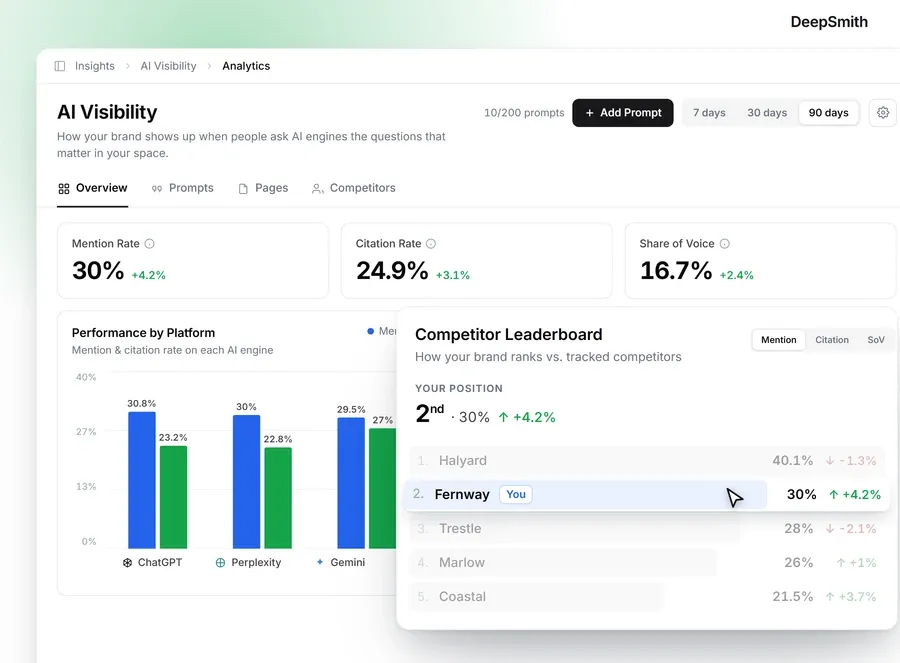
The first figure shows the overview that sits at the top of that module. Mention rate, citation rate, and share of voice are shown as three separate numbers, with a breakdown by engine and a leaderboard against tracked competitors. These numbers are demo data from a sample workspace, there to show the layout and not a result any customer achieved.
The second figure shows what sits behind a number like that. For a tracked question, you can read the answer an engine gave, see where the brand was named and which sources were cited, and compare it to the mention rate, citation rate, and position recorded for that question. This is the "keep the evidence" step from the list above, and it is also demo data.

If you'd rather start without software, measuring AI visibility manually walks through a spreadsheet approach you can run before you decide.
Which Should You Choose
You don't have to pick one. Here is a way to think about it by situation.
If most of your traffic and revenue still come from organic search, keep your rank tracking and Search Console reporting as they are, and add a small AI visibility check on the handful of questions your buyers ask. You'll learn quickly whether AI answers are naming you, without changing how you run SEO.
If leadership is asking what your AI search position is, you need the answer and citation view. Start with the free official reporting from Google and Bing to see what's already visible, then add an AI visibility tracker if you need whole answers, named competitors, or several engines in one place.
If you manage both organic search and AI discovery, use both, and keep them in separate reports so no one reads a citation rate as a traffic number. When the two disagree, such as strong rankings with low AI visibility, that disagreement is useful information about where to put effort next.
To see how this works on your own questions, you can start a free DeepSmith trial and look at real answers for the prompts that matter to your business.
Related guides
- Does Position Matter in AI Answers? Rethinking Rank for AI Visibility: Judge whether being listed first in an AI answer is worth chasing, and which signals (mention, framing, citation) are more reliable than a rank number.
- Oltre Alternatives: 8 Best AI Visibility and Content Tools for 2026: Compares eight Oltre substitutes (DeepSmith, Frase, Writesonic, Surfer, Profound, Athena, Goodie, Semrush) for buyers who want AI plus Google visibility tracking paired with content production, explaining which tools.
- SE Visible Alternatives: 7 Best AI Visibility Trackers for 2026: Compares seven substitutes for SE Ranking's SE Visible: DeepSmith, AthenaHQ, LLMrefs, RankScale, OtterlyAI, Peec AI and Profound.
- Siftly Alternatives: 8 Best Tools to Track How AI Describes Your Brand in 2026: For teams watching how AI models describe their brand, this ranks eight Siftly alternatives (DeepSmith, Profound, Peec AI, OtterlyAI, LLMrefs, Scrunch, AthenaHQ, Rankscale) on multi-engine tracking, prompt-level sentiment.
- Enterprise AI Visibility Platform Requirements: Security, Governance and Scale: Build a requirements checklist for an AI visibility platform covering SSO, role permissions, audit logs, API access, data residency and scale limits, so you can score vendors on.