You have seen a competitor show up in ChatGPT, you know you need to "do AEO," and now you are stuck on one binary: should I optimize for citations or mentions? If that question has been sitting in a doc for a week, take a breath. You are not behind. You just need a way to choose. This guide gives you a goal-to-signal framework and a seven-step method so a marketing lead can decide where to focus this quarter and stop guessing.
By the end, you will be able to say, in one sentence, which signal your funnel needs right now and why. That is the whole job.
First, the one difference that decides everything
A mention and a citation are not two words for the same thing. They answer two different questions about your brand.
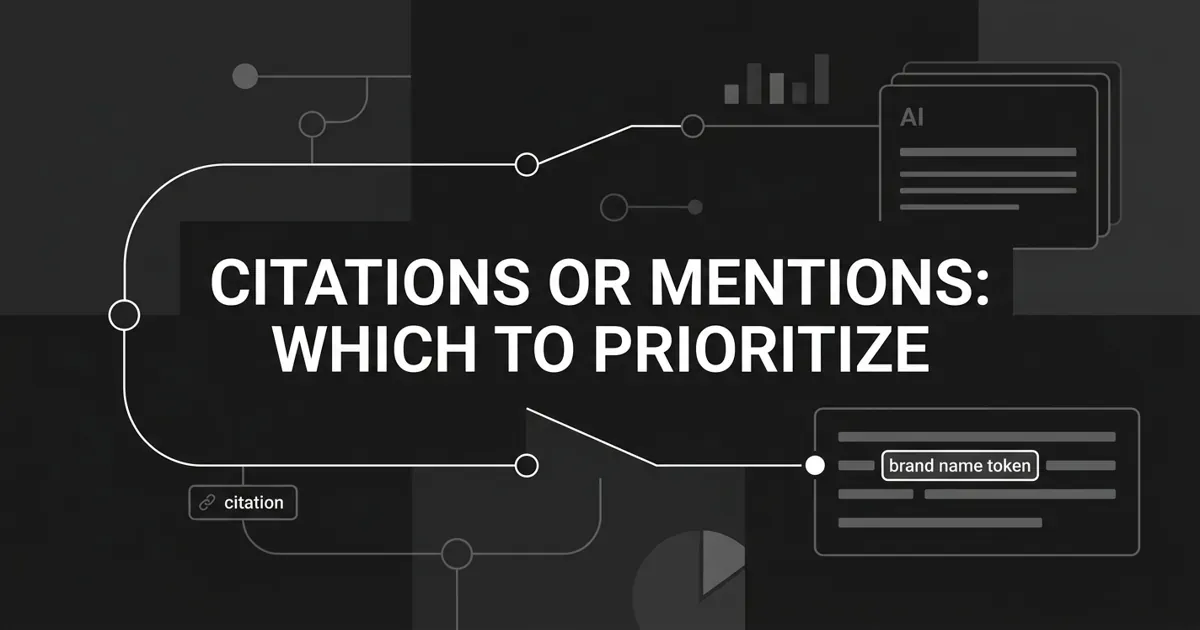
A mention is when the AI writes your brand name into the answer text. No link, no source block, just your name in the prose, often in a list or framed with a descriptor like "a popular option for X." A mention means the model knows you exist and connects you to the topic. It shapes perception inside the answer.
A citation is when the AI links to one of your pages as a source backing its answer, usually a numbered footnote or a source chip. A citation means the model is treating your page as evidence. It can also send a referral click when the user follows the link.
Here is the rule that unlocks the whole decision:
Mentions answer "do you exist and matter in this category?" Citations answer "can I trust what you published?" Pick the signal that matches the question your buyer is asking the AI right now.
That single line is the answer to should I optimize for citations or mentions. Everything below just helps you apply it to your own prompts.
The goal-to-signal cheat sheet
Before the steps, here is the matrix. Think of it as your AEO goal citation mention cheat sheet: find your primary goal, and you have your default signal. This is how you set your citations vs mentions priority without agonizing over every page.
| If your goal this quarter is | Prioritize | Because |
|---|---|---|
| Attributed authority and referral clicks | Citations | Citations carry the link and mark you as evidence the AI vouches for. |
| Share of voice and presence in the answer | Mentions | Mention share is what share of voice is built from. |
| Buyer influence at the decision stage | Mentions, first-position or "best"-framed | The buyer treats the answer itself as a shortlist. |
| Brand authority that compounds over time | Citations first, then mentions | Repeated citations build the trust that later turns into mentions. |
Now map it to your funnel, because the funnel stage where most of your prompts sit is the fastest tiebreaker for which AI visibility signal matters most to you.
| Funnel stage | The buyer is asking | Prioritize |
|---|---|---|
| Top of funnel ("what is X," "examples of Y") | Name the category and the players | Mentions |
| Middle of funnel ("best X for Y," "X vs Z") | Help me shortlist | Balanced, mentions leading with citation support |
| Bottom of funnel ("X pricing," "is X good for my case") | Prove it before I buy | Citations |
Why does the goal change the answer so completely? Because the two signals pay off in different currencies. Citations bring fewer clicks, but higher-quality ones: in one single-site study, ChatGPT referral traffic converted at 16 percent against 1.8 percent for Google organic. Mentions, meanwhile, are the raw material of consideration, and they turn out to be roughly three times more predictive of an AI recommendation than backlinks are. Neither is "better." They serve different goals, which is exactly why you choose.
One more axis quietly decides a lot of cases: your brand's current situation. If you are new or under-known, build mentions first, because the AI cannot cite a brand it does not yet know. If you are well-known but rarely cited, that is an authority gap, so build citable assets. If a competitor is suddenly cited everywhere, that is almost always a third-party signal event, like a new listicle or a Reddit thread, not something they did on their own site.
Keep this card open. The seven steps below turn it into a plan.
Step 1: Name the one goal you are optimizing for this quarter
Pick a single primary goal from the matrix: attributed authority and clicks, share of voice, buyer influence at the decision stage, or compounding authority. Then name the funnel stage most of your priority prompts live in. Write one sentence: "This quarter I am optimizing for [goal] at [funnel stage] for [this product line]."
You know this step is done when that sentence exists and your team agrees on it. It should feel almost too simple.
Where people go wrong: they optimize for "visibility" without ever naming a goal, so they can never tell whether a given page should chase a mention or a citation. The other trap is defaulting to bottom-of-funnel citations when most of the prompts you actually track are top-of-funnel questions the AI answers from memory. Name the goal first, and the rest of the work stops fighting itself.
Step 2: Sort your tracked prompts by funnel stage
Pull the list of prompts you already track, or generate a starter set, and tag every one with a funnel stage: problem-aware (top), solution-aware (middle), or decision-ready (bottom). Note the buyer intent behind each.
You are done when every prompt has one of three labels and you can see the distribution, something like 40 percent top, 35 percent middle, 25 percent bottom. That distribution is the single best predictor of where your effort should go.
Where people go wrong: they treat every prompt as equal and run one blanket strategy across the whole set. Or they build the prompt list straight from their SEO keywords, which skews heavily to top-of-funnel and quietly drops the decision-stage prompts where an AI recommendation actually converts a buyer. More than half of B2B decision-makers now start a buying journey inside an AI engine, so those bottom-funnel prompts are not a nice-to-have.
Step 3: Score each prompt for its current mention and citation status
For every prompt, record two things across the engines your buyers actually use: does the AI mention your brand in the answer (yes or no, and roughly where), and does it cite one of your pages (yes or no, and which page)?
You are done when you have a simple matrix: prompt by engine, with a mention column and a citation column. Do not be discouraged if it is mostly blank at first; a large share of brands have zero AI mentions at all right now, so an empty row is a starting line, not a failing grade. Now the gaps are visible. For any prompt you can see whether you are absent (no mention), present but not trusted (mentioned, not cited), or cited but invisible (a page is cited, but your name never appears in the prose).
Where people go wrong: they score once and never again, and they check a single engine. Perplexity, ChatGPT, Gemini, Claude, and Google AI Mode often return different brand sets for the same question. Citation behavior swings hard between them too; Perplexity cites on almost every answer, while ChatGPT cites far less often. A presence on one engine is not a presence across AI.
Step 4: Decide, per prompt, whether to chase a mention, a citation, or both
Now combine the funnel label from Step 2 with the current state from Step 3, and give each prompt one primary action. This is where you actually prioritize AI citation or mention work instead of doing all of it everywhere.
- Top-of-funnel prompt with no mention: push for a mention. Seed category presence on third-party surfaces.
- Middle-funnel prompt with a mention but no citation: push for a citation. Build the comparison or evaluation page the AI would link to.
- Bottom-funnel prompt with a citation but a weak mention: push for a mention, because the buyer needs to see you named, not buried in a footnote.
- Any prompt where a competitor is recommended and you are not: find the third-party source feeding that answer and pursue inclusion there.
Position matters more than most teams expect here. When a brand is named first in an answer, users are far more likely to go search for it, and "best" or "top" framing lifts that intent even higher. So on a decision-stage prompt, "get mentioned" is not the finish line; "get mentioned first" is. That nuance is worth a specific action, not a vague hope.
You are done when each prompt carries one clear action, not five.
Where people go wrong: they try to win both signals on every prompt. The economics do not support it. Because citation rates vary so much by engine, a single "do both everywhere" plan spends real effort where it cannot pay off. One action per prompt keeps the roadmap honest.
Step 5: Produce the asset that earns the signal you picked
The signal you chose dictates the asset. For citation goals, build the specific page shape the prompt wants: a definition page for "what is X," a comparison page for "best X for Y," a pricing explainer for "how is X priced." The AI tends to cite the page that matches the prompt's shape, not the most authoritative page on the topic. For mention goals, build assets that earn third-party pickup (original data, an expert point of view, a strong comparison) and seed them where the AI already looks, like industry review sites and community threads.
Here is a mistake worth naming: assuming your mentions come from your own blog. Roughly 85 percent of brand mentions in AI answers come from third-party pages. Your site is how you earn citations; other people's surfaces are how you earn mentions. Those are two different motions, and they still need to share one prompt list.
A pro tip for the citation side: put the answer high on the page. A large share of the passages AI engines quote come from the first third of a page, so a definition or a crisp comparison buried under 800 words of preamble is a missed citation. Clean, sequential headings and basic schema help too; pages built that way tend to get cited at meaningfully higher rates than pages that make the model dig.
This is the step where a platform earns its keep. This is where DeepSmith fits: its AI Visibility view shows per-prompt mention and citation rates, a competitor leaderboard, and a Pages view of which of your pages the AI actually cites, while Discover Prompts generates a starter prompt set from your product, persona, and buyer-stage context so you are not guessing what to track. Content Studio then turns each decided action into a publish-ready page, with the Writer handling research, linking, and metadata, and Autowrite producing on a schedule so you are not the bottleneck. One customer, a GTM lead, put it plainly: "Went from four articles a month to fifteen with the same two people."
You are done with this step when every prioritized prompt has a published page or a scheduled slot behind it.
Step 6: Wire measurement to the signal you chose
Measure the thing you decided to move. If you chose citations, track citation rate. If you chose mentions, track mention share, which rolls up into share of voice: your mentions divided by all brand mentions across you and your competitors for the same prompt set. If you chose balanced, track both. Set a baseline, a target, and a cadence, and break it down per prompt, per engine, and per funnel stage.
You are done when you can answer, prompt by prompt, "are we winning?" and each answer has a number attached.
Where people go wrong: they collapse everything into one brand-wide "AI visibility score." That single number is the most common mistake in this whole discipline, because it hides which lever moved. Mentions and citations are different signals; track them separately, report them separately, and decide from each. Watch the engine split too, since the same query surfaces different brands on different engines. DeepSmith reports mention rate, citation rate, share of voice, and visibility trend across the five named engines with per-platform breakdowns, so the separation is built in rather than something you reconstruct in a spreadsheet.
Step 7: Re-score on a cadence, because AI answers move
AI answers are not stable. A prompt where you were cited last quarter can lose that citation when a model updates or a new source outranks yours. Put a re-score on the calendar, quarterly at least, and stamp each row in your matrix with a "last checked" date.
You are done when re-scoring is a recurring event, not a one-time audit.
Where people go wrong: they treat the first score as permanent truth. It is not. Pages that go stale are markedly more likely to lose citations, and freshly cited competitors appear without warning. A signal you earned is a signal you have to defend. Building this cadence is also what quietly answers your longer-term aeo goal: citation, mention, or the deliberate mix you chose, held steady over time instead of reset every quarter.
What to do next
Start with Step 1 today. Name one goal, in one sentence, for one product line. That alone will tell you whether your next three articles should chase mentions or citations, and you can build from there.
Then keep pulling the thread. This guide is the decision spoke of a bigger picture. Once you have chosen a signal, you will want to know how to tell which one you are currently getting, what the real traffic payoff of each looks like, and how each engine treats the two differently. Those are separate reads, and they pick up exactly where this one stops.
If doing the tracking and the production by hand sounds like a lot, it is, and that is the honest reason tooling exists. You can start a 7-day free trial of DeepSmith and see your real per-prompt mention and citation data, plus real drafts, before you pay. One goal, one signal, one next step. You have got this.