If you run growth at a small SaaS company, you already know the problem with most of your content: it talks to everyone, so it lands for no one. Writing icp targeted content saas buyers actually recognize means naming one segment, one role, one company size, before you write a single sentence. This guide walks through the process end to end, from choosing the segment to checking whether AI assistants are matching your page to the right buyer's question.
By the end you will have a repeatable way to pick a segment, collect that segment's real language, brief a page against it, and measure whether it is working. This is not a promise that any page will rank first or get cited every time. It is a process for making your fit obvious to a reader and to a retrieval system, so ai matches content to buyer questions instead of matching nobody at all.
Step 1: Choose one ICP segment before you pick a topic
Start with one slice of your market, not the whole thing. An ideal customer profile describes the kind of company that is a good fit: industry, company size, and the operating conditions that change what they need. A persona is the individual inside that company, the person who will actually read the page. You need both, but they answer different questions. The ICP tells you which companies to prioritize. The persona tells you who is reading and what language they use. This is a different lens than a job-to-be-done page: you are segmenting by who the buyer is, not by the task they came to complete, so a job-to-be-done breakdown of that same task is a separate piece of work.

Write a one-sentence segment definition using this shape: for [role] at [industry or company type] companies of [size or operating scale], who need to [outcome], this page explains [subject] so they can [result]. If the sentence could describe three different audiences at once, it is too broad to write from. This is the foundation icp targeted content saas guides skip past too fast: the segment, not the topic, is the first decision.
Document the role, the buying influence (user, champion, evaluator, or economic buyer), the industry, the company-size band that changes budget or process, what makes a company a good fit, and what makes it a bad one. Pull this from CRM notes, sales calls, support tickets, or win-loss reviews, not from guesswork.
Common mistake: targeting "SaaS companies" as if every SaaS company buys the same way. A five-person startup and a 300-person company evaluate the same product through completely different processes. "Demand-generation leads at 50-to-200-person B2B SaaS companies who own organic acquisition" gives you a role, a company context, and a scale constraint to write against. "For marketers" does not.
You know the segment is ready when you can answer who this is for, what type of company they work at, what size constraint matters, and what would make this advice wrong for a different segment. A useful test: write two candidate segment statements and ask whether your examples and recommendations would actually change between them. If not, you have not found a real segment yet, you have just relabeled a generic one.
Step 2: Collect the buyer's real questions and language
Once the segment is set, gather the actual questions people in it ask, in their own words. Good sources include sales-call transcripts, discovery notes, CRM fields, customer interviews, support conversations, onboarding questions, site-search logs, review sites, and the objections your sales team hears on every call. This is how you build segment content ai search systems can actually use, because the language comes from real buyers instead of a marketer's guess at what they might say.
Group what you collect by role, industry, company size, the actual need, any constraints (budget, team size, tooling), and what evidence would make an answer credible. A useful pattern for writing new prompts: how does [role] at [industry or company type] with [size constraint] solve [question] when [constraint or alternative]? "How should a SaaS founder with a two-person marketing team create content for different buyer segments" is a real prompt shape. "Content marketing tips" is not.
A prompt set is ready when every prompt maps to one segment, the wording has enough context to tell that segment apart from a generic one, and duplicates are merged. Start with a manageable set of high-value questions rather than trying to list every possible query a person could type. That collection work is what turns a vague notion of segment content ai search into a matrix you can actually write from.
Pro tip: keep a "must be true for this segment" list next to a "do not assume" list. The first stops your draft from going generic. The second stops it from quietly importing enterprise budgets, headcount, or compliance requirements into a founder audience that has none of that.
DeepSmith's AEO module tracks a defined set of questions and reports mention rate, citation rate, and full answer history per prompt, with a Discover Prompts feature that drafts a starting list from stored product, persona, and buyer-stage context. That is useful for organizing and monitoring the questions you decide matter. It is not a substitute for the interviews and call transcripts that tell you what your buyer actually says.
Step 3: Turn the segment into a brief with a fit boundary
Before you draft anything, write a segment brief. It should hold enough that a second writer could produce the page without asking you a single question. Cover segment identity (role, seniority, industry, company size, buying influence), content intent (the primary question, the related questions, and the questions this page will not answer), and segment-specific context (responsibilities, constraints, terminology, what proof this reader trusts).
Then write a fit boundary, not just a feature list: for [segment], [capability] helps with [specific problem] because [mechanism], and it is a poor fit when [boundary]. Naming the poor fit matters as much as naming the good one. A page that only claims fit reads like an unqualified pitch, and it gives a retrieval system nothing specific to match against.
Common mistake: writing challenges and goals with no evidence behind them, then treating that persona sketch as a decorative sidebar instead of an actual constraint on the draft. If nothing in the brief would change what you write, it is not doing its job.
This is where a stored brand context earns its keep. DeepSmith's Deep IQ holds company positioning, claim boundaries, a persona profile, brand voice, and content-type structure as a standing reference, so you set the segment brief and fit boundaries up once instead of re-explaining the product every time someone drafts a new page. The lesson generalizes even without the tool: put the brief somewhere durable, not in a chat thread that disappears after one article.

Step 4: Map one page to one segment and one question cluster
Pick a single primary segment and a single primary question for the page. Add only the closely related questions that same reader would actually ask next. Build a short mapping: the segment, the primary question, the supporting questions, the questions you are deliberately excluding, the terminology this segment uses, the examples the page needs, and which existing pages it should link to.
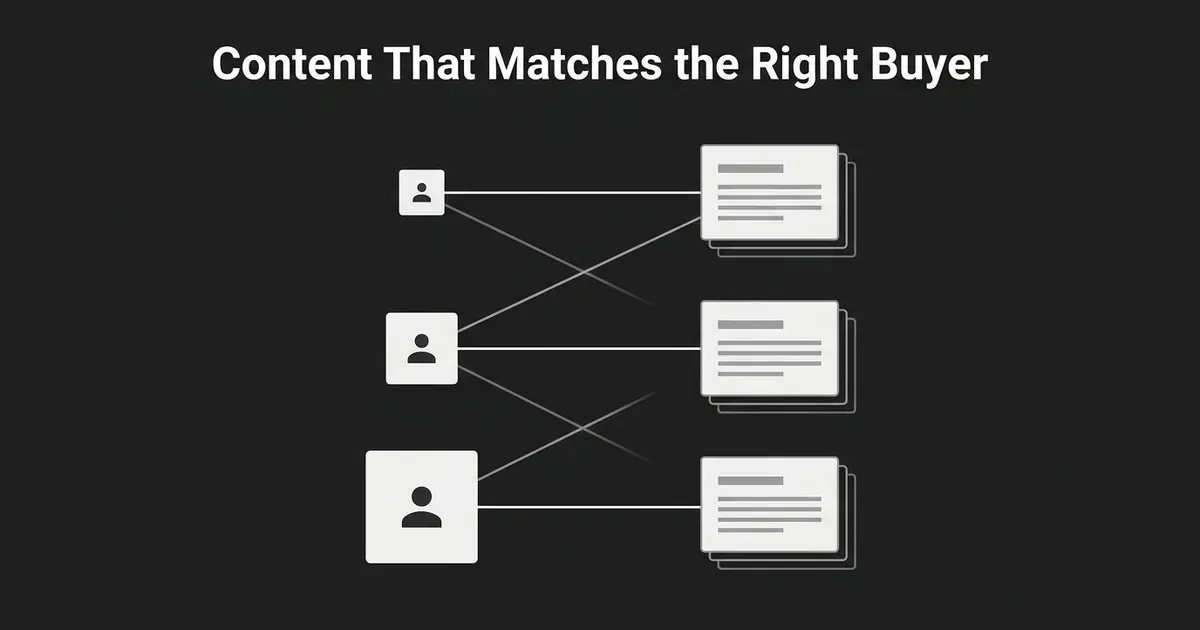
If a different segment needs a different example, a different buying argument, or a different fit boundary, that is a sign it deserves its own page, not a swapped headline on this one. Do not spin up five near-identical pages that differ only in the role name in the title; that adds maintenance burden without adding anything a retrieval system can use to tell them apart.
You will know the mapping is done when one person can describe the intended reader in a single sentence, every supporting question belongs to that same reader, and the page is not quietly competing with a product page or comparison page for the same question.
Step 5: Lay out the page so the fit is obvious
Write the structure before you write prose. Open by stating who the guide is for, what it helps them do, and the direct answer, in the first few paragraphs. Follow with the audience qualification: the role, industry, and company-size context that actually changes the advice. Then the numbered steps, each carrying what to do, how to tell it worked, and where people go wrong. Close with a short fit section, evidence, a checklist, and an FAQ.
This is the mechanics behind persona content aeo work that actually holds up: state the direct answer near the top of each section, use headings that read like the reader's own question, and keep constraints and examples specific enough that a different segment could not swap in without the page falling apart. A page for a solo founder should talk about limited team capacity and staying out of every editing loop. A page for a 50-person marketing team needs a different set of assumptions entirely, and pretending otherwise is exactly how content ends up generic.
Common mistake: repeating "for founders" in a heading without changing a single recommendation underneath it. A label is not a signal if nothing else on the page backs it up. Also watch for burying the real answer under a long, scene-setting introduction, or putting the fit information only inside a tab or an image where neither a reader nor a crawler can easily find it. Done well, this is what separates real persona content aeo systems can use from a page that just mentions a job title once.
Step 6: Write from evidence, not stereotypes
Draft every section against the brief you wrote in step 3. For each recommendation, state why this role, industry, or company size actually changes it, then give a concrete action, a labeled example, and the boundary where the advice stops applying. Use real customer language, product documentation, and clearly labeled illustrative examples. Never invent a customer quote, a conversion number, or a ranking. If you cannot support a claim, cut it or say plainly that it is unknown.
A fast way to check your own draft: swap the segment label for a different role or industry and see if every paragraph still reads fine unchanged. If it does, the page is not actually segment-specific, it is generic content wearing a label. That test alone catches most of what makes audience specific saas content collapse back into boilerplate.
Pro tip: write until the question is answered completely, not until you hit a target word count. A shorter page that fully resolves one segment's question beats a padded one every time, and it is a better example of audience specific saas content than a long page that hedges toward everyone.
Step 7: Check accuracy, visibility, and technical readiness before you publish
Run three separate checks, because a technically clean page is not the same thing as an accurate or relevant one. First, the segment and reader check: is the intended role obvious, does the industry and company size actually change the examples, does the page stay inside one audience the whole way through. Second, the product and factual check: are product names exact, are claims inside the boundaries you set, is pricing current, is every example labeled if it is illustrative rather than real. Third, the on-page and technical check: is the main content visible as crawlable text, is the page reachable through internal links, does any structured data on the page match what a reader can actually see.
Google's own guidance for AI features says a page has to be indexed and eligible for ordinary search results before it can show up as a supporting link in an AI answer, and that there is no special markup or AI-specific file that substitutes for that. Structured data describes a page; it does not persuade a system to prefer it. Getting your technical basics right is necessary, but it will not rescue a page that has nothing distinctive to say about a specific buyer.
DeepSmith's Writer step handles the research, internal and external linking, cover image, and metadata for a planned article, and Autowrite can carry a scheduled piece through to Produced Content without anyone opening the app. What stays a human job either way is deciding the segment, setting the claim boundaries, and reviewing the result before it goes live, since automation removes the mechanical work but it does not decide whether your fit boundary is honest.
Step 8: Track whether the right segment is finding the page
Set a baseline before you publish: record the exact prompts you expect this segment to ask, which engine you are checking, the date, whether your brand is mentioned, whether it is cited, and how the answer describes you. Recheck the same prompt set on a steady schedule, and watch whether the pages being cited belong to the segment you actually wrote for.
If the wrong audience keeps showing up in the answer, work through it in order: is the intended reader unclear on the page, is the terminology off for that segment, does the page try to serve two audiences at once, is a competitor's page simply more specific, or is the page just not indexed. Changing the prompt every time a result disappoints you tells you nothing; changing the page after a real pattern shows up tells you a lot.
DeepSmith pairs AI visibility tracking with content production, so mention rate, citation rate, and which pages are earning citations sit next to the tool that produces the next page needed to close a gap. That loop is only useful once you have a segment and a stable prompt set to check it against, because that is the only way to tell whether ai matches content to buyer intent or just to a keyword. Skip that step and you are just watching numbers move without knowing what they mean.
What to do next
Pick one ICP segment this week. Write the one-sentence definition from step 1, pull ten real questions from your last month of sales calls or support tickets, and draft a single page against that brief. Do not build the whole matrix of segments and pages before you know one of them actually works.
If you want the research, drafting, linking, and metadata work handled so you can focus on picking the right segment and reviewing the result, you can start a 7-day free trial and see it against your own product and persona data.