You typed your brand into ChatGPT, and there you were. Reassuring, right?
Then you tried the other kind of question. The one your buyer actually asks: "best tools for [what you do]." And you were nowhere.
That gap is not a fluke. It is the whole story. The quiet question underneath it is simple: does naming brand in prompt change citation, and by how much? It does, more than most teams expect. The kind of prompt someone types decides whether the AI describes you or has to go looking for you first.
Here is what you will walk away knowing. Branded prompts tell you how AI talks about you. Unbranded prompts tell you whether AI mentions you at all. The first is your reputation. The second is your discoverability, and it is the harder, more valuable thing to win. Let's take it one piece at a time.
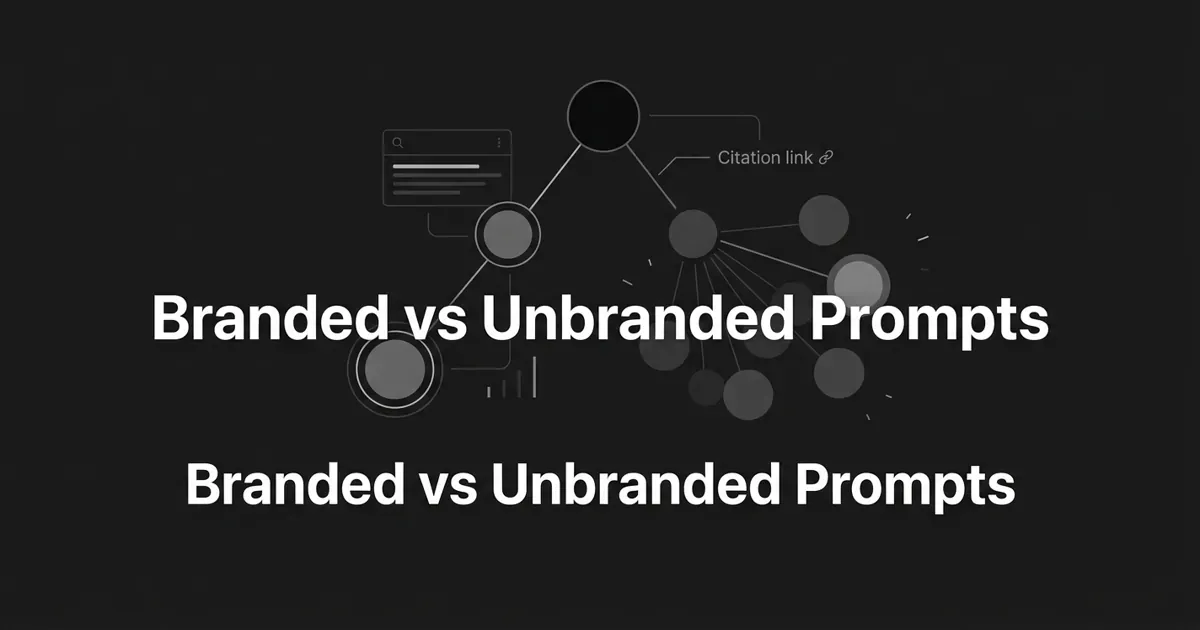
Branded vs unbranded prompts: the one difference that changes everything
Start with the definitions, because everything else hangs off them.
A branded prompt names you. "Is [your brand] worth it?" "[Your brand] vs a competitor." "Does [your brand] work for enterprise?" The brand is the subject of the question, so the brand is the expected answer. The user already chose to think about you.
An unbranded prompt names no one. "Best CRM software for startups." "Top tools for [your category]." "How do I solve [the problem you solve]?" The user describes a need. Now the AI has to decide which brands to surface, in what order, and why.
That is the branded vs unbranded prompts AI engines see all day, and they do completely different work for each. With a branded prompt, the model describes and judges something already named. With an unbranded one, it selects. It picks winners.
So the category prompt vs branded prompt split is really a split between two questions you should be asking yourself:
- Branded: how does AI describe me when someone asks about me? That is reputation.
- Unbranded: does AI bring me up when no one asked? That is discovery.
You need answers to both. But they measure different things, and confusing them is where a lot of teams fool themselves. Feeling good because you show up for your own name is easy. It is also the least meaningful win on the board.
What happens when someone names your brand
Good news first: on a branded prompt, you almost cannot lose the mention.
When the query already contains your name, the model has every reason to surface you. In any reasonable tracking setup, brand-prompt mention rates sit near 100 percent on the engines where you have any presence at all. You are the named entity. The AI is not deciding whether to talk about you. It is deciding how.
So what can you actually lose here? The framing. The sentiment. Which features get described, which get skipped, and which competitors get pulled into the answer beside you. That is the AI answer branded query behavior in a nutshell: description first, judgment second, and you do not control the pen.
This is why branded prompts are reputation monitoring, not visibility monitoring. The questions worth watching are these:
- Is the sentiment positive, neutral, or negative?
- Is the description accurate, or is the AI making things up?
- Are your real strengths included, or quietly left out?
- Which rivals show up alongside you?
- Which sources does the AI lean on as evidence?
That last one matters more than it looks. On branded queries, the sources skew toward your own site plus high-authority third parties: review platforms, comparison pages, analyst coverage. One 16-week study of roughly 3,000 brands found that on ChatGPT brand queries, company and product websites made up around 55 percent of citations early on and climbed past 60 percent over the window. Review platforms like G2 and Capterra crept up too. The model leans on your pages, plus the validation the rest of the web has already done for you.
One more quirk worth knowing. Branded answers tend to carry fewer citations. In that same data, brand queries averaged about five citations per ChatGPT answer, while category questions pulled around seven. A named brand is a focused question. The model does not need many sources to feel confident. That focus is exactly why branded prompts flatter you.
There is a catch here too. Engine behavior moves fast, and branded answers are sensitive to it. Over one stretch in early 2026, brand-query citations on ChatGPT dropped sharply for a few weeks before recovering. So even the AI answer branded query pattern you see today is a snapshot, not a fixed law. Watch the trend, not a single reading. The takeaway holds regardless: on a branded prompt, your presence is nearly guaranteed, and your energy is better spent auditing accuracy and sentiment than worrying about whether you appear.
What happens when no one names you
Now flip it. Someone asks the category question, and your name is not in it.
Here the whole game changes. The question is no longer how you are described. It is whether you are described at all. Inclusion becomes the metric that matters, and this is where your unbranded AI prompt visibility either exists or doesn't.
For most brands, it doesn't. A large 2026 study found that 90 percent of brands have zero AI search mentions on the category prompts in their space. Zero. The category-default winners are a small club, and everyone else is invisible when the buyer asks the question that counts. If that stings a little, take a breath. You are in very good company, and the gap is fixable.
Why is it so much harder? Because the AI is no longer leaning on your site. It is deciding who belongs in the category, and it makes that call using the rest of the web. One analysis of B2B SaaS categories found brands were about 6.5 times more likely to be cited through third-party sources than through their own pages on unbranded prompts. The signals doing the work:
- Cross-platform presence: you show up on G2, Capterra, listicles, Reddit threads, comparison pages.
- Entity associations: the model has learned you belong to this category and these use cases.
- Authority signals: backlinks, expert authorship, original research.
- Freshness: recent content proving you are still active and current.
Notice something. None of that happens at the moment of the prompt. It is presence you built before the question was ever asked. That is why unbranded coverage compounds, and why it cannot be faked on the day.
There is a silver lining. When an unbranded prompt does surface you, the tone is almost always kind. Sentiment across the major engines runs overwhelmingly positive, north of 90 percent on most of them. So the fight is not about controlling how you sound. It is purely about getting in the door. Category questions also carry more citations per answer, around seven on ChatGPT versus about five for branded ones, because the model has more brands to weigh and more claims to support.
Here is the reframe that helps. Your branded score and your unbranded AI prompt visibility are two separate scoreboards. The first is nearly always green. The second is the honest one. When leadership asks how you are doing in AI search, the branded number is the comforting answer and the unbranded number is the true one. Report both, and lead with the harder one.
Mention or citation? They are not the same thing
Here is a distinction that trips up almost everyone, and it sits right at the heart of your title. A mention and a citation are two different events.
A mention is when the AI names you in the text. It says your brand out loud in the answer.
A citation is when the AI links to a specific page of yours as the evidence behind a claim. It points a footnote at you.
You can get one without the other. The AI can describe you warmly and never link you. Or, stranger, it can cite your page as a source without ever naming you in the sentence. That second case has a name: a ghost citation. Your page did the work, but the reader scanning the answer never sees you.
Ghost citations are not rare. Across platforms, roughly 73 percent of AI citations are ghost citations, where the link is there but the brand name is not. On Gemini, that figure reaches 100 percent. Think about what that means. You could be one of the most-cited sources behind an answer and still feel invisible, because no human reading it registers your name.
So track both, separately. A high citation rate with a low mention rate tells you the model trusts your page but is not crediting you out loud. A high mention rate with few citations tells you the model knows you but is not backing its claims with your content. Different problems, different fixes. Lump them together and you will chase the wrong one.
Under the hood: why unbranded wins are so much harder
You do not need to be an engineer to get this. Two mechanics explain almost everything.
The first is retrieval. Before ChatGPT or Perplexity or Gemini writes a single word, a step called retrieval-augmented generation decides which sources the model is even allowed to draw from. If your pages are not in that retrieved set, you cannot be cited. Full stop. And retrieval rewards breadth and authority across many sources, not how much you publish on your own site. That is why so many citations come from earned, third-party media. The model is looking for corroboration, not a monologue.
The second is query fan-out. The AI takes one prompt and quietly explodes it into dozens of hidden sub-questions. "Best CRM for startups" becomes searches about pricing, integrations, ease of use, mobile support, migration, team size fit, and more. The engine answers all of them behind the scenes, then blends the result into one reply. If your content only speaks to the literal question and misses the hidden layers, you get filtered out before the answer is even written.
Put those together and you see the wall. An unbranded prompt asks you to satisfy retrieval across a fan-out of sub-questions, using sources you do not own. That is a lot of surface area. And even then, the bar is brutal: in one large retrieval study, ChatGPT pulled in hundreds of thousands of pages but used only about 15 percent of what it retrieved in the final answer. Being read is not the same as being cited.
Here is the part that should actually give you hope. Every one of those signals is buildable. None of it is luck. It is presence, structure, and coverage, laid down before the prompt arrives.
Different engines, same short list of brands
One more useful truth before we land this. The engines disagree on sources far more than they disagree on brands.
Compare the top cited domains across ChatGPT, Perplexity, Gemini, and Google's AI answers and the overlap can be as low as 16 percent. They reach for wildly different source types. ChatGPT spreads its citations across a long tail, so it surfaces smaller and lower-ranking pages more readily than the others. Perplexity behaves like a research librarian, favors trustworthy sources, and puts the large majority of brand mentions in the first few positions, though it leans hard on freshness and drops stale content within a couple of months. Gemini leans hardest on formal, authoritative domains and runs the most positive sentiment of the group. Google's AI surfaces lean more on user-generated content and review aggregators.
But compare the brands they ultimately recommend, and the overlap is much tighter. The divergence is in the path, not the destination. Different engines, roughly the same short list of winners.
What does that tell you? Do not optimize for one engine's favorite source. Optimize for breadth. If you are winning unbranded prompts on Perplexity but losing on ChatGPT, the cause is usually a source-mix gap, not a quality gap. Each engine has a default type of source it trusts, and your third-party footprint has to be wide enough to satisfy all of them at once.
Why unbranded coverage is the harder, higher-value win
Let's bring it home. If you only remember one thing, make it this: branded prompts confirm you own your name. Unbranded prompts confirm you own your category.
You can score 100 percent on your own name and 0 percent on your category at the same time. The two do not predict each other. Branded performance is a floor you were mostly handed. Unbranded performance is a summit you have to climb, because the model has to choose you when nothing in the prompt pointed its way.
That is also why it is worth more. The buyer who asks the unbranded question has not chosen you yet. Winning that answer is how you get discovered instead of merely described. It is where share of voice is actually won or lost, and where your competitors are quietly banking wins while their names, not yours, become the category default.
This is the throughline for branded vs unbranded prompts AI search, and it is worth saying plainly. Reputation is downstream of recognition. A great branded answer only helps the people who already knew to ask for you. The unbranded answer reaches the ones who didn't. The work to win it is the slow kind: third-party validation, source diversity, coverage of the hidden sub-questions, and the underlying presence that lets a model retrieve and name you when nobody pointed the way. It compounds, which is the good news. Every earned mention, every solid comparison page, every credible review makes the next unbranded win a little easier.
So what do you track? Both, but weighted. A sensible starting mix is roughly three unbranded prompts for every branded one. Branded prompts inflate your perceived visibility if you over-weight them, because you naturally ace your own name. Not sure where to begin? Start small. Run about 20 unbranded category prompts across the engines your buyers use, and read your inclusion rate. That single number, how often you show up when no one asked, is the honest scoreboard.
This is the moment a platform earns its keep. Watching branded and unbranded prompts by hand, across several engines, every week, is a real chore. AI visibility tools track both in one place, with per-prompt mention and citation rates and a per-platform breakdown, so you can read reputation and discovery side by side instead of guessing. DeepSmith is built for exactly this: see where you show up in AI answers, find the category prompts where you are missing, and produce the content that closes the gap.
You do not need to win every prompt this quarter. You need to see the gaps clearly and fix one at a time. Momentum matters more than perfection. Want to see where you stand? Start a free trial and run your first category prompts. The picture you get back is usually the push you needed.