You searched your own company in ChatGPT and it handed back a fact that stopped being true a year ago. Maybe it quoted a price you retired, named a founder who left, or described a product you have since rebuilt. If you are staring at ChatGPT wrong info about my brand and feeling that quiet panic, take a breath. This is fixable, and you do not need to fix all of it this week.
Here is the good news. The wrong answer is coming from one of two places, and once you know which, the fix gets much smaller. This guide walks a marketing lead through a workflow you can run this quarter to correct ChatGPT brand information, plus the mental model so you can adapt when OpenAI ships the next model. Let's start with why it happens at all.
The two ways ChatGPT repeats old facts
ChatGPT answers about your brand through two separate machines, and each one needs a different repair.
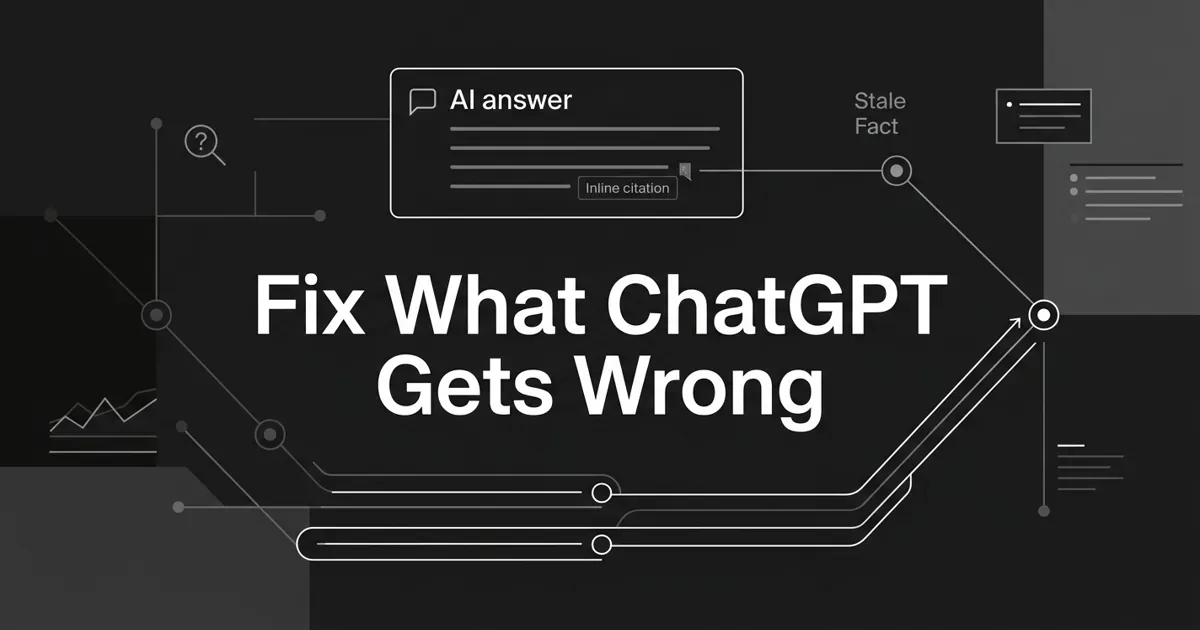
The first is training memory. The model learned facts about you during training and stores them in its weights. When it answers from memory, no web lookup happens and no source links appear. What you see is a snapshot of your brand frozen at the model's knowledge cutoff. Those cutoffs move with each version, and older facts that appeared consistently across many sources carry the most weight. That is why a retired detail can linger for months.
The second is live search. ChatGPT search, which launched in late 2024, rewrites your question into search queries, runs them against Bing, reads the top results, and writes an answer with inline citations. Roughly 87 percent of its citations match Bing's top organic results for the same query, so this track behaves like a re-ranked Bing snapshot. If a page with the old fact ranks on Bing, ChatGPT search shows it as if it were current.
Both machines can carry the same error. The difference is speed. Live-search fixes can land within days once the underlying page updates and gets re-crawled. Training-memory fixes wait for the next training run, which usually means months. So we fix the fast track first and set the slow track in motion at the same time.
Not sure which track your error came from? The next step sorts that out.
Step 1: Audit what ChatGPT says about you today
You cannot fix what you have not measured, so start by capturing the truth on the ground.
Open a fresh chat with no Memory and no custom instructions turned on. Ask the 15 to 25 questions a buyer would actually ask: your pricing, your alternatives, "what is [your brand]," "who founded [your brand]," and "[your brand] vs [competitor]." Screenshot every answer with the citation panel expanded. Then run the same prompts again in ChatGPT search mode so you capture the live-retrieval answers separately.
As you capture each answer, tag it right away: an answer with no links is training memory, an answer with inline citations is live search. That single tag is what turns a pile of screenshots into a plan. Note the specific wrong fact too, whether it is a retired price, an old headquarters, or a founder who has moved on, because you will want to confirm each one flipped later.
You will know this step is done when you have a labeled record of each wrong claim and the exact prompt that triggered it. Save the screenshots. You will re-run these same prompts in two weeks to see what moved, then diff the answers so you can see progress instead of guessing at it.
Where people go wrong: they check once, feel discouraged, and stop. The picture shifts week to week, so one snapshot is not enough. This is the repetitive part, and it is exactly the kind of thing a monitoring tool handles well. DeepSmith's AI Visibility module runs a defined prompt set on a schedule against ChatGPT and reports what was said and what was cited, which is this audit without the manual re-typing. The auditing is the work here, whether you do it by hand or let a tool run it.
Step 2: Sort each error into training memory or live search
Now label what you captured, because the label decides the fix.
Look at each wrong answer. Did it include inline citation links? That is a live-search error, and it is fixable in days to weeks by updating the cited pages. Did it answer confidently with no links at all? That is a training-memory error, and it needs the corpus to change before the next training run. Some facts are wrong on both tracks, so tag those as needing both.
You know this step is done when every wrong claim from Step 1 carries one of three tags: live search, training memory, or both.
The common mistake here is assuming everything is one problem. When you treat a training-memory error like a quick page edit, you update your site, see no change, and lose faith. The tag tells you what to expect and how long to wait.
Step 3: Fix the live-search errors first
Start here because this is where you get a win in days, and momentum matters more than perfection.
For each live-search error, find the cited URL. If it is your page, do three things: put the corrected fact in the visible body text (not only in schema), resubmit your sitemap, and ping Bing through IndexNow or Bing Webmaster Tools so it re-crawls fast. This is the fastest way to fix outdated ChatGPT brand facts, because live search re-indexes frequently and updates flow through quickly.
If the cited URL belongs to someone else, a directory, a review site, an old press release, or a Reddit thread, you fix it differently. Claim or update the listing where you can. For a Reddit thread that ranks, post a fresh, well-sourced thread in the same subreddit so it can outrank the stale one over time.
One thing to check before any of this: make sure ChatGPT can actually see your corrected page. OpenAI runs separate crawlers, and the one behind live search is OAI-SearchBot. If your robots.txt blocks it, your fix never reaches the retrieval index, and live search keeps quoting whatever it cached. Allow OAI-SearchBot and ChatGPT-User so your updated pages can be found and fetched. Blocking the training crawler, GPTBot, is a separate choice and does not erase anything the model already learned.
You will know this step worked when you re-test the same prompts a few days later and the citation now points to a page that states the right fact. If you are seeing ChatGPT old pricing, this is usually the track carrying it, especially when the number is scraped from a third-party page rather than your own. Watching a stale number get replaced by the current one is the clearest sign you can fix outdated ChatGPT brand facts on the fast track.
Where people go wrong: they update only their own site and forget the third-party page ChatGPT actually cited. Your site is one source among many. Fix the page that is being quoted, then confirm the corrected fact appears in plain body text and, where it applies, in schema.
Step 4: Correct your Wikipedia and Wikidata facts
If one source deserves its own workstream, it is this one. Wikipedia is the single most-cited domain in ChatGPT answers, and the model leans on it for entity facts: founding date, headquarters, leadership, history, product line. Get it wrong there and the error repeats almost verbatim.
Editing Wikipedia has rules, and following them protects you. If you have a financial relationship with the subject, disclose that conflict of interest on your user page and propose changes on the article's Talk page with reliable, independent, secondary sources. For a clearly verifiable correction, like a leadership change covered in the press, you can make a small cited edit with a clear summary. What gets reverted: promotional tone, undisclosed paid editing, citing only your own site, and AI-generated drafts pasted in whole.
Then handle Wikidata, the structured companion that AI systems use to tell one "Acme" from another. It is easier to edit and accepts a broader range of sources. Claim your brand's item, fill in the fields (official website, founder, inception, headquarters, industry, CEO), and add references from reputable secondary sources.
You know this is done when both the article and the Wikidata item state your current facts with citations. A quick reminder if no Wikipedia page exists: do not expect to force one. The notability bar for organizations is high and needs real independent coverage. When you cannot get a page, put your energy into Wikidata and the listings in the next step. Keeping your brand facts consistent across the web does more than any single edit.
Step 5: Refresh the third-party listings ChatGPT trusts
ChatGPT search treats certain platforms as primary sources for certain questions, so this step often matters more than editing your own site.
Write one internal "facts sheet" first: name, founded, headquarters, current leadership, pricing, positioning, and top products, in the exact wording you want to see everywhere. Then propagate that same text across the listings that show up disproportionately in ChatGPT citations. For B2B SaaS, that means G2, Capterra, TrustRadius, GetApp, and Software Advice. For most brands, add Crunchbase, your LinkedIn company page, Glassdoor, Google Business Profile, and Trustpilot.
You will know this step is done when every major listing reads back your facts sheet nearly word for word.
Here is the pro tip that makes this work: identical phrasing across sources is itself the signal. When many trusted pages say the same thing the same way, ChatGPT treats that phrasing as the truth. Small wording differences between listings are how the old fact survives, because the model tends to pick the most common phrasing, which is often the oldest.
Step 6: Add schema so crawlers read the right numbers
This step is quieter than the others, and it quietly reinforces everything else you just did.
Schema markup does not feed ChatGPT's training directly, but it helps Bing and other crawlers parse your pages cleanly, and structured content is increasingly extractable for AI answers. Deploy Organization schema on your homepage and About page, Product schema on product and pricing pages, and FAQPage schema on your FAQ and pricing pages. Use JSON-LD, and validate it before you ship.
You know this step is done when your key pages carry valid schema and, crucially, the schema matches the visible text on the page.
Where people go wrong: the visible page says one price and the structured data says another. That mismatch reads as suspect to both search engines and AI extractors, and it can even reintroduce the old number you were trying to retire. The right schema types genuinely help AI citations, but only when they agree with what a reader sees.
Step 7: Change the corpus for the training-memory track
This is the slow track, so set it moving now and let it work in the background while the fast fixes land.
You cannot submit a correction to OpenAI for a single fact. OpenAI has said plainly that it cannot reliably correct a specific false statement in ChatGPT's outputs. So instead of asking for an edit, you change the evidence. The principle is convergence: get the corrected fact to appear identically and authoritatively across enough high-authority sources that the next training run absorbs it as the dominant signal.
Your minimum corpus is your own canonical pages (About, Product, Pricing, Leadership), Wikipedia and Wikidata, the major third-party listings, and at least two independent press mentions that state the corrected fact. Then accelerate it with fresh coverage that all says the same thing: a wire press release when pricing or positioning changes, a contributed piece in a trade publication that names the corrected fact in the headline, a short podcast run with consistent messaging, and inclusion in reputable "best of" lists. Skip the low-quality directories and AI-written spam; Bing deprioritizes them and AI retrieval increasingly ignores them.
You know this track is progressing when the corrected fact shows up, worded the same way, across a growing set of authoritative pages. Expect three to six months for entrenched facts to shift, sometimes longer. This is how you durably update what ChatGPT says from memory, and it is the patient half of the job.
Step 8: Clean your own Memory and report the worst errors
One last check, because sometimes the "wrong" answer is only wrong for you.
ChatGPT Memory is a per-user store. If you or a teammate discussed the brand months ago, an outdated framing may be saved to that account and coloring every answer you personally see. Open Settings, then Personalization, then Memory, and clear anything stale. Just know this only fixes your own view. You cannot reach another user's Memory, so the real fix is still upstream in the steps above.
For genuinely harmful errors, use the thumbs down and the Report option under the message. These feed OpenAI's evaluation pipeline in aggregate. They will not edit a specific answer or send you a confirmation, so treat feedback as a signal you add on top of the real work, never as the fix itself.
You know you are done when your own Memory is clean and you have flagged the egregious cases, then returned your attention to the corpus and the cited pages, where the durable change happens.
What to do next
Take it one track at a time. This week, run the audit and fix the live-search errors, because that is where you see change fastest and feel the momentum. Next, open the Wikipedia, Wikidata, and listings workstream, then let the corpus work do its slow, compounding thing over the coming months.
The only part that truly needs to repeat is the watching. Facts drift, models update, and new pages rank. If you would rather not re-type 20 prompts every two weeks, DeepSmith's AI Visibility module tracks what ChatGPT says and cites about your brand on a schedule, so you catch the next stale fact early instead of by accident. It shows you what changed; the edits above are still yours to make. You can start a free trial and point it at your own prompts to see where you stand today.
You are closer to a clean record than it feels right now. Fix one track this week, and you have already started.