The choice in DeepSmith vs Getairefs is not a choice between two categories. Both tools measure how a brand appears inside generative AI answers, and both attach some article production to that measurement. The real fork is scope. Getairefs is a tracker-first product that adds a small monthly batch of articles. DeepSmith is a tracker joined to a full content production pipeline, where the same workspace plans, writes, schedules, publishes, and distributes. Which one fits depends on a single question: is measurement the bottleneck, or is content output the bottleneck?
This comparison sets the two tools side by side for a marketing lead deciding where to spend a limited budget. It treats each product honestly, names the real limits, and keeps the recommendation tied to the reader's situation rather than to a winner declared in advance. Both belong to the growing set of ai visibility tracking tools that report whether AI engines cite a brand, and both are legitimate choices for different teams. Readers arriving here often want one specific answer: whether DeepSmith works as a Getairefs alternative, or whether the lighter tracker is enough on its own.
A note on naming before the detail. The product marketed at getairefs.com appears on its own site under the brand Airefs. This article uses Getairefs to match the way most buyers search for it, and Airefs where the on-site brand is the clearer reference. They are the same product.
DeepSmith vs Getairefs at a glance
| Dimension | Getairefs (Airefs) | DeepSmith |
|---|---|---|
| Category | AEO tracker with light article production | AEO tracker with a full content production engine |
| Prompt-level engines | ChatGPT by default; Google AI Overview as a paid add-on | ChatGPT (Pro), plus Perplexity (Grow), plus Gemini (Scale), all ten engines (Enterprise) |
| Crawler analytics | Tracks ChatGPT, Claude, Gemini, and Perplexity bots hitting the site | Not the primary surface; focus is prompt-level visibility |
| Visibility metrics | Mention rate, share of voice, source identification | Mention Rate, Citation Rate, Share of Voice, Sentiment, Visibility Trend |
| Content produced per month | 1, 3, or 6 articles by tier; extra articles at $7 each | 20, 40, or 90 articles by tier |
| Production posture | AI-written drafts optimized for AI search | Publish-ready articles: researched, linked, cover image, metadata |
| Automation | None publicly documented | Autowrite schedules unattended generation on a set date |
| Brand context layer | Not publicly documented | Deep IQ stores company, product, persona, voice, and visuals |
| Distribution | Discussions module drafts Reddit, Quora, and LinkedIn replies | Repurpose plus Apps Library across many channels |
| Publishing destinations | WordPress plugin | WordPress, Webflow, Strapi, Sanity, Contentful, webhooks; Markdown and HTML export |
| Entry price | $24 per month annual (Lite), $29 monthly | $80 per month annual (Pro), $99 monthly |
| Top published price | $83 per month annual (Expert), $99 monthly | $299 per month annual (Scale), $399 monthly; Enterprise custom |
The table shows the pattern that runs through the rest of this comparison. On measurement, the two products overlap heavily. On production, they diverge by an order of magnitude. Reading the table by row is the fastest way to see which differences matter for a particular team.
What Getairefs is, and what it does well
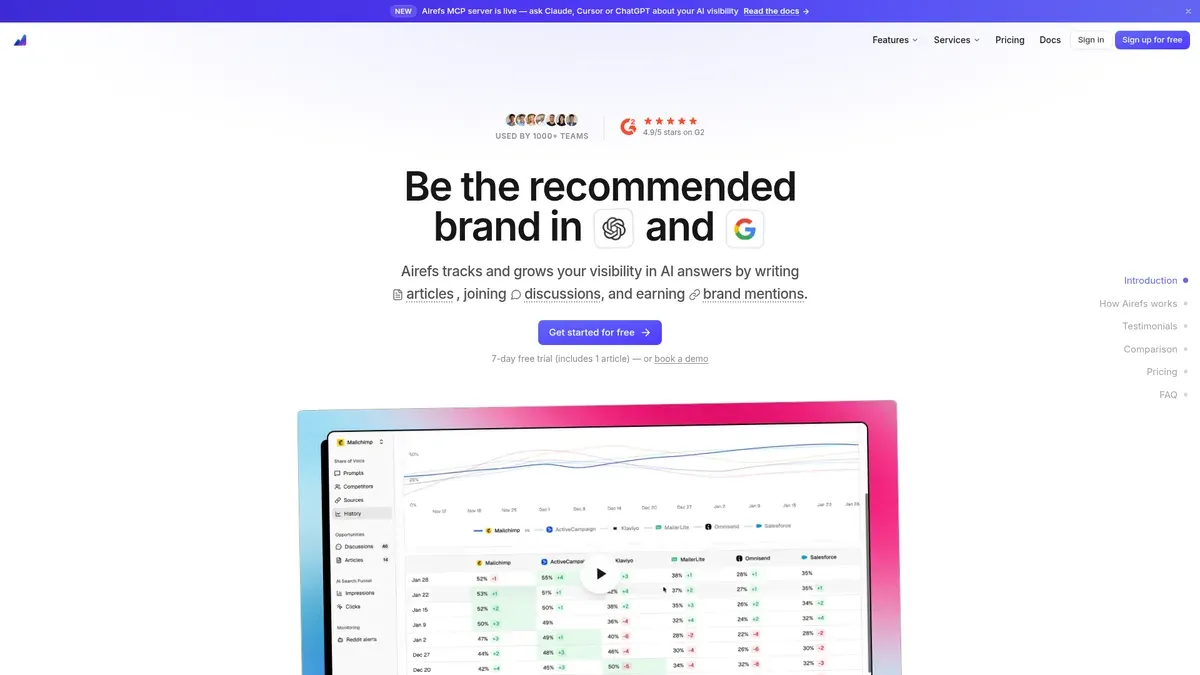
Getairefs positions itself around a single promise: to make a brand the recommended answer in ChatGPT and Google AI Overview. Founded in 2025 by Paul Boudet and Ozan Sener, it reports use by more than 1,000 teams and a 4.9 out of 5 rating on G2. As a getairefs visibility tracker, it is deliberately lean, and that focus is its main strength.
The product exposes two distinct measurement surfaces that are worth separating clearly, because the marketing language can blur them. The first is crawler and referral analytics. Getairefs tracks when AI crawlers from ChatGPT, Claude, Gemini, and Perplexity hit a site, reporting them as AI Crawler Impressions, and it counts AI Visitor Clicks, the referral visits that arrive from AI answers. This surface is server-side traffic analytics. It tells a team which bots are reading its pages and which answers are sending human visitors back.
The second surface is prompt-level visibility tracking, and it is the part most buyers mean when they call the product a getairefs visibility tracker. Here a team defines the questions buyers ask and Getairefs checks how the brand appears in the answers. This surface defaults to ChatGPT. Google AI Overview is available as a paid add-on, priced at $10, $20, or $30 per month depending on the plan. The distinction matters for anyone evaluating engine coverage, because the claim that the tool tracks the major LLMs describes the crawler analytics, not the prompt-level layer. At the prompt layer, Getairefs is ChatGPT-first with Google AI Overview as an upsell.
Around those two surfaces sit several practical features. Share of Voice is reported per prompt against competitors. Source identification names the specific URLs that an engine cited when it answered, which gives useful transparency into why a citation happened. A backlink opportunities view surfaces the third-party sites that AI leans on. Article recommendations produce a content gap list. The Discussions module is a distinctive touch: it surfaces Reddit, Quora, and LinkedIn threads that AI cites or that match tracked keywords, and it drafts replies, which suits teams that treat community participation as part of their visibility strategy.
Production exists, but it is metered. Getairefs writes 1, 3, or 6 AEO articles per month depending on tier, with additional articles at $7 each beyond the allowance. An official WordPress plugin, listed on WordPress.org, handles publishing into that one system. The honest read is that Getairefs writes to supplement a content operation, not to run one.
What DeepSmith is, and where its scope extends

DeepSmith is one platform for AI search analytics and content production. The intent is direct: see where a brand shows up in AI search, find the gaps, and close them with on-brand content, all in one place. Its production stance is a production engine, not a writing assistant, and its output is publish-ready, not a first draft to rescue.
On the measurement side, DeepSmith tracks five named metrics: Mention Rate, how often AI names the brand; Citation Rate, how often AI links to the brand's pages as sources; Share of Voice, visibility relative to competitors; Sentiment, whether AI describes the brand positively, neutrally, or negatively; and Visibility Trend, the period-over-period change. It also reports which sources AI cites most and which competitor pages win citations, with a per-platform breakdown. The engine catalogue is ten: ChatGPT, Gemini, Perplexity, Claude, Google AI Overviews, Google AI Mode, Grok, Meta AI, Microsoft Copilot, and DeepSeek. Coverage rises by tier. Pro tracks ChatGPT; Grow adds Perplexity; Scale adds Gemini; Enterprise and Custom cover all ten. A team that needs measurement across more than one engine at the prompt level will pay for DeepSmith's higher tiers to reach it. What the higher tiers buy is a ceiling of ten engines, against a Getairefs prompt layer that is ChatGPT-first with Google AI Overview added only as a paid extra. Single-engine tracking at the entry price is common to both products; the real difference is how far above it each one can go, and at what cost.
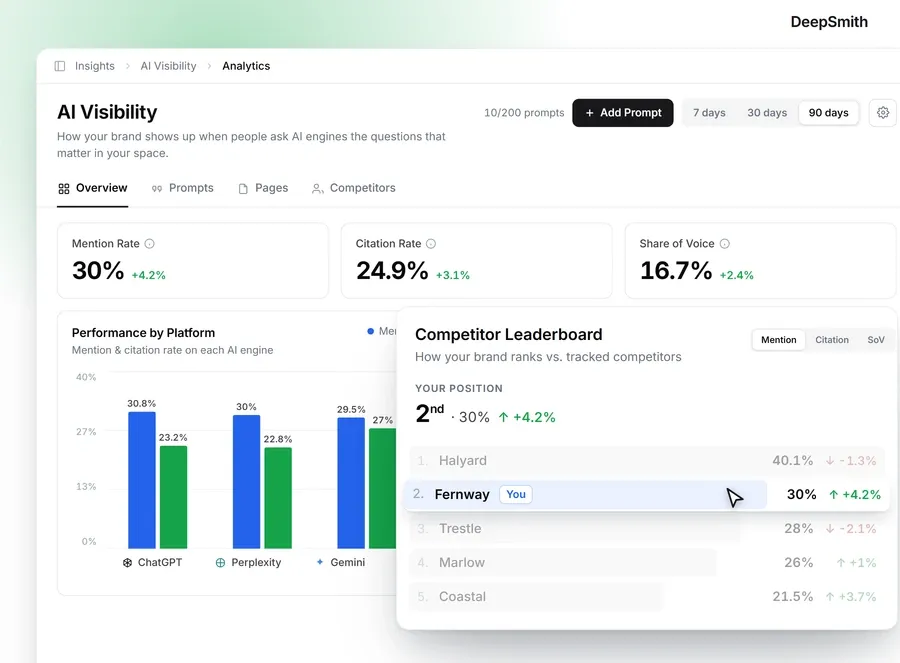
Where the two products separate is the rest of the platform. DeepSmith is organized as seven modules that share one brand context. AEO visibility handles the tracking already described. Content Map turns the brand's own site and its competitors' sites into a single topic taxonomy, so coverage gaps and untapped topics become a measurement rather than a hunch. Opportunity Agents read that data and return content ideas with the justifying data point attached to each one. Content Studio runs the production line from New Ideas to Planned Content to the Writer to Produced Content. The Writer turns one planned idea into a finished article that is researched, internally and externally linked, given a cover image, and fitted with publish-ready metadata. Autowrite takes this further by generating a scheduled article unattended on its planned date, which converts a content calendar from an intention into a process that runs without anyone in the app.

Two more layers give the production its consistency and reach. Deep IQ is the brand context store, holding company positioning, product profiles, persona detail, brand voice, visual guidelines, and reusable content types. Every module reads from this layer, which is how output stays on-brand and factually accurate about the product as volume climbs. Distribution is handled by Repurpose, which arrives with social posts already written for each finished article, and the Apps Library, which turns one article into native versions for channels including LinkedIn, X, Medium, Substack, newsletter and email, Reddit, Facebook, Instagram, and Slack or Discord. Publishing reaches WordPress, Webflow, Strapi, Sanity, Contentful, and custom webhooks, with Markdown and HTML export as a fallback.
The claim boundary is worth stating plainly, in fairness to both tools. DeepSmith tracks mention and citation; it does not control or guarantee rankings, citations, traffic, or revenue. What the platform does is report visibility and produce content against it. What that turns into commercially depends on the team using it, and this comparison does not extend past what the two products do.
Coverage and measurement compared
For a team whose only requirement is measurement, the two products are closer than the price gap suggests. Both report share of voice against competitors, both identify the exact sources behind a citation, and both give a defensible read on where a brand stands in AI answers. If the tracked engine is ChatGPT and the budget is tight, Getairefs delivers the core of what most ai visibility tracking tools promise at a lower entry price.
The divergence appears at two edges. The first is engine breadth at the prompt layer. Getairefs tracks ChatGPT by default and adds Google AI Overview as a paid extra, while DeepSmith adds Perplexity, Gemini, and the rest of its ten engines as the plan tier rises. A team that needs a single dashboard covering several answer engines finds it in DeepSmith, at the tier that carries the engines it cares about. The second edge is crawler analytics, where Getairefs has a clearer offering. Its AI Crawler Impressions and AI Visitor Clicks give a server-side view of which bots read the site and which answers send traffic back, a surface DeepSmith does not center. A team that wants that traffic-side telemetry specifically has a real reason to prefer Getairefs. The bound on it is what the surface actually measures: crawler impressions and visitor clicks report which bots read the site and which answers referred traffic, not whether the brand is named or cited inside the answer itself. That prompt-level question, the one most buyers mean when they call a product a visibility tracker, remains ChatGPT-first in Getairefs unless the Google AI Overview add-on is purchased.
Neither tool should be evaluated as a guarantee of outcomes. Both measure visibility; neither promises citations, rankings, or revenue. The metrics they report are directional signals for a strategy, not levers that force an engine to cite a page. Reading them that way keeps expectations realistic and keeps the comparison on the ground where a buying decision actually happens.
Production and distribution compared
Production is where the choice stops being close. Getairefs writes 1, 3, or 6 articles per month by tier, with extra pieces at $7 each. DeepSmith writes 20, 40, or 90 per month at its three published tiers. For a team producing content elsewhere and wanting a tracker with a few articles attached, the Getairefs allowance is a reasonable supplement. For a team whose bottleneck is output, the difference is not incremental; it is the difference between a supplement and an engine.
The posture of the output differs as much as the volume. Getairefs produces AI-written drafts optimized for AI search. DeepSmith produces articles that are already researched, internally and externally linked, fitted with a cover image, and given publish-ready metadata, then optionally generated unattended through Autowrite. The gap matters most for the marketing lead who spends more time editing and formatting drafts than deciding what to write, because a draft that still needs structure, links, and metadata is a draft that still consumes the reviewer's hours. Grounding every piece in a stored brand context layer is what keeps that volume from drifting off-voice or inventing product claims.
Distribution follows the same split. Getairefs approaches distribution through its Discussions module, drafting replies for Reddit, Quora, and LinkedIn threads that AI cites or that match tracked keywords, which is a community-participation model. DeepSmith approaches it through Repurpose and the Apps Library, turning each finished article into channel-native posts across LinkedIn, X, Medium, Substack, newsletter and email, and more. These are different theories of distribution, and the right one depends on whether a team's audience lives in forum threads or in owned and social channels. On publishing destinations, DeepSmith reaches WordPress, Webflow, Strapi, Sanity, Contentful, and webhooks, while Getairefs ships to WordPress through its plugin.
Price and total cost compared
On headline price, Getairefs is the cheaper starting point. Its Lite plan runs $29 per month, or $24 on annual billing, and its top published Expert plan reaches $99 per month, or $83 annual, with a dedicated AEO strategist included at that tier and a custom Agency plan above it. DeepSmith starts at $99 per month, or $80 annual, on Pro and reaches $399 per month, or $299 annual, on Scale, with a custom Enterprise plan above that. Both offer a 7-day free trial. A team comparing the two on the entry line alone will see Getairefs come in lower.
Headline price is not the same as total cost, and this is where the situation should drive the reading. If a team buys Getairefs for tracking and continues to produce content through a separate writing tool, a freelancer roster, or an agency, the true monthly spend is the Getairefs subscription plus that production stack. If a team buys DeepSmith and retires the separate writing and distribution tools because production and repurposing live inside the platform, the comparison shifts from subscription-versus-subscription to stack-versus-stack. The metered article allowance in Getairefs makes this concrete: at $7 per additional article beyond the plan, a team that tries to push real volume through it will watch the effective cost climb toward the price of a dedicated engine without gaining one. The honest framing is that Getairefs is cheaper when the job is measurement, and DeepSmith is often cheaper in total when the job is measurement plus meaningful output.
Which should you choose
The cleanest way to decide between DeepSmith or Getairefs is to name the binding constraint before comparing features.
Choose Getairefs when measurement is the constraint and budget is the ceiling. It fits a team that needs visibility tracking on ChatGPT and Google AI Overview at the lowest possible subscription, values source-level transparency into which URLs earned each citation, wants the crawler and referral analytics that show which bots read the site, and treats community threads as part of the strategy through the Discussions module. If content is already produced elsewhere and only a small monthly article allotment is needed on top of tracking, Getairefs is the lean and lower-cost option, and adopting it as the tracker while keeping an existing writing workflow is a coherent plan.
Choose DeepSmith when content output is the constraint. It fits a team that needs 20 to 90 articles per month, on a calendar, in a consistent brand voice, with tracking and production sharing one workspace and one context layer. It fits a team that needs engine coverage beyond ChatGPT, that wants hands-off scheduled generation rather than babysitting each draft, that needs direct publishing into WordPress, Webflow, Strapi, Sanity, Contentful, or webhooks, and that wants distribution built into each article rather than deferred to a separate project. For that team, DeepSmith works as a Getairefs alternative that closes the production gap the lighter tool leaves open.
When both measurement and output are constraints at once, the integration argument decides it. DeepSmith wins on the strength of one brand context feeding both the tracking and the writing, while Getairefs wins on price but leaves the team to assemble and pay for a separate writing and distribution stack. The question is not which tool is better in the abstract; it is which bottleneck is costing the team more right now.
If the bottleneck is output and a unified system is the goal, DeepSmith offers a 7-day free trial that populates a workspace with real data and real drafts before any payment. Teams that want to test the production claim directly can start a DeepSmith free trial and judge the drafts against their own bar.