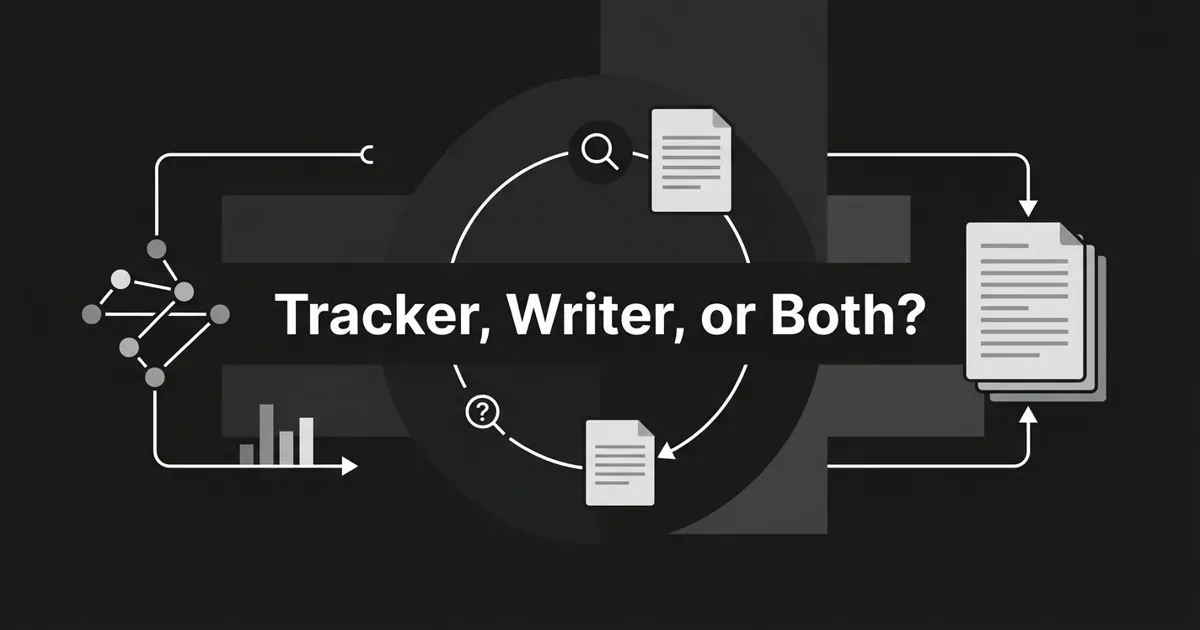
Most shortlists in this category mix product types that are not actually substitutes. A deepsmith vs profound vs writesonic evaluation is a case in point, because the three products represent three different answers to the same operating question: whether AI search visibility should be measured by one system and acted on by another, or measured and acted on inside the same one.
Profound is a dedicated tracker. It measures how AI engines answer questions about a brand, in considerable depth, and stops there. Writesonic is a writer that added a visibility layer. It produces long-form articles at volume and reports on a small set of engines alongside that output. DeepSmith is an ai visibility and content platform in the literal sense: tracking and production run as one loop, where the prompts a brand loses and the competitor pages winning citations feed the article queue directly.
Those are three archetypes, not three feature lists, and the archetype is what determines the shape of the content operation around the tool. This comparison examines each on engine coverage, production capability, price at the tier a real program runs on, and the handoff cost that sits between measurement and published work. It does not cover the pure-tracker field or workflow-builder platforms, and it does not treat any of the three as a general-purpose writing assistant.
The three archetypes at a glance
Figures below come from each vendor's published pricing and product pages, plus third-party reviews for Profound and Writesonic. Anything not publicly confirmed is marked as such rather than estimated.
| Dimension | DeepSmith | Profound | Writesonic |
|---|---|---|---|
| Archetype | Track and produce in one | Dedicated tracking only | Writer first, tracking layered on |
| Entry tier | Pro, $99/mo, or $80/mo annual | Starter, $99/mo annual | Starter, $99/mo, or $79/mo annual |
| Mid tier | Grow, $199/mo, or $160/mo annual | Growth, $399/mo annual | Basic $199/mo annual, Growth $399/mo annual |
| Enterprise | Custom | Custom | Custom |
| Engines at entry tier | ChatGPT | ChatGPT | ChatGPT, Gemini, Google AI Overviews |
| Engines at mid tier | ChatGPT, Perplexity | ChatGPT, Perplexity, Google AI Overviews | Same three |
| Engines at top tier | Ten: ChatGPT, Gemini, Perplexity, Claude, Google AI Overviews, Google AI Mode, Grok, Meta AI, Microsoft Copilot, DeepSeek | Up to nine | Up to ten |
| Tracked prompts | 50 / 100 / 200 / custom | 50 / 100 / custom | 50 / 100 / 200 / unlimited |
| Articles per month | 20 / 40 / 90 / custom | None | 15 / 25 / 50 / custom |
| Content production | Writer, Autowrite, direct CMS publishing | None | AI Article Writer, agentic pipeline |
| Site audits | Content Map coverage analysis, not technical audits | Agent Analytics for crawler behavior | SEO Checker and Optimizer, 100 to 2,500 pages by tier |
| Seats at entry tier | 5 | 1 | 1 |
| Free trial | 7 days, self-serve | Demo-gated, no self-serve trial | 7 days, self-serve |
Two rows carry most of the weight in a deepsmith vs profound vs writesonic decision: production capability, and the price of the tier where multi-engine tracking actually begins. The rest of this comparison works through both.
Profound: the dedicated tracker

Profound is an enterprise-grade AEO platform built for measurement and benchmarking. Answer Engine Insights reports per-prompt mention and citation rates with full answer history. Prompt Volumes estimates how often a given prompt is asked, using proprietary data. Shopping Agent Analytics tracks product visibility inside ChatGPT Shopping surfaces. Profound Sheets provides spreadsheet-style workflows for managing prompts, sources, and competitors, and is available at every tier.
The most genuinely differentiated surface is Agent Analytics, which measures how AI crawlers such as GPTBot, ClaudeBot, and PerplexityBot interact with a site: which URLs they request and how server resources respond. That capability runs at the edge or origin through integrations with Akamai, AWS, Cloudflare, Fastly, Google Cloud Platform, Netlify, and Vercel. Neither of the other two platforms in this comparison surfaces crawler behavior at that level. For an enterprise team whose AEO problem is partly an infrastructure problem, that is a real reason to choose Profound and not a marketing distinction.
Enterprise breadth is the second real strength. Profound's top tier covers up to nine engines, spanning ChatGPT, Google AI Mode, Google AI Overviews, Gemini, Microsoft Copilot, Perplexity, Grok, DeepSeek, Claude, and Meta AI, and adds custom regions and languages, an API, SSO and SAML with SOC2, a dedicated Slack channel, and a dedicated specialist on a 24-hour SLA. Teams with procurement and security review baked into every purchase will find that tier easier to defend than a self-serve subscription.
The limits are structural rather than incidental. Profound does not write or publish anything. Its recommendations live in dashboards, reports, and exports, which means the work of turning a visibility gap into a published page happens in a separate tool, on a separate budget, with a separate owner. The tracking is deep, and the tracking is where the product ends.
Coverage economics are the second constraint. Starter at $99 per month annual tracks ChatGPT only, and multi-engine coverage begins at Growth, which is $399 per month annual for three engines and 100 prompts. There is also no self-serve free trial at any tier: evaluation is demo-gated and sales-led, so the fastest path to seeing real data on a real prompt set involves a calendar invitation rather than a signup form.
Writesonic: the writer with a visibility layer

Writesonic approaches the problem from the opposite direction. It began as an AI writing product and now positions itself as an AI Search Growth Engine covering GEO, AEO, and AI visibility together. The writing side remains the deeper half of the platform, and the honest reading of writesonic vs deepsmith or writesonic vs any dedicated tracker starts there.
The AI Article Writer is a genuinely substantial pipeline: over 100 steps, eleven expert frameworks, awareness of E-E-A-T and the Helpful Content Update, articles in the 3,000 to 8,000 word range, research with real citations, a Humanizer pass that strips AI tells, and image generation through GPT-Image-2 and Nano Banana Pro. Alongside it, the SEO Checker and Optimizer runs site audits, scaling from 100 pages per audit on Starter to 2,500 on Growth. Integrations reach WordPress, Ghost, Webflow, Sanity, Contentful, Notion, Google Docs, Slack, Google Drive, Ahrefs, Google Search Console, Looker Studio, MCP, and an open API.
Scale is on Writesonic's side as well. The company reports more than 10,000 customers and names logos including Amazon, Unilever, Acer, OECD, Zoho, and iHeartMedia, and has been Y Combinator-backed since 2021. Its visibility data draws on a stated dataset of more than two billion AI conversations across 50-plus markets, refreshed weekly. DeepSmith and Profound do not publish comparable customer counts, so on raw installed base Writesonic is the largest of the three. That installed base was built by the writing product over several years, and the visibility tracker is the newer addition, so the customer count evidences the maturity of the writer rather than the depth of the tracking layer.
The price of entry is also the lowest of the three. Starter is $79 per month annual with 15 articles, 50 prompts, and three tracked engines, which is more engine coverage at the entry tier than either DeepSmith Pro or Profound Starter provides. For a team whose first requirement is a directional signal across ChatGPT, Gemini, and Google AI Overviews while it publishes, that entry tier is a defensible purchase. What the extra dollar buys elsewhere is worth noting: DeepSmith Pro at $80 per month annual carries 20 articles and five seats against Starter's 15 articles and a single seat, so the cheaper plan is also the smaller one on capacity and team access.
What bounds it is that the three engines do not grow. Starter, Basic, and Growth all track the same three: ChatGPT, Gemini, and Google AI Overviews. Claude, Perplexity, Grok, DeepSeek, Microsoft Copilot, Meta AI, and Google AI Mode all require Enterprise. A team paying $399 per month annual for Growth is paying roughly four times the entry price and receives 50 articles, 200 prompts, sentiment analysis, and larger site audits, but not a single additional engine. Perplexity in particular sits behind an Enterprise conversation, which is a notable gap for a platform sold on AI search visibility.
The Action Center follows a similar pattern. Its prioritized off-page actions, covering citations and digital PR, and on-page actions, covering content and technical fixes, are the mechanism by which tracking is supposed to become work. On Growth, that mechanism is metered at five off-page and five on-page actions per month, and the full version arrives only at Enterprise. Brand Explorer, Page Tracker, and Prompt Explorer are likewise Enterprise surfaces. The bundle is real, and at the self-serve tiers the tracking half of it is deliberately shallow. That is consistent with the platform's history: the writer is the mature product, and the visibility layer is the newer addition.
DeepSmith: tracking and production as one loop

DeepSmith is an ai visibility and content platform that tracks mention rate, citation rate, share of voice, sentiment, and visibility trend across ten engines: ChatGPT, Gemini, Perplexity, Claude, Google AI Overviews, Google AI Mode, Grok, Meta AI, Microsoft Copilot, and DeepSeek, with coverage rising by tier. The AEO module reports a per-platform breakdown, a competitor leaderboard, and the sources AI cites most. Prompts carries per-prompt mention and citation rates with full answer history, and Discover Prompts generates a starter prompt set from stored product, persona, and buyer-stage context. Pages shows which of a brand's own pages AI actually cites and which prompts drive those citations. Competitor citations shows who wins the same prompts, on which exact pages, and how each rival performs by platform.

That measurement layer resembles what a dedicated tracker provides. The difference is what happens next. Content Map crawls the brand's own site and an unlimited number of competitor sites onto one topic taxonomy, classifying every page by granular topic and funnel stage, then reports coverage gaps where a rival publishes more and untapped topics where a rival publishes and the brand has nothing at all, all re-checked every 24 hours. Opportunity Agents read that map, or the AI visibility data beside it, and return ideas with the justifying data point attached to each one: the tracked prompt being lost, the competitor citation worth taking, the decision-stage gap left open. Everything lands in New Ideas, the single backlog, where giving an idea a date turns it into Planned Content.
The Writer turns one planned idea into a finished, brand-grounded article: researched, internally and externally linked, with a cover image and publish-ready metadata. Autowrite removes the human from the loop entirely, writing a configured article on its scheduled date and landing it in Produced Content with no one in the app. From there, articles publish directly to WordPress, Webflow, Strapi, Sanity, or Contentful, or to custom webhooks, with Markdown and HTML export as a fallback. Every finished article arrives with social posts already written, and the Apps Library generates platform-native versions for LinkedIn, X, Medium, Substack, newsletter and nurture email, Reddit, and more.

Underneath all of it sits Deep IQ, a structured brand context layer holding company positioning, product profiles, buyer personas, brand voice, visual guidelines, and content types. It is set up once from the website during onboarding and used by every module, which is the mechanism by which output stays on-brand as volume rises rather than drifting. Content Map supplies the other half of that shared context, powering internal links, coverage signals, and deduplication from the same enriched page index the gap analysis runs on.
Pricing is Pro at $99 per month, or $80 annual, with 20 articles, 50 prompts, five seats, and ChatGPT; Grow at $199, or $160 annual, with 40 articles, 100 prompts, seven seats, and ChatGPT plus Perplexity; Scale at $399, or $299 annual, with 90 articles, 200 prompts, ten seats, and Gemini added; and custom Enterprise covering all ten engines with 1:1 onboarding and a dedicated account manager. A 7-day free trial runs on real data and real drafts, with no long-term contracts and no cancellation fees.
Coverage arrives by tier rather than all at once, and where it arrives is the thing to price. DeepSmith reaches multi-engine tracking at $160 per month annual, well below the $399 per month annual that both Profound Growth and Writesonic Growth require, and it does so with production included. Pro at the entry price tracks ChatGPT alone, which is where most buyer research starts, and the full ten engines sit at Enterprise alongside custom limits on every other metric.
Profound vs Writesonic: two ways to leave a gap open
The profound vs writesonic question is easier to resolve than it looks, because the two products fail in opposite directions. Profound measures deeply and produces nothing. Writesonic produces at volume and measures shallowly until Enterprise. Neither closes the loop on its own at the tiers most teams buy.
A team running Profound Growth at $399 per month annual gets three engines, 100 prompts, 9,000 responses per month, exports, and Profound Sheets, then needs a separate writing system to act on any of it. A team running Writesonic Growth at $399 per month annual gets 50 articles, 200 prompts, three engines, sentiment analysis, and a metered Action Center, then needs to accept that Perplexity, Claude, and Google AI Mode are not being watched at all.
Both paths therefore end at the same place, which is two subscriptions or one accepted blind spot. That is the fragmentation problem sitting underneath most martech consolidation work: overlapping tools, unused capability, and a workflow that crosses a boundary at the exact point where insight should become output.
What an aeo tool comparison usually leaves out
Most feature grids stop at engine counts and article quotas. The variable those grids miss is the handoff, meaning the human and operational cost of carrying a finding from the dashboard where it appears to the page that answers it.
In a two-tool stack, that handoff is a set of manual steps: someone reads the tracker, decides which gaps matter, writes a brief, briefs a writer or a separate AI writing tool, waits, reviews the draft against the original finding, adds internal links, sources a cover image, writes metadata, and publishes. The steps are unglamorous, they recur on every piece, and they are the reason identified gaps sit unclosed for months. An aeo tool comparison built only on capability checkboxes will price the two subscriptions correctly and ignore the labor between them entirely, which is usually the larger number.
The integrated architecture removes that boundary rather than optimizing it. When the tracked prompt, the competitor page winning it, the brand context, the content map, and the writer live in one system, the gap becomes a queued article without a rebrief, and Autowrite can carry it to Produced Content on a schedule. This is the substantive claim in any writesonic vs deepsmith or Profound comparison: not that the measurement is better, but that measurement and production share the same data and the same queue.
That advantage is conditional. A team with a mature content operation, dedicated writers, and an established brief process may already have a cheap handoff, in which case a dedicated tracker beside an existing workflow is the rational purchase. The integrated model pays off where the team is small, the handoff is expensive, and the backlog of identified gaps is longer than the capacity to close it.
Which should you choose
Choose Profound when AI visibility measurement is the requirement and content production is already handled elsewhere. Enterprise teams that need crawler-level Agent Analytics at the edge, custom regions and languages, SOC2 with SSO and SAML, and a dedicated specialist on an SLA are buying capabilities the other two do not offer. The budget assumption is $399 per month annual minimum for three engines, custom pricing above that, and a separate line item for whatever produces the content.
Choose Writesonic when the primary need is producing long-form SEO content at volume and a three-engine signal is sufficient. The AI Article Writer is a deep pipeline, the bundled site auditing has independent value, and the $79 per month annual entry price is the lowest of the three. The trade is that engine coverage stops at ChatGPT, Gemini, and Google AI Overviews through Growth, and the Action Center is metered until Enterprise.
Choose DeepSmith when the same team is responsible for both knowing where the brand is invisible and fixing it. The fit is strongest for lean content teams and agencies that want tracked prompts and competitor citations feeding an article queue, on-brand output grounded in stored context, and direct publishing into WordPress, Webflow, Strapi, Sanity, Contentful, or a webhook. Multi-engine coverage arrives at $160 per month annual with production included, which is below what either alternative charges for tracking alone at three engines.
Teams that cannot resolve the question on paper have a cheap tiebreaker available. DeepSmith runs a 7-day free trial on real data and real drafts, with no long-term contracts and no cancellation fees, so the integrated model can be tested against an actual prompt set and an actual published article before any commitment. Start a DeepSmith free trial and compare the loop against whatever stack is currently in place.