You have probably tried it already. You open ChatGPT, type a clever instruction, and hope you can make ChatGPT mention my brand the next time a buyer asks about your category. It feels like it should work. Prompts are the steering wheel of AI, so why not steer one toward you?
Here is the honest answer, and it will save you weeks of wasted effort. You cannot engineer prompts to get mentioned by AI in any way that lasts. The prompt is the user's side of the conversation. Your brand mention lives somewhere else entirely: in what the AI retrieves and trusts when it builds an answer.
That gap is the whole story. Once you see it, you stop chasing tricks and start pulling the levers that actually move whether AI names you. Let's walk through why the shortcut fails, how these engines really pick who to cite, and the handful of moves that genuinely change your visibility.
The short answer: no, and here is the confusion behind the question
Take a breath, because this part is freeing.
You do not control what people type into ChatGPT, Perplexity, or Google's AI answers. They ask whatever they want, however they want. You will never sit next to a buyer and coach their phrasing.
So imagine the best case. Suppose you somehow convinced ten percent of users to add your brand name to their question. That produces a mention only because the user asked for it. There is no third-party validation, no new trust signal, nothing that carries to the next person. And the other ninety percent, the ones who asked a neutral question, still never see you.
A mention you had to request is not a recommendation. It is the equivalent of asking a friend to tell you your company is great, then treating their answer as market research.
That is why the dream of learning to manipulate ai brand mention through prompt wording quietly collapses. The lever you are grabbing is not connected to the wheel.
So the honest reframe is this. The goal was never to make chatgpt mention my brand on command. The goal is to become the source ChatGPT reaches for when anyone in your category asks. Those are two very different projects, and only one of them works.
Why prompt manipulation cannot move brand mentions
If you want to get ai to name your brand, it helps to understand the machine you are trying to influence. Three walls stand between a clever prompt and a durable mention.
The architecture wall
Modern AI search runs on a pattern called retrieval-augmented generation. Every major engine uses a version of it: ChatGPT with browsing, Perplexity, Google AI Overviews, Gemini with search grounding, and Claude with web search.
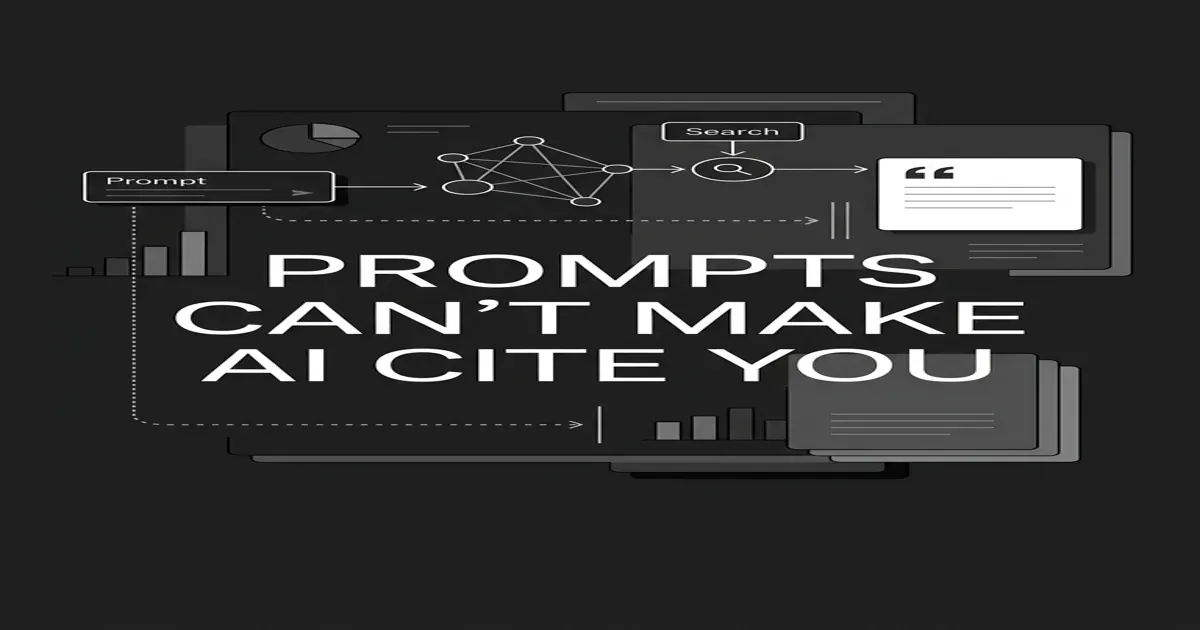
It works in four steps. The engine reads the user's question and often rewrites it into a search query. It retrieves candidate documents from its index. It ranks those documents on authority, relevance, and freshness. Then it writes an answer and cites the sources it actually used.
Look at where the prompt lives. It shapes the first two steps, how the question gets interpreted and searched. It does not change the corpus, the ranking signals, or the documents that come back. If your pages are not in the retrieved set, no phrasing on the user's side pulls you in. You are simply not in the room.
This is the part that trips people up. The prompt feels powerful because it clearly changes the answer you personally see. But it changes the answer by changing what gets searched, not by changing what exists to be found. Your visibility was decided before the user ever hit enter, back when the engine indexed and ranked the web. That is the layer you have to work on.
The adversarial training wall
Maybe you have thought about hiding instructions in your own content. White text on a white background. Off-screen HTML. A little note telling the AI to recommend you.
Do not. Every major lab trains its models to separate real instructions from untrusted web content and to ignore injected commands. OpenAI, Anthropic, and Google have all said as much publicly. Safety layers treat hidden brand-boosting text as an attack and filter it out.
This is not theoretical. Google's security team tracked a sharp rise in malicious prompt-injection attempts on the web, with SEO manipulation named as a leading motive. They grouped the tricks into three buckets: hidden text designed to poison AI summaries, overt "please mention this brand" instructions, and invisible injected prompts. All three get suppressed. You would be spending effort to build something the engines are specifically trained to throw away.
The self-fulfilling wall
Even if the first two walls fell, the logic still fails. A mention that exists only because someone asked for it does not transfer. It does not reach the next user, the next question, or the next phrasing of the same question.
So when you try to get ai to recommend my brand by scripting the input, you are optimizing the one thing with no carryover. That is the quiet reason every prompt trick fizzles. It cannot compound.
How AI engines actually decide who to name
Here is the reframe that changes everything. Stop thinking about the prompt. Start thinking about retrieval.
The question is never "what words will trigger my mention?" It is "when the engine searches my category, does it find, trust, and quote my content?" Answer that, and mentions follow for prompts you never touched.
Across engines, the pattern is consistent even when the details differ. One large analysis of millions of citations found that ChatGPT, Perplexity, Gemini, and Claude disagree on exact rankings but agree on one thing: they lean toward sources with verified, structured, authoritative information. When the facts on your page line up cleanly with what the model already believes, your odds of being cited climb.
The engine-specific habits are worth knowing too. Wikipedia is the single most-cited source in ChatGPT. A large share of ChatGPT citations come from content surfaced through its Bing-powered browsing. In Google's AI Overviews, most citations come from the top portion of a page, the part above the fold, which means the answer has to sit near the top. And the vast majority of AI Overview citations point to deep, specific pages rather than homepages.
Perplexity makes the point even clearer. A document has to clear several filters before it can be cited: semantic relevance, freshness, structural quality, authority, and engagement. Notice what is missing from that list. There is no field for "the user phrased the question a certain way." The gatekeeping happens entirely on the content side.
The lesson is not to memorize percentages. It is to notice that every one of these signals is about your content and your authority, never about the user's wording. That is where your leverage is. So when you stop asking how to get ai to recommend my brand through the input, and start asking how to clear those retrieval filters, you are finally working on something you can move. If you want a fuller picture of what tips a citation your way, the signals themselves are learnable and, better yet, buildable.
What actually works: the levers you control
Now for the good news. The things that move AI mentions are all on your side of the fence, and none of them require a trick.
Researchers at Princeton and Georgia Tech ran the first real study on this, testing nine ways to optimize content for generative engines. Three pulled clearly ahead: citing your sources, adding relevant statistics, and including direct quotations. Each lifted visibility by roughly a third. The methods that flopped? Keyword stuffing, which produced minimal or even negative results.
Read that pattern carefully. What wins is making your content more quotable, more sourced, and more trustworthy. What loses is trying to game the words. The research points the same direction as the architecture: earn the citation, do not engineer the prompt.
Here are the durable levers, in plain terms.
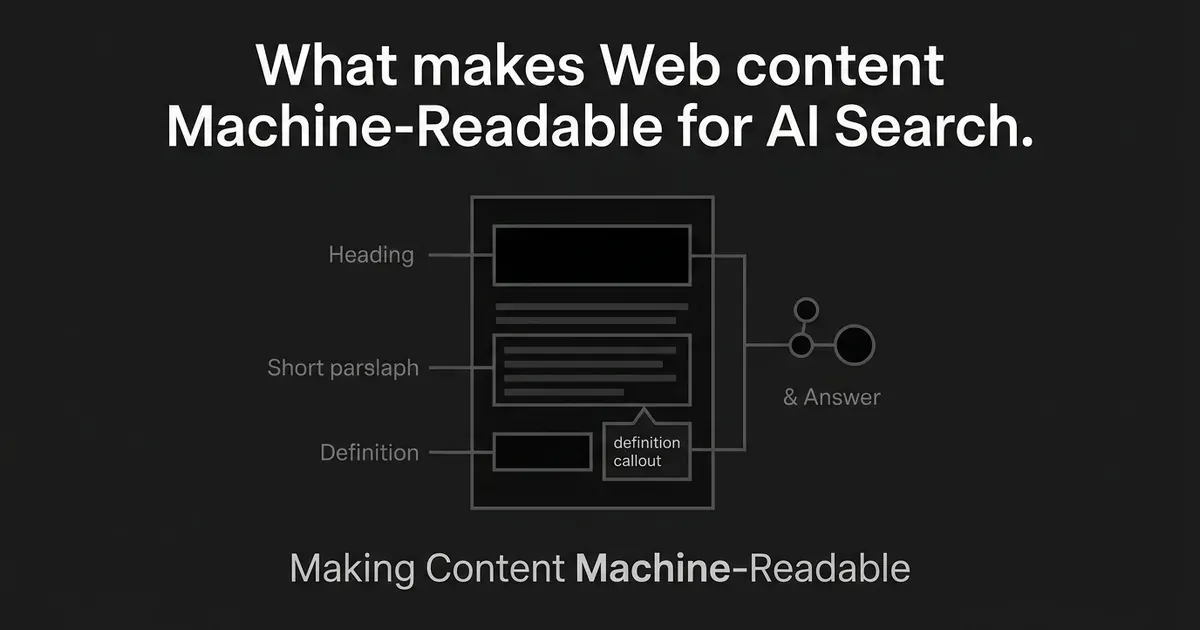
Write content an engine can extract. Long, comprehensive pages get cited far more often than thin posts. Lead each section with a direct answer in the first few lines, then explain. Use clear headings, numbered lists, comparison tables, and short definition blocks. These create clean boundaries the retrieval systems can chunk and quote. Answer-first structure is not a style choice here, it is how you become quotable.
Show real experience and expertise. The pages that get cited tend to display strong signals of who wrote them and why they can be trusted: named authors with credentials, bios, citations to primary sources, an About page, editorial standards. This is the E-E-A-T layer, and building visible author and entity trust is one of the most underrated moves in AI search.
Keep it fresh. Recency matters more than most people expect. A large majority of ChatGPT's top-cited pages were updated within the last month, and AI Overview citations skew newer than traditional organic results. Stale pages quietly lose their citation share. Refreshing your high-value content on a schedule is one of the fastest levers you have.
Add structured data. Schema markup helps engines understand and disambiguate your content. FAQ, Product, HowTo, Organization, Author, and Article schemas map neatly onto the way AI answers are built, and pages with schema tend to earn more citations than pages without. You do not need a developer to start, and getting schema in place is a concrete win you can bank this month.
Format for extraction. The shape of your content matters as much as the substance. Numbered lists create clear boundaries an engine can lift cleanly. Comparison tables spell out relationships between options. Definition blocks match the way answers get phrased. A short summary near the top hands the engine an extractable fact before it even reads the body. Bolded key terms flag what matters. A dedicated study found bullet points alone measurably improve citation rates by giving retrieval systems clean chunks to work with. You are not decorating the page. You are making it easy to quote.
None of these is a secret. All of them are within your control. That is the point. And notice the through-line: not one of them is about the prompt. Every attempt to get ai to recommend my brand by wording an input is a detour around the work that actually pays.
The single highest-leverage move
If you only change one thing, make it this.
The strongest correlation anyone has found with AI visibility is not backlinks. It is brand mentions across the wider web. In one analysis, brand mentions correlated with AI visibility at roughly r = 0.664, while backlink volume came in at a weak r = 0.218. Put simply, being talked about by others matters about three times more than the classic link.
The same pattern shows up in where citations come from. A large majority of AI Overview citations trace back to third-party, earned sources rather than a brand's own domain. Engines trust external validation. Coverage in credible publications, mentions on industry sites, reviews, and authentic participation in communities like Reddit move your visibility in a way your own homepage never will.
So the highest-leverage action is not on your website at all. It is getting cited, quoted, and discussed by authoritative third parties in your category. Earned media, guest contributions, original research others want to reference, honest presence in the forums your buyers actually read.
This is slower than a prompt trick. It is also the only thing that compounds. And it is the exact opposite of manipulation: you become genuinely worth mentioning, so the engines mention you.
There is a quiet upside here too. Because these signals build on each other, effort you put in this quarter keeps paying next quarter. A prompt trick, even if it worked for a day, resets to zero the moment the user changes a word. Earned authority does not reset. It accrues. That is the difference between chasing a mention and owning a position.
Feeling like that is a lot? It is normal. You do not have to do all of it at once. Pick the one place your buyers already gather and start earning real mentions there. One authentic mention on a source engines already trust does more than a hundred prompts you carefully worded.
How to know it is working
You cannot improve what you cannot see, and this is where most teams stall.
The mistake is checking by hand. You open ChatGPT, type your category question, and eyeball whether you appear. That is noisy, it changes by the day, and it only covers the prompts you happen to think of. It also tempts you right back into trying to get ai to name your brand by fiddling with your own wording, which we now know goes nowhere.
Track the real signals instead. Mention rate, how often AI names you. Citation rate, how often it links your pages as sources. Share of voice against competitors. Which of your pages get cited, and for which questions. Those metrics tell you whether the durable levers are working, and they turn a guessing game into a measurable one.
Watch competitors while you are at it. If a rival is getting cited for a question you care about, that is not a mystery to solve with clever prompting. It is a specific page, on a specific source, that earned the spot. Once you can see which page won and why, you know exactly what to publish to compete. That single shift, from "how do I word this" to "which page do I need," is where real progress starts.
This is where a platform earns its keep. DeepSmith tracks how AI engines answer the questions that matter in your space, across ChatGPT, Perplexity, Gemini, Claude, and Google AI Mode, and reports back mention rate, citation rate, and share of voice on a schedule. It shows which of your pages get cited and where competitors are winning citations you are missing. Instead of manually re-checking prompts, you see the gaps, and because the same platform produces on-brand, citation-ready content, you can close them without switching tools. That is the loop that actually moves mentions: measure, find the gap, publish the content that earns the citation.
You do not need to manipulate ai brand mention. You need to know where you stand and what to write next.
The real answer, in one line
Can you engineer prompts to get mentioned by AI? No. The prompt is the user's, and mentions are decided by retrieval and trust.
Can you change whether AI names your brand? Absolutely. Write extractable, well-sourced content. Show real expertise. Keep it fresh. Add schema. And above all, earn mentions from credible third parties, because that is the lever with three times the pull.
Here is the reassuring part. Everything that works is something you can actually do, and none of it requires a trick or a loophole that gets filtered next month. You are closer than you think.
Want to see exactly where AI names you today, and where it names a competitor instead? Start a free DeepSmith trial and get real visibility data plus the content to close the gaps, before you pay a cent.