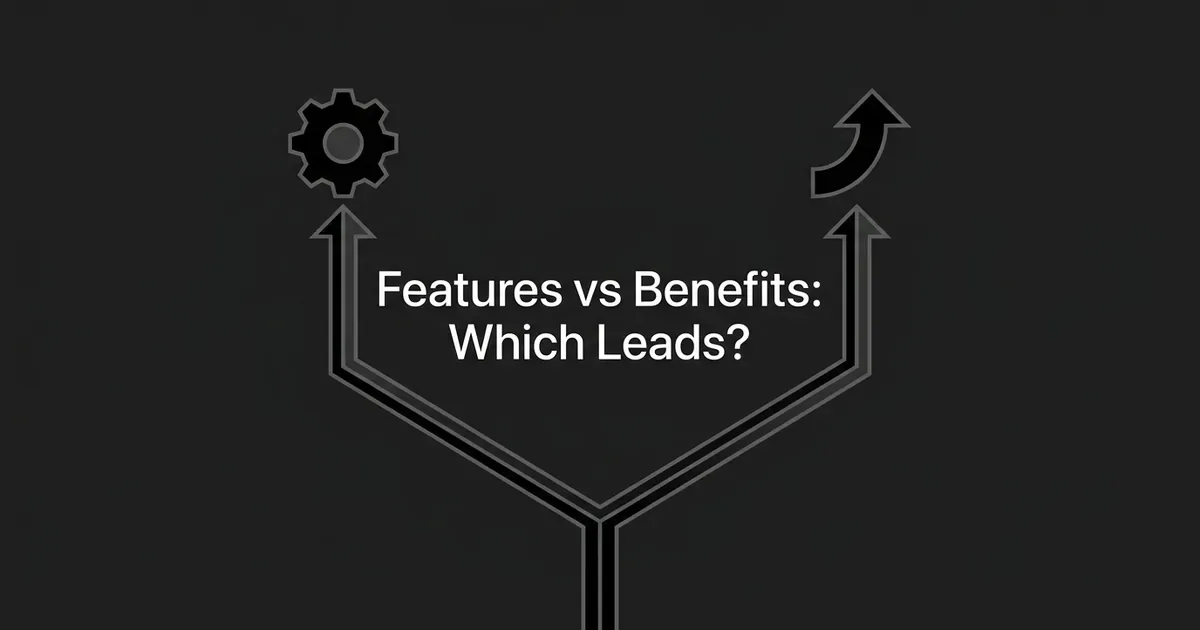
Should a piece of content open with what your product does, or with what changes for the reader once they use it? That's the real question behind the features vs benefits content marketing debate, and most advice on it stops at "benefits win." That answer is only right some of the time. The fuller answer is that benefits should lead when the reader is still deciding whether a problem is worth solving, and features should lead once the reader is checking whether a specific solution actually fits. Most strong content ends up doing both: benefits frame the decision, and features back it up.
Here's the short version before we get into why.
| Benefit-led | Feature-led | |
|---|---|---|
| Subject | The reader's problem or outcome | The product's capability or spec |
| Reader's question | "Why should I care?" | "Does this meet what I need?" |
| Works best for | Problem recognition, early education | Fit checks, comparisons, implementation |
| Main risk | Turns vague or overinflated | Turns into a jargon list nobody reads |
You can hold that table in your head for the rest of this article, because everything below is really an argument for when each row applies.
What counts as a feature
A feature is something the product has or does. It's owned by the product, not the customer, and it's usually easy to state plainly: automated scheduling, an API, a specific integration, a 500-user limit, a reporting dashboard, a particular security control. You can point at a feature and say exactly what it is.
Features are concrete, which is both their strength and their limit. A feature list tells a reader precisely what they'd be getting. It doesn't, on its own, tell them why any of it matters. This split shows up across most messaging fundamentals guides, even when they use different words for it. A prospect reading "supports 40 articles a month" has no way to know whether that's generous or thin until they connect it to their own publishing volume, which is a step the content has to do for them.
What counts as a benefit
A benefit is the value or change the reader gets from using the product, and it belongs to the audience, not the product. It answers a different set of questions: what problem does this solve, what gets easier or faster, why should the reader care at all.
The same feature can produce different benefits depending on who's reading. Automated scheduling might mean fewer missed publish dates to a marketing lead, fewer manual handoffs to an operations manager, and predictable release timing to an executive who never touches the tool directly. That's worth sitting with, because it means you can't write one benefit sentence and expect it to land the same way across every audience segment a page might reach.
A benefit without any feature, proof, or limitation behind it tends to feel vague. "Save time" is a claim almost any product in any category could make, and a reader who's evaluated more than one vendor has learned to discount it on sight.
The real difference is the question the reader is asking
Features and benefits aren't two writing styles you pick between at random. They answer different questions, and the question your reader is actually holding when they land on the page is what should decide the lead.
"Why does this matter to me?" or "could this even help?" is a benefits question. The reader hasn't committed to the problem yet, let alone a solution, so a list of capabilities is asking them to do work they're not ready for. "Does this meet what I need?" or "how exactly does this work?" is a features question. At that point the reader has already accepted that the problem is real and the category is worth their time, and what they need now is something concrete enough to check against their own situation.
This tracks pretty closely with buyer stage, though it's worth treating buyer stage as a proxy for the reader's question rather than a rigid ladder everyone climbs in order. Someone can land on a deeply technical page from an early-stage search, or arrive at an educational piece already knowing exactly what they want. Write to the question in front of you, and use stage as a rough guide rather than a label to force the page into.
What each side has to prove
Benefit-led content has to prove relevance. Its job is to make the reader believe a problem or outcome is worth their attention at all, and it does that with examples, use cases, and a plain description of what changes. It doesn't need to prove that a specific product can deliver, because at this point the reader isn't evaluating a specific product yet.
Feature-led content has to prove fit. Once a reader has accepted that the problem matters, "reduces manual work" isn't enough on its own. They want to know whether the thing integrates with what they already run, whether it handles their volume, whether it fits the way their team actually works. Specifications and capabilities are what make a claim checkable instead of just believable. This is close to the same work product marketing does when it turns competitive evidence into positioning and enablement material for a sales team.
Neither side proves the other's case. A benefit claim without any feature behind it can't be verified. A feature list without a benefit attached can't be interpreted. That's the actual argument for combining them, not just habit or convention: each one covers a gap the other leaves open.
Where each side tends to fail
Benefit-led content fails when it goes generic. "Grow faster," "work smarter," "save time" are the kind of lines that could sit on nearly any vendor's homepage, and a reader who has looked at more than one option has already learned to skim past them. The fix isn't to drop benefits, it's to keep every consequential one tied to a mechanism: not just "save time," but save time by cutting a specific manual step, for a specific kind of team, under specific conditions.
Feature-led content fails the opposite way. It lists capabilities before the reader has any reason to care, which reads as company-centered rather than reader-centered, and it's especially weak for broad, problem-led searches where the reader hasn't chosen a category yet. A capability dump also invites a second failure: not every feature deserves a benefit forced onto it. Some are table stakes or internal plumbing, and pretending otherwise just inflates the page.
When benefits should drive the content
Lead with benefits when most of these are true: the reader may not fully understand the problem yet, the topic is broad or educational, several different products or approaches could solve it, and the feature set would be more distracting than helpful before the context is set. This covers problem education, trend or benchmark explainers, category education, and most strategic frameworks, including a piece like this one.
There's evidence behind this beyond intuition. A large multi-study retail experiment found that grouping products by the problem they solve, rather than by shared attributes, made people picture using the product more vividly and led them to choose more items as a result, an effect that traced back to that mental imagery rather than to the attributes themselves, according to research published in the Journal of Retailing. The study looked at retail categorization rather than content pages directly, but the underlying mechanism, that framing around the outcome makes the value easier to picture, is the same reason benefit-led framing tends to work early.
The content's job at this stage is to help the reader name a problem and see why it's worth solving, not to introduce a specific product too early. A weak version of this leads with "our platform has automated scheduling." A stronger version leads with the actual friction, a content calendar that stalls the moment the person running it gets pulled onto something else, and only then explains what a system built to keep moving would change. Features can still show up here, but only as light, illustrative examples of how a solution might work, never as the organizing idea.
When features should drive the content
Lead with features once the reader already understands the problem and is checking whether a specific solution can handle it. That's true for product specification pages, integration documentation, implementation and migration guides, configuration resources, and any page where the reader needs to validate something before they can move forward, often because other people on their team are going to ask them to.
This is also where a buying group starts to matter. A single deal usually involves more than one kind of reader: a decision-maker weighing business impact, a technical evaluator checking requirements and integrations, a day-to-day user thinking about workflow change. One benefit-only paragraph won't satisfy all of them, and pretending it will just pushes the real evaluation into a sales call instead of the page doing its job. Feature detail earns its place here because the benefit is usually already accepted, and the open question is whether this particular product can deliver it inside this particular environment.
Keep the reader's task visible even in feature-heavy content. A specification list with no reminder of what decision it's supporting turns into a reference document nobody reads start to finish.
Building this into a page or a cluster
At the page level, ask three questions before you decide the lead. Stretched across a full buyer journey, these same three questions decide whether a cluster reads as one coherent argument or a pile of disconnected pages. What does this reader already know? What does the content need to help them decide or do next? And what would make the page feel incomplete if you removed it, the outcome or the concrete detail? If cutting the benefits would make the page pointless, benefits should organize it. If cutting the features would leave the reader unable to compare, validate, or implement anything, features need to be prominent. When both would leave a gap, use the benefit as the frame and the features as the layer underneath that proves it out. This is also the standard search engines increasingly use when judging a page, whether it's genuinely helpful and written for people first, not which framing style happens to win by default.
At the content cluster level, the same logic scales up. Awareness pages should carry the problem, the consequence, and the desired outcome. Consideration pages should compare approaches and tradeoffs, using features to show how each one actually works rather than just describing products side by side. Decision pages need fit, specifications, and proof. Adoption content needs exact detail: configuration steps, workflows, the specific things a reader needs to actually use what they bought. A cluster that's all benefit-led awareness pages and nothing else leaves a serious buyer with no way to verify anything, and that gap is worth finding with a proper content gap analysis before a serious buyer finds it for you. A cluster that's all feature pages leaves no path in for someone who hasn't decided the category matters yet, which is its own kind of gap a content plan should catch early rather than late.

This is easier to see once you can look at your coverage as a map instead of a list of published titles. DeepSmith's Content Map classifies your existing pages by topic and funnel stage, so you can tell at a glance whether your awareness content is thin, your decision-stage pages are missing, or you've built plenty of one and almost none of the other. That's a feature. The benefit is that you stop guessing where the gap actually sits and start planning the next piece to close it, instead of adding another page to whichever pile is already tallest.