Most AI visibility programs begin the same way. Someone opens ChatGPT, types three or four buyer prompts, scans the answer for the company name, and screenshots the result into Slack. A month later, someone repeats the exercise with slightly different prompts. The AI visibility tool vs manual monitoring decision usually arrives when leadership asks what the trend looks like and nobody can answer, because there is no trend, only a folder of screenshots.
The honest position is that manual AEO monitoring is not worthless. It is a legitimate qualitative instrument and a poor quantitative one. Teams that manually check ChatGPT brand mentions are collecting real observations; the collection method simply destroys most of the information those observations could carry. Personalization changes the answer per user, sampling variance changes it per run, two engines cover a fraction of where buyers research, and nothing is stored in a form that supports comparison over time.
The two approaches are evaluated below on the axes that determine whether a monitoring method can be trusted: engine coverage, sampling rigor, historical record, competitive context, cadence, and total cost including the time nobody bills.
Manual Checks vs an AI Visibility Tool at a Glance
| Criterion | Manual checks in ChatGPT and Perplexity | Automated AI visibility tool |
|---|---|---|
| Engines observed | ChatGPT almost always, Perplexity sometimes | Three to ten, by vendor and tier |
| Prompts per cycle | Roughly 3 to 10, ad hoc | 15 to 400 by tier, fixed and repeatable |
| Samples per prompt | One | Multiple per cycle, automated |
| Personalization control | None; Memory, Custom Instructions, and session history apply | Consistent collection conditions |
| Historical record | Screenshots and recollection | Full answer history per prompt |
| Competitor benchmarking | Manual reading of each answer | Automated share of voice against a named set |
| Detection lag | Weeks, whenever someone remembers | Hours, with alerting on rate changes |
| Direct cost | None | $29 to $399 per month at most mid-market tiers |
| Hidden cost | Several hours per week per person | Setup and prompt curation, then unattended |
| Genuinely suited to | Qualitative reads, tone checks, curiosity | Rates, trends, competitive tracking |
What Manual AEO Monitoring Actually Involves
Manual monitoring, as practiced, means opening ChatGPT and Perplexity, typing somewhere between three and ten buyer prompts, and eyeballing whether the brand appears. The prompts are whichever ones the person at the keyboard thinks of that day, the cadence is weekly to monthly, and logging is informal: screenshots pasted into Slack or Notion, and often nothing at all.
Guidance on how to monitor AI search manually rarely names the controls that would make the exercise defensible. Those controls exist, and a disciplined spreadsheet method implements several of them, but they are not what a marketing lead does when curiosity strikes on a Tuesday afternoon. The workflow examined here is ad hoc eyeballing, and the failure modes below belong to that version specifically.
Personalization: The Same Prompt Does Not Return the Same Answer
ChatGPT applies at least five layers that alter a response based on the user rather than the question.
Memory. When enabled, Memory retains context from prior chats, uploaded files, and connected apps to personalize future responses. It can be turned off, but the default is on and most users never touch it. Two people running an identical prompt on the same date and model version can see different brands named, purely because one account carries prior marketing context.
Custom Instructions. These are persistent guidelines applied to every new conversation. A marketer who has stored "you are a senior B2B marketer" and "always favor tools under $100 per month" receives a materially different recommendation list than a user with empty Custom Instructions, prompt and model held constant.
Session history. Earlier turns shift what the model treats as relevant. The same question asked at minute one and minute ten of one session can return different outputs.
Model routing. ChatGPT routes between several model families, so two checks on different days can land on different models and return different rankings. The user typically neither controls nor observes which model answered.
Retrieval mode. When the system judges that a prompt needs fresh information, it invokes a web search tool and blends the results into the answer. Whether that fires depends on prompt wording and toggle state, neither of which a manual checker holds fixed.
Teams that manually check ChatGPT brand mentions therefore see two different brand lists from one prompt run twice in a week, for reasons unrelated to the brand's actual presence in AI answers. The noise comes from variables the observer cannot see.
Sampling: One Observation Is Not a Rate
Personalization is not the only source of variation. Even with model, prompt, account, and date held fixed, large language model inference is not strictly deterministic. Published research on the non-determinism of supposedly deterministic settings documents output variation at temperature zero, driven by batching, kernel scheduling, and floating-point operation ordering. The effect is small but non-zero, and accumulates across longer generations.
The measurement problem follows. Mention rate is the share of responses naming a brand; citation rate is the share linking to its pages. Both are rates, and a rate requires repeated samples before the observed value converges on the true one.
A single observation per prompt returns a point estimate of either zero or one hundred percent. If the true mention rate is fifty percent, one check reports one of those extremes, and nothing indicates which is closer to reality. Narrowing the estimate to within plus or minus ten percentage points at ninety-five percent confidence requires on the order of one hundred samples per prompt. A team checking one prompt per week per engine accumulates roughly four samples per month, an order of magnitude short of the threshold at which the number means anything.
This is the central defect in ad hoc checking. It does not produce bad measurements. It produces observations that are not measurements, then invites decisions from them.
The Volatility Data a Manual Check Cannot See
Independent tracking over time shows how much movement a periodic manual check samples from.
- SISTRIX, analyzing 82,619 prompts across 17 weeks, found that Google replaces roughly 56 percent of cited sources in AI Mode responses every week. The figure refers to AI Mode specifically, not to classic AI Overviews or to ChatGPT.
- BrightEdge's weekly tracking reports the opposite-looking result at the core of the distribution: 96.8 percent of cited domains and 97.2 percent of mentioned brands unchanged week over week.
- Profound reports that ChatGPT and Perplexity share only about 11 percent of cited domains, and documents citations shifting by as much as 60 percent week to week for individual prompts or categories.
- Trakkr, from Peec AI, reports that 73.4 percent of cited URLs appear only once across its sample, with an average cited-URL half-life of about 30 days.
- Profound also reports that fewer than 20 percent of ChatGPT brand mentions carry trackable links. Most references are textual, not clickable citations.
The SISTRIX and BrightEdge numbers are not in conflict; they measure different parts of one distribution. The long tail churns aggressively while the core set of well-known brands stays sticky at the domain level, and that combination is what makes ad hoc checking misleading. A marketer sampling a handful of prompts observes the stable core, concludes that nothing has changed, and misses the long-tail churn where the movement actually happens. The surface is stable enough to reassure and unstable enough to matter.
Model cadence compounds the problem. Flagship releases have arrived on a roughly three to six month cycle in recent years, with smaller updates more often, so a comparison against "what ChatGPT said last quarter" may be a comparison against a different system.
Engine Coverage: Two Surfaces Out of Many
Manual checking almost always means ChatGPT, and sometimes Perplexity. It almost never means Google AI Overviews, Google AI Mode, standalone Gemini, Claude, Microsoft Copilot, Grok, Meta AI, or DeepSeek. Buyer research spans those surfaces, and the eleven percent cited-domain overlap between ChatGPT and Perplexity indicates that observations on one engine do not generalize to another.
A marketer who opens a browser to check Perplexity for brand citations is measuring one retrieval stack with its own behavior. Perplexity performs live hybrid retrieval over the web, reranks candidates for relevance, freshness, authority, and extractability, then synthesizes an answer with numbered inline citations. ChatGPT blends parametric memory with optional live retrieval and surfaces links only where the model chooses to. These are different systems producing different citation sets, so a check on one says little about the other. Coverage is not a matter of thoroughness: two engines checked by hand sample a fraction of the surfaces where buyers form opinions, and that fraction does not extrapolate.
No Baseline, No Trend, No Competitive Context
Ad hoc checks produce point observations without stored history, and three consequences follow. Without a baseline, this week's appearance cannot be classified as improvement, regression, or noise. Without a retained series, gradual changes stay undetected until they are large. Without a tracked competitor set, there is no way to establish whether rivals are gaining ground, which is usually the question leadership actually asks.
Feedback speed is the practical cost. A lost citation or a new competitor citation surfaces the next time somebody remembers to check, often weeks after the shift occurred, by which point the cause has already compounded. Automated platforms detect rate changes within hours. Manual checks run on calendar reminders and good intentions.
Where Manual Checking Genuinely Earns Its Place
Manual AEO monitoring has a real role, and a comparison that denied it would be dishonest.
Reading a full response by hand is the only way to evaluate how a brand is characterized rather than whether it is named. Tone, accuracy, framing against competitors, and outright hallucination are qualitative properties that a mention-rate number does not capture, and before a launch or a sales conversation, reading the actual answer is the right move. Spot checks on competitor content serve the same purpose: a marketer can see whether a specific competitor page is being picked up and how the engine describes it.
The boundary is clear. Manual checks answer qualitative questions about individual answers. They cannot answer quantitative questions about rates, trends, or relative position, because sample size, personalization exposure, and missing history all sit on the quantitative side of the line.
The AI Visibility Tool Category, Compared Honestly
Automated platforms differ on engine coverage, prompt volume, pricing transparency, governance, and whether they stop at analytics. Anyone who has researched how to monitor AI search manually will recognize the underlying workflow, executed at a sample size that supports a conclusion.
Profound

Profound tracks ChatGPT, Perplexity, Claude, Gemini, Grok, Microsoft Copilot, Meta AI, DeepSeek, and Google AI Overviews. Starter is $99 per month monthly, or $82.50 annual, covering 50 prompts on ChatGPT only. Growth is $399 monthly, or $332.50 annual, covering 100 prompts across three engines. Agency bundles start at a $99 base plus a $399 add-on for full client workspaces. Its strength is discovery-first monitoring, surfacing prompts and citations a team did not think to track, alongside agent-traffic analytics and white-label reporting. Reviewers note noisier raw data than some competitors, a dashboard with a learning curve, and no closed-loop attribution to revenue. The broad engine list is real, but nine-engine coverage belongs to higher tiers, not the entry price.
Otterly AI
Otterly tracks ChatGPT, Perplexity, Google AI Overviews, Gemini, and Microsoft Copilot on paid tiers. Lite is $29 per month for 15 prompts across ChatGPT and Perplexity only, with no GEO audit. Standard is $189 for 100 prompts, all five engines, and a full GEO audit. Premium is $489 for 400 prompts with white-label reporting, dedicated support, and API access. Gemini and Google AI Mode are add-ons from $9 to $149 depending on tier. Otterly has the lowest entry price in the category and an approachable interface, with full-text prompt capture and Looker Studio export. Data refresh lags by hours to days, per-prompt and per-engine pricing escalates at scale, unused prompts do not roll over, and the platform does not estimate traffic or revenue. Fifteen prompts sits below the 25 to 50 range where most programs start.
Peec AI

Peec confirms coverage of ChatGPT, Perplexity, and Gemini. Its differentiator is competitor gap analysis that surfaces the specific URLs and contexts where rivals win, plus tag-based prompt grouping, custom prompts, CSV export, and a Looker Studio connector. It covers fewer engines than Profound, and its pricing is quote-based rather than published, so budgeting requires a sales conversation before a cost comparison is possible.
Scrunch AI
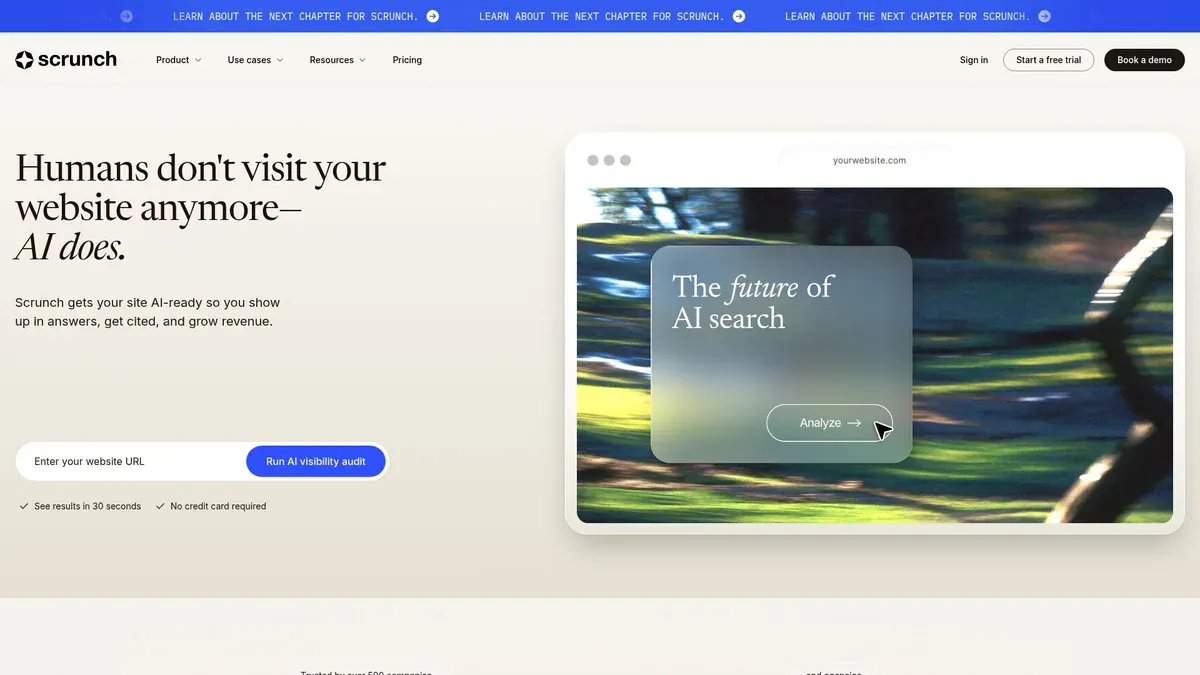
Scrunch covers ChatGPT, Perplexity, Gemini, Claude, and Google AI Overviews, adding Copilot and Grok at enterprise tiers, one of the broadest mainstream footprints. It positions itself as an AI customer experience platform, with AI Pages rendering for agent retrieval, persona targeting, real-time monitoring, and enterprise reporting. That coverage comes with an enterprise sales motion, no transparent mid-market pricing, and more setup overhead than a narrower tool, which matters for a lean team needing a number this quarter.
AthenaHQ
AthenaHQ names nine models including ChatGPT, Perplexity, Google AI Overviews, Google AI Mode, Gemini, Claude, Copilot, and Grok, with more on request. An Essential free tier provides $25 of credit and 300 credits; Starter is $295 per month, or $300 per month in annual credit for 3,600 credits; Enterprise is custom. The governance surface is the strongest in this set: SSO, SAML and OIDC, role-based access control, audit logs, persona targeting, BI connectors for Tableau, Power BI, and Looker, an executive dashboard, a two-hour SLA, and a dedicated specialist. Credit-based pricing is harder to budget against than a flat prompt count, and Starter prices above several competitors.
Goodie AI
Goodie tracks ChatGPT, Gemini, Perplexity, Claude, DeepSeek, and Rufus, pairing monitoring with an optimization hub that includes an AEO writer, a topic explorer, and AI shopping optimization for agentic commerce. It sits in closed beta with an enterprise sales motion and a narrower integration ecosystem than established platforms, so availability rather than capability is the near-term constraint.
DeepSmith vs Manual Monitoring

DeepSmith tracks mention rate, citation rate, share of voice, sentiment, and visibility trend across a fixed prompt set, on a collection schedule, with full answer history retained per prompt. Ten engines are covered: ChatGPT, Gemini, Perplexity, Claude, Google AI Overviews, Google AI Mode, Grok, Meta AI, Microsoft Copilot, and DeepSeek. Coverage rises by tier: Pro tracks ChatGPT, Grow adds Perplexity, Scale adds Gemini, and Enterprise covers all ten.

Pricing is $99 per month for Pro, $199 for Grow, and $399 for Scale, or $80, $160, and $299 on annual billing, with custom Enterprise pricing. Pro includes 50 tracked prompts, 5 seats, and 20 articles per month; Grow, 100 prompts, 7 seats, and 40 articles; Scale, 200 prompts, 10 seats, and 90 articles. A 7-day free trial runs on real data, with no long-term contracts.
Pro tracks ChatGPT only, and ChatGPT is where most buyer research starts. What matters at that tier is prompt volume against sampling rigor: 50 tracked prompts sampled on a schedule with retained history, against 15 prompts at Otterly Lite and the 3 to 10 a manual session covers once. For a team whose immediate question is whether its buyer prompts return the brand at all, 50 repeatedly sampled prompts are a stronger instrument than a handful of one-off observations.
Against the broader-coverage platforms, Enterprise covers all ten engines, more than the nine Profound and AthenaHQ name at their top tiers, while Scale sits at three for teams not needing that breadth. The larger difference is structural. Every platform here reports where a brand is invisible; DeepSmith also produces the content intended to close the gap from the same context. Opportunity Agents read that visibility data and a Content Map of your site against unlimited competitor sites, returning ideas with the justifying data point attached, so the backlog is evidence-backed rather than guessed. The writing pipeline handles research, internal and external linking, schema, metadata, and a cover image, then publishes to WordPress, Webflow, Strapi, Sanity, Contentful, or a webhook. Autowrite runs that unattended on a schedule, and Produced Content exists for review before publishing.

For a marketing lead with neither tracking nor a production pipeline, the question is how many tools the program requires. An analytics-only platform reports what is missing; closing it stays a separate workflow on a separate budget.
Which Should You Choose
Choose manual spot checks when the question is qualitative and occasional: how a brand is described, whether an answer contains an inaccuracy, or how a competitor page is being characterized. Reading the full response by hand is the correct instrument, and it costs nothing.
Choose the lowest-cost automated entry point, such as Otterly Lite at $29 per month, when the goal is to establish that systematic tracking is worth doing at all. Expect to outgrow 15 prompts quickly.
Choose a broad-coverage analytics platform such as Scrunch, AthenaHQ, or Profound at its higher tiers when SSO, role-based access control, audit logs, BI connectors, and an SLA are hard procurement requirements. Budget for a sales conversation and a separate content workflow.
Choose Peec AI when competitor gap analysis at the URL level is the primary job and quote-based pricing is not an obstacle.
Choose DeepSmith when the program needs both halves: measurement of where the brand is missing from AI answers, and publish-ready content produced from that same context to close the gap. A team on Pro or Grow that publishes consistently is usually better served than one paying for nine engines it does not read and writing everything by hand.
Start a 7-day DeepSmith free trial and see real prompt data and real drafts before paying.