You want a number. I understand the pull.
A number is easy to brief, easy to check, easy to defend in a planning meeting. So you go looking for the right content length for AI search, and you find one blog saying 1,500 words, another saying 3,000, and a third saying short and punchy wins now.
Take a breath. The reason you cannot find the number is that the number does not exist.
What does exist is a decision rule, and it is a better tool than a quota. By the end of this piece you will know what the evidence actually shows about the length of pages AI engines cite, why depth on one question beats raw volume, and how to pick a length for your next article without guessing. You will also know what to do when a page is not cited, which is the part most teams get wrong.
The Honest Answer: No Word Count Earns You a Citation
There is no ideal article length for AI search, and the clearest confirmation comes from Google itself. Google's guidance on optimizing for generative AI features says plainly that there is no ideal page length, and that you should create content for your audience rather than rewrite it to satisfy generative AI. Its guidance on AI features adds that there are no extra requirements for showing up in AI Overviews or AI Mode beyond the usual Search eligibility fundamentals.
Read that again, because it takes the pressure off. No secret threshold. No hidden minimum you have been failing to hit.
Search "ideal article length AEO" and you will find plenty of confident numbers anyway. Most of them are averages of pages that got cited, quietly reframed as targets. Those are two very different things, and the difference is the whole game.
So here is the rule to write on a sticky note:
The right length is the shortest piece that fully answers the question you set out to answer, covers the qualifications a reader needs to act on it, and gives an answer engine complete, relevant material to work with. Anything past that is just words.
Your next step this week is small. Take the piece you are about to brief and write its one question in a single sentence. Not the topic. The question. If you cannot fit it in a sentence, the scope is the problem, not the word count.
What the Data Says About the Length of Cited Pages
The largest direct look at cited-page length found that no single length band owns AI citations. Ahrefs published an analysis in December 2025 covering 560,346 AI Overviews and 1,677,876 cited URLs, with 174,048 pages where the content could be cleanly extracted and measured.
Here is what those cited pages looked like:
- The average cited page ran 1,282 words, against 1,188 words for pages ranking in the organic comparison.
- 53.4% of cited pages were under 1,000 words.
- 30.6% landed between 1,000 and 2,000 words.
- 16.0% were over 2,000 words.
- Inside the short group, 16.6% were under 350 words and 36.8% ran from 350 to 1,000.
Short pages get cited. Medium pages get cited. Long pages get cited. That is the finding.
The position data is even more freeing. The correlation between word count and where a page appeared in the citation list was 0.04 Spearman, which is essentially zero. Average length by position barely moved: 1,270 words at position one, 1,291 at position two, 1,291 at position three, and 1,690 across positions four through ten.
Page type mattered far more than any blog benchmark. Median cited length came in at 315 words for listings, 317 for core pages, 387 for user-generated content, 407 for video, 507 for interactive tools, 534 for listing collections, 676 for documents, 1,166 for articles, and 1,226 for audio. Ahrefs also noted that the longest cited blog post in the set was around 3,500 words, with no sign of 10,000-word mega-guides taking over.
Now the honest complication, because you deserve the full picture. A separate April 2026 study from Digital Applied sampled 1,000 US-English desktop AI Overviews across ten query intents and roughly 30 verticals, collecting 4,243 unique cited URLs and comparing them against the next 50 organic results per query as a control. In that sample, pages over 2,500 words were cited 1.6 times as often as pages under 800, with the lift starting around 1,800 words and flattening near 3,500. Its authors read that as longer pages offering more usable material to extract, not length itself being a quality signal. The same study found domain authority was its strongest single page-level correlate at +0.61 Pearson.
Two studies, two different measurements, two different sample designs. One looked at citation position across a huge set of cited pages. The other looked at citation frequency against a matched control in a much smaller set.
Do not average them. Do not pick the one that flatters your current draft. The useful takeaway sits underneath both: word count for AI citation is a description of what happened, not an instruction for what to write. Neither study licenses a universal target, and the second one is a reason to stay curious rather than smug about the first.
One more thing worth knowing before you quote any of these numbers in a deck. The big Ahrefs analysis describes pages that were already cited. It does not compare them against a matched set of pages that were passed over, so it cannot tell you the odds that a page of a given length gets picked in the first place. Descriptive, not causal. The smaller study did build a control group, but it leaves other details unpublished, including its full query list and the statistical tests behind its numbers.
None of that makes either study useless. It just means you should treat both as evidence that a universal word count is unsupported, rather than as a formula. Anyone selling you an ideal article length AEO benchmark is reading further into this data than the data allows.
Why Depth Per Question Beats Raw Word Count
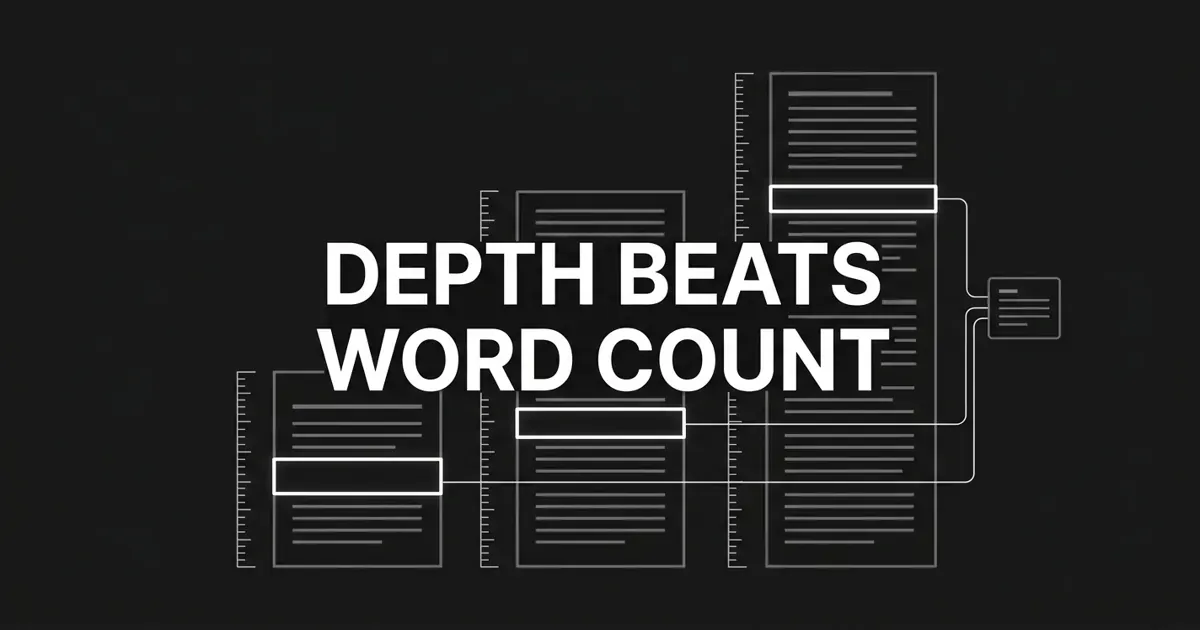
Depth is how completely you resolve the reader's uncertainty. Length is how many words you used doing it. They are not the same thing, and only one of them is worth optimizing.
A page has enough depth when the reader can act without opening another tab. Depending on the question, that might need a direct answer, the mechanism behind it, the conditions where the answer changes, the tradeoffs, the evidence to trust it, and an honest note where the evidence is thin. A narrow factual question can be fully answered in a few hundred words. A multi-condition buying decision may genuinely need several thousand. Those are different depth requirements, not competing strategies.
Raw length fails as a target for four reasons, and you have probably felt all four.
It measures volume, not coverage. A 2,000-word article can circle one point beautifully and still skip the qualification that decides the reader's next move.
It rewards scope creep. Chasing a count pushes you to bolt on adjacent sections that dilute the page's relevance to its primary question.
It confuses availability with usefulness. More text gives a system more material to look at. Only relevant material helps it answer.
It hides page-type differences. Cited medians ran from roughly 315 words for listings to over 1,100 for articles. "Enough" is not one number across formats.
Marketers type "does length matter AI search" into Google every day, and the honest answer is yes, but indirectly. Complex questions need more words to answer responsibly, so length rises as a consequence of depth. It is an output of your scoping decision, never the input.
Try this on your next draft: read each section and ask what specific uncertainty it removes. If a section does not remove one, it is filler wearing a heading.
Long Pages, Short Answers: How Length Meets the Passage AI Uses
A citation does not mean an engine read and used your whole article. It usually means one part of your page was useful.
Google's own documentation on its ranking systems describes passage ranking as a system that identifies individual sections of a page to better understand how relevant that page is to a search. That is a strong hint about the level where usefulness gets judged, and it means total page length and the quality of one answer-bearing section are separate questions.
Here is what follows from that, stated as an inference rather than a law:
- A longer page can hold more candidate answer material, which helps when the question truly has several required dimensions.
- The same longer page can hold more irrelevant material, which does nothing for you.
- A shorter page can be extremely useful when it carries a complete answer to a narrow question.
- Your total word count tells you nothing about whether any individual section stands on its own.
Point four is where your worry is better spent. The academic GEO paper nudges in the same direction: its content experiments found that adding statistics and adding quotations improved its visibility measures, with the best methods lifting one metric 22% and a subjective impression score 37%. Read that carefully, though. The paper's "word count" metric measures the answer text attributed to a source, not the length of the source page. It is evidence that better material beats more material, not evidence for a page-length target.
Skip the temptation to chase a magic passage size. You will see confident claims about 75 to 150 word chunks or the first 30% of a page mattering most, and the evidence for those numbers is not there. If you want the mechanics of how content chunking works, that is its own subject. For length decisions, one habit covers it: make sure every claim that matters carries enough context to survive being read alone.
A Six-Step Way to Pick the Length of Your Next Article
Ready for the practical part? Here is the process I run every time someone asks "how long should article be for AI" and expects a number back. It takes about ten minutes per piece once it becomes a habit.
1. Start with the question, not a benchmark. Write the one question the page must satisfy in a single sentence. Resist the urge to widen it into a category overview while you draft.
2. List what a complete answer must resolve. Before writing, note the facts, distinctions, conditions, examples, and caveats a reader needs. That list is your real brief. It is also your scope test: if an idea is not on the list, it does not belong in the piece.
For this article, that list was short and specific: whether a universal count exists, what the strongest evidence actually measured, whether short and long pages both get cited, why length is not depth, how passage-level relevance changes the picture, what to do when studies disagree, and how a team can test its own pages. Seven items. Everything else got left out on purpose, including formatting tactics that deserve their own piece.
3. Write until the list is covered, then stop. Do not pick 1,500 or 2,500 words first and go hunting for ideas to fill the space. If the answer is complete at 900 words, you are done. If a necessary distinction is missing at 3,000, add it.
4. Run a removal test. Go paragraph by paragraph and ask whether cutting it would make the answer less accurate, less complete, or less usable. If not, cut it. This is a far better length control than matching a competitor's count.
5. Run a standalone test. For each major claim, ask whether it stays accurate if someone reads only that passage. Watch for vague back-references, missing conditions, and context that lives three sections away. No special chunk length required, just self-sufficiency.
6. Validate with real citation data. Publish, then watch which prompts your page shows up for, whether it is mentioned or actually linked, and which of your pages engines pick. Use that to calibrate your next scope decision instead of copying someone else's word count.
That last step is where teams usually stall, because checking prompts by hand across engines does not scale past a handful of pages. This is the part DeepSmith is built to carry: AI Visibility tracks the prompts that matter in your space, reports mention and citation rates, shows which of your pages earn citations, and shows which competitor pages are winning the ones you want. No tool knows a universal article length, and no tool can guarantee a citation. What you get is the feedback loop that turns a length decision from a guess into something you can test.
When a Page Is Not Cited, Do Not Just Add Words
If a page you believed in gets ignored, adding 800 words is almost never the fix. That is the reflex, and it usually produces a longer page with the same gap.
Diagnose first. Ask which of these is actually true:
- A depth gap. The page never answers a decision-critical part of the question.
- A relevance gap. The page answers a different question from the one the prompt asks.
- A trust gap. The source signals are thin, which is worth remembering given that domain authority was the strongest page-level correlate in the Digital Applied study.
- A platform difference. You are cited in one engine and not another, which is a targeting question, not a length question.
Only one of those four is solved by writing more, and even then the fix is more answer, not more words. Pick one underperforming page this month, run it through those four questions, and change the single thing you find. Momentum matters more than a full-site rewrite.
Where This Leaves You
There is no ideal article length for AI search, and that is good news, because it means you were never behind on a target that does not exist.
Write to the complexity of the question. Give a complete, relevant answer with the evidence and qualifications a reader needs, then stop before the answer gets diluted. Let word count be the result of that judgment. Then check what actually earned citations and let real data, not a benchmark from someone else's topic, shape the next piece.
If the measurement half is the part you keep postponing, that is normal, and it is also the part that makes every future length call easier. DeepSmith tracks where you show up in AI answers, finds the gaps, and produces on-brand content grounded in your product, persona, and voice context, so a piece hits the depth you intended instead of a word quota. You can start a free trial and see real data and real drafts before you decide anything.
The next time a brief comes back with "how long should article be for AI search?" scrawled in the margin, you have an answer that holds up: as long as the question needs, and not a word longer.
One question. One complete answer. That is the whole strategy.