Koala plans, writes in bulk, links and auto-publishes on a schedule, so it suits a team that wants volume with little hands-on work. Semrush Content Toolkit (ContentShake AI) walks one article at a time from topic to WordPress post and adds repurposing and shared boards, so it suits a smaller team that wants guidance. DeepSmith is a strong alternative when you also want to know where AI engines leave your brand out, because it tracks those answers and turns the gaps into publish-ready articles that Autowrite publishes on schedule.
Choosing between Koala AI vs Semrush Content Toolkit mostly comes down to how you want to work. Koala is built to produce and publish articles in volume from a plan, while Semrush Content Toolkit moves you through one post at a time and expects you to review each step. Price follows the same split. Koala starts at $25 a month on a word allowance, and Semrush Content Toolkit is a single plan at $60 a month billed annually. DeepSmith sits next to both for teams that want to see how AI engines describe their brand and write the pages that change it. This page compares the three on the facts we could verify as of September 2026.
Koala vs Semrush Content Toolkit: the short answer
- Choose DeepSmith if you want AI answer tracking and article production in one self-serve plan, from $99 a month with a 7-day free trial, and you want Autowrite to publish finished articles on a date you set.
- Choose Koala if you want bulk generation, internal linking and scheduled autopublishing from $25 a month, and an on-demand check of Google AI Overviews is enough for your AI search needs.
- Choose Semrush Content Toolkit if you want a guided, one-post-at-a-time workflow built on Semrush data, with repurposing and shared boards, at $60 a month billed annually.
| Criterion | DeepSmith | Koala | Semrush Content Toolkit |
|---|---|---|---|
| Entry price (monthly) | $99 (Pro) | $25 (Starter) | Not listed |
| Annual price (per month) | $80 (Pro) | Not listed | $60 (Base) |
| Output at entry tier | 20 articles per month | 45,000 words per month | 10,000 articles per month, 5 SEO boosts |
| Free trial | 7 days | 5,000 words and 25 credits, no card | 7 days |
| Grounds output in stored brand knowledge | Yes | Yes | Partial |
| Internal linking | Yes | Yes | Not listed |
| Bulk generation | Yes | Yes | Not listed |
| Scheduled autopublish | Yes | Yes, Boost and above | Not listed |
| Publishes to a CMS | Yes | Yes, four CMSs | Yes, WordPress |
| Repurposes into other channels | Yes | Partial | Yes |
| Tracks brand mentions in AI answers | Yes | Partial, Google AI Overviews only | No |
| MCP server | Yes | Yes | Not listed |
| Review rating | 4.8/5 on G2 | 4.5/5 on Capterra | 7.2/10 on Info-Tech SoftwareReviews |
Pricing and features as of September 2026, from each vendor's site and public reviews.
Koala

Koala is a self-serve AI SEO content platform from koala.sh, sold as one subscription with six products: Brand DNA, KoalaWriter, KoalaChat, KoalaImages, KoalaLinks and KoalaMagnets. Its SEO agent reads Search Console and Analytics, plans a calendar and hands topics to KoalaWriter, and the finished articles go out to WordPress, Shopify, Webflow or Ghost with internal links. It is built for bloggers, affiliate and niche publishers, local businesses and agencies that run several brands, and nine public plans run from $25 to $2,000 a month.
The standout is the pipeline. Bulk mode writes from a keyword list on every paid plan, and Content Calendar Autopilot publishes an approved calendar on a schedule from the Boost plan at $99 a month. The real limit is how it measures AI search. Its checks cover whether Google AI Overviews cite your domain, they run on demand, and Koala does not describe tracking of ChatGPT, Perplexity or Gemini answers. Reviewers on Capterra give it 4.5/5 from 70 reviews and praise drafting speed and SEO structure. Trustpilot shows 3/5 from 22 reviews, with complaints about slow support and credit or refund disputes, and some reviewers say the drafts need editing and fact-checking.
Semrush Content Toolkit

Semrush Content Toolkit is the product that used to be called ContentShake AI. Semrush split its platform into separate toolkits in May 2025, and the old name now redirects to the Content Toolkit. It is a guided workflow. Topic Finder suggests topics with search volume and difficulty from Semrush data, the SEO Brief Generator builds a brief from top-ranking pages, the AI Article Generator writes the draft, and the Content Optimizer scores it against SEO and AI search criteria. It then repurposes the article into posts for LinkedIn, Facebook, Instagram, X and Pinterest, emails, and Google Business Profile updates. Publishing goes to WordPress, Mailchimp and Semrush Social Poster.
It is aimed at individual marketers, small content teams and SEO beginners, and there is one public plan, Base, at $60 a month billed annually. The limit reviewers name most often is the five SEO-boosted articles a month included in Base, with ten more for $30 a month. The Content Toolkit also does not track brand mentions or citations in AI answers, which Semrush sells separately as the AI Visibility Toolkit. Product-specific reviews are thin. Info-Tech SoftwareReviews shows 7.2/10 from 7 reviews, and hands-on reviewers praise topic discovery and briefs while saying the text and images need human review.
DeepSmith: the alternative that tracks AI answers and writes the fix

Koala and Semrush Content Toolkit both start from what you want to rank for. Neither starts from what AI engines say about you. Koala checks Google AI Overviews for a keyword on demand, which is a real and useful check, and Semrush Content Toolkit has no AI answer tracking at all. DeepSmith puts that measurement first and ties it to production.
DeepSmith checks the questions you define on a schedule and reports mention rate, citation rate, share of voice and sentiment, with the full answer history for each prompt. Pro tracks ChatGPT, Grow adds Perplexity, Scale adds Gemini, and Enterprise covers all ten engines. The Content Map compares your site with your competitors' sites topic by topic, and Opportunity Agents turn those gaps into content ideas that each carry the data point behind them.

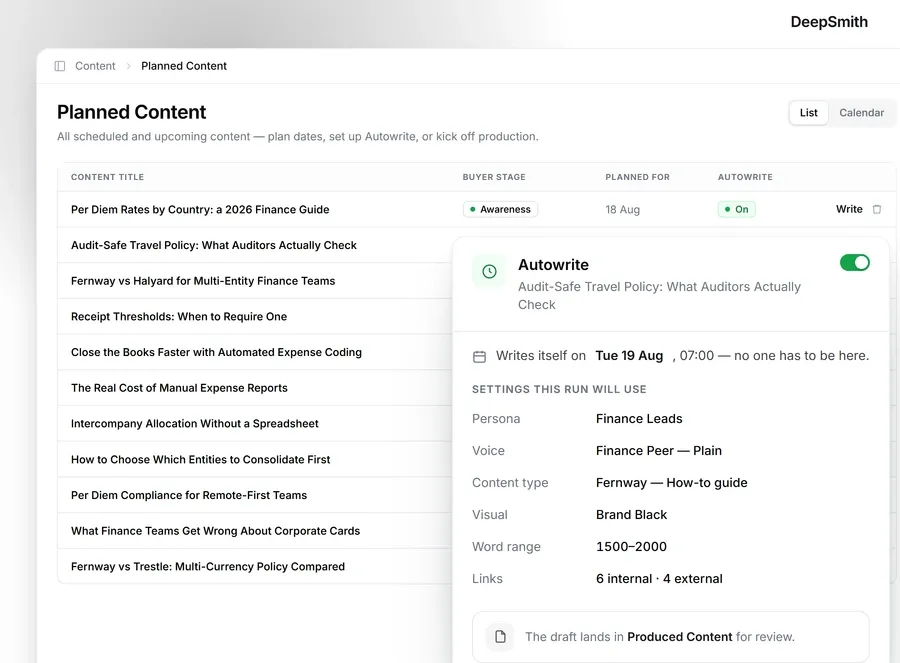
From there the Writer produces a finished article that is researched, internally and externally linked, and comes with a cover image and publish-ready metadata, grounded in the company, product, persona and voice records you store in Deep IQ. Autowrite writes an article on its scheduled date with no one in the app, and Produced Content publishes to WordPress, Webflow, Strapi, Sanity or Contentful, or to your own webhooks.
Plans run $99, $199 and $399 a month, or $80, $160 and $299 a month billed annually, with 20, 40 and 90 articles a month and a 7-day free trial. DeepSmith is SOC 2, GDPR and ISO certified and rated 4.8/5 on G2. For a team that needs the tracking and the writing to share one set of data, that combination is the reason to look at it next to either tool.
Topic research and planning
Koala is ahead on planning, because its agent builds a content calendar from your own Search Console data while Semrush Content Toolkit starts from a topic you type in.
Semrush Content Toolkit has the more recognizable data source. Topic Finder groups keywords into topics with total volume, average difficulty and intent, refreshes saved topic lists weekly, and every brief carries secondary keywords with volume and difficulty, all from Semrush's own databases. Its content gap finding is only partial, though, since the documented input is a starting topic and a location, with no dedicated gap report. Koala's agent reads Search Console and keyword data, finds topics competitors cover that you do not, and can plan a topical cluster of pillar and supporting articles. It does not name the provider of its keyword and backlink data, so you cannot tell how its numbers compare with Semrush's.
What DeepSmith does: the Content Map crawls your site and any number of competitor sites onto one shared topic list and funnel stage, so coverage gaps and untapped topics are measured. Opportunity Agents then return ideas with the evidence attached, such as the competitor page winning citations for a prompt you track.
Drafting and brand grounding
Koala is ahead on grounding, since its Brand DNA knowledge base feeds every article while Semrush Content Toolkit grounds output in a brand voice sample.
Koala imports services, credentials, FAQs and pricing from a website or Google Maps listing into an editable knowledge base, fetches live web data while drafting, and writes in more than 100 languages. Deep Research and Extended Research start at Professional. Semrush Content Toolkit builds up to 50 brand voices from uploaded writing samples, each with audience personas, and writes in about seven or eight languages. Its documentation describes no knowledge base, document uploads or live fact and citation research, and Semrush itself advises human review before publishing. Koala's reviewers report the same need, with drafts that can read as formulaic and citations worth checking. Both tools still leave you with editing to do.
What DeepSmith does: Deep IQ stores your company, products, personas, brand voice and content types once, and every article the Writer produces is grounded in those records, so a draft arrives with your product claims and voice already applied.
Bulk output and publishing
Koala is ahead on volume and hands-off publishing, because it can write from a keyword list and publish on a calendar, which Semrush Content Toolkit does not document.
Koala's bulk mode is on every paid plan and runs from a keyword list. It is bounded by your word allowance and by queue concurrency, since articles go through a shared queue and are written one at a time by default. Autopilot publishing starts at Boost, and the CMS list covers WordPress, Shopify, Webflow and Ghost plus signed webhooks. Semrush Content Toolkit generates articles one at a time from the dashboard or chat, and unattended scheduled article publishing is not documented. Where it is stronger is collaboration. Boards can be shared with teammates for comments, and My Content has an approve-and-publish step, with extra users at $20 a month. Koala describes no seats, roles or approvals beyond sharing one account. Semrush Content Toolkit also repurposes in a way Koala only does through general chat prompts.
What DeepSmith does: you plan articles individually or in bulk and give each one a date, and Autowrite writes it on that date against the same stored persona, voice, content type and link targets. Every finished article also arrives with social posts written, and the Apps Library adapts it for LinkedIn, X, newsletters and more.
Pricing and value
In a Semrush Content Toolkit vs Koala AI price check, Koala is cheaper to start, at $25 a month against $60 a month billed annually, but the two meter value differently.
Koala meters articles in words, so Starter includes 45,000 words and 500 credits a month, and premium models use two or three times the word allowance. Credits are shared across chat, images, links, the agent and MCP research, and they expire monthly. The features many teams buy it for sit higher up, with the SEO scoring editor and KoalaLinks at Professional ($49) and the uncapped agent and Autopilot at Boost ($99). Semrush Content Toolkit is simpler to read. One plan, with 10,000 articles a month on the pricing page, five SEO-boosted articles, and add-ons of $30 for ten more boosts and $20 per extra user. Its month-to-month price was not published in the state we captured, and a help article describes unlimited standard articles, so confirm the allowance at checkout.
What DeepSmith does: pricing is three self-serve plans with the article count and tracked prompts named on each, 20 articles and 50 prompts on Pro, 40 and 100 on Grow, 90 and 200 on Scale, with no long-term contracts. Pro at $99 a month is the same price as the Koala plan that adds scheduled publishing, and it includes the tracking.
From insight to action
Koala is ahead on AI answer visibility between the two, because it can check Google AI Overviews citations and Semrush Content Toolkit cannot check any AI answers.
Both tools do offer structural guidance for being cited. Koala's agent recommends direct answers, FAQ blocks and schema, and the Content Toolkit's optimizer checks things like authorship credentials and question and answer formatting. Neither documents a measured citation outcome, so those are best read as formatting advice. Koala's checks tell you whether an AI Overview cites your domain for a keyword, run when you ask, with no recurring history. The Content Toolkit would need Semrush's separate AI Visibility Toolkit to see the same thing. In most cases that means the AI side of your strategy is a manual check with Koala and a second purchase with Semrush.
What DeepSmith does: it tracks your prompts on a schedule across the engines your plan covers, shows which of your pages AI cites and which competitor pages win instead, and sends each gap to Opportunity Agents as an idea with its evidence. The Writer produces the article, Autowrite or a manual review publishes it, and the next collection run shows whether the citation moved.
Which should you choose
- DeepSmith fits marketing teams that want one place to see where AI engines leave the brand out, decide what to write because of it, and have publish-ready articles go live on a schedule, starting at $99 a month with a 7-day free trial.
- Koala fits publishers, affiliate sites, local businesses and agencies that want high-volume article production, internal linking and calendar-based autopublishing from $25 a month, and that are comfortable editing drafts.
- Semrush Content Toolkit fits an individual marketer or a small team that already works with Semrush data and wants a guided topic-to-post workflow with repurposing and shared boards at $60 a month billed annually.
Start a DeepSmith free trial to see your AI visibility gaps and the first articles that close them.