You already picked a publishing schedule, and now every post feels like a small emergency that lands on a weeknight or a weekend. If that sounds familiar, this guide is for you. It's written for founders and solo bloggers who want to learn how to blog consistently by making the work repeatable, so a post doesn't depend on a burst of motivation that may or may not show up. By the end you'll have a simple process for planning each post, starting it when you sit down, finishing it without rewrites at midnight, and recovering when a week goes sideways.
One note before we start. This is a workflow suggestion, not a proven formula, and nobody can promise that a particular routine will prevent burnout. It also won't tell you how often to publish, because you've already made that call. The goal here is to help you keep the schedule you chose and avoid blogging burnout along the way.
1. Map the work behind your publishing dates
Start with the dates you've already committed to. For each post, write down the real stages it goes through: picking the reader's question, gathering your own examples and outside evidence, outlining, drafting, checking claims, editing, preparing the page, and publishing. Next to each stage, put a name. Mark the ones that truly need you, like product examples and final approval, and the ones someone else could take on.
Then look back at your last article and find the stage that caused the late-night rewrite or the missed date. For a lot of founders it's the checking stage, because a product claim turns out to need a second look right before publishing. Leave room for review in the plan, not just a draft deadline. It also helps to keep a smaller fallback task for the days when your day falls apart, like answering one section question or marking the claims that still need to be verified.
You'll know this step is done when the next article has a defined question, an owner, a working document, a list of remaining stages, and a next action that fits a session you actually have available.
Where people go wrong is treating the publish date as the only task. Another common slip is quietly raising the commitment because a competitor seems to be publishing more. If the schedule you chose keeps running past the hours you really have, that's a workload problem, and a habit can't create hours that aren't there. It's fine to reduce the scope or hand pieces of the work to someone else.
Here's a quick example. Say your customer calls turn up three objections worth writing about. You record those questions today, and you keep your own time for the product examples and the fact approval, instead of trying to do every research, formatting, and publishing task yourself.
2. Attach a small writing action to a dependable cue
Most people who want to build sustainable content writing habits say something like "I'll write more." That goal doesn't tell you what starts the work. A cue does. Something like "After my regular planning meeting, I open the current outline and write the answer to one buyer question" gives you a place, a document, and a first move.
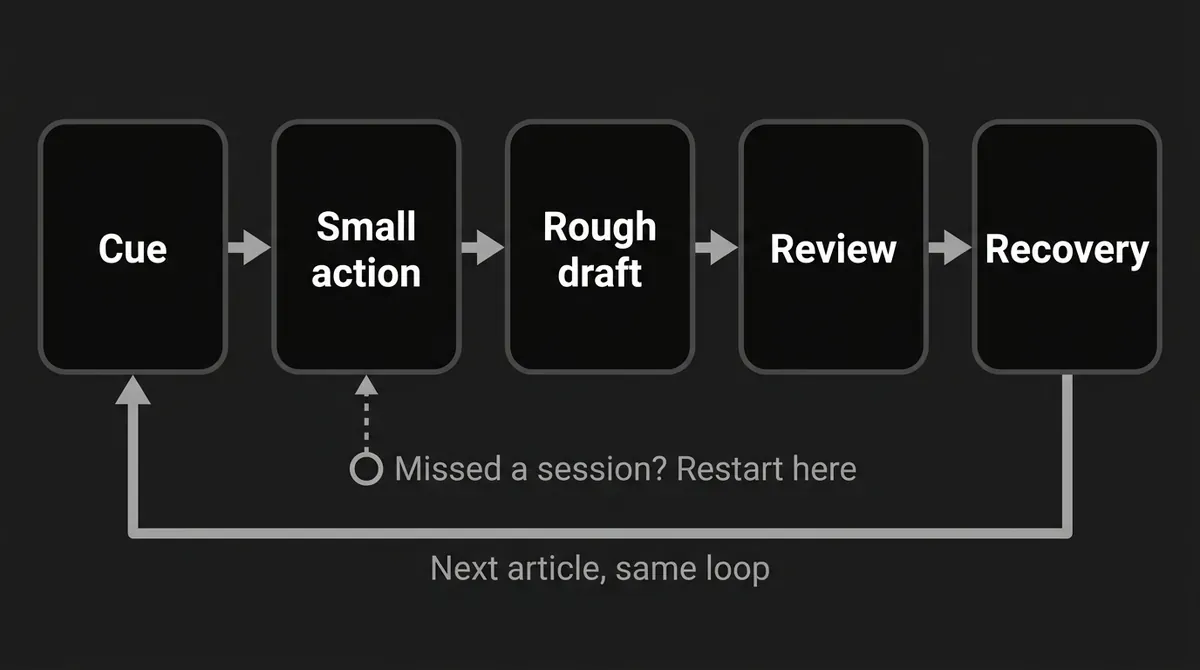
Keep the document and your source notes easy to reach, so you aren't hunting for them each time. If you like using a calendar block, protect it from meetings you could move. The cue matters more than finding the perfect hour of the day. At the end of every session, write down the next physical action, so the following start is already decided when you come back.
You'll know it's working when you can say exactly when you'll begin, which document you'll open, and what the first small action is. A good session doesn't have to end with a finished article.
The usual mistake is reading one missed session as proof that the habit failed. Researchers at University College London reported that repeating a behavior in the same situation helps a habit form, and that missing a single opportunity didn't noticeably disrupt the process in their study, though marked inconsistency did. That study looked at everyday health-related behaviors, not blogging, so treat it as a reason to go easy on yourself after one skipped day and nothing more. Their reported average of 66 days isn't a deadline for your writing habit either, because people varied a lot.
3. Keep a queue of specific reader questions
Ideas are easier to write when they're already shaped. As you go through your week, capture the questions customers keep asking, the objections that come up in support, and the things you explain again and again during onboarding. For each one, jot down who is asking, the exact question, why the answer matters, what you already know, what evidence is missing, and whether an existing page should be updated instead of writing a new one.
Then pick one question you can actually answer for your next piece. If an idea depends on a product decision or a legal review, leave it with that dependency instead of putting it straight into your writing queue.
You're done when a tired version of you, a few weeks from now, could open the note and know what question to answer, where the evidence will come from, and whether to create a page, improve one, or wait.
People go wrong here by collecting appealing headlines without a clear job for the article, or by copying a competitor's angle. Another slip is starting a new page when an existing one already owns the question. And an unsourced claim doesn't become safe just because it's sitting in a backlog.
A simple document works fine for all of this. If you already use DeepSmith, Opportunity Agents can suggest ideas backed by your AI visibility or Content Map data, and New Ideas is the one backlog where those ideas land, whether they came from an agent, a manual entry, or an import. You still decide whether a suggestion matches a real buyer question and whether an old page needs work first. An agent won't find every worthwhile topic, and it can't promise a citation. If you want to see how gaps become a backlog, this walk-through of turning AI visibility gaps into a content backlog covers it.
4. Turn one question into a short working brief
Before you write a sentence of the article, write a short brief. It needs the reader, a one-sentence answer, a few distinct sub-questions, your own example or product detail, the evidence you still need, the claim you must not make, and what the reader should be able to do afterward. Put the sub-questions in a sensible order and use them as your section headings. Collect enough material to support those sections and then stop researching, unless a real gap shows up. If a fact is missing, keep it visible in the draft as an open question instead of inventing an answer to keep going.
If you're wondering how to write faster, this is the biggest single thing you can do, because a lot of slow writing is really slow starting. Once each section has a job, you can begin with any section whose evidence is ready.
You'll know the brief is done when each proposed section has a clear purpose. It's a scaffold, and it doesn't have to read nicely.
The usual mistakes are researching forever because the question is too broad, and drafting from a keyword alone with no reader problem behind it. Purdue's writing lab separates the writing process into invention, composing, and revision, and its prewriting questions include purpose, audience, genre, style, and what research you need. That's a useful order to borrow.
Here's a small example of a brief. The reader question is "What should our admin do when a teammate leaves?" The working answer describes the documented offboarding steps, names the permission checks, and flags any step that needs an administrator. Your own input is the product's real settings and a screenshot you've reviewed. The open question is whether an integration keeps access after removal, and the brief says not to claim that every integration revokes access on its own unless someone has verified it. If you want more on shaping sections, outlining an article around the questions AI users ask goes deeper.
5. Draft the answer in sections before polishing sentences
Start with the section whose answer is clearest to you. Put the direct answer near the top, then the action, an example, the evidence, and any exception. When you hit a detail you don't know, drop in a placeholder like "[verify setting name]" and keep moving, instead of stopping to solve it or making something up. If the blank page is what stops you, spend a few minutes freewriting what you'd tell a customer over a call, and then organize that against your brief. Save line edits, formatting, the title, and the introduction for a separate pass.
This is also how to stop procrastinating writing in a practical way, because most avoidance comes from trying to judge every sentence while you're still producing it. Research on procrastination describes it as unnecessary, voluntary delay even though you expect it to cost you, and it treats the task feeling unpleasant as a bigger factor than plain laziness. A draft can feel unpleasant because the topic is unclear, the task is too big, or product accuracy feels high-stakes. Avoidance brings quick relief, and that relief can make the next delay more likely. So it helps to find the exact point that's stopping you. If the question is fuzzy, narrow it. If evidence is missing, ask for it. If the opening feels intimidating, answer one sub-question in rough language. If you truly don't have the capacity, change the workload, because willpower won't fix that. Psychologist Fuschia Sirois has also talked about self-compassion after procrastinating, which is a good reason not to turn one missed session into a spiral of self-criticism, though it doesn't excuse ignoring a commitment you really made.
You're done when the draft answers its main question, covers the planned sub-questions, and clearly marks what's still missing. It can be rough. A complete draft isn't automatically ready to publish.
Common mistake: If every writing session starts with new research and ends with polishing the introduction, you may never reach the answer. Keep one question and an outline in view, draft the useful sections first, and revise afterward.
Another slip is treating fast text as a finished article. Your real advantage as a founder is product knowledge, and no word-count target changes that.
If hand-drafting is the bottleneck, DeepSmith's Writer runs research, planning, writing, internal and external linking, cover image generation, and publishing metadata in a multistage pipeline grounded in your product, persona, and voice context, and the result arrives ready for you to review. You still check the product-specific evidence and claims, so this is a way to spend your time on judgment instead of assembly. It's more than a single-prompt writing assistant, and it doesn't replace your review.
6. Batch compatible tasks and protect drafting from interruptions
Group similar work together. Collect questions in one sitting, prepare several briefs together, draft one section without editing another at the same time, and then do a deliberate review pass afterward. Silence notifications you don't need during focused work where you can, close unrelated tabs, and leave yourself a note about where to resume before an interruption you can't avoid.
If you're looking for how to write faster through batching, keep in mind that it doesn't have to mean writing several complete articles in one day. Batch only as much as stays sustainable, because an occasional huge production sprint isn't automatically a healthy process. If you want a longer look at this approach, there's a guide on batching content production as a solo founder.
You'll know it's working when a session has one defined mode and one output, such as two usable outlines or one rough section, instead of a day spent bouncing between messages, research, drafting, and metadata. You also have a way back in after a real interruption.
The mistake to avoid is expecting batching to remove every interruption cost. The American Psychological Association describes measurable costs when people switch between tasks, especially complex or unfamiliar ones, which is a good reason to keep research, drafting, and editing apart when you can. One laboratory study of 48 participants doing simulated office email work found that interrupted people worked faster but reported more stress, workload, frustration, and pressure. That study doesn't tell you how many minutes a blogger saves by batching. What it does suggest is that fast work can come with a cost that doesn't show up in the output, so speed alone is a poor way to judge whether your process is sustainable.
7. Review for usefulness and accuracy, then hand off repeatable production work
Do a separate review against your brief. Ask whether the direct answer is correct, whether the piece has a useful first-hand example, and whether a reader could actually complete the task. Check that product details are current, the evidence is enough, and the exceptions are clear. Highlight every number, price, product setting, quotation, integration, comparison, and promise of an outcome, and check each against a current source or the person who knows. Remove or qualify what you can't verify. A tighter checking routine, like this line-level editing checklist, makes the pass faster because you're not deciding what to look for each time.
Then look at what in your process is purely mechanical, such as formatting, linking, metadata, and scheduling, and decide what someone else or a system can handle without you giving up responsibility for accuracy.
You're done when a reader could act on the article, the important claims have been checked, unknowns are resolved or qualified, and a named person has approved publication. If it helps readers understand the work, a byline or a note on how the piece was made is fine.
People go wrong by calling an unreviewed draft finished, or by using automation to fill a calendar with pages that add nothing original. Google's guidance asks whether readers leave having learned enough to reach their goal, and it says generative AI can help with research and structure while warning that producing many pages without adding value for users may violate its spam policy. That's a quality safeguard. It doesn't say AI-assisted writing is banned. For more on where a human check belongs, see adding review and QA gates to an AI content pipeline.
If you can't start each production run yourself, DeepSmith's Autowrite can write a configured idea on its scheduled date and place the finished article in Produced Content, where you review and edit it before it goes out through the publishing options you've connected. The honest promise here is less manual starting and less assembly work. It doesn't promise factual correctness, rankings, leads, or freedom from review.
8. Protect recovery and adjust when the process starts to strain
Leave space between focused tasks, and leave space for time away from work altogether. At the end of each writing cycle, make a few notes. Which stage did you keep putting off? Did the piece need an unplanned rewrite? Is the writing taking time from sleep, product work, or rest you need? Then change the cause. You might narrow the scope, improve the brief, protect a work block, move a task to someone else, or renegotiate a commitment. After a missed session, pick the next smallest useful action instead of an all-night catch-up sprint.
A short check at the end of each cycle is enough: which part of this post used up unexpected time, did I have the evidence when I began, and what can I remove, prepare earlier, delegate, or reschedule next time? Track friction and tiredness alongside whether the post shipped, because a streak on its own can't tell you if the process is sustainable.
You'll know you're done when you can say what you'll repeat and what you'll change for the next article, and whether the problem was avoidance, missing inputs, interruptions, or a workload that's simply too big.
The usual mistake is treating tiredness as a character flaw, or believing a productivity trick will fix chronic overload. NIOSH notes that fatigue has multiple causes, no single remedy fits every situation, and work schedules should allow enough rest and recovery. If you want to avoid blogging burnout, it helps to know what burnout means. The World Health Organization describes occupational burnout as coming from chronic workplace stress that hasn't been managed well, with three parts: exhaustion, growing distance or cynicism toward the work, and reduced professional efficacy. It's an occupational phenomenon and not a medical diagnosis, so an ordinary reluctance to draft one post isn't the same thing. If those feelings stick around, or they affect how you function day to day, a lighter workload and support from a qualified professional matter more than a stricter writing streak.
What to do next
Take the next article on your list and do three things this week. Write its reader question, write a one-page brief, and decide the first small action and the cue that starts it. Then run the whole process on that one piece and look at how it went before changing anything else. If you'd like some of the production work taken off your plate, start a DeepSmith free trial and see how a prepared idea turns into a brand-grounded article that you review before it goes out, with Autowrite handling the scheduling when you're ready for it.