You can generate ten articles this week. You cannot generate the one thing that makes them credible.
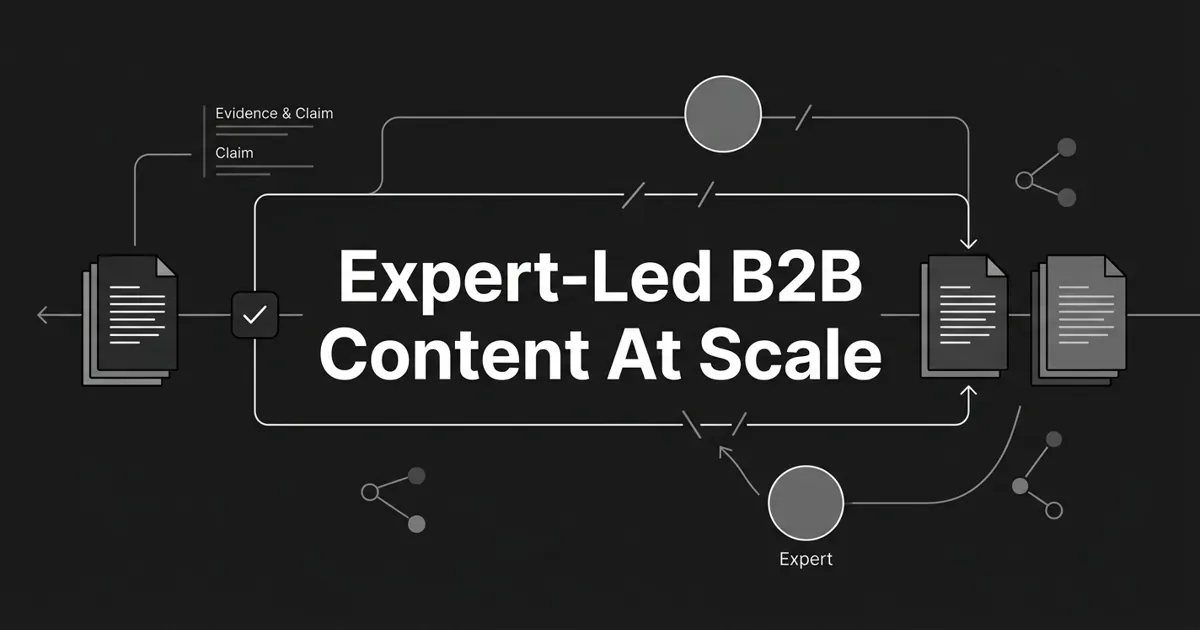
That is the real tension in ai content for b2b. A model drafts fast, but it cannot supply your product's actual limits, the caveat your engineer would add, or the point of view that survives a six-month evaluation. This guide hands you a b2b content workflow that captures expert knowledge once, reuses it everywhere, and sends only the risky claims back to an expert.
Here is the short answer.
Keep subject-matter experts in the loop by giving them three jobs, not one. They contribute source knowledge before drafting, verify high-risk claims during review, and approve a defined scope at the end. AI does the repeatable production work. A fluent draft is never proof that a claim is true.
If that sounds like more process than you have time for, stay with me. Almost all of it is set up once.
See the four jobs before you touch a tool
Every considered-sale article contains four kinds of work. Mixing them up is what makes expert-led ai content feel impossible.
| Job | Owner | What they decide |
|---|---|---|
| Strategy | Marketing lead | Buyer problem, stage, angle, success measure |
| Domain truth | Subject-matter expert | Product reality, technical limits, claim boundaries |
| Narrative | Writer or editor | Structure, clarity, whether the expert's view survived |
| Production | The AI system | Research inside approved sources, draft, links, metadata, assets |
Notice the asymmetry. Experts do the scarce work that needs judgment. The machine does the abundant work that needs speed. On a team of two, one person wears several hats. What cannot happen is a decision with no name attached to it.
Review effort should scale with claim risk, not word count. That is the hinge the whole workflow turns on.
Step 1: Choose the buyer decision before you choose the keyword
Start with the decision your content helps someone make. A keyword tells you what a person typed. It says nothing about the objection or the proof a buying group needs.
Write down six things: the primary buyer role and the roles who influence them, the stage, the exact question the page answers, the trade-off the reader is weighing, the product facts that must be right, and the next action the page makes possible. Then compress it: for [role] at [stage], answer [question] so the group can decide, using [approved evidence], while avoiding [out-of-scope claims].
Pick one primary reader. Just one. Then list the adjacent stakeholders whose questions need answering or linking: technical evaluator, economic buyer, security reviewer, implementation owner, procurement, legal.
Why does this matter more in B2B? Because your article gets forwarded. Forrester's 2024 Buyers' Journey Survey reported an average of 13 people involved in a B2B purchasing decision. Treat that as directional. The lesson holds: your page has to stay accurate after it leaves the champion's inbox.
Your own data can pick this work instead of a brainstorm. DeepSmith's AI Visibility tracks the prompts you define and reports mention rate, citation rate, and which competitor wins each one. Content Map classifies your site and your competitors' sites onto one topic and funnel-stage taxonomy, so coverage gaps are a measurement instead of a hunch. Opportunity Agents return ideas with the data point attached, which is the difference between a backlog you can defend and one you guessed at. None of it decides whether the angle is technically sound. That stays your expert's call.
How you know it is done. You can say out loud why this page should exist, for whom, and what evidence would make it useful.
Where teams go wrong. Defining success as "include the keyword and publish," which produces pages that rank for a phrase and help nobody decide anything.
Step 2: Capture your expert once and reuse it everywhere
This is the step that unlocks b2b content at scale, so give it real attention.
Pick the SME with the right knowledge for this page, not the most senior person free on Thursday. Sometimes that is the engineer who designed it. Sometimes it is the salesperson who hears the same objection weekly.
Before asking for time, tell them why you picked them, what the article is for, the questions you will cover, how long it takes, and whether they will review the finished piece. Unclear expectations create pushback. Clear ones usually get a yes.
Then run a 20 to 30 minute capture session. Ask questions that surface judgment, not definitions:
- What are customers struggling with right now, and what do they get wrong about this?
- What would you say to a smart prospect one to one?
- Under what conditions is this recommendation valid?
- What would make you reject this approach entirely?
Record it when you have permission, transcribe it, and keep the transcript with the approved sources. No time for a live call? A tightly scoped written response works. The source just has to be attributable, current, and permission-aware.
Now turn the capture into a source pack:
| Source-pack field | What you record |
|---|---|
| Topic and buyer job | The question and decision this expertise supports |
| SME owner | Name, role, expertise, and a backup reviewer |
| Capture date | When the source was created |
| Transcript or notes | Raw language, examples, objections, reasoning |
| Approved sources | Current docs, specs, security material, messaging |
| Claims to make | Statements the SME confirms are accurate |
| Claims to avoid | Unsupported promises, outdated capabilities, restricted comparisons |
| Conditions and caveats | Versions, prerequisites, exceptions, dependencies |
| Review scope | What the SME approves, and what stays with the editor |
| Refresh trigger | Product change, policy change, or a review date |
Never ask the SME to draft the article. Ask for the scarce input only they can give, then reuse it across a whole topic cluster. Batch related questions into one session, and rotate a roster so one person is not carrying everything.
One-third of B2B marketers in Content Marketing Institute's 2023 research said access to subject-matter experts was a problem. If that is your team, you are not disorganized. You are paying for the same expertise repeatedly instead of banking it.
Banking it is what DeepSmith's Deep IQ is for. It holds your positioning, product profiles, personas, brand voice, content types, and trusted sources, and every module reads from it. Put the approved SME language and claim boundaries there and no article starts from a blank prompt again. Deep IQ does not interview your expert or verify a claim. It keeps the answer once you have it.
Pro tip. The way to cut SME time is not to remove the expert. Capture the reasoning once, stamp it with a date and an owner, and return only when something changes.
How you know it is done. Another writer can tell what is safe to claim without booking a new meeting.
Where teams go wrong. Treating the interview as a one-off favour for one article instead of an asset with a date, an owner, and a refresh trigger.
Step 3: Turn the source pack into a claim-aware brief
The brief is where your b2b content workflow gets rigorous or gets vague. Build it before anything is generated.
It carries the buyer job and stage, the angle, the heading sequence, the answer that belongs near the top, the objections to resolve, the source-pack references, the allowed proof points, and the prohibited claims.
Then add the part most teams skip. A claim ledger.
| Claim type | Evidence | Owner | Risk | Status |
|---|---|---|---|---|
| Product or technical statement | Approved doc or SME passage | Technical SME | High | Unreviewed, verified, corrected, removed |
| Buyer or market statement | Named research or first-party data | Strategist | Medium | Verified or needs source |
| Customer result | Case evidence plus permission | Customer or legal owner | High | Approved, restricted, removed |
| Comparison or superlative | Defined comparison set | Product or SME | High | Verified, qualified, removed |
| Recommendation | SME rationale or labeled opinion | SME and editor | Medium | Accepted or reframed |
The ledger exists for one reason: to stop a fluent sentence passing as a verified fact. When a claim has no approved evidence, mark it unresolved, then get the evidence, label it as opinion, or cut it.
Use the transcript to generate angles, not to outsource judgment. Asking a model for three to five angles and the buyer objections buried in the transcript is a good use of it. You still choose, and you still check it reflects your expert's actual view.
How you know it is done. A writer can tell which facts are settled, which need verification, and which must never appear.
Where teams go wrong. Asking AI to "write an authoritative article about" something with no evidence attached, then letting it invent statistics or customer results. If a number is not in your approved research, replace it or delete it.
Step 4: Generate from stored context, never a blank prompt
Now you write, and this is where the volume comes from. Feed the system the brief, source pack, claim ledger, brand voice, product context, persona, content type, and the explicit prohibitions.
Tell it to:
- Answer the primary question directly, near the top.
- Preserve the SME's reasoning and terminology without inventing quotations.
- Keep fact, recommendation, and opinion visibly separate.
- Use only approved product claims, and flag anything missing evidence.
- Include the caveats, prerequisites, and implementation detail.
- Answer the supporting stakeholders' likely objections.
The machine handles research inside the approved boundary, the outline, the draft, formatting, links, metadata, imagery, and distribution assets. You choose the angle, protect the expert's point of view, and decide what is publishable.
Thought leadership, legal, financial, customer stories, and outcome claims stay human-led.
DeepSmith's Content Studio runs this stage. Ideas move from New Ideas to Planned Content to Produced Content, and the Writer researches, outlines, drafts, links internally and externally, generates a cover image, and prepares metadata in one pass. Keyword coverage, heading structure, schema, and linking are part of creation rather than manual cleanup afterward, with up to five internal links placed during generation. From Produced Content you review, edit, and publish to WordPress, Webflow, Strapi, Sanity, or Contentful.
Autowrite can even generate a configured article on its scheduled date with nobody in the app. Read that capability carefully. A scheduled generation is automated production, not expert approval, and a high-risk piece should never skip the SME review your brief specified.
How you know it is done. Your reviewer can trace every high-risk claim to a source or a name.
Common mistake. Reading "publish-ready" as "verified." Publish-ready describes a production state. Fluency is not verification and never has been.
Step 5: Route every draft by claim risk
Assign a risk tier before the draft goes anywhere. The tier decides how much human judgment it gets.
| Tier | Typical content | Review treatment |
|---|---|---|
| Low | Routine summaries and updates making no new product or outcome claim | Light editorial review plus a factual spot check |
| Medium | Educational content with product context, implementation advice, recommendations | Editor plus the relevant technical SME |
| High | Architecture, security, pricing, regulated claims, ROI claims, customer stories, competitive claims | Named SME plus the accountable legal, security, or executive approver |
Those are a starting point for routing, not a legal classification. Write your own triggers. In a considered sale, treat these as high risk until the right owner says otherwise:
- Integration compatibility and supported versions.
- Security, privacy, data retention, or deployment claims.
- Implementation timelines and quantified cost or revenue outcomes.
- Superlatives, customer names and results, and claims about what a competitor can or cannot do.
Route by stakes, not by who happens to be online. A draft does not advance on a vague "looks good" from someone unqualified to give it.
How you know it is done. Low-risk work moves fast without dragging an engineer into routine copy, and high-risk work cannot quietly take the fast lane.
Where teams go wrong. Two opposite failures: a six-person committee on every article, which rebuilds the bottleneck you were removing, or waving everything through, which is how one wrong integration claim costs a deal.
Step 6: Run an SME review of AI content that asks for decisions, not proofreading
Here is where most teams lose their experts. They forward a 3,000-word draft with "can you take a look?" and hear nothing for two weeks.
A useful sme review of ai content gives the expert the draft, the claim ledger, the source passages, and a short set of decisions, with the technical statements highlighted. Ask for two focused passes.
Pass one, accuracy and boundaries. Is each technical statement true as of today? Is the terminology right for that version or deployment? Does any sentence imply a promise you cannot make?
Pass two, point of view. Would you say this to a smart prospect? Does it explain why the recommendation matters, not just what it is? And the best question of the lot: which sentence here is technically true but misleading without context?
Give them simple labels: Keep, Correct, Qualify, Needs evidence, Escalate, Remove. Never ask them to rewrite the article in their own style.
The review is finished when every high-risk claim is resolved and the SME approves a defined scope. "Technical accuracy and product claims for version X" is a real approval. A thumbs up on the whole document is not.
Pro tip. Ask for decisions, not proofreading. "Is this claim true, under what conditions, and what would you add or remove?" gets a same-day answer. "Please review this article" gets you a fortnight of silence.
How you know it is done. No orphaned technical statement is waiting on an expert who never comes back.
Where teams go wrong. Accepting an undefined approval, so nobody can later say what the expert actually signed off on.
Step 7: Check the article can travel through the buying group
Your expert signed off on the facts. That is not the same as the page doing its job. This short pass is what makes expert-led ai content commercially useful.
You check strategic fit. Does the piece serve the buyer job and stage you declared? Is there a real editorial angle, or did it drift into a generic explainer? Could a champion use this to explain the decision to someone else?
Your editor checks clarity and voice. Your SEO and AEO owner checks that the agreed prompt coverage, headings, internal links, metadata, schema, and alt text are actually there. The technical reviewer returns only if a change touches a verified claim.
For citation-ready structure, put a direct answer near the top, use descriptive headings, define the important terms, and organize the evidence so a reader or an answer engine can follow the passage. That is clarity, not a magic trick.
Worth saying plainly, because it saves you money: Google's guidance is that a page needs to be indexed and eligible to appear in Search with a snippet to be eligible as a supporting link in its AI features, with no additional technical requirements or special optimizations. No new AI text files, no special schema.
Common mistake. Letting an SEO pass quietly add new product claims or "best" language after the SME signed off. Any new claim goes back to its owner, or the ledger stops meaning anything.
How you know it is done. One clear primary job, the supporting objections covered, and every claim either resolved or explicitly qualified.
Step 8: Record the sign-off, publish, and feed what you learn back
Keep the approval record small enough that people actually fill it in: article version, buyer role and stage, risk tier, SME reviewer and approval scope, claim-ledger status, and refresh trigger.
Publish once the accountable approver confirms readiness. Keep the source pack and the corrections, so the next article inherits better context than this one started with. That compounding is what produces b2b content at scale, not raw generation speed.
Repurpose while the context is fresh, into LinkedIn posts and newsletter sections. Every derivative carries the same claim boundaries as the article. A 200-word social post can flatten a carefully qualified technical statement faster than the original ever could.
Then measure both halves of the system. On production: SME minutes per article, the corrections made, and the share of articles with a named expert and approval scope.
On visibility, track your defined prompt set over time. Mention Rate is how often an engine names you. Citation Rate is how often it links your pages as sources.
DeepSmith supplies both sides of that loop. Autowrite generates on the scheduled date and hands the result to Produced Content for review, and Repurpose plus the Apps Library turn a finished article into channel-native assets. AI Visibility reports the mention, citation, and competitor signals, and Content Map rechecks sitemaps every 24 hours. The tool removes repetitive production work. Your SME still owns technical truth, and your approver still owns publication.
Feed the results back. Mentioned but not cited? Check whether the page holds clear evidence and a quotable passage.
How you know it is done. The approval record is complete, the refresh trigger is known, and the visibility data has gone back into the backlog.
Where teams go wrong. Measuring article count alone. A system that doubles output while doubling expert corrections has not improved anything.
What to do next
You do not need all eight steps live by Friday.
Pick one high-value buyer question. Book one 20 to 30 minute capture session. Build the source pack and the claim ledger for that single piece, then run it through risk-based routing end to end and see where it snags. That is your whole first week.
The second article is faster, because the source pack already exists. That is the point of the entire b2b content workflow: the expensive part happens once.
Want the shared context, the visibility data, and the production pipeline in one place while you build this? Start a free DeepSmith trial and run your first piece through it. Keep your SME review exactly where it is. The tool takes the toil, not the accountability.