You typed the question your best buyers ask into ChatGPT, and the answer cited a person. A name, a job title, a LinkedIn profile. Just not yours.
That stings. It is also the most fixable visibility problem in B2B right now, because LinkedIn AI citations follow patterns you can work with this week.
This guide is for a marketing lead who owns AI visibility and does not have a spare quarter to spend on it. By the end you will know what it takes to get cited from LinkedIn by AI, and you will have a seven-step plan for turning profiles, articles, and posts into the sources engines quote when a buyer asks a professional question. You do not need a bigger team. You need a smaller first step, and then the next one.
Let's start with why the platform sits where it does, because the why tells you exactly what to change.
Why AI engines lean on LinkedIn when the question is professional
For B2B and professional queries, LinkedIn is the most over-represented domain in AI answers. Several independent 2026 analyses landed on the same picture from different angles: LinkedIn ranks first among cited domains for professional queries, and among the top two cited domains for chatbot answers overall. In the Google AI Overviews citation distribution, LinkedIn sits near the top at roughly 1.3% of citations, ahead of Gartner, NerdWallet, and Forbes.
The trend line matters more than the ranking. Engines have been citing LinkedIn sources up to five times more often year over year, and LinkedIn articles now make up something like 15% of AI-generated responses in the verticals analysts have studied.
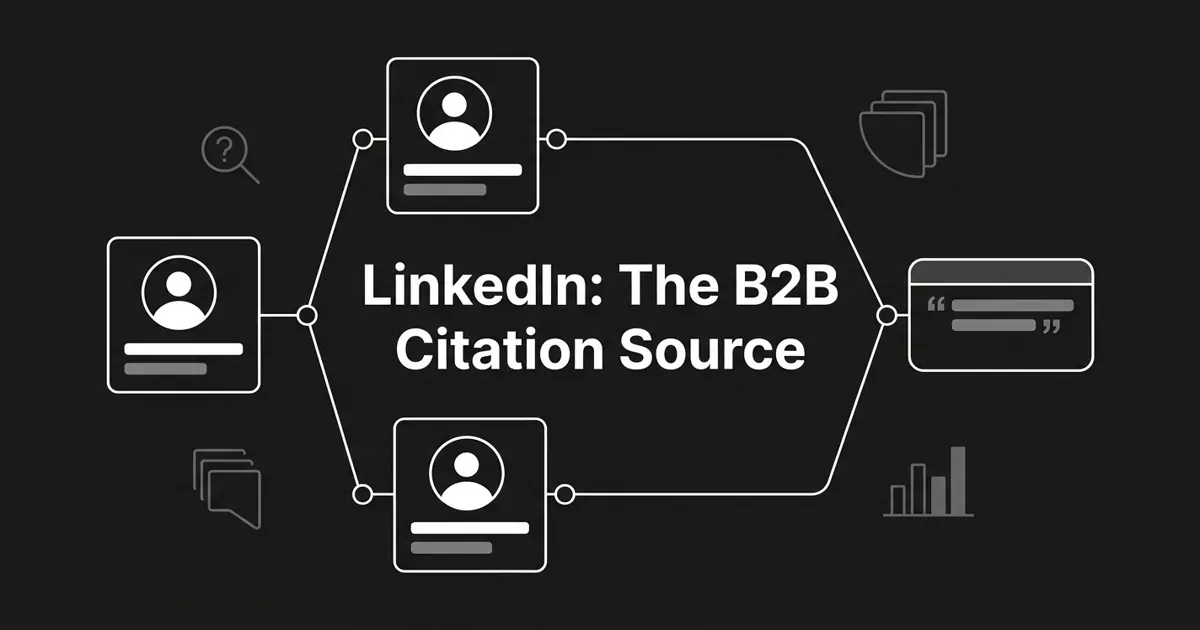
Here is the part most teams miss. A joint study of 9.5 million AI citations found that about 75% of LinkedIn citations come from individual member profiles rather than company pages. A separate analysis of 89,000 LinkedIn URLs cited by AI engines reached a similar conclusion: engines are reading profiles to judge the credibility of the people behind a brand.
So why does one platform pull this much weight? Six signals, all concentrated in one place.
- Person-level credentials. A profile carries name, title, employer, education, certifications, skills, endorsements, and recommendations. That is closer to a verified credential record than anything else on the public web.
- Employer-anchored claims. Profiles tie a human to a company, so an engine can resolve "this person said X about company Y" against a real professional identity.
- Freshness. Posts surface in near real time and carry clear timestamps, which matters for questions about who is doing what right now.
- Structure. Headings in articles, line breaks in posts, bullets, and tagged authors give retrieval systems clean chunks to lift.
- Domain trust. LinkedIn carries high classical authority, and that carries through into retrieval even when the final answer is synthesized.
- Intent match. B2B questions are person-and-company shaped. LinkedIn is the largest public corpus that is natively the same shape.
Read those six back and one conclusion falls out. Your most valuable AI-visibility asset in B2B is probably not a landing page. It is a named human on your team with a well-built profile and something specific to say. That is the quiet mechanism behind thought leadership AI visibility: engines are not rewarding your opinions, they are resolving who is credible enough to quote.
That is what LinkedIn B2B AEO actually means: treating the platform as a citation surface rather than a distribution channel. Here are the seven steps.
Step 1: Map the buyer prompts where a profile would settle it
Start by listing the 20 to 50 questions your buyers actually type into ChatGPT and Perplexity at the point where a person's credibility decides the answer. Think "who is the expert on X," "what does company Y do," "best tool for [use case]," "opinions on [industry shift]."
What to do: write each prompt in the buyer's words, not your category's words. Put them in one sheet with four columns: prompt, current mention rate, current citation rate, and the owner on your team.
How you know it's done: every row has a named owner, and you can read the list top to bottom without hitting a prompt that makes you shrug.
Where people go wrong: loading the list with prompts that are not person-centric. "How do I do keyword research" will not return a profile, because the engine is not looking for a human. If the question does not want a person or a company, LinkedIn will not surface for it. Filter hard, and the rest of the plan gets easier.
If building that list from scratch feels like the thing that will stall you, that is normal, and it is also the part software handles well. DeepSmith's Discover Prompts generates a starter set of buyer questions from your product, persona, and buyer-stage context, so you edit a list instead of inventing one.
Step 2: Find your citation gap by SME name, not brand name
Now run the prompts. Every one, on every engine you care about, and write down what comes back.
What to do: for each prompt, record whether a LinkedIn source appears, whose profile or article it is, which employer they belong to, and which format got cited. You are looking for which LinkedIn content AI answers already pull from in your category. Build a simple matrix of prompt by cited source by us-or-competitor. That matrix is your gap.
How you know it's done: you can point at a specific competitor's SME and say "that is the person the engine trusts on this cluster, and we have nobody there."
Where people go wrong: auditing only the brand string. This is the single most common mistake, and it is expensive. If roughly three quarters of the LinkedIn citation surface is member profiles, a brand-name audit misses most of what is happening. Search by the names of your people, and by the names of their people.
Run it across more than one engine while you are here. LinkedIn AI citations are not distributed evenly across engines. ChatGPT and Perplexity overlap on only about 11% of their sources, and they surface a different number of them: Perplexity Pro tends to return around 5.4 distinct sources per buyer-intent answer, ChatGPT around 3.1, Gemini around 2.7, and Google AI Overviews around 1.9. More sources per answer means more room for your content to be one of them, so Perplexity is often where a new profile shows up first.
Doing this by hand, weekly, across engines, is where good intentions go to die. DeepSmith's AEO module tracks each prompt on a schedule and reports mention rate, citation rate, the exact pages cited, and which competitors win which prompts, so the gap matrix maintains itself instead of eating your Friday.
Step 3: Lock your SME roster
Pick the humans. Three to seven named people who are already on LinkedIn and whose actual job matches a tracked cluster.
What to do: for each topic cluster in your map, assign at least three subject-matter experts. Check that each person's current title genuinely matches the expertise you want them cited for, and that they are willing to post. Willingness beats seniority here.
How you know it's done: every cluster has three names next to it, and none of those names made you wince.
Where people go wrong: assigning expertise that the title does not support. A "Head of Marketing" headline making authority claims about enterprise data security is a mismatch an engine can read, and it undercuts the claim instead of supporting it. Match the person to the cluster, or pick a different cluster.
Pro tip: resist the urge to make this the founder's job alone. Founder-led everything is how a content program becomes one person's calendar problem. Three credible voices compound faster than one exhausted one.
Step 4: Rewrite each profile as a credential document
A profile is not a resume here. It is the document an engine reads to decide whether your person is the authority on a question.
What to do: work five fields in order.
- Headline. Title, then employer, then one keyword phrase that matches a tracked prompt. Explicit beats clever.
- About section. Open the first paragraph with a crisp, direct answer to the closest tracked prompt, using real entity names. "I lead [function] at [Company], focused on [topic]." Supporting detail comes after.
- Experience entries. Lead each role with a declarative statement of what that person does, not a bullet list of responsibilities. Declarative lines index as facts.
- Skills. Keep the top three tight and aligned to the cluster. Endorsements on three real skills say more than thirty listed ones.
- Featured section. Pin the three articles you most want quoted, in priority order.
How you know it's done: the first screen of every SME profile contains a one-line answer to a question you are tracking, in language a stranger would understand.
Where people go wrong: burying the answer. A beautiful narrative About section that reaches the point in paragraph five reads well to a human and chunks badly for a machine. Also common: a "helping ambitious teams unlock growth" headline with no role title in it. There is nothing there for an engine to anchor a credential to.
If your team's profiles all need this, do one this week. Just one. Momentum matters more than a perfect rollout.
Step 5: Publish long-form articles as your canonical answers
Posts are the fast surface. Articles are the compounding one. LinkedIn articles get cited at a multiple of last year's rate precisely because they are persistent, indexable, and tied to a named author.
What to do: treat each article as the canonical answer document for exactly one prompt cluster.
- Title it the way the buyer asks the question, close to verbatim.
- Put a 60 to 80 word direct answer near the top. That block is the most-lifted part of the page.
- Use four to six section headings, each opening with the section's claim in its first sentence.
- Use lists where the question expects enumeration.
- Byline it with the SME's exact profile name, current title, employer, and a link to the profile, so the claims tie back to a verified identity.
- Close with a question that restates the tracked prompt.
How you know it's done: someone who has never met you could read the title and the top block and get a complete, correct answer without scrolling.
Where people go wrong: writing corporate-voiced articles with no byline, or a byline whose name does not exactly match the profile. The credibility anchor breaks, and the anchor is the whole point. The other failure is volume without substance. Only about 15% of B2B thought leadership gets rated good or excellent by the people who read it, and roughly nine in ten B2B readers click through to check the source behind an AI answer. The bar is not "AI-readable." The bar is good.
This is the step where an internal content program either scales or stalls, because one canonical article per cluster per SME is real work. DeepSmith's Content Studio produces publish-ready articles with that structure built in during creation, crisp answers near the top of every section, clear headings, internal links, and metadata, so what lands is an article your SME can put a byline on rather than a draft to rescue. As Pallav A., an SEO Specialist at Tahshop AI, put it: "Drafts come out close to final because the system has context it needs."
Step 6: Engineer posts as citable snippets
Now the fast surface. A post is not a teaser for the article, it is a small, self-contained answer that happens to link to one.
What to do: build each post in four parts.
- A one-line declarative claim, not a rhetorical hook.
- A two to four sentence direct answer. This is the unit engines lift most often.
- Three to five bulleted supporting points, one line each.
- A close that names the person, the title, the company, and links the full article.
How you know it's done: the first thirty words stand alone as an answer, and the post links to a persistent article URL.
Where people go wrong: hook-heavy posts with nothing quotable in the middle. "I learned something wild last week" gets engagement and earns zero LinkedIn AI citations, because there is nothing in it an engine can extract as a claim. Two more habits to drop: vague pronouns after the first sentence, when explicit role and employer would resolve the identity cleanly, and leaning on polls and carousels, which read as media rather than as text.
Line breaks are doing more work than you think. A post written as one dense paragraph tends to get summarized. A post written as separate claims tends to get quoted.
Step 7: Measure weekly, then feed what you learn back into production
The loop is the strategy. Everything above is setup, and a LinkedIn B2B AEO plan without a weekly loop is just a to-do list with better formatting.
What to do: once a week, re-run every tracked prompt and log four things: mention rate, citation rate, the exact URL cited, and the author cited. A newly cited post or article is a signal to make more of that format on that topic. A cluster that stays silent is a signal to commission the next article.
How you know it's done: next month's content calendar is written from the log, not from a brainstorm.
Where people go wrong: filing this as a monthly report. Engines refresh their retrieval sets constantly, and a month-old snapshot is a month of guessing. Weekly is the right rhythm, and weekly only stays realistic if the collection is automatic.
Common mistake worth naming twice: optimizing for one engine. Given how little the source sets overlap, a plan tuned only to ChatGPT leaves Perplexity, Gemini, and Google AI Mode untouched. Track the portfolio.
This is the other place a platform earns its keep. DeepSmith runs your tracked prompts on a schedule across ChatGPT, Perplexity, Gemini, Claude, and Google AI Mode, depending on your plan, and reports mention rate, citation rate, share of voice, and visibility trend in one view, with the competitor pages winning your prompts sitting right next to them. The same platform then turns those gaps into the next articles, which is the part a tracker alone leaves on your desk.
Where this fits, and what to do next
LinkedIn is not a distribution channel in this plan. It is where your source-of-truth claims live, in the voice of named humans with checkable credentials. That is what makes it the shortest path to thought leadership AI visibility for a B2B team, and it is why the LinkedIn content AI answers rely on tends to be a person, not a page.
Be honest about the trade-offs while you build. Everything it takes to get cited from LinkedIn by AI has a different clock. Posts move fast and fade. Articles move slower and compound. Profiles are the slowest to shift because engines weigh history, and they are also the highest-leverage surface once they land. A balanced plan runs all three, and it does not promise you a citation, because nobody can. What you can control is whether your expertise is legible when an engine goes looking.
So here is your smaller first step. Pick one tracked prompt. Open the profile of the one person on your team who should own it. Rewrite the headline and the first paragraph of the About section so they answer that prompt in plain words. That is twenty minutes, and it is the highest-yield twenty minutes in this entire guide.
Then do the next one next week. You already have the expertise. This is just making it findable.
When you want the tracking and the writing running as one system instead of two tabs, you can start a free DeepSmith trial and see real prompt data and real drafts on your own topics before you pay for anything.