Three general-purpose AI writers dominate most shortlists, and the Jasper vs Copy.ai vs Writesonic decision rarely comes down to prose quality. All three draft competently. What separates them is the layer around the draft: how tightly brand context is enforced, whether the tool automates a production chain or a single document, and how much of the structural work that AI answer engines reward arrives by default rather than from an editor afterward. A best AI writing tool 2026 evaluation therefore turns on a narrower question than output quality, namely which of those constraints binds hardest on a given team. The sections below examine each tool on brand governance, SEO tooling, and AEO readiness, and are explicit about where the public evidence is thin.
The Short Answer for Each Team Type
Jasper suits teams whose primary constraint is on-brand consistency across many assets, regions, or sub-brands. Copy.ai suits teams whose constraint is process repeatability across sales and marketing, not long-form depth. Writesonic suits SEO and content teams that want long-form article production and AI-search visibility tracking inside one subscription.
| Dimension | Jasper | Copy.ai | Writesonic |
|---|---|---|---|
| Primary positioning | Brand-controlled marketing AI platform | GTM workflow platform (chat plus workflows) | SEO and GEO article writer with visibility tracking |
| Core drafting surface | Canvas, Grid, Agents, Campaigns | Chat and multi-step Workflows | AI Article Writer with SEO and GEO modes |
| Brand context layer | Brand Voice, Brand IQ, Style Guide, Visual Guidelines, Knowledge | Brand Voice plus Infobase (uploaded documents) | Brand voice profile per article or customer |
| SEO tooling | SurferSEO integration (SEO Mode) | SEO checklist steps inside workflows | Built-in keyword research, SERP analysis, NLP terms, internal links |
| AEO and GEO output | Jasper IQ grounding, FAQ Agent for structured Q&A | Workflows configurable for definition blocks and Q&A | Dedicated GEO Mode: definitional answers, named entities, FAQ schema |
| Native visibility tracking | None in mid-2026 | None in mid-2026 | AI Visibility Tracker, up to 10 engines at Enterprise |
| Notable integrations | Webflow, SurferSEO, Zapier, Make, API, MCP | HubSpot, Salesforce, Google Docs, Slack, Notion | WordPress, Webflow, Sanity, Contentful, Ghost, Ahrefs, GSC |
| Published entry price | Pro from about $59 per month, annual, 1 seat | Chat at $29 per month, 5 seats | Starter from about $79 per month, annual, 1 user |
List prices move, promotions run seasonally, and monthly billing sits above the annual rates shown. The figures above reflect the most recent verified list prices at the time of research and warrant re-checking on each vendor's pricing page before purchase.
Jasper: Brand Governance as the Production Constraint

Jasper is the most enterprise-oriented of the three. It positions as AI purpose-built for marketing, and the substance behind that positioning is a context layer rather than a drafting model. Brand voice, style guide, knowledge assets, audience definitions, and visual identity are encoded into a profile that every generation respects.
The drafting surfaces are differentiated by asset shape rather than by task. Canvas is a document-style long-form editor with brand context applied, and it is the main surface for articles and briefs. Grid handles tabular, high-volume short-form work such as product descriptions, ad variants, and meta descriptions. Campaigns produces a bundle of related assets, including email, landing page, ad, and social, from a single brief. Content Pipelines strings the stages together, from brief through draft, refinement, and publication. A Translation Agent extends output to roughly thirty languages while preserving the defined voice.
Two mechanisms bear directly on AEO readiness. Jasper IQ grounds output in uploaded reference material, which reduces the incidence of invented claims and encourages the kind of sourced, specific writing that answer engines tend to extract. The FAQ Agent generates structured question-and-answer blocks in a scannable format, grounded in the same brand knowledge, and those blocks map cleanly onto FAQ schema and passage-level extraction.
SEO tooling is delivered through a SurferSEO integration rather than built in. SEO Mode surfaces keyword suggestions, natural-language terms, and content scoring inside the editor, but full functionality assumes a Surfer subscription alongside the Jasper one.
Jasper also publishes a dedicated GEO product page that frames the platform for generative-engine optimization and refers to monitoring AI citation rates and identifying content gaps. That language should be treated with care. As of mid-2026 there is no public confirmation of a separate, fully launched citation-rate dashboard shipping as a distinct product, and the claim sits inside broader platform marketing. The defensible reading is that Jasper approaches generative-engine optimization through its context and content layers, not through a named tracker.
Where Jasper is strongest. The governance stack is the deepest of the three. For an organization running several brands or regions where voice drift creates real reputational cost, that layer is the product.
Where it is constrained. Pro carries the highest entry price of the three and includes a single seat, which pushes teams toward Business pricing early. Business and Enterprise terms are custom and not publicly itemized, so budgeting requires a sales conversation. There is no native AI-visibility tracking product comparable to Writesonic's, and long-form output on technical or niche subjects still requires human editing, which is true of all three tools.
Copy.ai: Workflows Over Documents
Copy.ai has moved away from its origins as a copywriting template library and now positions as a go-to-market AI platform, with AI applied across prospecting, account research, deal acceleration, content production, and post-sale motions. That is the broadest revenue-team framing of the three, and it is also the source of the platform's main limitation for content buyers: breadth across the revenue motion has been bought at some cost to depth on any single asset.
The differentiating primitive is Workflows: multi-step, branching prompt chains that automate a process end to end, for instance taking a topic through brief generation, drafting, a quality check against a defined checklist, and export. Chat provides a conversational drafting surface with model selection across OpenAI, Anthropic, and Google models inside a single workspace. Brand Voice applies tone and style rules across both surfaces, and Infobase stores uploaded documents, decks, and sheets so that outputs can be grounded in the organization's own material. A library of roughly ninety starter templates covers common marketing and sales tasks.
On SEO, Copy.ai publishes an automation capability with workflow steps for SERP and competitor research and on-page checklists, plus a dedicated long-form blog workflow template. What it does not offer in mid-2026 is a live optimization layer in the editor: there is no first-party SERP scraping or natural-language-term engine comparable to SurferSEO's real-time scoring. SEO is a step in a chain rather than a signal in the document.
The AEO mechanism follows the same pattern. A workflow can be configured to emit definitional openings, FAQ blocks, and schema-ready headings, and Infobase grounds claims in source documents, which supports attribution and expertise signals. The capability is genuine, but the team has to build it. Where Writesonic ships a GEO mode and Jasper ships an FAQ agent, Copy.ai ships the means to construct both. For a team with the appetite to design and maintain workflows, that flexibility is an advantage; for a team that wants correct structure by default, it is unfinished work.
Where Copy.ai is strongest. The workflow engine is the most capable of the three, and the sales-marketing handoff is genuinely well served: prospecting sequences, enablement material, and case studies live in the same system as blog production. The published entry price of $29 per month for five seats is the lowest of the three and the only one that makes a small team viable without a per-seat upgrade.
Where it is constrained. Long-form depth trails dedicated article writers, and the tool is better suited to shorter go-to-market assets than to full pillar articles. Credit consumption on workflows is difficult to forecast, so teams should model credits per task before committing to volume. Tiers above Chat are sales-led with custom pricing, and vendor terminology for those tiers has shifted over time, so current names and figures warrant direct verification.
Writesonic: Native SEO and the Only Visibility Surface of the Three

Writesonic sits at the intersection of SEO content production and AI-search visibility. It pairs an AI Article Writer with an AI Visibility Tracker, and it is the only one of the three with a first-party visibility surface in mid-2026.
The Article Writer is a multi-step pipeline aimed at long-form output, commonly in the three thousand to eight thousand word range, marketed as more than a hundred steps across eleven expert frameworks, and producing outline, draft, and polish stages with internal links and citations. SEO Mode is native rather than integrated: keyword research with volume, difficulty, and intent, SERP and competitor analysis, natural-language terms, internal linking suggestions, expertise and trust guidance, and FAQ schema suggestions. GEO Mode is a separate mode that structures a draft for answer-engine extraction, adding definitional answers near the top, named entities, FAQ schema, citation-ready formatting, and structured question-and-answer blocks.
The AI Visibility Tracker monitors prompts, citations, sentiment, and share of voice across ten AI platforms at the Enterprise tier, including ChatGPT, Perplexity, Claude, Gemini, Grok, DeepSeek, Microsoft Copilot, Meta AI, Google AI Mode, and Google AI Overviews, with a narrower subset at lower tiers. A competitor leaderboard and a view of the sources AI engines cite most in the brand's category accompany it, and an Action Center suggests on-page and off-page fixes based on observed gaps.
One qualification matters for how the tracker should be read. It measures brand presence and citation patterns inside AI answers, which is visibility, not verified downstream traffic or conversion. Writesonic uses citation in the sense of an answer engine naming or linking to a page, and that is a legitimate and useful signal, but it is not attribution data.
Where Writesonic is strongest. The native SEO toolkit removes the need for a separate Surfer subscription, CMS and SEO-data integrations are the widest of the three, and the article pipeline is built for pillar content and topical clusters rather than short assets.
Where it is constrained. The brand governance layer is lighter than Jasper's Brand IQ, with voice set per article or per customer rather than enforced centrally, which matters at volume or across multiple brands. Enterprise administration and governance are similarly lighter than Jasper's higher tiers. Credit metering at higher tiers requires capacity planning, and the Action Center is still evolving, so feature gaps against mature analytics suites should be expected.
Copy.ai vs Jasper on Brand Control and Long-Form Depth
The Copy.ai vs Jasper question is usually framed as price against polish, which understates the difference. Both tools support a brand voice and both accept uploaded reference material. The distinction is enforcement. Jasper's stack combines voice profiles, knowledge assets, a style guide, and visual guidelines into a layer that constrains every generation, and it is the correct answer where inconsistent output carries a real cost. Copy.ai's Brand Voice and Infobase produce grounded output, but with less granular style and visual governance.
On long-form, Jasper's Canvas is a document-first editor with brand context applied, while Copy.ai's strength is chaining steps rather than deepening a single document. Teams that publish long analytical articles weekly will find Jasper the closer fit; teams whose content output is a mix of short assets tied to a revenue motion will get more from the workflow engine, at roughly half the published entry cost.
Writesonic vs Jasper on SEO and AEO Tooling
The Writesonic vs Jasper comparison inverts on tooling. Jasper's SEO capability arrives through a partner integration and its AEO contribution is indirect: grounded, sourced content plus schema-ready FAQ blocks. Writesonic's SEO capability is first-party, and its GEO Mode targets answer-engine extraction explicitly, producing the definitional openings, entity density, and structured Q&A that AI search engines tend to favor when selecting passages to cite.
The counterweight runs the other way on control. Writesonic can produce structurally correct content faster, but the brand layer governing that content is lighter, and structurally correct content in a voice that does not match the brand still requires an editing pass. The practical division is that Writesonic optimizes the shape of the page and Jasper optimizes the substance and consistency of what fills it. Teams whose bottleneck is structure should weight Writesonic; teams whose bottleneck is voice and factual grounding should weight Jasper.
The Measurement Gap All Three Share
Any honest AI content generator comparison has to separate three layers that vendors tend to merge: producing a draft, structuring that draft so answer engines can extract it, and measuring whether answer engines actually cite the published page. All three tools do the first. All three do some version of the second, with Writesonic the most direct. On the third, the picture is thinner than the marketing suggests.
Jasper and Copy.ai ship no native visibility surface in mid-2026. Writesonic ships one, and it is a real product, but its full ten-engine coverage sits at the Enterprise tier under custom pricing, with narrower tracking below that. More importantly, none of the three closes the loop: a tracker that reports where a brand is absent from AI answers, sitting in a platform that also writes, is only useful if the gap it finds becomes the next brief.
This is the gap DeepSmith was built to close. DeepSmith tracks mention rate, citation rate, share of voice, and sentiment across ten engines (ChatGPT, Gemini, Perplexity, Claude, Google AI Overviews, Google AI Mode, Grok, Meta AI, Microsoft Copilot, and DeepSeek), reports which specific pages earn citations and which competitor pages win the prompts a brand is losing, and produces publish-ready articles from that same context, with keyword coverage, heading structure, schema markup, internal linking, and metadata built in during writing rather than added afterward.

| Capability | Jasper | Copy.ai | Writesonic | DeepSmith |
|---|---|---|---|---|
| Native AI visibility tracking | No | No | Yes | Yes |
| Engines covered | Not applicable | Not applicable | Up to 10 at Enterprise | 10 at Enterprise, tiered below |
| Page-level citation attribution | No | No | Citation patterns reported | Yes, per page and per prompt |
| Gaps feed the content pipeline | No | No | Action Center suggestions | Yes, tracked prompts and competitor gaps feed the idea backlog |
| Lowest published entry price | About $59 per month, annual | $29 per month | About $79 per month, annual | $80 per month annual, $99 monthly |

Engine breadth is a wash at the top of the two ladders: Writesonic reaches ten engines at Enterprise, and DeepSmith covers the same ten at Enterprise and Custom. Both tier that coverage down. DeepSmith's ladder runs Pro at $99 per month tracking ChatGPT with 50 prompts and 20 articles, Grow at $199 adding Perplexity with 100 prompts and 40 articles, Scale at $399 adding Gemini with 200 prompts and 90 articles. Pro is a single engine, and it is the engine where most buyer research starts. At comparable price points, tracked-prompt volume is broadly similar to Writesonic's; the difference is what happens to a gap once it is found, since Writesonic's Action Center remains an evolving suggestion layer rather than a production pipeline.
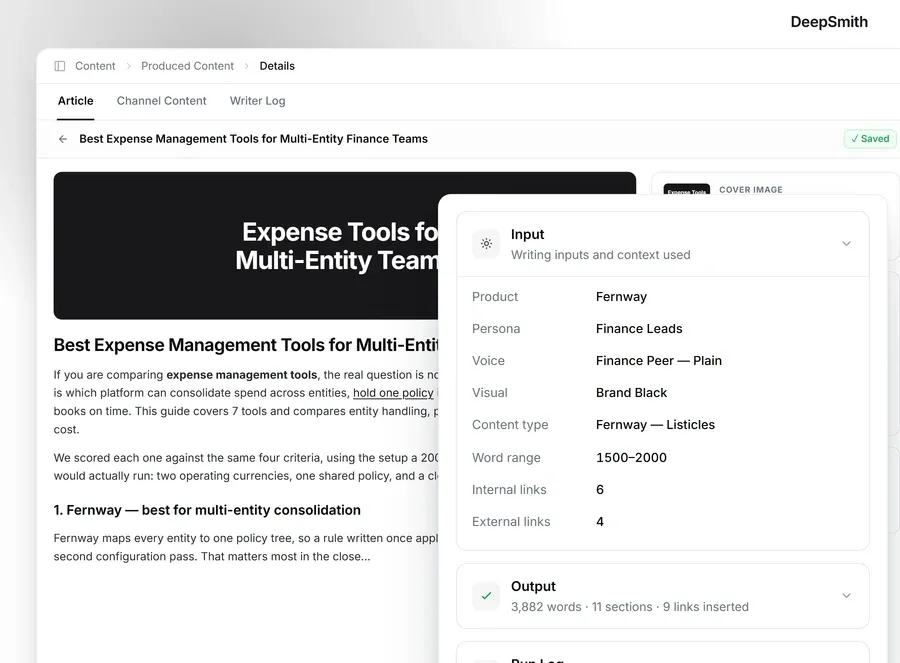
DeepSmith is built for the publishing loop rather than the whole go-to-market motion: it does not produce sales sequences or prospecting copy, which is Copy.ai's territory. Teams whose primary need is short-form revenue copy should choose accordingly.
Pricing: What the Entry Tier Actually Buys
Headline prices mislead across these three because the entry tiers buy different things. Copy.ai's Chat tier at $29 per month includes five seats, unlimited words in chat, model selection, Brand Voice, Infobase, and the template library, but not Workflows, which sit in the sales-led Growth tier. Jasper Pro at roughly $59 per month billed annually includes the full product surface, including Canvas, Grid, Campaigns, Agents, Content Pipelines, and SEO Mode, but only one seat, two brand voices, five knowledge assets, and three audiences. Writesonic Starter at roughly $79 per month billed annually covers a single user and single project, with AI articles, site audits, and tracking limited to ChatGPT, Gemini, and Google AI Overviews; broader engine coverage, sentiment analysis, and the Action Center arrive at Basic near $199 and Growth near $399.
The pattern is consistent: the cheapest tier of each tool withholds the feature that the tool is actually known for. Copy.ai withholds workflows, Jasper withholds seats, Writesonic withholds engine coverage. Buyers should price the tier that contains the capability they are buying for, not the entry tier.
Which Should You Choose
The best AI writing tool 2026 selection depends less on drafting quality, which is broadly comparable across the three, than on which constraint binds hardest.
Choose Jasper if brand consistency across multiple brands, regions, or audiences is the binding constraint, if governance and approval workflows matter more than a low entry price, and if a separate SurferSEO subscription is acceptable.
Choose Copy.ai if the content function sits close to sales, if repeatable multi-step workflows across prospecting and production are worth configuring, and if five seats at a low published price outweighs long-form depth.
Choose Writesonic if long-form SEO article production is the core job, if a native SEO toolkit and wide CMS publishing matter, and if some visibility tracking inside the same subscription is worth the lighter brand layer.
Consider DeepSmith if the constraint is neither drafting nor structure but the loop between them: knowing which prompts a brand loses in AI answers, which competitor pages win them, and turning that into published, on-brand articles without a second tool and a second workflow. A 7-day free trial returns real tracking data and real drafts before any commitment, with no long-term contract.