You checked your analytics after a month of AI search work, and the referral numbers barely moved. If that stings, take a breath. It does not mean the work failed. It means you are measuring one payoff and missing the other.
Here is the honest answer to the question everyone asks first: do ai citations drive traffic? Yes, but a small amount, and only citations can. Mentions rarely send a click at all. That does not make mentions worthless. It makes them a different tool for a different job.
By the end of this piece, you will be able to set realistic expectations for both signals separately. One earns you clicks. The other shapes the buyer while they read. Let's untangle them, one at a time.
Two signals, two very different jobs
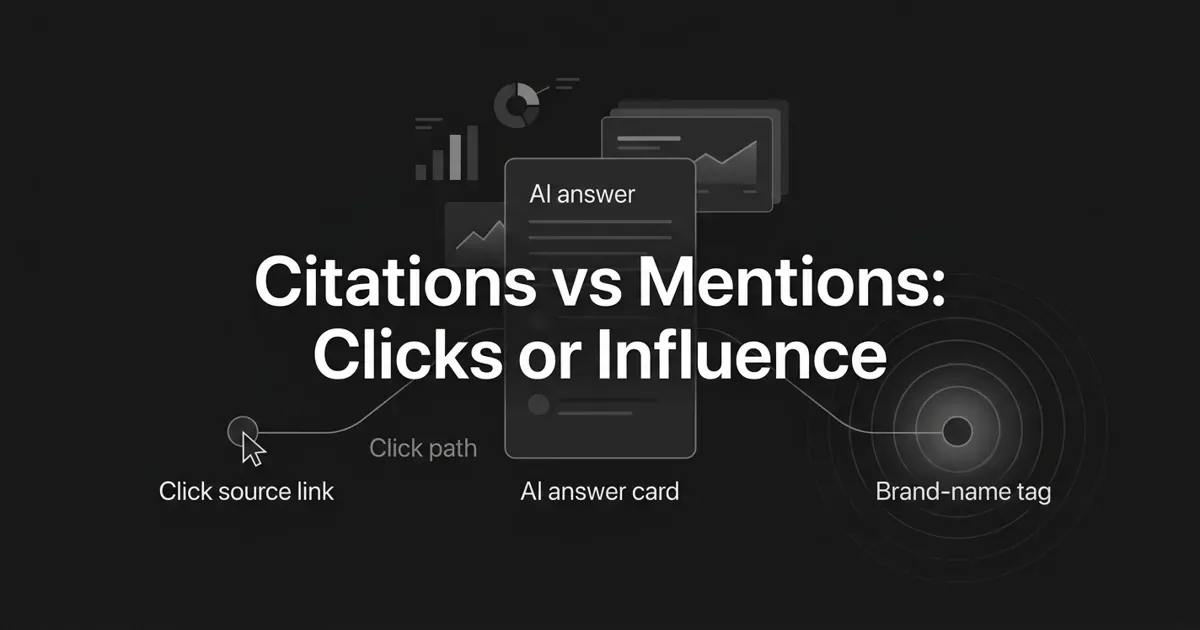
A citation is a clickable source link inside an AI answer. A mention is your brand name appearing in the answer text itself, with no link to click.
That one distinction explains almost everything about ai answer clicks vs influence. Citations are the only signal that can produce a referral click, because they are the only one with a link. Mentions do the work that used to happen after the click: they put your name on the buyer's shortlist while they are still reading the recommendation.
Think of it as two questions. Would the reader click a link? That is a citation. Does the reader see your brand name? That is a mention. Sometimes you get both, which is the rare strong position. Often you get neither.
And here is the pattern almost nobody expects. The most common outcome is that AI cites your page as a source without ever naming you. Semrush calls this a ghost citation. In their study of nearly 4,000 brand appearances, 61.7% were ghost citations: your research was used to justify a competitor's recommendation, and your brand was never mentioned. Only 13.2% earned both a citation and a mention.
So before you judge your AI search results as a single number, split them. Citations are about earning the click. Mentions are about shaping the decision. Confusing the two is the fastest way to feel like nothing is working when plenty is.
Do AI citations drive traffic? Yes, but less than you hope
Let's answer the click question directly. Do ai citations drive traffic? Yes. A citation is the only mechanism that can send a visitor from an AI answer to your site. But the volume is small, and you should expect that going in.
Most AI answers are read, not clicked. Pew Research found that when an AI summary appeared, users clicked a traditional result in only 8% of visits, versus 15% when no summary was present. The links inside the AI summaries themselves were clicked in roughly 1% of all visits. The answer satisfies the reader on the page, so the click never happens.
Zero-click is now the default. SparkToro found that 68% of Google searches in early 2026 ended with no click to any external site, up from 60% in 2024. AI tools in aggregate send less than 1% of all traffic out to other sites. On queries where an AI Overview appears, organic click-through fell from 1.41% to 0.64% in Seer Interactive's data, roughly a 55% drop, with other measures putting the reduction near 58%.
If that feels grim, here is the good news. The clicks you do get are worth far more.
Microsoft Clarity studied 1,277 sites over eight months and found AI-referred traffic converted to sign-ups at 1.66%, versus 0.15% for search and 0.13% for direct. That is not a rounding error. It is more than a ten-fold difference on that event. Other analyses put AI search traffic at roughly four to five times the conversion rate of standard organic. One case study saw revenue rise 35% even as monthly traffic fell 20%, because the visitors who arrived were closer to buying.
So does getting cited by chatgpt bring visitors? Yes, and ChatGPT drives the largest absolute share of AI referral traffic, about 87% of it across industries per Conductor. But that share is still only a sliver of your total traffic. The realistic picture is small volume, high value per visit.
The growth is real where it lands. Perplexity referrals to U.S. publishers grew sharply in 2024, with big news sites going from a few thousand monthly visits to tens or hundreds of thousands. Gemini referral traffic grew 388% year over year in one window, off a small base. The direction is up, even if the totals are still modest against what search once delivered.
There is a blunt way to see the imbalance. Cloudflare tracks how many times an AI crawler takes your content versus how often it sends a visitor back. For some engines that ratio runs into the hundreds of thousands to one. The machines read a lot and refer a little. That is the structural reality behind the "AI is killing my traffic" headline, and pretending otherwise helps no one.
One more caution: citation traffic is volatile. SeoClarity tracked ChatGPT citation volumes dropping 86% to 94% across markets between February and April 2026, then partly recovering. A citation strategy that looked strong one quarter can look broken the next. Plan for the swings, and do not tie your whole case to citations alone.
The takeaway on citation traffic vs brand influence starts here: citations are your measurable, trackable channel. They are just a smaller channel than the old Google firehose, so size your expectations to match. Keep the citation traffic vs brand influence split in your head as you read the rest, because the mention side of the ledger works nothing like this.
Do mentions send traffic? Almost never, and that is the point
Now the harder question. Do mentions send traffic? Almost never as a direct click. There is usually no link to click. If you are waiting for mentions to show up in your referral report, you will wait forever.
That is not a bug. A mention is the AI saying "use this brand" inside the answer. The influence lands in the moment of reading, before any click, before anything your analytics can capture. The buyer forms a shortlist in their head, and your name is either on it or it is not.
This matters more every quarter. Forrester found that 94% of business buyers now use AI, and that buyers are twice as likely to name generative AI or conversational search as their most important information source than any other, ahead of vendor sites, sales reps, and product experts. More than half of business AI use happens on private, firewalled tools, so even the influence you are winning often happens where you cannot see it at all.
So where does the value of a mention show up? Later, and indirectly. The buyer reads your name, remembers it, then searches for you by name a week later. That looks like branded search growth. Or they visit you directly. That looks like a direct traffic lift. Then they convert on a path that never credits the AI answer that started it. BrandLight has a name for this: "conversions from nowhere." You caused them, but attribution cannot see the cause.
Here is the reassuring part. You do not need analytics to prove a mention happened. You can read it. Open the answer, ask the buyer's question, and see whether the AI names you. That is the mention, right there in the text.
Whether you get named also depends on the question. Semrush found that comparative questions produce a mention rate more than twice as high as dry informational ones, and how-to questions run high too. Short, conversational prompts pull far more brand mentions than long, technical ones. That means mentions do their loudest work early, when a buyer is casually asking "who should I look at," and citations matter more later, when the same buyer is comparing and ready to click. The ai answer clicks vs influence split even tracks the buyer's journey.
And what earns mentions is different from what earns citations. Citations come from your own pages. Mentions come from your brand's footprint across the open web. Evertune found that brand search volume predicts AI visibility better than any other metric, and that brands in the top quarter for web mentions earn more than ten times the AI citations of the next quarter. Third-party coverage, forums, and reference pages do the heavy lifting. Ahrefs found brand mentions three times more predictive of AI visibility than backlinks.
So mentions do not send traffic, and they still drive pipeline. That is the whole paradox in one line.
It depends on which engine you look at
Here is where a lot of strategies go wrong. People say "AI citations" or "AI mentions" as if the engines behave the same way. They do not.
ChatGPT cites often and names brands rarely. Semrush measured an 87% citation rate but only a 20.7% mention rate. It is your traffic engine: it links, but it does not say your name.
Gemini is the mirror image. It cites only about 21% of the time but names brands 83.7% of the time. It is your mention engine: it recommends you out loud but rarely gives a link. It is also the fastest growing, up 388% year over year in one Similarweb window.
Perplexity sits in the balanced middle, with smaller volume but high intent. Microsoft Clarity measured Perplexity converting at seven times the rate of both direct and search traffic. Copilot showed the highest lift of all in that study, 17 times direct traffic for subscriptions, skewed toward enterprise buyers.
Google AI Overviews and AI Mode are their own case: they cite from pages that already rank, but they almost never send the click, with zero-click rates as high as 93% on AI Mode. Claude cites least aggressively of the major engines and refers the least traffic back, so treat it as an influence surface rather than a click source. None of these behaviors are wrong, they are just different, and a strategy that ignores the differences leaves value on the table.
The practical lesson: the same brand can be a "citation winner" on ChatGPT and a "mention winner" on Gemini at the same time. There is only about 11% domain overlap between ChatGPT and Perplexity citations, so tracking one engine tells you almost nothing about another. If you want a full picture, you have to look across engines, not pick one and generalize.
You do not have to master all of them at once. Start with the one or two engines your buyers actually use, and read the answers on both the click side and the naming side.
What good looks like, and why you should track both
So what should you aim for? Track two numbers, not one, because they measure two different jobs.
Citation rate is how often you get cited across the questions you track. For B2B SaaS, a reasonable target sits around 20% to 30% of tracked prompts, per Averi.ai; below 10% means you are effectively invisible, and above 40% is category-leading. Peec.ai, after analyzing more than a million citations, puts a healthy per-page citation rate around 1.1 to 1.5, with anything above 2.0 exceptional.
Mention rate is how often the answer names you at all. It runs far below citation rate on average, roughly 38% across engines in Semrush's data, and it swings hard by engine and by question type. Comparative and how-to questions produce far more mentions than dry informational ones.
Then there is share of voice: your slice of all the citations in your category. It tells you not just whether you show up, but whether you are winning against the brands you compete with.
Here is the encouraging part. Most of your competitors are flying blind. Only about 14% of enterprise marketing teams currently track AI and LLM visibility at all, per Siteimprove. Simply measuring both signals puts you ahead of most of the market. Tracking itself is an edge.
This is the gap a platform like DeepSmith is built to close. It tracks mention rate and citation rate side by side across engines like ChatGPT, Gemini, and Perplexity, shows which of your pages actually get cited, and puts your share of voice next to your competitors. You get to see the click signal and the influence signal as two separate lines, instead of guessing from a single referral number that only ever told you half the story.
If you can only build one habit this month, make it this: look at both rates, on the engines your buyers use, and write down where you stand. You cannot improve a number you refuse to look at.
Setting expectations you can actually defend
Let's bring it back to the question that started this: which one actually sends you traffic or pipeline?
If you need measurable traffic you can point to in a report this quarter, optimize for citations. They are the only signal your analytics can attribute, they convert well above organic, and you can study exactly which pages get picked up. Just size the number honestly: small volume, high value, real volatility.
If you want to shape the buyer before they ever click, optimize for mentions. You will not see them in your referral report. You will see them in branded search, in direct traffic, and in deals that close warmer than they should. And you can read the mentions directly in the answers, which is proof enough to act on.
The strongest position is both. Brands that earn a citation and a mention together are 40% more likely to resurface in the next AI answer, and only about 30% of brands stay visible across consecutive answers at all. So the goal is not to pick a side. It is to build toward the position where AI both names you and links to you.
One thing you should never do: promise your leadership guaranteed traffic from AI citations. The honest promise is realistic traffic plus measurable influence. That is a stronger story anyway, because it is true, and because it survives the next quarter when the citation numbers wobble.
You are closer than you think. If you already publish citation-worthy content and you already have some brand presence across the web, you are earning both signals right now. The next step is simply to see them clearly and set expectations to match.
Ready to see where you stand on both fronts? Start a free DeepSmith trial and watch your mention rate and citation rate side by side, on the engines your buyers actually use.