Jasper is a marketing platform built around AI, not just a jasper ai writer for one-off drafts. It ties together brand context, specialized agents, campaign workflows, and team governance in one workspace. The short answer on whether it is worth it: yes, for marketing teams that produce content again and again across brands, channels, and people. It is a harder case for a solo writer who just wants an occasional draft, for anyone who expects the first output to be publish ready with no editing, or for a team whose real goal is getting cited by AI engines, which Jasper does not measure and which is where something like DeepSmith covers both the tracking and the content. Jasper's biggest value risks are its price once you add seats, the custom cost of the Business plan, a credit system layered on top for some features, real setup time, and reviewer reports of output that still needs a human pass. This jasper review judges the platform on marketing copy quality, brand voice control, workflow depth, collaboration, integrations, governance, jasper ai pricing, and how much editing the output still needs.
What Jasper Does
Jasper is made and sold by Jasper, and it positions itself as a generative platform for on brand written and visual marketing content, not a general purpose writing tool. The pitch is that a team sets up its brand and marketing context once, then reuses that context everywhere: content creation, optimization, personalization, research, and campaign work.

The platform is built from a handful of connected pieces.
Jasper Agents are specialized workers meant to handle defined marketing tasks instead of leaving everything to open ended chat. Named agents include an Optimization Agent (keyword research, SEO analysis, headline work, and internal linking strategy, pulling in Semrush data when connected), a Research Agent (turning research into briefs and campaign ideas), and a Personalization Agent (using Salesforce data, currently in beta for Business). These agents cut down on repetitive marketing tasks, but they do not remove the need to check sources and edit the final copy yourself.
Content Pipelines are Jasper's workflow layer, built around a plan, create, adapt, activate cycle: gathering the insights that inform the work, generating aligned content, localizing or personalizing it for different audiences, then pushing it into the systems or channels where it runs. This is most useful for a team that repeats the same content process across campaigns. A single person writing one article at a time will not get as much out of it.
Canvas is the collaborative surface for drafting, editing, and refining content in real time, with agents available while you work. It is meant for hands on work, not fully autonomous publishing. Grid is built for scaled, structured content execution, and Grid output rows are a credit consuming action under Jasper's pricing model, with a test mode offering free rows before normal usage starts costing credits. Jasper Studio is a no code environment for building custom agents and workflows, most relevant to a team adapting Jasper to its own internal process.
Jasper also includes Chat and a Marketing Editor for applying brand voices directly to copy. Having brand context available does not guarantee every response is accurate or polished. Reviewers still describe generic or repetitive passages and the need for manual refinement, especially when a prompt lacks enough campaign detail.
On the visual side, Jasper supports an AI Image Suite alongside its written content tools, and its brand context system covers visual guidelines like color palettes, typography, and imagery style. Public pricing material does not spell out exact image generation limits, so treat that as a capability to confirm at signup rather than an unlimited feature.
Jasper Brand Voice
Brand Voice is one of the clearest reasons a marketing team would pick Jasper over a general writing tool. It is designed to learn a brand's tone and characteristic language from real examples, then apply that learned style to new content.
Setting one up follows a defined path: open Brand Voice inside Jasper IQ, add or edit a voice, decide whether it is visible workspace-wide or kept private, upload up to eight examples (text, files, or URLs), let Jasper analyze them and describe the resulting style, preview the voice on a blog post, LinkedIn post, or product description, compare a version with it applied against one without, then save.

Once saved, a Brand Voice can be applied inside agents, the document editor, or Jasper Chat, and an administrator can set a default voice that users are free to override. Plan tier matters here: Pro includes two Brand Voices, while Business includes unlimited voices along with the broader Jasper IQ feature set. Only Business customers can currently apply a Style Guide, the layer governing formatting, punctuation, and terminology. If centralized voice control across many contributors is why you are looking at Jasper, that fuller package sits on Business, not Pro.
Brand Voice can meaningfully cut down on repeated briefing and keep output more consistent, provided the uploaded examples genuinely represent how your brand writes. What it does not promise is perfect imitation of a distinctive writer, factual accuracy, a publish ready first draft, consistent quality when a prompt is thin on context, or editorial judgment. Independent reviewers back this up: they often praise the tone consistency, but plenty also describe the output as generic or repetitive, with final copy still needing an edit before it goes out.
Features
Jasper's brand intelligence layer, Jasper IQ, is meant to hold everything a team would otherwise re-explain in every prompt: Brand Voice (tone and off limits language), Knowledge Base (product details, messaging, FAQs), Audiences, Visual Guidelines, Style Guide (formatting and terminology rules), and Product IQ (underlying product facts). Jasper says these rules apply at generation time, shaping the first draft rather than getting caught in a later review pass. The recommended starting setup is one Brand Voice, two Audiences, and five Knowledge Base items, and Jasper IQ in full is a Business plan feature, so do not assume the full set comes with Pro.
Jasper's integrations list is broad: the product page claims more than 1,000 integrations, with named ones including Slack, Google Drive, Microsoft SharePoint, Adobe Workfront, Semrush, Salesforce, Webflow, Google Sheets and Docs, Chrome, Zapier, and Monday.com. Some carry plan or beta limits: Semrush feeds the Optimization Agent, Salesforce's personalization link is in beta for Business, and an API and MCP server let its brand context travel into other AI tools.
On security and governance, Jasper's own materials state SOC 2 Type II certification, GDPR, CCPA, and PCI compliance, annual penetration testing, SSO with SAML 2.0 on Business, role based access, an in-app AI audit log, and a policy that customer data is not used to train its models. These are Jasper's own statements about its own systems, worth including in a governance checklist, but a certification is a baseline, not a guarantee about how any one organization ends up using the tool.
Pricing
Jasper AI pricing has two commercial tiers on the public site. Pro runs $69 per seat per month billed monthly, or $59 per seat per month on annual billing, roughly 20 percent cheaper but with a 12 month commitment. Pro includes one user, with the option to add up to five total users through a sales conversation. Business pricing is custom, also starts with a 12 month commitment, and requires talking to sales, so there is no public number to compare directly against Pro.
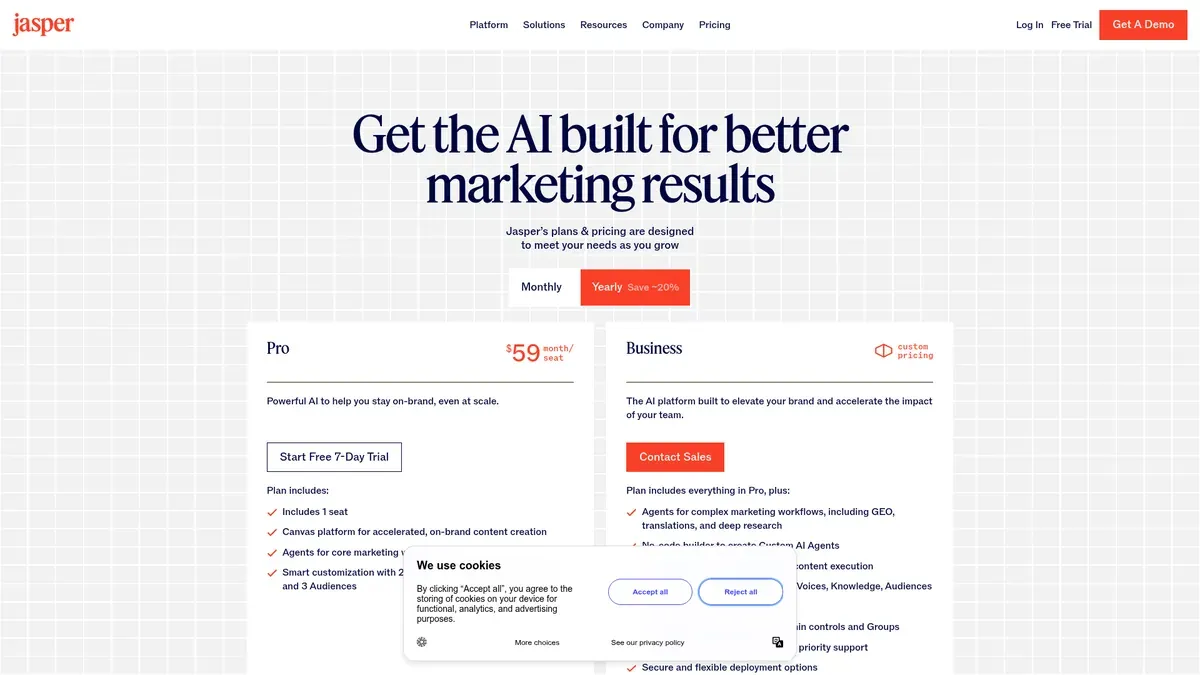
Jasper offers a seven day free trial of Pro, with no permanent free plan advertised. A 20 percent nonprofit discount is available after trial signup and eligibility documentation. Cancellation is allowed anytime with no charge for future billing periods, though some G2 reviewers report that access to past work does not always continue smoothly after payment stops, which is worth flagging as user feedback rather than stated policy.
Business adds custom solutions for larger teams, SSO and SAML 2.0, role based access, an AI audit log, unlimited Brand Voice and full Jasper IQ, the no code agent builder, Jasper Grid, and dedicated account management. Seats, credits, and agent runs are customized per contract.
Layered on top of seat price is a credit system. Business bundles Chat, Agents, Studio, and IQ as unlimited, but credit consuming actions include API and MCP usage, Grid output rows, and runs of the Research, Optimization, and GEO agents. Credits are shared across the workspace from a base allocation, additional credits can be purchased through the account team, and low credit alerts arrive at 10,000, 5,000, 1,000, and zero remaining. The exact dollar cost per credit consuming action was not published clearly enough in the sources for this review to state a number, so check Jasper's current rate card before you budget around it.
Third party directories can also carry stale numbers: Capterra's listing shows a starting price of $29 per month, which does not match the $69 or $59 per seat pricing on Jasper's own current pricing page. Treat Jasper's own site as the source of truth.
Put together, the real jasper ai pricing picture depends on more than the seat cost: how many seats you need, whether Business is required for IQ, Style Guide, or governance, how much Grid and agent usage your team will generate, the setup work to build out brand context, and the editing time you still have to budget for. The value case gets stronger the more of those recurring manual tasks Jasper actually replaces, and weaker if your team only needs a handful of short drafts a month.
Output Quality
Jasper's directory ratings are strong on the surface: Capterra shows an overall rating of 4.8 across 1,855 reviews, and G2 shows 4.7 across 1,307 reviews. These are aggregated satisfaction scores, not controlled quality benchmarks, and no independent test of Jasper's output quality against competitors turned up in the research for this review.
Reviewers consistently praise fast creation of marketing copy, versatility across ads, email, landing pages, blog posts, and social content, an approachable interface, useful templates, straightforward collaboration, and consistent brand voice. Capterra's categorized data shows 97 percent positive sentiment across 144 reviews for versatile marketing copy and 100 percent positive across 112 reviews for accelerated content creation.
The complaints cluster just as consistently. A first draft is not always close to what you wanted. Output can read as generic or repetitive, sometimes with duplicated phrases, and some reviewers report hallucinated facts or limited depth on complex research topics. Capterra's category breakdown shows 88 percent of 41 reviews negative on recurring content duplication and 66 percent of 96 reviews negative on restrictive or costly credit usage. Some users also report billing or cancellation friction after they stop paying.
None of this makes Jasper unusual among AI writing tools, but the honest expectation is a strong first draft that still needs a real editing pass, not publish ready copy straight out of the box.
Pros and Cons
Where Jasper genuinely shines:
- Reusable brand context (voice, audience, product facts, style, and visual guidance) that carries across Canvas, Grid, and Agents once it is set up.
- Marketing specific workflows: agents for research, optimization, and personalization, plus a pipeline model built around real campaign stages rather than one-off prompts.
- Collaboration and governance depth on Business: SSO, role based access, an audit log, and shared brand context suited to teams larger than one writer.
- Multi-channel production spanning written and visual content, with integrations into tools like Slack, Google Drive, Semrush, and Salesforce that reduce handoffs between systems.
- A real speed advantage over a blank page, backed consistently by reviewer feedback on ease of use and faster first drafts.
Where it falls short:
- Business pricing is custom and starts with a 12 month commitment, so you cannot fully compare total cost until you talk to sales.
- The credit layer on top of seat pricing adds a second cost dimension for Grid, agent runs, API, and MCP usage that takes real forecasting to manage.
- The strongest features depend on real setup work. Skip the brand context configuration and you get more generic output, not the differentiated version of the product.
- Brand Voice improves consistency, not accuracy. Reviewers still report generic phrasing and factual slips that need catching before publish.
- The full feature set (agents, pipelines, Canvas, Grid, Studio, IQ, integrations, governance) is a lot to learn for someone who wanted a simple writing tool.
Who Should Use Jasper
Jasper fits marketing teams producing content continuously, organizations juggling multiple brands or regions, teams that need several distinct Brand Voices, and companies with a documented messaging system ready to feed in. It suits marketing leads trying to cut repetitive briefing and first draft work, teams that need collaboration, SSO, and governance in place, and organizations already using tools like Semrush, Salesforce, or Slack that Jasper connects into. None of this pays off without investing time in setup and keeping a human in the editorial loop.
Who Should Skip Jasper
Jasper is a weaker fit for a solo writer who only needs the occasional short draft, a buyer whose top priority is the lowest monthly price, or a team unwilling to put in the configuration work Brand Voice and Jasper IQ depend on. It is also a poor match for anyone expecting first drafts to be publish ready without review, anyone who needs independently verified research rather than AI-assisted summaries, or a team that cannot tolerate variable, usage based costs. If you need fully transparent pricing before a sales call, or you only want a basic jasper ai writer without collaboration or governance, Jasper's breadth will feel like overhead rather than value.
Alternatives to Consider
If Jasper's breadth, seat cost, or credit layer is the sticking point, a few tools cover parts of the same job.
- Copy.ai began as an AI copywriter and has rebuilt itself around GTM automation, with workflows, agents, and data tables alongside the writing tools, so it appeals to a team that wants go to market operations more than a marketing content workspace.
- Anyword is built for performance marketers and scores copy variations before you spend on testing them, which makes it a narrower, cheaper fit if paid ads, email, and landing page copy are most of your output.
- Content at Scale (also sold as RankWell and BrandWell) turns a keyword, URL, or document into a full long-form SEO post with an optimization score and a WordPress publishing step, so it suits blog volume rather than multi-channel campaign work.
- DeepSmith is the alternative on a different axis: content built to earn AI citations, not brand voice marketing copy at volume, which is what Jasper is genuinely good at. DeepSmith tracks how AI engines answer the questions that matter in your category, which of your pages get cited, and where competitors take citations you do not, then produces publish-ready on-brand articles from that same data. Pricing is public at $99, $199, and $399 per month with a 7-day free trial, with engine coverage rising by tier.

Is Jasper Worth It?
Jasper earns its price when the real problem is not just generating words. It is worth it when a team needs brand voice consistent across multiple contributors, several content types from the same context, coordinated campaigns, connections into tools it already uses, and real governance over how AI gets used. The value case gets stronger the more manual tasks Jasper replaces at once: repeated briefing, brand style reminders, content adaptation, and agent assisted optimization.
It is probably not worth it when a team only needs occasional drafts, does not need shared brand context, cannot justify a $69 monthly Pro seat, or will not touch the deeper workflow and governance layers. It is also a poor fit for anyone planning to treat AI output as finished copy without fact-checking it first.
The honest verdict is conditional: Jasper is a capable marketing operations platform with a credible brand context and workflow story, and its real value is not that it can produce text (plenty of tools can do that) but that it combines brand context, marketing specific agents, collaboration, governance, and reusable workflows in one place. That combination is worth the price for an operational marketing team that will use it repeatedly, and a harder sell for a light user chasing the cheapest possible first draft.
The gap this review keeps running into is measurement. Jasper can hold your brand context and produce copy across channels, but nothing in it tells you whether ChatGPT, Perplexity, or Gemini name you when someone asks about your category, or which of your pages they cite when they do. DeepSmith works that axis: it tracks mention rate, citation rate, and share of voice against named competitors on the prompts you choose, maps the topics where a rival publishes and you have nothing, and then writes the publish-ready article aimed at that specific gap. It is not a replacement for Jasper's brand voice and campaign workflow strengths, and it is the better answer when the question is "why are we invisible in AI answers" rather than "how do we draft more ad copy this week." You can try DeepSmith free for 7 days.