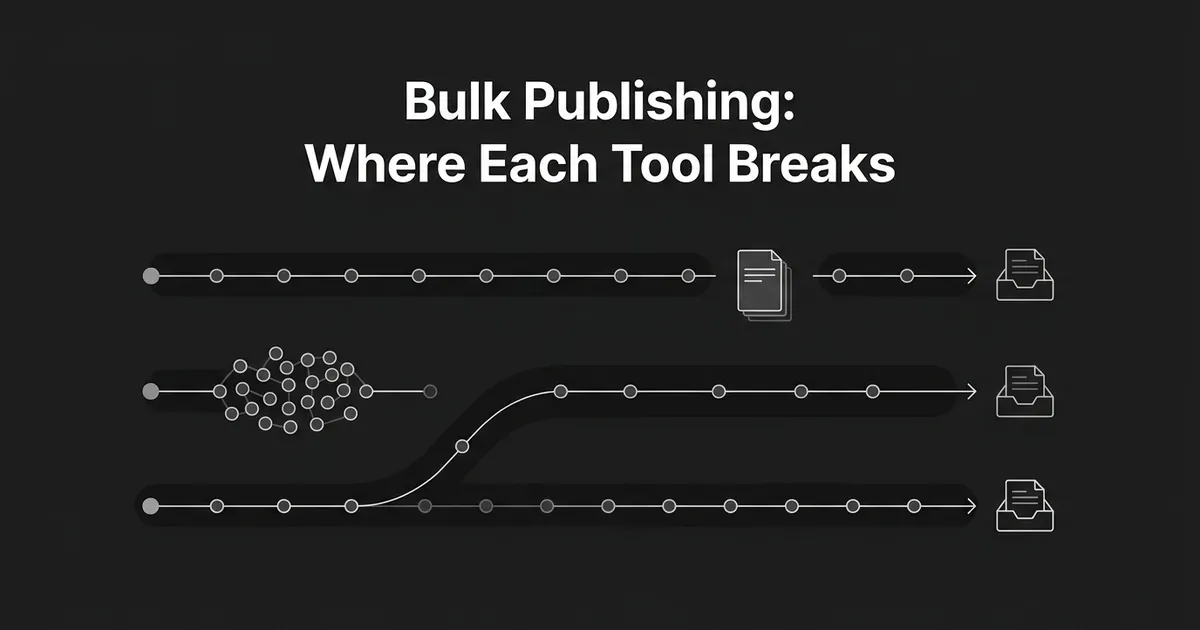
Jasper and Surfer SEO solve different halves of publishing at volume. Jasper generates in bulk through Grid but stops short of putting finished articles into a CMS on a schedule, while Surfer publishes straight to WordPress but has no native bulk generation or scheduled run of its own. DeepSmith is built for the whole job: it schedules ideas in bulk, writes each one on its date, and publishes to your CMS without anyone opening the app.
If you're asking Jasper vs Surfer SEO for bulk publishing, the honest answer is that neither tool was built to take an idea all the way to a published article on its own, and each is missing a different piece of that chain. Jasper can generate a batch of drafts through Grid, but getting them into a CMS on a schedule is not something its own pages document. Surfer can push a finished article straight to WordPress, but generating many articles at once and scheduling that run are both only partly there. This piece looks at Jasper or Surfer SEO for bulk publishing specifically, not the two tools overall, and where DeepSmith fits when the job is publishing SEO content at volume. For a jasper vs surfer seo bulk seo publishing decision, the workflow gap between generating drafts and getting them live matters more than any single feature line. The full comparison of the two is in Jasper vs Surfer SEO: Key Differences Between Brand Agents and SERP Scoring.
Jasper vs Surfer SEO for bulk publishing: the short answer
- Choose DeepSmith if you want one system that schedules articles in bulk, writes each one on its date, and publishes it to WordPress, Webflow, Strapi, Sanity or Contentful without you opening the app.
- Choose Jasper if your team already runs on Jasper IQ for brand voice and needs Grid's spreadsheet-style bulk generation, and you're fine handling CMS publishing yourself after the drafts are done.
- Choose Surfer SEO if your main need is a direct WordPress connection for articles you're still creating and reviewing one at a time, not a bulk run.
Comparison table for publishing at volume
| Criterion | DeepSmith | Jasper | Surfer SEO |
|---|---|---|---|
| Entry price (monthly) | $99/mo | $69/mo per seat | $49/mo (billed yearly) |
| Free trial | 7 days | 7 days (Pro) | 7 days (Pro) |
| Bulk generation | Yes | Yes, Business plan only | Partial |
| Scheduled auto-publish | Yes | Not listed | Partial |
| CMS publishing | Yes | Partial | Yes |
| Brand knowledge grounding | Yes | Yes | Yes |
| Workflow automation | Partial | Yes, Business plan only | Partial |
| Content repurposing | Yes | Yes | Yes |
| Review rating | 4.8/5 on G2 | 4.7/5 on G2 | 4.8/5 on G2 |
Pricing and features as of September 2026, from each vendor's site and public reviews.
Jasper in brief
Jasper is an AI marketing content platform built around agents and a stored brand context layer called Jasper IQ. For bulk work specifically, Grid is a spreadsheet-style system that runs many rows of content generation at once, at 10 credits per row, but it sits on the Business plan alongside custom pricing and a platform fee plus credits. The Pro plan, at $69 a month for one seat, does not include Grid at all. On publishing, Jasper's own integration pages describe a Webflow app for generating and revising content inside Webflow, plus exports to Google Drive, SharePoint, Box, Adobe Workfront, Monday.com and Asana, none of which are a CMS in the blogging sense, and no direct WordPress or Contentful publishing is documented. Scheduled publishing on a recurring basis is not covered on any scraped page either. Reviewers rate Jasper 4.7/5 on G2 and 4.8/5 on Capterra, and praise fast first drafts and brand voice consistency, with cost and generic output that needs editing as the recurring complaints.

Surfer SEO in brief
Surfer is best known for its Content Editor and Content Score, which grade a draft against top-ranking and AI-cited pages while you write. For getting a finished article live, Surfer's advantage is real: a free WordPress plugin publishes straight from the Content Editor with images attached, and it's included from the Standard plan at $99 a month up. Contentful shows editing guidelines in context, and Zapier can connect the workflow to other CMSs on the higher plans. What Surfer does not have is a bulk-generation screen: nothing on its own pages documents creating many articles in one run, and the closest it gets is calling Auto-Optimize through the API or using Zapier to trigger Surfer AI article creation one at a time. Scheduled, hands-off publishing runs the same way, through Zapier rather than natively, and Surfer's own update notes mark a Surfy Agent that would write and publish at scale as coming soon, not shipped. Reviewers rate Surfer 4.8/5 on G2 and 4.9/5 on Capterra, praising the editor's real-time guidance, while price and document or credit limits are the most common complaint.

DeepSmith: the alternative that publishes on its own
The gap Jasper and Surfer each leave for a publishing-at-volume workflow is the connective tissue between the pieces they do have. Jasper generates in bulk but a batch of Grid rows still needs to be moved into a CMS by hand. Surfer publishes cleanly to WordPress but has no native way to create the batch of articles that would fill that pipeline, or to run the whole thing on a schedule.
DeepSmith is built around that whole sequence, not one piece of it. Planned Content lets you schedule a batch of ideas at once, individually or in bulk, rather than generating rows in a spreadsheet and publishing them separately later. Autowrite then writes each planned article on its own date, hands-off, with no one needed in the app, and the finished piece lands in Produced Content already researched, internally and externally linked, with a cover image and metadata attached. From there it publishes straight to WordPress, Webflow, Strapi, Sanity or Contentful, or to your own webhooks, in one action. All of this runs inside a fixed monthly article allowance rather than a credit meter: 20 articles a month on Pro at $99, 40 on Grow at $199, and 90 on Scale at $399, each with annual pricing lower still.


Head-to-head for bulk publishing
Bulk generation
Jasper wins the raw bulk-generation contest. Grid runs a genuine batch of content generation across many rows at once, the way a spreadsheet runs a formula down a column, and that is a real capability the record shows clearly. The catch is that Grid lives on the Business plan, priced on request with a platform fee and credits, so a team choosing Jasper for bulk generation is choosing the custom-priced tier by definition. Surfer has no equivalent screen: nothing in its documentation describes creating many articles from one action, and the workarounds run through the API or through Zapier chaining single Surfer AI runs together.
What DeepSmith does: DeepSmith schedules a batch of planned ideas at once from Planned Content, and Autowrite writes each one on its own date without a spreadsheet or an API call in between. The batch and the writing step are one system, not a generation tool paired with a separate publishing step.
CMS publishing
Surfer wins this one outright for a reader whose CMS is WordPress. The plugin is free, publishes from the Content Editor directly, and carries images with it, available from the Standard plan. Jasper's side of this is thinner: its Webflow app covers one CMS, and everything else documented is an export to a file-storage or project tool, not a publish action into a blog.
What DeepSmith does: publishing is not gated to one CMS. A finished article goes to WordPress, Webflow, Strapi, Sanity or Contentful, or to a webhook for anything else, from the same Produced Content screen that shows the word count and link count the article was built with.
Scheduled, hands-off publishing
Here the two vendors land in roughly the same place: neither documents a native way to write and publish on a recurring schedule without someone in the app. Jasper's GEO Hub runs its visibility reports on a schedule, but that is monitoring, not content going live. Surfer's path to anything scheduled is Zapier, and the feature that would do this itself, the Surfy Agent, is announced but not shipped as of this writing.
What DeepSmith does: Autowrite is exactly this feature, already working. An idea scheduled in Planned Content writes itself on its date and can go all the way to published with no one opening the app, which is the step both other tools currently leave to a workaround or a future release.
Which should you choose
- DeepSmith fits a team that wants the batch scheduling, the writing and the CMS publish to be one workflow, with a fixed monthly allowance instead of a credit meter to manage.
- Jasper fits a team already invested in Jasper IQ for brand voice and multichannel content, that can absorb the Business plan's custom pricing for Grid and is comfortable publishing the results itself.
- Surfer SEO fits a WordPress-based team whose real need is optimization plus a clean publish button for content they're still producing one article at a time, not a bulk run.
If your bottleneck is the gap between generating content and getting it live on your schedule, start a free trial of DeepSmith and see the whole pipeline, from planned idea to published article, run itself.