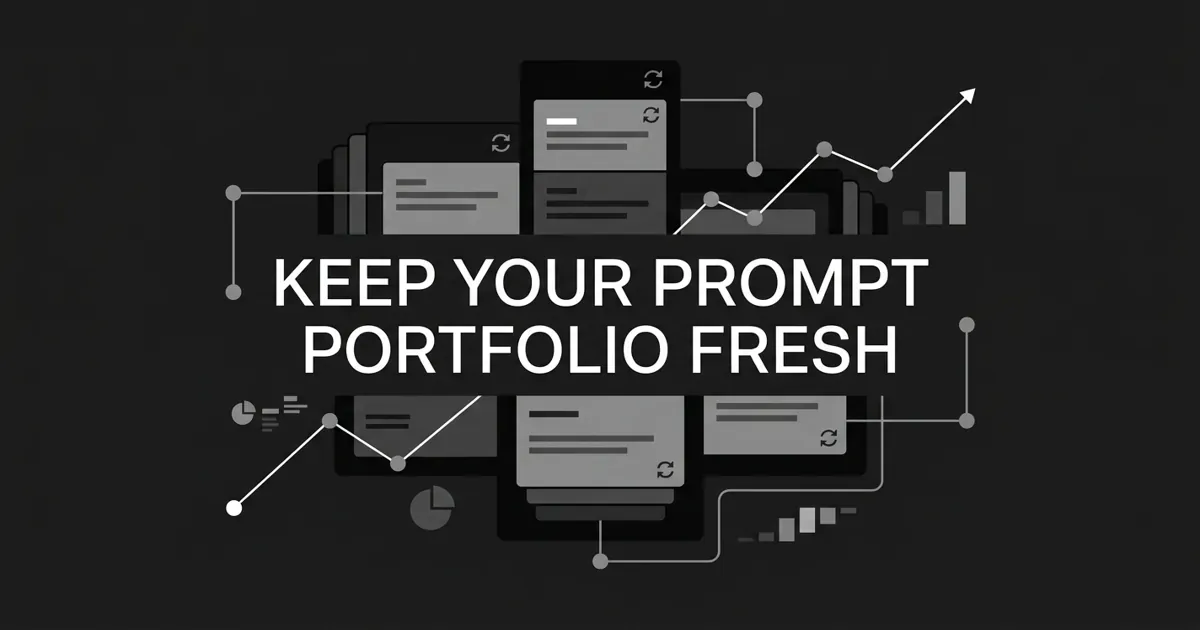
You built a solid set of tracked prompts. That was the hard part, and you already did it.
Here is the catch. The work to keep AI prompt list fresh does not end when you finish that first setup. AI answers shift week to week. Models get retrained. Buyers change how they ask. A prompt that surfaced your brand six months ago can quietly go dark, and your dashboard keeps reporting on a question nobody types anymore.
This guide is for the marketing lead who already runs some prompt tracking and wants a maintenance rhythm they can actually keep. Not a beginner's intro to AEO, and not another one-time audit. By the end you will have a cadence, a six-step upkeep loop, and a clear rule for when to retire, refresh, or leave a prompt alone.
Let's make this feel small and doable, because it is.
Why a prompt portfolio goes stale
A tracked-prompt list is a living asset, not a checklist you file away. Four forces pull it out of date, and it helps to name them so you know what you are defending against.
Model drift. Foundation-model vendors ship updates on roughly a quarterly cadence, with smaller changes in between. Each release can shift which sources get cited, how long answers run, and which questions trigger live retrieval versus recall from training. When the model under an engine changes, the answers change with it, even though you did nothing.
Buyer-language drift. Search queries keep getting longer, more conversational, and more layered with context. AI answers reward multi-clause questions, so the wording that qualified a buyer last year may not surface them today.
Competitive lock-in. When one competitor owns a prompt for six tracking periods straight, that prompt has stopped being useful real estate for you. It is a billboard for them.
Business churn. Products retire, segments shift, your ICP evolves. Prompts tied to a dead feature or an old persona stop representing real revenue questions.
The stakes are not small. McKinsey estimates AI search could touch around $750 billion in revenue by 2028, and about half of Google searches now surface an AI summary. Ahrefs found AI Overviews cut click-through for the top organic result by roughly 58%. The visibility game is moving to answers, and a stale prompt set means you are measuring the wrong part of it.
If that feels like a lot, take a breath. You do not fix all four forces at once. You set a rhythm, and the rhythm does the work.
Set your maintenance cadence first
Before any single step, decide how often each layer of upkeep happens. Everything else hangs off this. Industry guidance lands on a simple four-layer rhythm, and you can adopt it as-is.
Weekly: track. Run every tracked prompt at least once a week on every engine you cover. High-stakes prompts, the category-defining and branded ones, deserve three runs a week to tighten the sample and catch shifts faster. One response is a coin flip. A week of runs is data.
Monthly: review, lightly. Scan for movement. Any prompt whose mention or citation rate moved more than about 20% week over week, with no content change on your side, gets flagged. That is a triage pass, not a rebuild.
Quarterly: deep refresh. This is the main event. Prune dead prompts, rewrite stale wording, add prompts tied to launches and new buyer language. Call it your refresh prompt portfolio AEO routine. It happens to line up neatly with budgeting and reporting cycles, which makes it easy to defend on the calendar.
Annually: resize. Once a year, step back and ask whether the whole set is the right size and shape.
Here is the honest answer to how often review tracked prompts really needs to happen: weekly to watch, monthly to triage, quarterly to rebuild, yearly to resize. You are not staring at a dashboard every day. You are keeping a light, predictable beat.
The quarterly deep refresh is the heart of any refresh prompt portfolio AEO plan, so protect that block of time first and let the lighter layers fill in around it.
The six steps below are what you actually do during that monthly and quarterly work. Think of them as the loop that keeps everything current. Run through them once and the rhythm starts to feel automatic.
Step 1: Inventory and tag every prompt
You cannot maintain what you cannot see. Start by pulling your full list into one view.
Export every tracked prompt with a few fields attached: owner, last-run date, last result (mention and citation percentage), trend direction, an intent tag (compare, define, evaluate, troubleshoot), a funnel stage, the persona, and the product line it maps to. Give each prompt a version number, starting at v1, and store the original wording.
How you know it is done: every prompt in your set has a tag, an owner, and a version. Nothing is floating.
Where people go wrong: they skip versioning. Then three months later they rewrite a prompt, lose the original phrasing, and break their own historical trend line. Version first, edit second.
This inventory is exactly what an AI visibility dashboard is built to hold. In DeepSmith, the AEO module keeps your tracked prompts in one place with per-prompt mention rate, citation rate, share of voice, and trend already attached, so the inventory step is mostly reading rather than rebuilding a spreadsheet by hand. The point of the tool is to make this the boring part.
Step 2: Score each prompt as keep, refresh, or retire
Now you judge. Every prompt gets sorted into one of a few buckets, using symptoms you can actually see on the dashboard.
Here is a simple decision table to work from.
| What you see | What to do |
|---|---|
| Performing, framing current, brand in scope | Leave alone, keep tracking |
| Performing but phrasing feels dated or off-brand | Refresh the wording, keep it |
| Underperforming, but topic and buyer language still live | Rewrite, give it one more quarter |
| Underperforming and the topic has decayed | Retire |
| Performing, but the product or segment retired | Retire |
| Competitor has locked the answer for six-plus periods | Retire, or pivot to a less contested nearby prompt |
A few thresholds help you make the call instead of guessing. More than 20% week-over-week movement means investigate within a couple of days. A 30-day downward trend past 15% means schedule a refresh. Ninety days below 2% citation share with no upward signal makes a prompt a retire candidate. Treat these as starting points and calibrate to your own baseline.
How you know it is done: every prompt has a label. Keep, refresh, rewrite, or retire.
Where people go wrong: they read a single bad response and panic-delete a prompt. One answer is noise. A trend across a month is signal. Score on the trend.
That triage list of gaps and decays is not just cleanup. Each underperforming prompt with a live topic is a content brief waiting to happen, which is where the next few steps head.
Step 3: Mine fresh buyer language
This is the step most teams skip, and it is the one that keeps your set honest. Buyer language is something you mine continuously, not a project you finish.
Pull real phrasing from where your buyers actually talk: Google Search Console queries, sales-call transcripts, support tickets, review sites like G2 and Capterra, Reddit and niche communities, "People Also Ask" expansions, and the follow-up questions AI answers suggest.
Then cluster what you find by intent, not by wording. Watch for the tells that language has moved: queries getting longer, new modifier phrases ("for a 12-person team," "for regulated industries," "without a dedicated ops person"), and question forms shifting from "what is" toward "best X for Y" and "how do I."
The move that matters most is translation. Turn your internal jargon into the way a real buyer would say it. "Mid-market CRM with role-based access" becomes "best CRM for a small sales team without dedicated RevOps." Same intent, human words.
How you know it is done: you have a fresh list of real buyer phrasings, grouped by intent, ready to become prompts.
Where people go wrong: they only track brand-name prompts. If the engine never names you, you get no signal at all. Track the category questions and problem questions your buyers ask before they know your name.
Common mistake: letting the loop run without ever feeding buyer language back in. A prompt library that never gets re-checked against how people actually talk decays within months. The words move on. Your prompts should too.
Step 4: Rewrite and add prompts
Now you turn that language into prompts. This is where you update AI prompts to track against what buyers say today, not what they said a year ago.
Rewrite the "refresh wording" prompts in a conversational register with real intent qualifiers: segment, company size, use case, regulation, integration. Add brand-new prompts tied to recent launches, new segments, or category terms that just entered your buyers' vocabulary. Each quarter you update AI prompts to track so the set keeps pace with the market.
How you know it is done: your refreshed and net-new prompts are written, tagged, and versioned, ready to test.
Where people go wrong: they let the set bloat. More prompts is not better. A working portfolio is usually 30 to 50 prompts for a single-product SMB team, scaling to 75 to 150 for multi-segment or multi-product programs. Agencies often standardize at 30 to 50 per client. Cap the working set and protect your signal-to-noise. Add one, and be willing to retire one.
When you need to expand coverage fast after a launch, a prompt generator grounded in your own context beats brainstorming from a blank page. DeepSmith's Discover Prompts creates starter prompt sets from your product, persona, and buyer-stage context, which is a practical way to widen coverage during the quarterly refresh without inventing questions off the top of your head.
And when scoring surfaces a real gap, the fix is content, not just a new prompt. This is where measurement turns into motion. DeepSmith's Content Studio produces the on-brand, publish-ready article that answers the question the engine is not citing you for, so the loop closes instead of just flagging problems. Aditya G, Marketing Director at Bindbee, put it plainly: "We are able to track prompts for which we rank in AI answers, generating meetings."
Step 5: Parallel-test before you retire anything
Do not swap a prompt cold. Run the new one next to the old one first.
Keep both live for one to two weeks. Promote the new prompt only when it returns equal or better signal than the one it replaces. Then archive the old wording. Archive, do not delete, so your historical trend line stays intact.
How you know it is done: the new prompt has one to two weeks of data, beats or matches the old one, and the old wording is safely archived.
Where people go wrong: they delete the old prompt the moment the new one goes live, and lose the ability to compare periods. You worked hard for that history. Keep it.
This is also the discipline that protects you around model updates, which are the single biggest external shock to your set. When a major release lands, pause your period-over-period comparisons for 7 to 14 days and let the answers settle before you read anything into the movement. A handful of evergreen, brand-agnostic control prompts (something like "what is CRM software?") act as canaries: when they move and you changed nothing, suspect the engine, not your content. Subscribe to release notes from the major model vendors and treat each big release as a re-baseline moment, not an emergency.
Step 6: Version and document every change
The last step is the one that makes the whole thing repeatable. Write down what you did.
Keep a simple changelog: date, prompt, action (retire, refresh, or add), the reason, and the owner. Update go-live dates, version numbers, and any engine-specific variants. It takes a few minutes and saves you hours of "wait, why did we change this?" later.
How you know it is done: anyone on your team can open the changelog and see what changed this quarter and why.
Where people go wrong: they hold the history in one person's head. Then that person goes on leave, and the portfolio freezes. Documentation is how you maintain AI prompt tracking list quality as a team instead of a solo act. It is also how you maintain AI prompt tracking list continuity when people come and go.
Pro tip: budget about 10% of your responses each month for a human to actually read. Automation catches the movement. Only a person can tell you the engine mentioned your brand with the wrong product, the wrong customer, or the wrong positioning. Presence is not the same as accuracy.
Track the KPIs that tell you a prompt is decaying
Your maintenance decisions are only as good as the signals feeding them. A few metrics carry most of the weight, and you already saw them in the inventory.
- Mention rate: how often the engines name your brand across your tracked set.
- Citation rate: how often they link to your pages as a source.
- Share of voice: your slice of mentions and citations versus competitors on the same prompts.
- Visibility trend: the period-over-period direction, which is what actually triggers a refresh.
- Framing accuracy: whether the engine describes you correctly, checked by a human, not a number.
- Engine coverage rate: how many of your engines even return an answer for a prompt.
Read these weekly as a glance, review them monthly, and deep-audit them quarterly. The trend is the trigger. A single number in isolation tells you almost nothing, but a 30-day slide tells you exactly where to spend your next refresh.
If you are running this across multiple brands or clients, keep each portfolio in its own workspace so the cadences run in parallel without bleeding into each other. Separate context, separate prompts, separate beat.
What to do next
You do not need to overhaul anything this week. You need a rhythm. Everything above is one repeatable loop to keep AI prompt list fresh without turning it into a second job, and the calendar does most of the remembering for you.
Start here. Put four recurring events on your calendar: a weekly tracking run, a monthly triage, a quarterly deep refresh, and an annual resize. That single act turns prompt maintenance from a thing you keep meaning to do into a system that runs on its own beat.
Then, this month, do just Step 1. Inventory and tag what you already track. That is the smallest first step, and it makes every step after it easier. Momentum matters more than perfection here.
If you want the tracking, the buyer-language signals, and the content production that closes the gaps living in one place instead of five browser tabs, that is exactly what DeepSmith is built for. You can start a free trial and see real prompt data and real drafts before you pay.