If the state of AI search in 2026 feels like a wall of noise, take a breath. You do not need to track a hundred changes. You need to understand three.
Buyers have moved. The engines they use are splitting apart. And the rules for who gets named in an answer no longer look like the SEO rules you already know. That is the whole story this year, and once you see those three shifts clearly, the "what do I do now" part gets a lot smaller.
Here is the promise. By the end of this piece, you will understand what actually changed in AI search this year, why each change is real and not hype, and what it means for how buyers find you. We will ground every shift in a dated number, because a trend you cannot cite is just a feeling.
Put simply, the state of AI search 2026 comes down to this: your buyers are asking machines to shortlist vendors, and most brands have no idea whether they make the list. That is scary if you look away from it. It is fixable if you do not.
Let's walk through it together.
How AI search is changing in 2026: three shifts, not a hundred
Here is the short version. Buyer adoption crossed into majority behavior, the engine mix fragmented, and AI citations stopped following organic rank.
That is how AI search is changing at the structural level. Everything else you are reading about is a detail hanging off one of those three.
Why does framing it this way help? Because it turns an overwhelming topic into a checklist you can actually reason about. Is a buyer more likely to ask an AI engine than to Google? Yes. Are they all asking the same engine? No, not anymore. Does ranking on Google still earn you the citation? Only partly. Hold those three answers in your head and the rest falls into place.
Let's take them one at a time.
Shift one: buyers moved to AI search, and most won't move back
AI search is now majority behavior, not an early-adopter habit. Half of consumers report using AI-powered search today (McKinsey, October 16, 2025, n=1,927). On the B2B side it is higher: 73 percent of B2B buyers now use AI tools like ChatGPT and Perplexity in purchase research (survey reported April 2, 2026).
Read those two numbers again. Your buyers are already there.
The habit is also sticky. Half of the consumers who use AI search say they would be unlikely to switch back to traditional search once they start (McKinsey). More than 75 percent say AI-powered search gives them better results than a classic search engine. When a behavior feels better and people refuse to reverse it, that is not a fad. McKinsey models up to 750 billion US dollars in revenue impact by 2028 from this shift.
Adoption is global, though uneven. The Stanford HAI 2026 AI Index found generative AI reached 53 percent population adoption within three years of release, faster than almost any prior technology. The rate varies by country, so treat the global figure as direction, not a local guarantee.
Here is what this means for you. The moment a buyer forms a shortlist has moved upstream, into a chat window, before they ever land on your site. Per McKinsey, 20 to 50 percent of B2B buyer shortlists look materially different when AI search is in the mix. That is the whole game. If the engine does not name you while it is helping someone decide, you are not in the room where the decision starts.
You do not need to panic about this. You need to know it is happening, which most teams still do not. Only 22 percent of marketers are actively tracking AI visibility today (Digitaloft). That gap is your opening. While most of your competitors are still arguing about whether AI search matters, the ones who simply started looking are quietly learning which questions surface them and which do not. That head start compounds, the same way early SEO movers built advantages latecomers never fully caught.
AI search trends 2026: the engine mix is splitting apart
For the first time, ChatGPT is not the runaway default. That single fact reshapes the AI search trends 2026 made obvious.
Look at US generative-AI usage share as of July 1, 2026 (FirstPageSage): ChatGPT 52.1 percent, Claude 21.5 percent, Google Gemini 13.3 percent, Microsoft Copilot 8.4 percent, and Perplexity 3.4 percent. One year earlier, Claude held 3.6 percent. The same tracker shows ChatGPT's line sliding from 75.1 percent in October 2025 toward 60.5 percent by mid-2026.
So the market did not consolidate. It fanned out. Claude rose from roughly 2 percent to 21.5 percent of US chatbot usage in about 30 months. On referral traffic, Gemini grew 388 percent year over year while ChatGPT grew about 52 percent (SimilarWeb, June 15, 2026). ChatGPT still drives the largest share of AI referral traffic, roughly 78 percent globally in February 2026 (SE Ranking, 63,987 sites), but the direction of travel is unmistakable.
Then there is Google's own surface. Google AI Mode passed one billion monthly active users (Google I/O, May 19, 2026), and AI Overviews now reach more than 2.5 billion users across 200-plus countries. AI Overviews already appear on 60.32 percent of US queries (Advanced Web Ranking, 2026) and on 25.11 percent of Google searches, up from 13.14 percent in March 2025 (Conductor, 21.9 million queries). An AI Mode search runs about three times longer than a classic search, and more than one in six is multimodal. Buyers are literally asking in a different language than they typed in 2024.
Why does this matter to you? Because each engine trusts a different mix of sources. ChatGPT leans on Wikipedia, Reddit, and category-defining reference material. Claude relies on user-generated content two to four times more than its peers (Search Engine Land, June 2026). Gemini favors official brand sites and E-E-A-T signals. Perplexity prizes verifiable, factual sources. A brand's real "citation surface" is the union of all five, not one favorite.
So a playbook tuned only to ChatGPT will miss most of the answer surface within a year. If you only change one thing about your engine strategy this quarter, stop treating AI search as a single channel.
Shift three: citations broke away from rankings
This is the shift that catches SEO teams off guard, so let's say it plainly. Ranking in Google's top ten no longer reliably earns you the AI citation. They have become two separate problems.
Only 14 percent of URLs cited by Google AI Mode rank in Google's traditional top ten (Search Engine Journal, 2026). Roughly 40 percent of sources cited in AI Overviews rank lower than the top ten in classic organic results (Wordstream, 2026). Organic rank still helps, Ahrefs found 76 percent of AI Overview citations pull from top-ten results, but that leaves a wide band where the basement ranks win the answer and the page-one ranker gets skipped.
The source pool is also surprising. In Google AI Overviews, the most-cited domains in June 2026 were YouTube (20.9 percent), Reddit (19.6 percent), and Facebook (11.6 percent), followed by Google, Instagram, Wikipedia, and Amazon (Ahrefs, 3M-plus queries). Traditional publishers did not make the top ten. On ChatGPT, Wikipedia and Reddit together drive over 25 percent of US citations, while the Wall Street Journal, the New York Times, and Bloomberg do not appear in its top 20 (5W Research, May 11, 2026).
Now the part that feels contradictory but is not. Brand-managed sources account for 86 percent of all AI citations across the engines Yext studied (Yext, January 6, 2026). Your own pages, listings, and help content still do most of the work. The catch is that being named requires the engine to actually have earned, third-party, and community proof to draw on. ChatGPT mentioned brands in just 3.9 percent of the queries one audit studied (Instant Press, June 1, 2026). If your brand is not in the earned corpus the engine reaches for, you are effectively invisible for most questions in your category.
So what does this shift ask of you? Stop assuming a good Google ranking carries over. The mechanics of how AI search is changing here reward extractable, answer-first content plus a real footprint on the sources these engines trust. Schema markup alone lifts citation rates by roughly 30 percent (GetAISEO). It is a different discipline, and it is learnable.
What the AI search statistics 2026 actually say about traffic
Here is the number that trips people up, so let's defuse it first. AI platforms drove only about 0.24 percent of global web traffic in January 2026 (SE Ranking). Tiny, right? That is why some teams shrug.
Do not shrug. The AI search statistics 2026 keeps producing tell a "less traffic, far higher quality" story, and quality is where the money is.
Adobe's Q1 2026 data is the clearest signal. AI-referred visitors converted 42 percent better than non-AI traffic in March 2026, a full reversal from March 2025, when the same traffic converted 38 percent worse. That is an 80-point swing in a single year. The March 2026 profile: revenue per visit up 37 percent, time on page up 48 percent, and a bounce rate about a third lower than non-AI traffic. Shopify saw AI-referred orders convert nearly 50 percent higher than organic search on product pages in May 2026, and AI beat organic in 23 of 25 merchant categories.
Independent numbers point the same way. One aggregation put AI search conversion at 14.2 percent versus Google's 2.8 percent (Superprompt). Volume is still growing fast too: AI-referred retail traffic grew 393 percent year over year in Q1 2026 (Adobe).
So the honest read is this. AI search is a small stream today and a high-intent one. The visitor who arrives already half-decided is worth more than ten who bounce. That is why visibility now matters more than raw click volume, and why "it is only a fraction of traffic" is the wrong thing to measure. These are the AI search statistics 2026 that should shape your planning, not the vanity ones.
The B2B blind spot: most brands are invisible where buyers now look
Here is the uncomfortable headline. 96 percent of B2B companies are effectively invisible in AI-driven buyer discovery, showing up only when the buyer already knows the brand name (2X 2026 AI Visibility Index, April 20, 2026). Only 4.3 percent maintain a healthy funnel where the brand surfaces on early-stage questions.
Sit with that for a second. The funnel inverted. AI is naming the brands buyers already know and skipping the ones trying to get discovered, which is the exact opposite of what a discovery channel is supposed to do.
The 2X study traced the invisibility to structural blind spots you can actually fix: missing or incomplete structured data, blocked or unmanaged AI crawlers, thin third-party review ecosystems, few independent citations across the open web, and unmanaged community sentiment on places like Reddit. Meanwhile, 25 percent of B2B buyers say generative AI has already overtaken traditional search for vendor research (Column Five Media, January 23, 2026), and 2 to 6 percent of B2B organic traffic already comes from AI sources, growing 40 percent-plus per month (Forrester).
None of that is a death sentence. It is a punch list. The brands in that healthy 4.3 percent are not smarter than you. They started measuring and fixing sooner.
That is really the whole state of AI search 2026 in one sentence: the buying journey now starts inside an answer you cannot see unless you go looking, and the brands that go looking early get to shape what the answer says. The ones that wait get described by whatever the engine happened to find. You would rather write your own story than let a model guess at it, and right now you still can.
What these shifts mean for your discovery strategy
Let's turn the trends into a short, doable plan. You will not fix everything this month, and you do not need to.
First, measure before you optimize. You cannot improve a citation rate you have never looked at. Pick the engines that matter for your buyers, define the real questions they ask, and check who gets named. Tracking mention and citation rates across ChatGPT, Gemini, Perplexity, Claude, and Google AI Mode is now table stakes for any team that sells through discovery, and the gap between tracking and acting is where competitors pull ahead.
This is one place where the platform we build, DeepSmith, fits the problem: it watches how AI engines answer the questions in your space, shows where you are missing, and then produces the on-brand content to close those gaps from the same data. The point is not the tool. The point is that measurement and production have to live in the same loop, or the gap you found on Monday reopens by Friday.
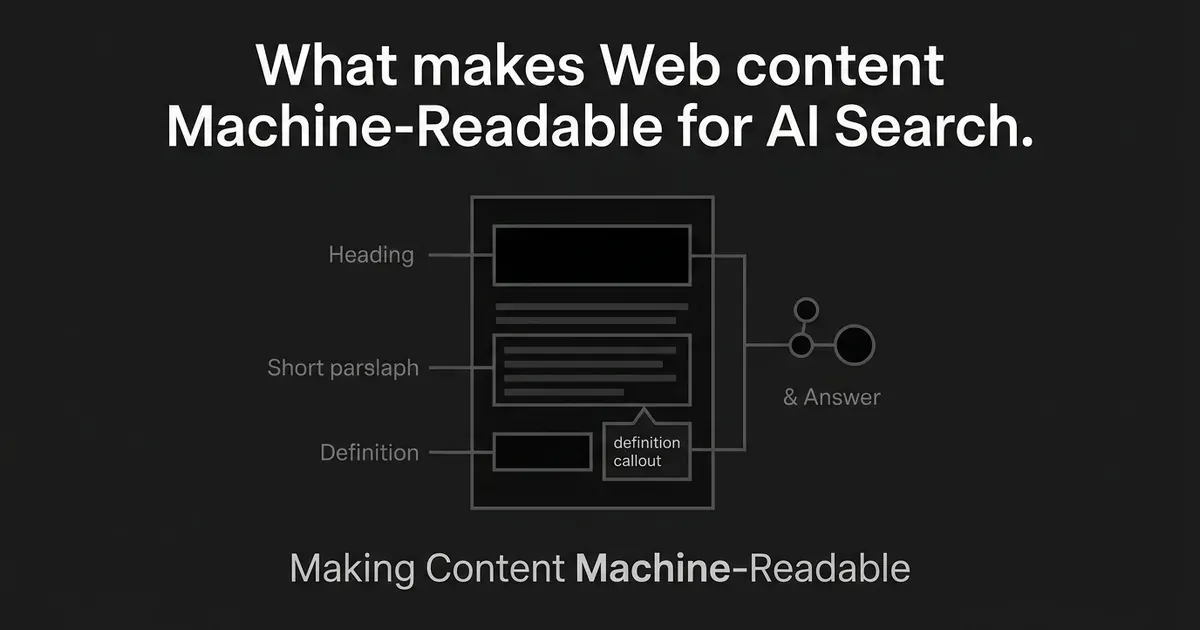
Second, write for extraction, not just ranking. Lead each page with a crisp answer, structure it so an engine can lift a clean passage, and back your claims with dated evidence. Publish-ready here means the article ships already structured for this, not a rough draft you rescue later.
Third, build a footprint on the sources these engines actually trust. That means earned third-party coverage, credible community presence, and your own well-structured pages, since 86 percent of citations still trace back to brand-managed sources.
Fourth, do not spread yourself thin across every engine at once. Start where your buyers are, learn the citation behavior there, then expand. Momentum matters more than perfection.
The future of AI search will keep moving. New engines will rise, shares will shift, and the numbers in this piece will age. But the shape of the future of AI search is already set: buyers ask, an engine answers, and a small set of trusted sources decides who gets named. Build for that shape and you are ready for whatever the next quarter's numbers say.
You are closer than the headlines make it feel. Start with one engine, one set of buyer questions, one honest look at where you stand. That is enough to begin.
Want to see where you already show up in AI answers, and where you don't? Start a free DeepSmith trial and check your own gaps in an afternoon.