You typed your own brand into ChatGPT, and something else came back. That stings. If you are shopping for Mentionable alternatives right now, you are not behind, you are just at the point where guessing stopped working.
Here is the good news. This market got crowded fast, which means there is almost certainly a tool shaped like your problem. The hard part is that every vendor uses different words for the same thing, and the same word for different things.
So let's make this simple. Below are eight alternatives to Mentionable that track whether AI answers name your brand, cite your pages, or hand the moment to a competitor. You get what each one does well, where it stops, and who should pick it.
One thing to settle first, because it changes everything: do you want to see the gap, or close it? Most of these tools show you the scoreboard. A few help you do something about it.
How we chose these Mentionable alternatives
Criteria first, so you can argue with the ranking instead of trusting it. We scored the mentionable.ai competitors below on six things, in this order.
- Answer engine coverage. ChatGPT, Perplexity, Google AI Overviews, Google AI Mode, Gemini, and the assistants around them.
- Measurement depth. Mention rate, citation rate, source URLs, position, share of voice, sentiment, competitor comparison, prompt history, and page-level attribution.
- Actionability. Recommendations, audits, prompt discovery, optimization work, or a real link between a finding and a task.
- Workflow fit. API, exports, BI connectors, CMS integrations, seats and workspaces, and whether the tool only monitors or also produces.
- Price and scale. Public entry price, and what the plan actually meters.
- Fit for a marketing lead. Whether it turns "we are not being mentioned" into a backlog you can defend to your boss.
A quick vocabulary check, because this trips up almost every buyer. A mention means the answer names your brand. A citation means the answer links to one of your pages as a source. Share of voice is you compared to rivals. Presence or visibility is usually an aggregate of several things. A tool can be excellent at one and silent on the rest, so never compare two percentages until you know both definitions.
One more warning worth ten minutes of your time. A homepage may list a dozen models while the plan you can afford includes three. Always read the plan table, not the logo strip.
Mentionable alternatives at a glance
| # | Tool | Best fit | Public entry price | Beyond monitoring |
|---|---|---|---|---|
| 1 | DeepSmith | Teams that want tracking wired to publish-ready content | Pro $99/mo, Grow $199/mo, Scale $399/mo | Content Map, Opportunity Agents, Content Studio, Autowrite, CMS publishing, repurposing |
| 2 | AthenaHQ | Broad model coverage plus prescriptive actions | Essential free, Starter $295/mo | Recommendation engine, citation intelligence, content optimization agent |
| 3 | Otterly | Small teams starting cheap, growing into reporting | Lite $29/mo | GEO recommendations, audits, crawlability checks, content briefs |
| 4 | Profound | Prompt demand research plus crawler analytics | Starter $99/mo billed yearly | Answer Engine Insights, Prompt Volumes, marketing agents, Agent Analytics |
| 5 | Scrunch | Data teams that want raw responses and APIs | Core $250/mo | Visibility audits, optimization opportunities, Query and Responses APIs |
| 6 | Rankscale | Agencies wanting credit-based breadth and dashboards | Essentials $20/mo | Citation overlap, semantic share of voice, REST API, Looker Studio |
| 7 | LLMrefs | Budget buyers who want many engines at once | All in One $79/mo | Fan-out query discovery, source filtering, content-gap insights, CSV and API |
| 8 | Goodie | Closed-loop AEO with revenue attribution | Explorer $399/mo | Prompt Research, optimization actions, revenue attribution |
Prices were checked on September 2, 2026. They move, so confirm before you buy.
1. DeepSmith: best for turning AI visibility gaps into published pages
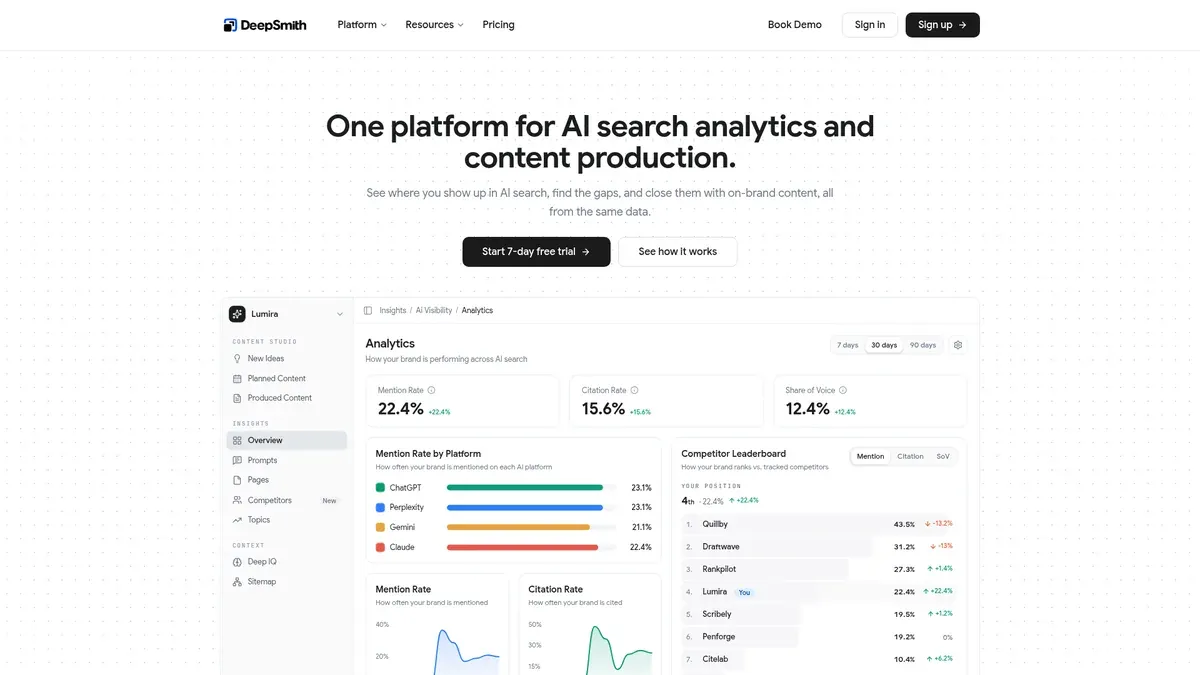
Best for: marketing leads who need mention and citation tracking and a production system that acts on what the tracking finds, without shipping the data into a second tool.
Let's be direct about why this one sits at the top of our own list. DeepSmith is an AI search analytics and content production platform in one. It tracks how AI engines answer questions about your brand, shows you where you are invisible or losing, and then produces on-brand content from that same data.
That loop is the whole argument. Every other tool on this page ends its job at the insight. Someone on your team still has to turn that insight into a brief, a draft, an edit, internal links, metadata, a cover image, and a publish. That is the part that eats your week.
What DeepSmith measures
Ten engines are named: ChatGPT, Gemini, Perplexity, Claude, Google AI Overviews, Google AI Mode, Grok, Meta AI, Microsoft Copilot, and DeepSeek.
The AEO module reports Mention Rate, Citation Rate, Share of Voice, Sentiment, and Visibility Trend, with a per-platform breakdown and a competitor leaderboard. You get per-prompt mention and citation rates with full answer history, so you can read the actual answer an engine gave. A Pages view shows which of your pages AI cites, each page's share of your total citations, and the prompts driving them. Competitor citations show you who wins your prompts, on which exact pages.
Not sure which prompts to track? Discover Prompts generates a starter set from your product, persona, and buyer-stage context, so you are not staring at an empty list on day one.

What happens after the finding
Content Map crawls your site and unlimited competitor sites onto one shared topic taxonomy, sorted by funnel stage. It flags coverage gaps where a rival publishes more, and untapped topics where you have nothing at all. Sitemaps re-check every 24 hours, so new pages fold in with no re-import.
Opportunity Agents read your visibility data and your Content Map and return ideas with the evidence attached. Not a brainstorm. Each idea carries the data point that justifies it, which is what lets you defend a backlog instead of apologizing for it.
Content Studio carries an idea through New Ideas, Planned Content, the Writer, and Produced Content. The Writer returns a finished, brand-grounded article with internal and external links, a cover image, and publish-ready metadata. Autowrite writes a scheduled article on its date with nobody in the app. Produced Content publishes straight to WordPress, Webflow, Strapi, Sanity, or Contentful, with Markdown and HTML export as a fallback.

Deep IQ stores your positioning, products, personas, brand voice, visual guidelines, and content types once, so every draft is grounded in your real business instead of a re-briefing. And Repurpose turns the finished article into LinkedIn, X, newsletter, and other channel-native versions, which is the step that normally falls off the list.
DeepSmith pricing
| Plan | Monthly | Annual | Articles/mo | Prompts | Seats | Engines |
|---|---|---|---|---|---|---|
| Pro | $99 | $80 | 20 | 50 | 5 | ChatGPT |
| Grow | $199 | $160 | 40 | 100 | 7 | ChatGPT, Perplexity |
| Scale | $399 | $299 | 90 | 200 | 10 | ChatGPT, Perplexity, Gemini |
| Enterprise | Custom | Custom | Custom | Custom | Custom | All 10 engines |
There is a 7-day free trial with real data and real drafts before you pay. No long-term contracts, no cancellation fees. Enterprise adds 1:1 onboarding and a dedicated account manager.
The honest scope note: engine coverage is tiered. Pro tracks ChatGPT, Grow adds Perplexity, Scale adds Gemini, and all ten need Enterprise or Custom. If your board wants every model on the entry plan, price Enterprise or look at a breadth-first tracker below. For most teams the first three engines are where the buyers actually are, and the rest of the platform is doing work no monitoring tool does at any price.
2. AthenaHQ: best for broad model coverage and prescriptive action

Best for: teams that want model-spanning visibility, competitor intelligence, and recommendations, with commerce and analytics connections.
AthenaHQ calls itself a command center for AEO and GEO. It tracks brand presence across 11+ major LLMs, including ChatGPT, Gemini, Perplexity, Claude, and Google AI Overviews. You get mention frequency, competitor share of voice, sentiment, citations, citation gaps, and prompt and response analysis.
Key features: the Athena Recommendation Engine names the gaps preventing citation and gives on-page and off-page actions. The Citation Engine and the Ask Athena copilot help you read your own data. Integrations include Google Analytics 4, Search Console, Shopify, Webflow, and Framer, with Tableau, Power BI, and Looker at Enterprise.
Pricing: Essential is free with 300 credits and $25 in free credit. Starter is $295 a month with 3,600 credits and a stated $300 monthly free credit. Enterprise is custom. One credit equals one AI response.
The limitation: usage is credit-metered, so a high-volume team has to model response volume and may buy extra credits, and API access on Starter is a paid add-on. AthenaHQ also describes a deliberately limited traditional SEO feature set.
Pick AthenaHQ over DeepSmith when broad model coverage, recommendation agents, or Shopify and BI reporting matter more than producing the content yourself.
3. Otterly: best for accessible monitoring you can grow into

Best for: solo marketers and small teams who want structured monitoring now and more prompts, API access, and BI reporting later.
Otterly tracks whether you appear in AI answers, how often you are cited, your position and context, the cited URLs, sentiment, and how you compare to rivals. It reports Share of AI Voice, flags queries won and lost, and adds GEO recommendations, content audits, crawlability checks, predictive scoring, and content briefs.
Key features: core coverage is ChatGPT, Google AI Overviews, Perplexity, and Microsoft Copilot. Claude, Google AI Mode, and Gemini are paid add-ons. The Looker Studio Connector comes free on Standard and above and syncs mentions, share of voice, average rank, domain citations, and URL-level citation data.
Pricing: Lite is $29 a month for 15 prompts, Standard is $189 for 100, Premium is $489 for 400, and Enterprise is custom starting from $1,000 a month. A free trial is offered. Extra prompt packs and model add-ons are priced separately.
The limitation: Otterly says so itself, and it is refreshingly honest. Manual searches can differ from its numbers because AI platforms personalize answers using memory, history, and location. Read the trend, not the single result.
Pick Otterly when a low entry price and focused monitoring are the point.
4. Profound: best for prompt demand research plus crawler analytics
Best for: larger marketing organizations and agencies that want to know what people ask AI, and what AI bots do on their site.
Profound names Perplexity, ChatGPT, Claude, Gemini, Grok, Microsoft Copilot, DeepSeek, and Google AI Overviews. Answer Engine Insights shows how AI represents your brand in conversation. Prompt Volumes shows what people actually ask, which is the closest thing this market has to keyword volume.
Key features: the AEO Report covers AI Visibility, Source Citations, Brand Sentiment, and Content AEO. Agent Analytics tracks how AI crawlers read your site, with connections to Vercel, AWS CloudFront, Cloudflare, Fastly, and Netlify. Demand Gen, Brand, and Content agents handle marketing tasks.
Pricing: Starter is $99 a month billed yearly with 50 prompts, 1,500 responses, one seat, and ChatGPT only. Growth is $399 billed yearly with 100 prompts, 9,000 responses, three seats, and three engines. Enterprise reaches up to nine engines and adds SSO and API access.
The limitation: the plan ladder is steep. Starter watches one engine with one seat, and API access waits for Enterprise. Budget for Growth if you need Perplexity and Google AI Overviews.
Pick Profound when server-side crawler and referral data is the thing you cannot get elsewhere.
5. Scrunch: best for response-level data and API-driven reporting

Best for: data-oriented marketing operations that want raw records, not just a dashboard.
Scrunch monitors prompt results and brand presence, shows how you appear across important prompts, surfaces the sites shaping AI answers, and tracks change over time with explanations of why a change matters.
Key features: three APIs do the heavy lifting. The Query API returns aggregated, precomputed metrics for BI and scheduled exports, sliced by date, prompt metadata, persona, tag, platform, competitor, sub-brand, source URL, and branded versus non-branded. The Responses API returns full AI answers with citations, sentiment, and competitors. An agent traffic API captures AI bot logs from your CDN or edge. Looker, Power BI, and Tableau are named destinations.
Pricing: Core is $250 a month with 125 prompts, five site audits, one workspace, and five licenses across ChatGPT, Perplexity, Google AI Overviews, and Copilot. Enterprise reaches nine LLMs and adds API access and SSO. Core has a 7-day free trial with no card required.
The limitation: charges are based on AI responses collected, so cost climbs as you add brands, prompts, or platforms. The checked pages do not describe an article generation or CMS publishing workflow.
Pick Scrunch when your team wants the raw data in its own pipeline.
6. Rankscale: best for credit-based breadth and shareable dashboards
Best for: agencies that need wide engine coverage, white-label options, and dashboards clients can open.
Rankscale tracks visibility across ChatGPT, Gemini, Perplexity, Claude, DeepSeek, Mistral, Grok, Copilot, and more. Two metrics stand out. Cross-model citation overlap measures how consistently you get cited across models. Entity-level semantic share of voice looks at how prominently and credibly your brand appears, not just whether it appeared.
Key features: authenticated REST API on higher tiers, public dashboard sharing without full accounts, and a Looker Studio connector on Pro and above that reports visibility score, sentiment, average position, detection rate, mentions, and citations, up to 10,000 records per request.
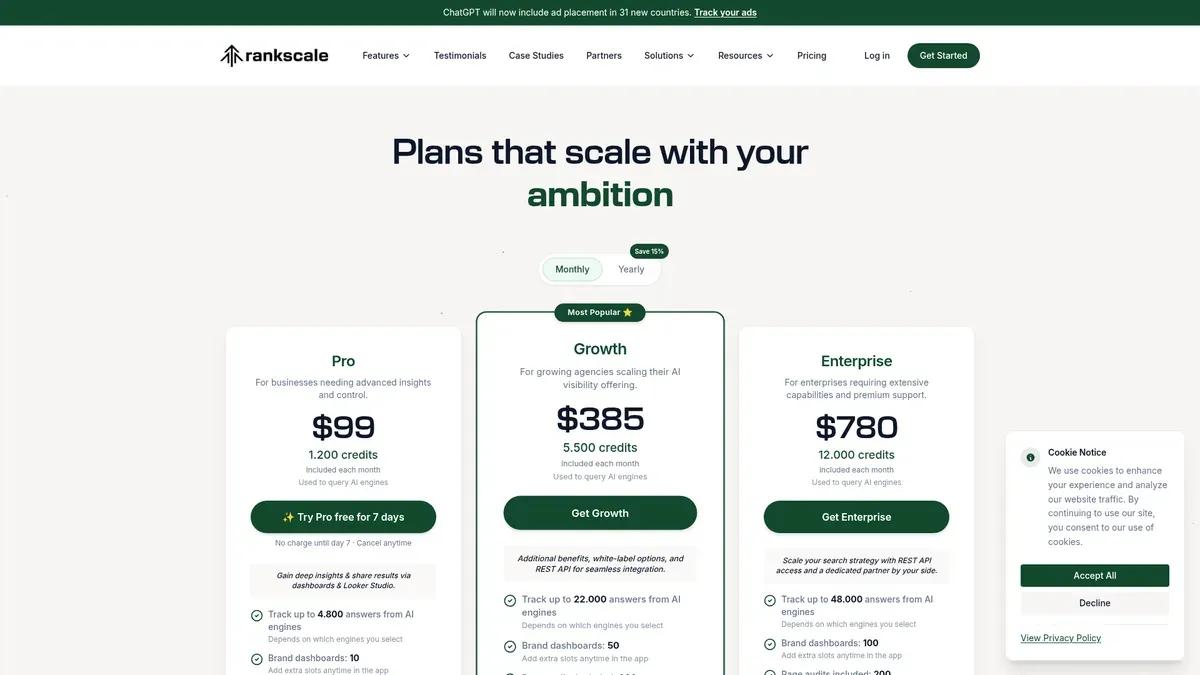
Pricing: Essentials is $20 a month, Pro is $99 with 1,200 credits and up to 4,800 answers, Growth is $385 with 5,500 credits, and Enterprise is $780 with 12,000 credits. Pro carries a 7-day free trial with no charge until day seven. Credits typically cost 0.25 per engine queried per prompt, so your real answer count depends on how many engines you switch on.
The limitation: some of the most interesting parts, including entity tracking and semantic dominance models, are in private beta or limited to select partners. Confirm what is live before you sign.
Pick Rankscale when breadth and client-facing reporting matter most.
7. LLMrefs: best for low-cost tracking across many engines
Best for: budget-conscious marketers and SEO teams who want ten engines without a ten-engine invoice.
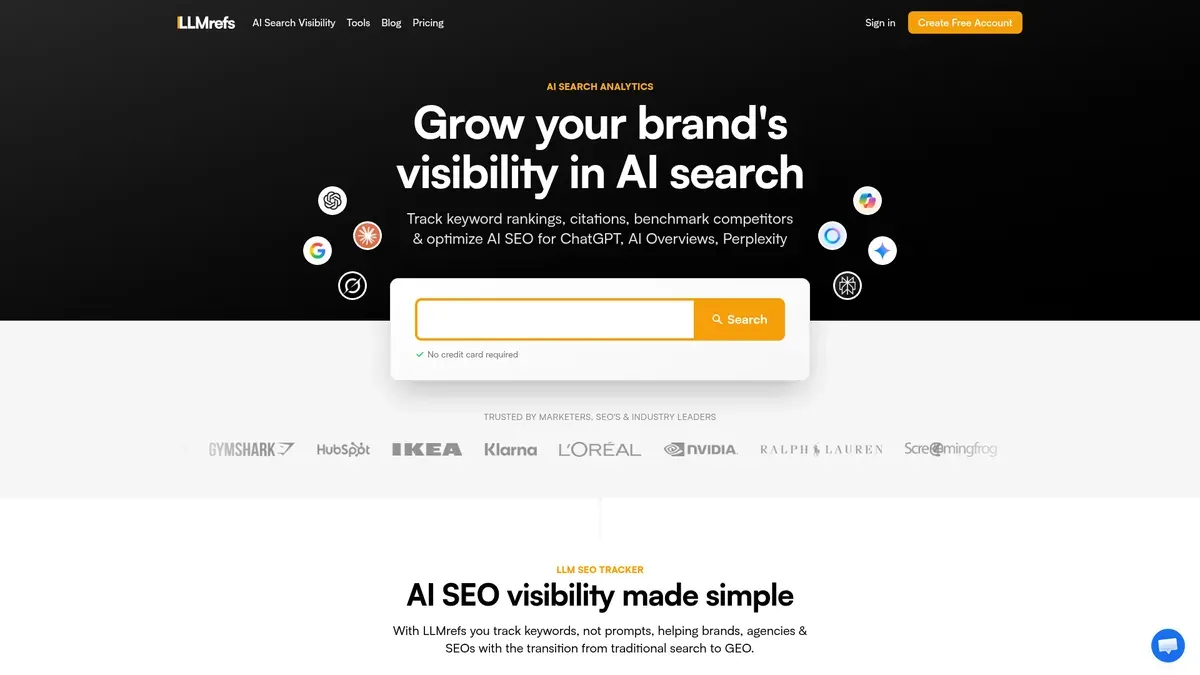
LLMrefs tracks ChatGPT, Google AI Overviews, Google AI Mode, Gemini, Perplexity, Claude, Grok, Copilot, Meta AI, and DeepSeek. Its model is keyword-led rather than prompt-led. You give it keywords, and it generates fan-out prompts based on real conversations people have with AI chatbots.
Key features: brand mention tracking, source and citation filtering across the full set of cited URLs, share of voice and position metrics, competitor benchmarking, content-gap insights, geo-targeting, and weekly visibility reports. CSV export and API access are included, along with unlimited projects and unlimited team members.
Pricing: one public plan, All in One at $79 a month, covering 500 prompts across all engines with no per-engine fees. A 7-day free trial is displayed with no card required.
The limitation: the keyword-led design is a real fork in the road. If you have carefully written buyer prompts and want to track exactly those, automatic fan-out generation is not the same workflow. Updates are described as at least weekly.
Pick LLMrefs when price and model breadth beat prompt-level control.
8. Goodie: best for closed-loop AEO with revenue attribution

Best for: teams that want visibility work tied to revenue, and are fine with a demo call above the entry plan.
Goodie describes a full-stack AEO platform covering research, monitoring, optimization, and revenue impact. Prompt Research finds the exact prompts your customers use and prioritizes the high-intent ones. Visibility Monitoring covers mentions, citations, sentiment, and competitive share.
Key features: Optimization Actions give you a prioritized playbook of what to fix and where, metered per plan. Analytics and Attribution connects AI visibility to revenue and reports AI-search growth impact. Enterprise adds custom revenue modeling and a dedicated AEO strategist.
Pricing: Explorer is $399 a month with 100 prompts, 3,000 responses, 10 optimization actions, three seats, up to 10 pages, and ChatGPT, Google AI Overviews, and Perplexity. Pro adds Gemini, Copilot, and Rufus. Enterprise reaches up to 11 models. Pro and Enterprise prices are not stated publicly. Explorer includes a 7-day free trial.
The limitation: the entry price is the highest self-serve number on this list, the page cap is low at 10, and the checked pages do not state a public API or export. Two of three tiers require a demo.
Pick Goodie when the CFO wants AI visibility expressed in revenue.
How to choose your Mentionable alternative
Take a breath. Ranking the best mentionable alternatives is easier than it looks, because you only need to answer one question and the rest follows.
Do you need to see the gap, or close it?
If the answer is "close it," and your bottleneck is that nobody has time to write the pages your visibility data keeps pointing at, choose DeepSmith. Measurement, evidence-backed ideas, brand-grounded articles, internal links, metadata, scheduling, publishing, and repurposing sit in one loop.
If your bottleneck is somewhere else, one of these is genuinely the better buy:
- Every model tracked, with recommendations attached: AthenaHQ.
- The smallest sensible starting spend: Otterly Lite at $29, or Rankscale Essentials at $20.
- What people ask AI, plus what AI crawlers do on your site: Profound.
- Raw responses and citations flowing into your own BI stack: Scrunch.
- Agency work with white-label dashboards for clients: Rankscale.
- Ten engines on one small invoice: LLMrefs.
- AI visibility reported as revenue: Goodie.
Two practical notes before you compare quotes. First, the units are not the same. Credits, prompts, responses, checks, audits, pages, and optimization actions all mean different things, so a $99 plan and a $79 plan can be nowhere near each other in real capacity. Second, if mentionable pricing is what sent you looking, remember that the cheapest tracker is only cheap if someone on your team has the hours to act on what it finds.
Start with 20 to 30 prompts your buyers actually ask. Watch them for a month. That is enough to see the shape of the problem, and it is a small enough first step to do this week.
Try the does-both approach
If you want your tracking and your content to live in one place, start a DeepSmith free trial. Seven days, real data, real drafts, no contract. You will know inside a week whether closing the loop changes your output, and that is a much better test than another comparison table.