Profound and Bluefish both track how AI engines talk about a brand. Profound gives your team agents that write and publish content, and Bluefish pairs its software with a managed strategy team and leaves the writing to you. DeepSmith is a strong alternative to both, because it tracks AI visibility and writes publish-ready articles on self-serve terms, from $99 a month with a 7-day free trial.
If you are choosing between Profound or Bluefish, most of the decision comes down to who does the content work once the tracking shows a gap. One tool expects your own people to do it with software help, and the other sells you analysts who tell you what to do. Price and access matter too, since neither one publishes a paid price. This page compares them on features, pricing and fit, and then shows where DeepSmith sits next to them.
Profound vs Bluefish: the short answer
- Choose DeepSmith if you want AI visibility tracking and finished articles in one self-serve platform, with plans from $99 a month, a 7-day free trial and no sales call.
- Choose Profound if you want the deepest tracking data plus agents that write, optimize and publish content, and you can buy through a sales-led, credit-based Enterprise package.
- Choose Bluefish if you are a large brand that wants a managed strategy team and analyst services around the software, and you already have people who will write and publish the content.
| Criterion | DeepSmith | Profound | Bluefish |
|---|---|---|---|
| Entry price (monthly) | $99/mo (Pro) | Custom; free 7-day Trial | Not published |
| Annual price | $80/mo billed yearly | Custom | Not published |
| Prompts at entry tier | 50 | 50 (7-day Trial) | Not published |
| Engines at entry tier | 1 (ChatGPT) | 3 (Trial) | Not published |
| Most engines on any plan | 10 | Up to 9, Enterprise | 10+ claimed |
| Free trial | 7 days | 7 days | No |
| Citation tracking | Yes | Yes | Yes |
| Writes full articles | Yes | Yes | No |
| Publishes to a CMS | Yes | Yes | Not listed |
| Brand-context grounding | Yes | Yes | Yes |
| Shopping assistant tracking | - | Yes, ChatGPT Shopping, Enterprise only | Yes |
| Public API | Yes, read-only | Yes, Enterprise only | Partial |
| SOC 2 | Yes | Yes | Yes, listed as a badge |
| G2 rating | 4.8/5 | 4.5/5 | Not rated |
Pricing and features as of September 2026, from each vendor's site and public reviews.
Profound

Profound is an AI marketing platform that tracks how ChatGPT, Google AI Overviews and AI Mode, Gemini, Perplexity, Claude and other engines mention and cite a brand. It then uses agents to research, draft, optimize and publish content from that data. It was founded in 2024 in New York and says it has raised $334.5 million across five rounds. It is built for enterprise and mid-market marketing, SEO and content teams, and for agencies.
The standout is how much sits in one place. Profound reports visibility, rank, share of voice, URL-level citations, sentiment and query fan-outs, and its agents can turn those findings into briefs and full articles grounded in brand context. The limit is access and cost. Paid pricing is not public, agent runs use credits, and the free Trial lasts seven days with 50 prompts that cannot be customized. Seven of its nine listed engines are Enterprise only.
Reviewers on G2 give it 4.5/5 from 1,130 reviews (checked September 29, 2026), and they praise the citation analytics and competitor benchmarking. The complaints are mostly about price, a learning curve and wanting clearer recommendations.
Bluefish

Bluefish is a sales-led platform for large enterprise brands, and the company targets the Fortune 500. It tracks how AI assistants and Amazon's shopping assistants describe a brand, generates optimization tactics, and measures which actions moved the numbers. Bluefish Labs launched in 2024 in New York and reports $68 million in total funding after a $43 million Series B in April 2026.
Its standout is the strategy layer. Agentic Campaigns produce page-specific tactics for your team to carry out, AI Accuracy checks what engines say against a Brand Vault of your own facts, and Bluefish says most of its customers also buy its strategy and analyst services. The limit is that it does not write or publish articles. Its own site says "Bluefish provides the direction. You stay the author."
There is also very little to check from the outside, and that is worth weighing for a purchase this size. The company publishes no prices, every call to action is a demo request, and the G2 listing for Bluefish had no reviews when we looked on September 30, 2026. That means there is no user feedback to weigh yet, and the Capterra page named Bluefish belongs to an unrelated code editor, so its rating should not be applied here.
DeepSmith: the alternative that tracks and writes on self-serve terms
Profound already writes content, so the gap for this buyer is smaller than it first looks. The difference is in the terms. Profound's agents run on credits inside a sales-led package, and its pages describe an approval step before anything publishes. Bluefish sells the strategy and leaves the production to your team. Neither one puts a price on the page, so a buyer cannot test either against a budget without a conversation first.
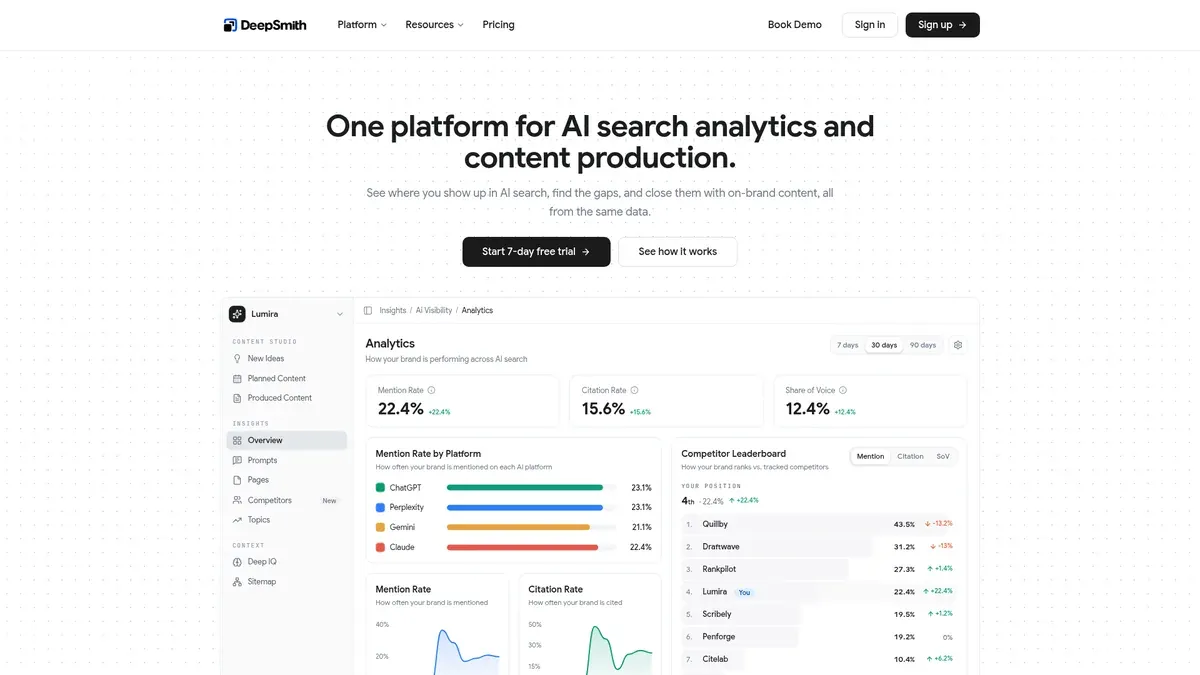
DeepSmith tracks AI visibility and produces the articles in one platform, from one set of data. The AI Visibility module checks the questions you care about on a schedule and reports mention rate, citation rate and share of voice, with the pages AI cites and the competitors winning citations. Opportunity Agents read that data and return content ideas, each with the data point that justifies it. Content Map adds a view of the topics you and your competitors cover, so gaps are measured instead of guessed.
From there the Writer turns a planned idea into a finished article that is researched, linked, and grounded in your Deep IQ brand context, with a cover image and publish-ready metadata. Autowrite does it on a schedule with no one in the app. You can review in Produced Content or publish straight to WordPress, Webflow, Strapi, Sanity or Contentful.
Plans are Pro at $99 a month (20 articles, 50 prompts, 5 seats), Grow at $199 (40 articles, 100 prompts), Scale at $399 (90 articles, 200 prompts), and a custom Enterprise plan. Annual billing brings those to $80, $160 and $299. There is a 7-day free trial and no long-term contract. DeepSmith holds SOC 2, GDPR and ISO certifications and is rated 4.8/5 on G2.


Engine coverage
Profound has the clearer engine story for chat assistants, and Bluefish has the clearer story for shopping assistants.
Profound lists nine engines on Enterprise: ChatGPT, Perplexity, Google AI Mode, Gemini, Microsoft Copilot, DeepSeek, Claude, Google AI Overviews and Exa Search. The Trial covers three (ChatGPT, Gemini and Google AI Overviews). Its pages also name Grok and Meta AI, but they are not in the pricing grid, so I would not count on them without asking. Profound does track ChatGPT Shopping, on Enterprise only.
Bluefish says it tracks more than 10 AI systems daily, and it names ChatGPT, Gemini, Google AI Overviews, Claude, Perplexity, Amazon Rufus and Alexa for Shopping. It does not publish the full list, and existing customers ask support to turn on Alexa for Shopping. If Amazon's assistants matter to your category, that is a real reason to look at Bluefish.
What DeepSmith does: DeepSmith covers ten named engines, including ChatGPT, Perplexity, Gemini, Claude, Google AI Overviews and Google AI Mode, with coverage rising by plan from ChatGPT on Pro to all ten on Enterprise. Amazon's shopping assistants are not among them. For brands tracking chat answers, the same data feeds the ideas and articles that follow.
Tracking depth and measurement
Profound gives you more to look at, and Bluefish gives you a stronger way to tie actions back to results.
Profound reports visibility score and rank, share of voice, URL-level citations with source categories, sentiment themes, FactCheck and query fan-outs. It also adds Prompt Volumes, which models prompt demand from licensed consumer panels, and Agent Analytics, which reads server or CDN logs to see AI crawler visits. The crawler tools need developer or infrastructure access to set up.
Bluefish measures visibility, favorability, safety and accuracy by product line, topic, audience and AI channel. Its Attribution and Collections features tie a dated tactic to the metric it moved, against a static prompt baseline. It does not document how it collects answers, how often it samples each prompt, or how long it keeps history, so you have to ask in the demo. Its published ROI figures come from a Forrester study that Bluefish commissioned, based on six interviews and a modeled company, so they are projections and not customer results.
Services and access
This is the sharpest difference in Bluefish vs Profound, and it comes down to who you work with.
Bluefish is software plus people. Its services cover onboarding, program operations, audits, strategy consulting and executive briefings, and a dedicated strategist helps decide what to do. You get that help, and you also need a sales process, a negotiated order form and a team that executes the tactics.
Profound is software with an Enterprise support layer. It has a self-serve Trial, so a team can try it before talking to sales, but the useful parts, including the API, answer history, exports and most engines, sit behind the Enterprise package. Public materials do not describe a managed strategy service included on every plan, so a team that wants hands-on strategy help should ask what each package includes.
What DeepSmith does: DeepSmith is self-serve from the first day. You can start a 7-day trial, see real data and real drafts, and pick a plan without a sales call. Enterprise adds 1:1 expert onboarding and a dedicated account manager for teams that want them. The strategy work is built into the product through Opportunity Agents, so the analysis arrives as a backlog of ideas instead of a meeting.
Pricing and value
Neither vendor publishes a paid price, so the comparison on cost is mostly about what you can learn before you talk to anyone.
Profound shows a free seven-day Trial and a custom Enterprise package. Agent use consumes credits that depend on how complex the run is, higher credit levels require an Enterprise package, and reviewers describe it as expensive. Agency pricing is behind a toggle, and we could not confirm a current figure, so I am leaving it out.
Bluefish shows no plans at all, and its terms page was not available when we checked, so contract terms such as renewal and refunds are worth asking about directly. Pricing is set in a negotiated enterprise order form, there is no trial, and the managed services are an add-on to the contract. You cannot compare it on cost until you are in the sales process.
On openness alone, Profound is easier to evaluate, because you can use the Trial and read the plan grid. Even so, the Trial is short and narrow, with no answer history, exports or API, so it shows you the interface more than the full Enterprise experience.
What DeepSmith does: DeepSmith publishes every plan. Pro is $99 a month, Grow is $199 and Scale is $399, with a fixed monthly allowance of articles and tracked prompts on each. That means a team can work out the cost of tracking plus 20, 40 or 90 articles a month before starting, and compare it with the cost of a sales-led contract. There are no long-term contracts and no cancellation fees.
From insight to action
On this axis Profound is the clear winner of the two, because it writes and Bluefish does not.
Profound's agents draft briefs and full articles from live citation data, refresh and optimize existing pages, and publish approved drafts to WordPress, Sanity, Contentful, Webflow and other CMSs. The output is described as ready for human review, with an approval step before anything goes live, though Profound also calls it publish-ready.
Bluefish stops earlier. It ranks recommendations by impact, generates marketing tactic briefs and page-specific tactics, and tells you what to change. Your writers, agency or other tools then do the work, and no CMS connector is named on its pages. If you have a strong content team that only needs direction, that can be enough. If you do not, the tactics pile up as a to-do list that someone still has to own, and the review of what gets written and published stays with your people.
What DeepSmith does: DeepSmith closes the loop in one platform. The tracking shows where you are missing from AI answers, Opportunity Agents turn the gap into ideas with the evidence attached, and the Writer or Autowrite produces a publish-ready article that is already internally and externally linked. Apps Library then turns the article into LinkedIn, newsletter and other channel versions. The people on your team spend their time on judgment, not on formatting and linking.
Which should you choose
- DeepSmith: you want to find the gaps in AI answers and fix them with finished articles, on a published price and a free trial, whether you are a small team, an agency, or a larger group that still wants to move without a sales cycle.
- Profound: you are an enterprise or mid-market team that wants the widest analytics and agents in one sales-led package, and you are comfortable managing credits.
- Bluefish: you are a large brand, often in retail or consumer goods, that wants analysts to guide a multi-team program, tracks Amazon's shopping assistants, and has writers ready to carry out the tactics.
Ready to see the tracking and writing together? Start a free DeepSmith trial and run it on your own prompts.