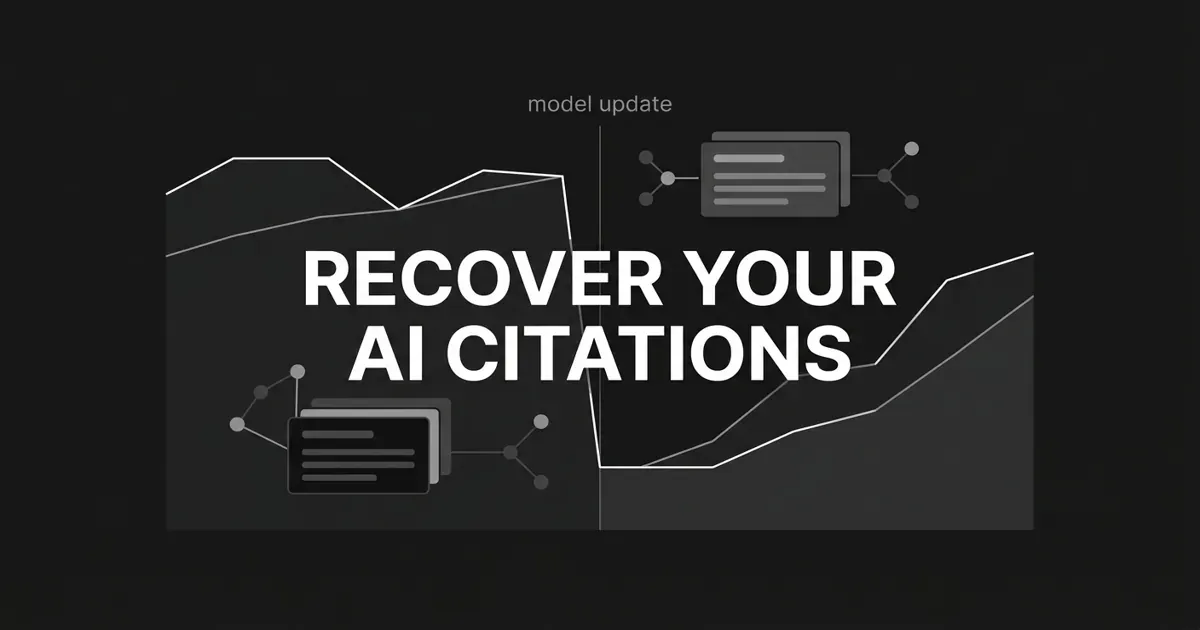
You typed "a model update dropped my citations" into a search bar, and now you are here, staring at a chart that fell off a cliff. Take a breath. This is one of the most fixable problems in AI search, once you know what actually happened.
Here is the good news up front. A model release citation drop is almost never your fault, and it is rarely permanent. When a new model ships, citations are not deleted. They are reassigned. Your job is not to rebuild from zero. It is to make your pages the obvious pick the next time the engine runs its retrieval pass.
This is an AI algorithm update recovery guide built for exactly that moment. It is for the marketing lead who watched citation share slide in a single week, cannot find a mistake on their own site, and needs a plan tuned to post-release volatility rather than a generic SEO audit. We will confirm the cause first, then walk eight steps you can run inside your normal weekly workflow. No rewrites from scratch. No panic. One step at a time.
Why this keeps happening now
The AI results page is versioned now, not steady-state. Two releases in the last year reshaped which sources get cited, and neither one cared what you published.
Gemini 3 became the default model behind Google AI Overviews on January 27, 2026. It is more selective on technical and fast-moving topics, pulls more sources per response, and weights freshness harder than the model before it. The Gemini update AI Overview citations picture is the clearest example we have. One study of 100,000 keywords found roughly 42 percent of previously cited domains got replaced, and each AI Overview started pulling about 32 percent more sources per answer.
GPT-5 landed earlier, on August 7, 2025. With web search on, its responses are about 45 percent less likely to include a citation than earlier models, because it answers more from training and saves live search for fresher or more obscure questions. If a GPT update lost visibility you spent a year building, that shrinking citation surface is a big part of why.
Both events triggered platform-wide drops that no affected brand caused. The marketers who read those drops as their own fault burned months on the wrong fixes. The ones who recognized a release event recovered faster. That is the whole game here: name the cause correctly, then act.
Step 1: Confirm a release actually caused the drop
Before you change a single page, confirm you are dealing with a release event and not something on your own site. Run these five signals. If all five fire, you almost certainly have a release-driven drop and this framework fits. If two or more fail, you are looking at content decay, a technical issue, or a competitor out-executing you, and that is a different playbook.
Signal one, date alignment. The drop started within 14 days of a confirmed release. Check it against the Gemini 3 default in AI Overviews (January 27, 2026), GPT-5 (August 7, 2025), the public ChatGPT search rollout (February 5, 2025), and the documented ChatGPT citation events on March 8 and April 19, 2026.
Signal two, no site changes. No rewrites, redesigns, schema removals, robots.txt edits, canonical changes, migrations, or lost backlinks in the 30 days before the drop. Search Console shows no manual action.
Signal three, a cross-platform pattern. The same prompt set shows the drop on at least two engines among ChatGPT, Gemini, Perplexity, Google AI Mode, and Claude. If only one platform moved, suspect something platform-specific or brand-specific instead.
Signal four, the shape of the decline. A model release citation drop looks like a cliff, a sharp step-down inside a week. Content decay looks like a slow slope over months. If a model update dropped my citations describes a sudden fall, not a gentle fade, that shape is your evidence.
Signal five, competitive context. Competitors on adjacent topics fell in the same window. A release reshuffles citations broadly. If only you dropped, look for a brand-specific cause.
How to tell it is done: all five signals fire, and you can say out loud which release you are recovering from. Where people go wrong: they skip this step, assume the worst about their own content, and start rewriting pages that were never the problem.
Step 2: Lock your baseline and freeze changes
This next step feels counterintuitive, so trust it. For at least 14 days from the suspected release date, change nothing on the affected pages.
Instead, capture a baseline. Record your citation rate per page across ChatGPT, Gemini, Perplexity, Google AI Mode, and Claude. Note the top three prompts where you lost citations and the top three where you held or gained. Date it, save it, and treat it as the reference point for everything that follows.
This is the step where a citation tracker earns its keep. If you are watching citation rate per prompt per platform by hand, this is slow and error-prone. A platform like DeepSmith checks your tracked prompts on a schedule across the covered engines and reports mention rate, citation rate, and share of voice with trends, so your baseline is a dashboard you already have rather than a spreadsheet you build under stress. Coverage rises by tier, so match the plan to the engines your buyers actually use.
How to tell it is done: you have a one-page, dated snapshot of citation rate per prompt per platform. Where people go wrong: they rewrite content on day one. Early rewrites destroy the comparison data and reset the model's view of the page before you even know what changed. Freeze first.
Step 3: Reverse-engineer the new retrieval shape
Now, look at who won. For each high-priority prompt, document the sources the engine cites today. You are hunting for the pattern the new model prefers, and it usually shows up in one of three ways.
Format shift. Did citations move from blog posts to product pages, from long guides to comparison tables, from prose to FAQ blocks, or from authoritative domains to user platforms like Reddit and YouTube?
Depth shift. Did the winning sources get longer and more comprehensive, or shorter and more extractable? Did they add statistics, named experts, or original data?
Entity shift. Did the new winners start naming the same products, standards, or organizations more often? Did Wikipedia or Wikidata entries appear that were not there before?
Do this for your top prompts and you stop guessing. You can borrow the same method you would use to teardown a rival's cited pages, just pointed at the post-release winners on your own prompts. Build a small per-prompt table: top three cited sources before the drop, top three after, with format, depth, and entity notes for each.
How to tell it is done: you can describe, in a sentence per prompt, what the new winners have that your page lacks. Where people go wrong: they only check whether they got cited, and never ask why the new winners did.
Step 4: Re-ground your priority pages on real sources
Here is the single highest-leverage edit after a release, and it is not a rewrite. It is grounding your pages in evidence. A well-known study of generative engine optimization found that adding citations, statistics, and expert quotations to a page produced up to a 40 percent lift in generative-engine visibility. Treat that as directional, not a promise, but the direction is clear and consistent.
For each priority page, do four things.
Add at least three sourced statistics from the last 12 months, each hyperlinked to its original source. Generic numbers do not count. Specific, attributable, recent numbers do.
Add at least two named quotations from identifiable practitioners or analysts, each linked to where they were published. Anonymous quotes carry no entity weight.
Add at least five named entities relevant to the topic, people, products, organizations, standards, each linked to a canonical reference where you can.
Update the visible "last updated" date and the schema dateModified to match. Models read the visible date and the schema date as separate signals, so keep them in sync.
This is heavy lifting to do by hand across a backlog, and it is exactly the manual work that keeps you editing instead of strategizing. A production engine that writes with your stored brand context can ship these grounded edits inside the pipeline rather than as a one-off project per page, so the recovery moves at the speed of your calendar.
How to tell it is done: every priority page has a visible "sources and data" block, the body references those sources inline, and the schema is consistent. Where people go wrong: they drop the sources into a footer. Retrieval models weight inline citations far more heavily than a footer list.
Step 5: Add FAQ schema and make your answers extractable
After a model update, the format the retrieval layer rewards often shifts, and one pattern held clearly after Gemini 3: pages with structured question-and-answer pairs tend to get cited more than pages without them.
For each priority page, identify the five to ten questions the page actually answers. Add an FAQPage schema block using the exact phrasing a real person would type, not your internal labels. Then write each answer as 40 to 60 words with the direct answer in the very first sentence, because that first sentence is what the retrieval layer most often lifts.
One rule you cannot skip: the question-and-answer pairs have to be visible in the page body, not hidden in the schema alone. Hidden FAQ content is ignored by retrieval models and is a manual-action risk. When you add FAQ schema for AI citations, the markup only helps when the visible content matches it.
How to tell it is done: the page passes Google's Rich Results Test for FAQPage, every pair is visible in the rendered HTML, and each answer's first sentence stands on its own. Where people go wrong: they stuff 30 questions onto one page. Schema works best at five to ten tightly scoped questions.
Step 6: Set a freshness cadence you can actually keep
Decay starts the moment a page stops moving. Unrefreshed pages lose AI citations at a measurable rate, and a commonly cited window for that decay is about 13 weeks. A release event just makes that clock matter more.
So set a refresh cadence by content type and put it on a calendar:
- Statistics-heavy pages, product pages, "best of" roundups, and comparison pages: monthly.
- How-to guides, definitions, and explainers: quarterly.
- Thought leadership and evergreen narrative: twice a year.
Each refresh has to change at least three real things: the title, the intro, two body statistics, one example, the dateModified value, or an internal link. Then re-render, re-submit the sitemap entry, and re-fetch the URL in Search Console. This is the same discipline behind any content refresh for AI citations, just run on a schedule instead of a whim.
How to tell it is done: every priority page has a documented refresh date on the calendar and the next one is scheduled. Where people go wrong: they change the date only. A date-only edit reads as cosmetic and triggers no real re-evaluation.
Step 7: Build off-site entity authority
Here is the part most teams underweight. After a release, retrieval layers lean on your presence across the web more than on your backlink count. One study of 75,000 brands found web mentions correlated with AI Overview brand mentions at 0.664, while Domain Rating sat at 0.326 and referring domains at 0.295. Mentions beat backlinks.
So spend your outreach energy where it moves the needle now.
Get your brand and priority products named in industry publications, podcasts, and roundups, even without a link. Make sure you have a Wikipedia or Wikidata entry wherever you meet the notability bar, since citation frequency tracks with entity-graph presence. And keep your entity descriptions consistent across your own site, your social bios, your About page, and third-party listings, because inconsistent descriptions weaken the signal. This is the slow, compounding work of building AI search authority that does not depend on backlinks.
How to tell it is done: you have a running list of ten publications, podcasts, and listings where your brand is named, maintained as a quarterly pipeline. Where people go wrong: they chase backlinks when an unlinked mention in an authoritative source would move AI citations more.
Step 8: Measure, attribute, and iterate for 90 days
Your AI algorithm update recovery is not a single push. It is a loop. Track citation rate per prompt per platform every week for 90 days and compare against your Step 1 baseline, grouping each change by the intervention it likely came from.
Watch three things. Citation rate: the share of tracked prompts where you are named or linked as a source. Share of voice: your slice of citations against a defined competitor set, per platform. And prompt-level recovery: for the exact prompts that drove the original drop, has citation rate returned to baseline at 30, 60, and 90 days?
This is where measuring AI search citations closes the loop. Recovery is uneven across engines, so a single aggregate number will hide which fix is working where. A tool that segments citation rate and share of voice by platform, and lets you annotate when you shipped each change, turns a guessing game into attribution you can act on.
How to tell it is done: you have a weekly dashboard of those three metrics, segmented by platform, annotated with the interventions you applied. Where people go wrong: they watch one platform and miss that the same edit helped on Gemini and hurt on Perplexity.
The moves that matter most, in order
If you can only do a few of these this month, do them in this order. This is the ranking the studies support.
- Inline citations, statistics, and expert quotations. The single highest-leverage edit.
- FAQ schema with visible question-and-answer pairs.
- Source freshness, both the visible date and the schema dateModified.
- Format match, moving your page to whatever format the post-release winners now use.
- Brand mentions in third-party publications.
- Entity consistency across the web.
Notice what is not on the fast track: a full rewrite. You almost never need one. Refresh, do not rebuild.
What to do next
Start with Step 1 this week. Just confirm the cause. If all five signals fire, you have your answer and you can stop blaming your content. Then freeze, baseline, and pick your top three prompts to recover first. You do not need to fix everything. You need to fix the pages that drove the drop, in the order that gets you the most citation share back the fastest.
Whether it was the Gemini update AI Overview citations story or a GPT update lost visibility problem, the recovery moves are the same. A release-driven drop left alone compounds, and the competitors who recover first capture share that is hard to win back. So the smallest useful move today is worth more than a perfect plan next quarter.
If you want the baseline, the reverse-engineering, and the recovery edits to live in one place instead of five browser tabs, that is exactly what DeepSmith is built for: track where you show up across AI engines, find the gaps a release opened, and produce the on-brand content to close them, from the same data. You can start a free DeepSmith trial and see your own citation baseline before you commit to anything.