Rytr is a low-cost template writer for short copy and blog sections, with a free plan and paid plans from $7.50 a month billed yearly. The Semrush Content Toolkit (ContentShake AI) is a guided workflow from topic to WordPress post, built on Semrush search data, at $60 a month billed yearly. Neither documents AI answer tracking inside the product. DeepSmith tracks how AI engines answer questions about your brand, finds the gaps, writes the articles and can publish them on a schedule.
Rytr vs Semrush Content Toolkit comes down to how much of the article process you want the tool to carry. Rytr gives you short pieces of copy and blog sections from templates, and you put the post together yourself. The Semrush Content Toolkit takes you from a topic through an SEO brief to a full article and out to WordPress. Both cost far less than a writer's time. DeepSmith sits one step earlier, starting from what AI answers say about your brand and carrying the work through to a published article.
Rytr vs Semrush Content Toolkit: the short answer
- Choose DeepSmith if you want one platform that tracks AI answers, finds the content gaps, writes researched articles and publishes them on a schedule, from $99 a month with a 7-day free trial.
- Choose Rytr if you need inexpensive short copy and blog sections, or a free plan, and you are happy to build the full post yourself.
- Choose Semrush Content Toolkit if you want a guided path from topic research and SEO briefs to a WordPress post, at $60 a month billed yearly.
Comparison table
| Criterion | DeepSmith | Rytr | Semrush Content Toolkit |
|---|---|---|---|
| Entry paid plan, billed yearly (per month) | $80 (Pro) | $7.50 (Unlimited) | $60 (Base) |
| Entry paid plan, billed monthly | $99 (Pro) | Not listed | Not listed |
| Free trial or free plan | 7-day trial | Free plan, 10K characters a month | 7-day trial |
| Articles at entry tier | 20 a month | Unlimited generated characters | 10,000 a month, 5 SEO-boosted |
| Long-form articles | Yes | Partial | Yes |
| Short-form marketing copy | Partial | Yes | Yes |
| Keyword research with volume and difficulty | - | Not listed | Yes |
| Content briefs or outlines | Partial | Partial | Yes |
| Trainable brand voice | Yes | Yes | Yes |
| Grounding in stored company knowledge | Yes | Not listed | Partial |
| AI answer visibility tracking | Yes | Not listed | No |
| Publishes directly to a CMS | Yes | Not listed | Yes, WordPress |
| Writes and publishes on a schedule | Yes | Not listed | Not listed |
| G2 rating | 4.8/5 | 4.7/5 | 4.4/5 (Semrush suite) |
Pricing and features as of September 2026, from each vendor's site and public reviews.
Rytr
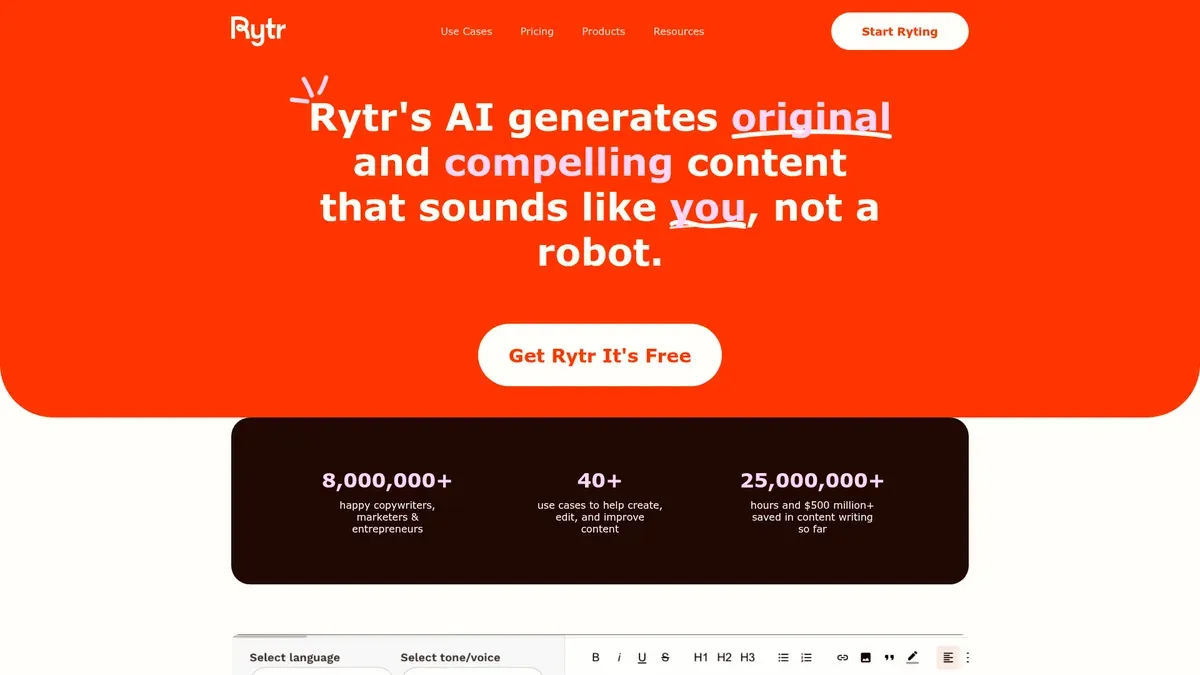
Rytr is an AI writing assistant that generates and edits short-form marketing copy and blog sections from more than 40 templated use cases, in preset tones or in a voice trained on your own writing. It is built for individuals, freelancers and small businesses that want quick first drafts of emails, ads, social posts, product descriptions and blog sections. You pick a use case, a language and a tone, give it a short input, and edit the result in a document-style editor.
The standout is the price. There is a free plan with 10K characters a month, Unlimited at $7.50 a month billed yearly, and Premium at $24.16 billed yearly or $29 monthly. My Voice mirrors a writing sample, a Copyscape-backed plagiarism checker is included on paid plans, and a Chrome extension works on every plan. A usage-based API is sold separately. Readers weighing other budget writers can browse the list of Rytr alternatives, which covers nine options. Rytr launched in 2021 and has been owned by Copysmith since an October 2022 acquisition.
The real limit is long-form SEO work. Rytr builds a blog post section by section: an outline, then a paragraph per heading, then continued writing. Its pages do not document keyword research, SERP analysis, content scoring or internal linking. Reviewers on G2 give it 4.7/5 from 820 reviews, checked in September 2026, and praise ease of use and price, while noting generic output that needs editing. For teams that also track AI search, AirOps vs Rytr asks whether a copy assistant is still enough. Some reviewers allege billing or refund problems, which are individual reports and not established findings, and Rytr's terms say subscriptions are not refundable except at the company's discretion.
Semrush Content Toolkit

The Semrush Content Toolkit is the product Semrush used to sell as ContentShake AI. People who search for Rytr vs ContentShake AI are looking at the same tool, since the old name now redirects to the Toolkit. It finds topics, builds SEO briefs, generates and optimizes articles for Google and AI search, and repurposes them into social posts and emails.
It is aimed at individual marketers, small content teams and SEO beginners who want one guided workflow at a single fixed price. Topic Finder returns topics with search volume, keyword difficulty and intent. The SEO Brief Generator analyzes top-ranking pages and produces a title, outline, secondary keywords and writer instructions. Publishing goes to WordPress, Mailchimp and Semrush Social Poster, and Base supports up to 50 brand voices. A Content Optimizer scores a draft for SEO and AI search criteria and offers a one-click rewrite, and Boards let teammates comment in real time.
The limits are specific. Base includes 5 SEO-boosted articles a month, and 10 more cost $30 a month. Reviewers say generated text and images still need human review. The Toolkit does not track brand mentions or citations in AI answers, which Semrush sells as a separate AI Visibility Toolkit. The only product-specific rating is 7.2/10 from 7 reviews on Info-Tech SoftwareReviews, and the G2 4.4/5 covers the whole Semrush suite. Semrush has been part of Adobe since the acquisition completed in April 2026.
DeepSmith: the alternative that starts from AI answers and publishes on schedule
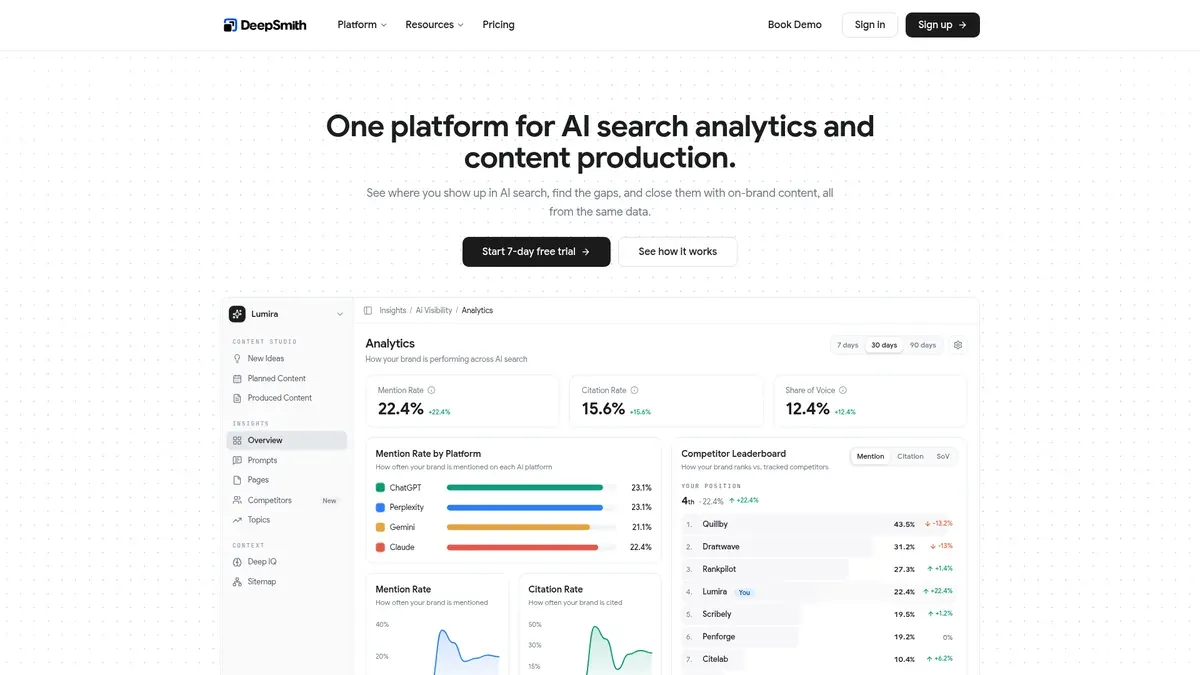
Rytr starts from a topic you have already chosen. Semrush Content Toolkit finds topics from search volume and keyword difficulty, which suits Google SEO well, and its Content Optimizer checks drafts against AI search criteria. Neither tool tells you whether ChatGPT or Perplexity names your brand today, or which competitor pages those engines cite instead. That is the gap DeepSmith is built around, since it is an AI search analytics and content production platform in one.
The AEO module tracks mention rate, citation rate and share of voice on a schedule, with a per-platform breakdown, a competitor leaderboard and the sources AI cites most. Mention rate and citation rate are separate numbers because citations and brand mentions are different signals. The method for turning visibility gaps into a content backlog is covered in a separate guide. Content Map turns your site and competitor sites into one map of topics, so coverage gaps and untapped topics are measured. Opportunity Agents return content ideas with the data point that justifies each one attached. DeepSmith picks topics from AI answers and competitor coverage rather than from a keyword volume database.

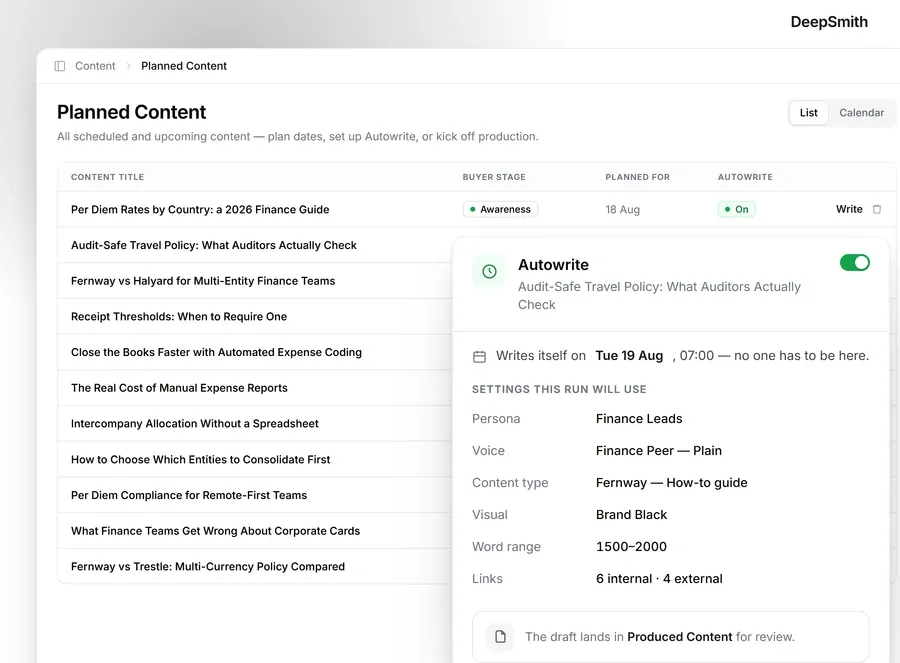
From there the Writer turns a planned idea into a finished article that is researched, internally and externally linked, and grounded in Deep IQ, with a cover image and publish-ready metadata. Autowrite writes the article on its scheduled date and can take it through to published without anyone in the app. Produced Content publishes straight to WordPress, Webflow, Strapi, Sanity or Contentful.
Plans are Pro at $99 a month ($80 billed yearly) with 20 articles, 50 tracked prompts and ChatGPT; Grow at $199 ($160) with 40 articles, 100 prompts and ChatGPT plus Perplexity; and Scale at $399 ($299) with 90 articles, 200 prompts and Gemini added. Enterprise covers all ten engines. There is a 7-day free trial and no long-term contract, and DeepSmith is rated 4.8/5 on G2.
Pricing and value
In a Semrush Content Toolkit vs Rytr price check, Rytr is the cheaper tool on every plan, and it is the only one of the two with a permanent free plan. Semrush Content Toolkit costs more, and it includes a brief generator, topic data and WordPress publishing that Rytr does not document.
Rytr's Unlimited plan is $7.50 a month billed yearly, and Premium is $24.16 billed yearly or $29 monthly. The word unlimited covers generated characters only. Extra languages, multiple voices and custom use cases are Premium only, and plagiarism checks are capped at 50 or 100 a month. The Semrush Base plan is $60 a month billed yearly with a 7-day trial. Surfer SEO vs Rytr covers the same price gap against a dedicated SEO tool. Extra users are $20 a month, and the monthly-billed price was not published in the state we checked. Semrush's pricing page lists 10,000 articles a month while its help article says unlimited standard articles, so confirm that at checkout. On trials, Rytr shows no time-limited trial and relies on its free plan, while Semrush charges the first payment automatically at the end of the 7-day trial unless you cancel.
What DeepSmith does: DeepSmith publishes its prices and its monthly article allowance together. Pro at $99 a month covers 20 articles and 50 tracked prompts on one self-serve plan, so tracking and writing are bought and counted in the same place.
SEO research and briefs
Semrush Content Toolkit wins here clearly. It pairs keyword volume, difficulty and intent with a brief built from the top-ranking pages for your keyword and location, with a title, an H2 and H3 outline, a word count and writer instructions. The Content Optimizer then scores a draft and rewrites it in one click, which Rytr's pages have no counterpart for. Surfer SEO vs Semrush Content Toolkit puts the Toolkit's brief workflow next to a specialist optimizer. Rytr has a Blog Idea and Outline use case that makes ideas and outlines from a few keywords, but it shows no volume or difficulty data and no analysis of ranking pages.
What DeepSmith does: Content Map shows the topics where a competitor publishes more than you, and the topics where you have nothing at all. Opportunity Agents turn those gaps, along with your AI visibility data, into ideas that each carry their evidence, so a backlog can be defended rather than guessed at.
Long-form writing and editing
On long-form, Rytr vs ContentShake AI is not close: Semrush Content Toolkit is the better fit for full articles, and Rytr is the better fit for a wide range of short formats. The Toolkit generates a whole article with an intro, headings and a conclusion from a prompt, a topic or a brief, and an editor with chat and quick commands. Semrush advises human review before publishing, and reviewers agree it is needed. Rytr's templates cover emails, ads, captions, product descriptions and meta titles, and Semrush documents no ad or product-copy templates. Rytr's Premium plan writes in 35 or more languages, while Semrush lists eight, counting American and British English separately.
What DeepSmith does: The Writer produces one finished, brand-grounded article per planned idea, with research, internal and external links, a cover image and metadata already in place. Internal links are placed from your Content Map, which is the idea behind automated internal linking. The output is aimed at being publish-ready, so review is an editorial check.
Brand voice and grounding
This is close to a tie on voice and a modest edge to Semrush on volume. Both build a voice from a writing sample. Rytr offers one tone match on Unlimited and multiple on Premium, and Semrush supports up to 50 voices with editable audience personas. A separate guide covers how to ground AI content in brand voice and product facts. Neither documents a full store of company or product facts, which matters for anyone publishing at volume, since a voice sample carries tone and little else. Semrush grounds output in its brand voice sample and data from Semrush, and Rytr documents no knowledge base.
What DeepSmith does: Deep IQ holds your positioning, products, personas, brand voice, visual guidelines and content types, set up once from your website and used by every module. Each article starts from that stored context, which keeps product claims accurate without re-briefing a writer.
From insight to action
Semrush Content Toolkit is ahead on getting content out the door. It publishes or sends drafts to WordPress for up to 100 sites, sends emails to Mailchimp, schedules social posts through Semrush Social Poster, and repurposes an article into posts for LinkedIn, Facebook, Instagram, X and Pinterest. Rytr documents no direct CMS publishing, although its Chrome extension works inside WordPress and other web editors. Byword vs Semrush Content Toolkit looks at the batch-versus-repurpose question in more detail. Neither documents unattended scheduled article publishing, and neither tracks what AI engines say about your brand.
What DeepSmith does: DeepSmith closes the loop. It tracks AI answers, finds the gap, plans the article, writes it, publishes it to your CMS and tracks whether the page starts getting cited. For a wider view of tools that push posts into a CMS, see the roundup of AI content tools with auto-publish. Autowrite runs the writing on a date you set, and the Apps Library turns the finished article into native versions for LinkedIn, X, Medium, newsletters and more.
Which should you choose
- DeepSmith fits content and marketing teams, and agencies, that want to know where their brand is missing from AI answers and then produce the articles that close those gaps in one platform. It suits anyone who wants publishing to run on a schedule instead of a task list.
- Rytr fits freelancers, small businesses and solo marketers who mostly need short copy and blog sections at the lowest price, or who want a free plan to try first.
- Semrush Content Toolkit fits SEO beginners and small teams that already use Semrush data and want a guided route from topic to WordPress post at $60 a month billed yearly.
Start a DeepSmith free trial to see your AI visibility, your gaps and your first planned articles on real data.