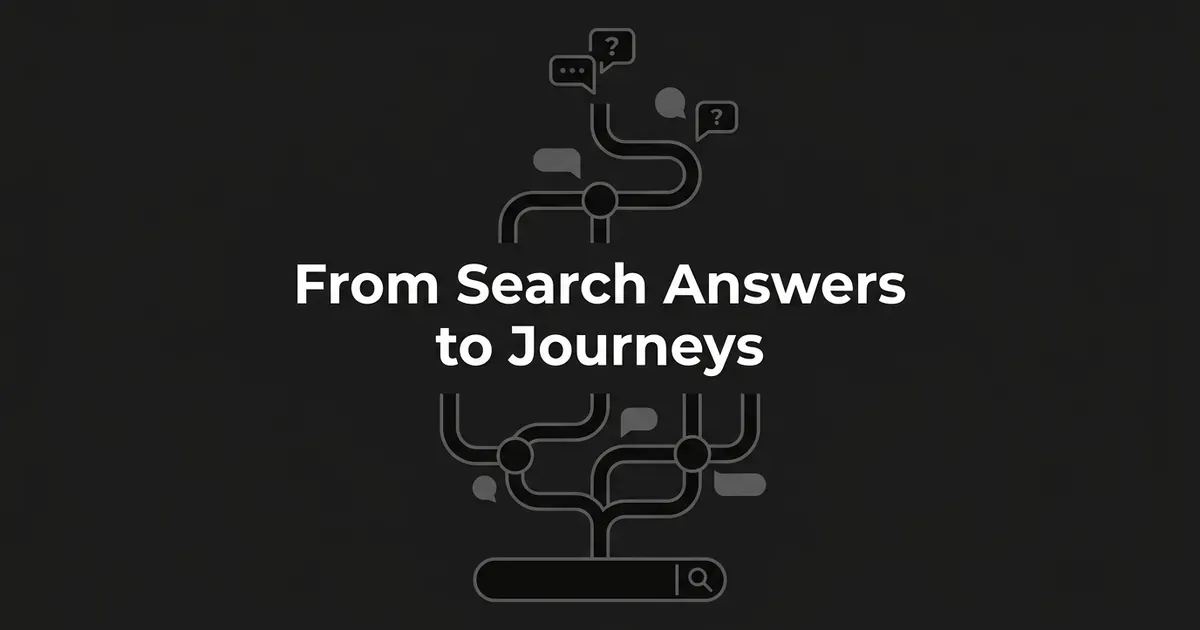
Google search journeys are the reason a keyword-by-keyword content plan is starting to feel thin. Google now describes a search as an evolving information task, not a single query that gets a single answer. For your content plan, that means the thing you are planning around should expand from one page for one query to a useful set of content that helps a person move from a question to a decision. Traditional results still matter and this is not a claim that ranking is dead. It is a description of how people are asking questions now, and what a plan needs to cover because of it.
What Google Means by a Search Journey
Picture someone looking for a restaurant. The old search was short: "restaurants New York." The actual need behind it was longer: a neighborhood, a party size, a price range, a dietary restriction, maybe kids in tow. Google has said its AI features are built around the fact that people can now type that whole need in one go, instead of compressing it into two or three words they hope a search box will understand.
That is the real shift behind the phrase search answers vs search journeys. Google's own numbers back it up. In May 2025, Google said early AI Mode queries were about twice as long as a typical search. By October 2025, it said people were asking questions nearly three times longer as the feature rolled out to more places. By May 2026, Google reported the average AI Mode query in its US data had grown to roughly triple the length of a normal search, with AI Mode past a billion monthly users and its query volume more than doubling every quarter since launch. These figures come from different snapshots and Google has not published a single clean multiplier you can quote as a permanent benchmark, but the direction is consistent: questions are getting longer and carrying more context.
Google also says AI Mode holds onto that context. You can ask a follow-up without repeating yourself, and the system tries to carry your intent forward. Google calls the mechanism behind a single complex question query fan-out: it breaks your question into several related searches across subtopics and sources, then pulls the results together into one response. You cannot see the list of sub-queries it ran, and Google has not published one, so treat fan-out as a signal about how many angles a real question has, not a checklist to reverse-engineer.
None of this replaces the plain search box. Google is explicit that its AI features are query-dependent and show up only when its systems judge they add value. A person looking for a phone number or a known website still gets the search they have always gotten.
How a Search Journey Differs From a Single Search Answer
If you are trying to hold onto one clean line for search answers vs search journeys, here it is. A search-answer model treats a query as self-contained. Someone types a short phrase, gets a ranked list or a direct answer, and your content plan usually maps one keyword to one page. Related questions become separate keyword targets, and whatever the reader needs to know next is outside your plan entirely.
A search-journey model treats that same query as one moment inside a longer task. The person may start with an incomplete or complicated need, add constraints as they think of them, ask a follow-up, compare a few options, and eventually act. Google says AI Mode is built for exactly this kind of exploratory, multi-step question: comparing products, working through a how-to, planning something with several moving parts, or asking a nuanced question that used to take several separate searches to answer.
The web still matters inside that journey. Google says AI Mode surfaces supporting links and can show a wider, more varied set of pages tied to a response, and frames those links as a way for someone to find pages they might not have found on their own. That does not guarantee your page gets picked, and it is not evidence that AI citations are quietly replacing organic rankings. It does mean Google is still describing the web as a place to explore, not just a database to strip an answer out of.
Google is also upfront about the limits. Similar questions worded differently can produce different answers and different links. Context does not always carry the way it should, and AI Mode can produce an answer that is off or just wrong. So the honest way to describe this shift is probabilistic, not mechanical: search is becoming more conversational for a real slice of queries, and less so for the rest.
Why This Changes What a Content Plan Should Optimize For
Here is the planning consequence of this Google search evolution content strategy question: the unit you plan around should widen from a keyword to a decision.
A keyword is usually a visible fragment of a bigger job the reader is trying to finish. Take "project management software," "best project management software," and "project management software pricing." Planned as three separate keyword targets, you get three thin pages that each answer one moment and ignore the rest of the decision. Mapped as a journey, the same topic turns into a sequence: what problem does the buyer actually have, which approaches could solve it, which criteria matter, what trade-offs change the answer, how should they compare the options in front of them, and what do they need to know about cost or rollout before they commit.
That is not an argument for turning every topic into seven thin pages. Some of that sequence belongs in one solid guide. Other parts deserve their own page because the audience or the depth needed is genuinely different. The point is to record, on purpose, which decisions your content covers and which ones it leaves the reader to figure out alone.
It also reframes what "coverage" means. A backlog full of introductory posts about a category can look complete by volume and still leave a reader stuck the moment they try to compare approaches, judge fit, or estimate the effort involved. A useful way to audit that backlog is by the job each piece does for the reader: discovery (naming the problem and the category), understanding (explaining how it actually works), evaluation (comparing approaches and trade-offs), and action (helping someone plan, choose, or avoid a common mistake). A topic with a pile of discovery content and nothing at the evaluation or action stage is not covered. It just looks covered.
What to Actually Plan For Now
A few concrete habits follow from this Google search evolution content strategy shift.
Brief for the follow-up, not just the opener. Before anyone drafts a piece, ask what the reader will want to know right after they finish it. What term will still be unclear. What objection would stop them from trusting the answer. What changes if their budget, team size, or industry is different from the example in the piece. Building those questions into the brief makes an article more complete for a human reader, which is also what makes it a better source for an AI response to point to.
Give each piece two jobs: answer the question it was written for, and make the next question easier. That second job does not need an artificial "read next" box. It means defining a term before you lean on it, naming the trade-off instead of hiding it, and being honest about what the piece does not settle.
Resist the urge to write a page for every phrasing. Google's own generative-AI guidance is direct about this: it tells publishers to prioritize useful, expert-led, people-first content and explicitly warns against producing a separate page for every possible variation of a query. There is no special page length or writing style that AI search rewards on its own. So do not stretch an article because a longer query implies a longer answer is owed, and do not spin up a near-duplicate page because a keyword tool surfaced a new variant of something you already cover well.
Score new ideas by what you can actually add. First-hand experience, a clearly attributed number, a point of view backed by evidence, a specific example, an honest account of a trade-off. If a planned piece cannot answer "what does this add that isn't already out there," it is a candidate to cut or fold into something stronger, not a slot to fill because the calendar has room.
Measure more than one ranking. A single position on one query cannot tell you whether your content supports the whole task a reader is working through. Track visibility across the discovery, evaluation, and action stages separately, not just the head term. Watch which pages get cited or surfaced when that kind of measurement is available to you, and keep an eye on where a competitor or another source is answering the next question better than you are. A marketing lead running this kind of audit by hand across dozens of tracked questions and competitor pages usually hits a ceiling fast, which is the exact gap that a platform built to watch AI-search visibility and turn the gaps it finds into a production backlog is meant to close.
Where the Journey Framing Gets Misread
A few things this shift does not mean, worth saying plainly so the idea does not get overstated.
It does not mean classic search results are gone. Google is explicit that its AI features only appear when its systems decide an AI answer adds value, and a plain results page is still what most queries get.
It does not mean Google has a formal "journey ranking factor." Nothing in Google's own statements establishes that it scores your site's journey architecture as a single ranking variable. Say this is a strategic lens, not a confirmed mechanic, and you will be right every time.
It does not mean every reader question deserves its own page, and it does not mean longer content wins by default. Google says plainly that there is no ideal page length required for generative search. Depth should match the decision, not a template.
It also does not mean a study of ChatGPT explains how Google's AI Mode works. A 2026 academic study of roughly 234,000 real ChatGPT conversations found that Google's top search results carried more informational diversity than ChatGPT's generated answers across most categories, with creative topics as the one clear exception. A separate industry study of ChatGPT prompts found that about a third of prompts triggered a background search, averaging a little over two searches each. Both are useful evidence about how conversational AI tends to behave, but neither one is a description of how Google's AI Mode selects or ranks anything, and treating them as interchangeable is a common mistake worth avoiding in your own thinking about this.