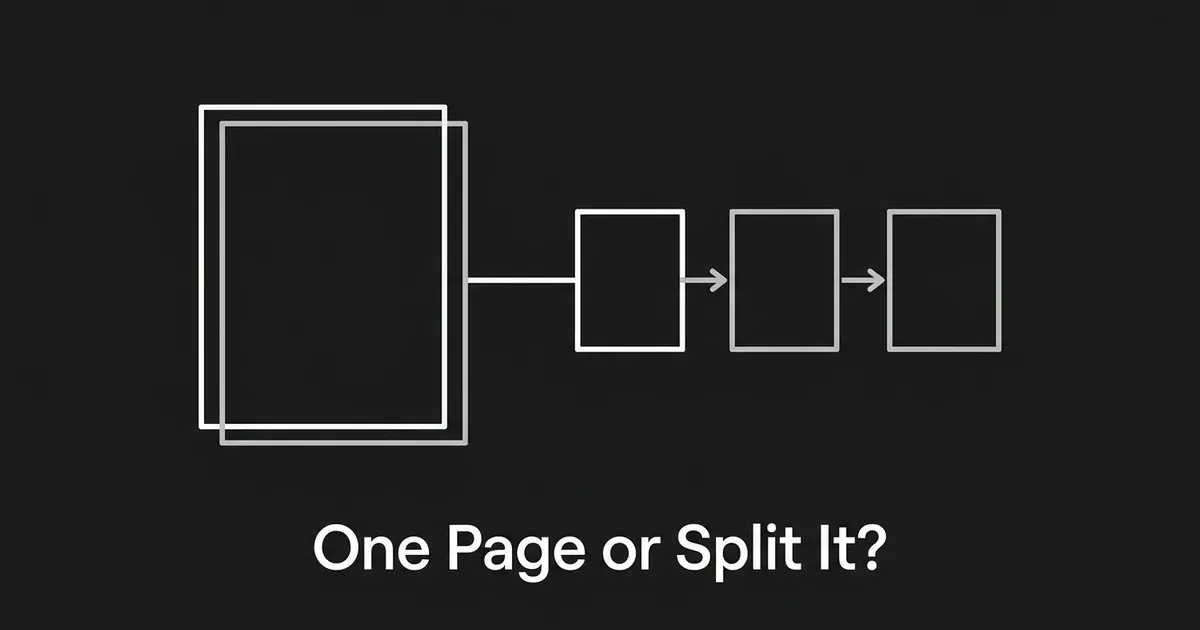
If you're staring at a 4,000-word draft and wondering whether to break it into a page two, the short answer is that you should keep it on one page unless you can point to a real reason not to. Length by itself is not that reason. Split it when there's a measured performance problem, or when a section actually works better as its own article, not because the piece feels long on the screen.
That's the decision in one sentence, but the single page vs multiple pages seo question deserves more than a one-liner, so here's a quick look at where the two approaches actually differ before we get into each one.
| Decision axis | One complete page | Sequential pages |
|---|---|---|
| Reader task | Good when the reader needs the whole explanation or wants to jump between sections | Can work for content people naturally read in installments |
| Landing experience | The whole answer is right there, whichever section someone lands on | A later page might get found on its own, so it needs to make sense without page one |
| Navigation | Scrolling and jump links avoid a forced page load | Every transition is a click and a load, so the sequence has to be obvious |
| Performance | Fine unless the page is heavy, but that's worth checking either way | Can lighten the first load, but doesn't make up for a bad split |
| Publishing work | One URL, one canonical, one thing to maintain | Multiple URLs, each with its own canonical and crawl check |
What "one page" actually means
A single-page article holds the whole argument, the examples, and the conclusion at one URL. The reader scrolls through it, and if you've added a table of contents or jump links, they can skip around instead of reading top to bottom, and nothing they need is hidden behind another click.
It's worth saying plainly that one page isn't automatically a good page. You can write 3,000 words at a single URL and still bury the answer, skip section headings, or load the page so slowly that nobody gets past the first screen. Keeping content together solves the fragmentation problem. It does nothing for organization or speed on its own, so don't treat "we didn't paginate" as the finish line.
What pagination actually means
Pagination seo is really a mechanics question layered on top of an editorial one: a paginated article splits one piece into a sequence of URLs, connected by next and previous links. Page two is a continuation of page one, not a new article answering a different question. Google treats each URL in that sequence as its own page for indexing purposes, which is exactly why the mechanics (how you link them, how you set the canonical) end up mattering more than people expect.
This is a different move from building a hub page that links out to separate, independently useful articles. That's a topic cluster, and it's a legitimate editorial choice of its own. The tell is whether the second piece can stand alone. If someone can land on it cold, understand what they're reading, and get something out of it, it's a real article. If it only makes sense as "the rest of the thing I read on page one," it's pagination, and it should be built and judged as pagination.
A complete "view all" version, offered alongside the split pages, is a third option worth knowing about. Whether it's actually usable depends heavily on how fast it loads, since a view-all page that drags will lose the very readers it's meant to serve.
Reader task and the landing page problem
Start with what the reader is actually trying to do. If the questions, the evidence, and the conclusion form one connected argument, that's a single-page job. Splitting it means someone can land on the wrong fragment, either the setup without the payoff or the payoff without the setup, and neither is a good first impression of your site.
This matters more than it might seem because you don't control which page someone lands on. Search and AI answer engines can surface any URL in the sequence, not just page one. A later page in your sequence needs to work as an entry point on its own: enough context that a stranger arriving there understands what they're looking at and where the rest of the argument lives. If a proposed page two is genuinely just a dangling ending, that's a sign to reconsider the split rather than publish it and hope.
Some material really is naturally consumed in installments, and for that kind of content, a sequence can suit the reader fine, provided each transition is intelligible on its own. The test is the same either way: would a stranger landing on this specific URL know what they're reading?
Navigation, clicks, and what actually slows people down
Every page break is a click and a page load. A single scrollable page avoids that entirely, at the cost of the page itself potentially being heavy if it's long, image-rich, or built on a slow template.
This is where a lot of the pagination-for-seo instinct comes from: the idea that breaking a long page into pieces will make it load faster and therefore rank better. That can be true for the individual page weight, but it ignores the cost on the other side, meaning the repeated round trips a reader has to make to get through the whole thing. A faster-loading first page doesn't make up for three more clicks before someone reaches the part they actually needed.
If you do split, the navigation itself has to carry weight it wouldn't otherwise need to: visible, crawlable next and previous links, a clear sense of where the reader is in the sequence, and ideally a way back to the start. A pagination control that only works through a JavaScript button, with no real link underneath, isn't discoverable the same way, and it's an easy thing to get wrong when a dev team builds it fast.
Performance: measure it, don't assume it
Google's Core Web Vitals give you the actual bar to check against: Largest Contentful Paint within 2.5 seconds, Interaction to Next Paint under 200 milliseconds, and Cumulative Layout Shift under 0.1. These are page-experience targets, not pagination rules, and they're the right place to start if performance is your actual concern.
Before you split anything, test the existing single page on a real mobile connection and see where it actually falls short. If it's slow, find out whether the problem is the amount of text or something else entirely, like unoptimized images, heavy scripts, or a bloated template. Splitting a page in half doesn't fix a rendering problem, and you'll have paginated for nothing if the slowness follows you into every component page anyway.
Attention research backs up a related but separate point: Nielsen Norman Group's scrolling analysis found readers spend roughly 57 percent of their page-viewing time above the fold and about 74 percent within the first two screenfuls. That's a strong argument for putting your clearest answer and your strongest section cues early in the piece, wherever it lives. It isn't evidence that forcing a page break improves reading or rankings. Use it to write a better-organized single page, not as a reason to chop the page up.
The real risk in a weak split
Picture the scenario that gives this worry its shape. A solid guide walks through a decision, and then its final two paragraphs and the actual conclusion get shipped off to a separate "page 2." Someone who lands on page one never sees the payoff without clicking through. Someone who lands cold on page two gets a conclusion with no setup behind it. Neither version does the reader any favors, and it's an easy trap to fall into once "the article is long, let's split it" becomes the whole plan.
This is where the thin-content worry around pagination seo actually comes from, and it's the same worry people are pointing at when they talk about splitting content seo risk, so it's worth being precise about what is and isn't established here. Google's people-first content guidance asks whether a page provides substantial, complete value to a reader, and that's a fair lens to hold a proposed page two up against. But there's no documented word-count threshold, no confirmed pagination-specific penalty, and no universal percentage loss that applies here. A component page needing the page before it to make sense isn't automatically a violation either. Google's own guidance explicitly supports multi-page articles and explains how to make them crawlable properly.
The honest way to frame it is that an arbitrary break carries a real usability risk you can reason about and test for yourself, but that is not the same thing as a proven Google penalty, and writing about it as if it were overstates what the evidence actually shows.
If you do need a break, put it at a real section boundary, one where the content on either side can each stand up as its own coherent read, and make the sequence unmistakable to anyone who lands there.
When a separate article beats a page two
Sometimes what looks like a pagination decision is actually a content architecture decision in disguise. If a section of your draft has its own question, its own evidence, and its own conclusion, that's usually a sign it deserves to be its own linked article rather than a numbered continuation of this one. A broad page can cover the overarching question and link out to pages that each answer a narrower one, which is a hub-and-spoke structure, not pagination with extra steps.
Conductor's writing on pillar and cluster pages makes a similar point about scope: a comprehensive pillar page connects to more focused cluster pages, and there's no fixed length that makes a pillar page "correct." That's a useful model for deciding what belongs together and what belongs apart. It isn't a rule that every long article needs to become a cluster, only a reminder that splitting content along real topic boundaries is a different, often better, move than splitting it because the word count got high.
The mechanics, if pagination wins
Splitting content seo mechanics are where most of the actual risk lives, not in the decision itself, so treat this section as the checklist for anyone who's already decided to go ahead.
If you've genuinely decided pagination is the right call, a few details determine whether it works or quietly costs you traffic.
Give every page in the sequence its own stable URL. A fragment after a hash mark isn't enough to distinguish pages from Google's point of view, since fragments are ignored for this purpose.
Link every page to its neighbors with real, crawlable HTML anchors, not just a button that runs some JavaScript. Both directions matter: next and previous. A link back to the start of the sequence helps too, since it keeps the whole thing navigable instead of a one-way chain.
Give each page its own canonical URL. Don't point page two's canonical at page one, since page one doesn't contain page two's content and that mismatch tells search engines the wrong thing about what's actually on each URL. A genuine complete "view all" version is a separate, conditional case, and it isn't a shortcut you can apply by default.
Skip rel="next" and rel="prev" annotations if you were planning to lean on them. Google has said it no longer uses them to identify pagination relationships, so the visible, crawlable links are doing the actual work now, not the markup in your page head.
Once it's live, check it. Use Search Console's URL Inspection on the first page and on the later ones to see what got indexed and whether the live version is actually reachable. An eligible URL still isn't a guaranteed one, so don't treat "it validated" as "it's working." Watch reader behavior and search performance over time, and resist the urge to credit or blame the pagination decision alone for whatever changes you see.
A decision rule you can actually use
- Name the reader's actual task. One connected question and one conclusion means one page. Genuinely separate questions mean separate linked articles, not a numbered sequence.
- Check whether the single page is actually failing someone. Is it measurably slow on a real connection? Hard to navigate even with clear headings? Length alone isn't a diagnosis, so don't split on a feeling.
- Preview every proposed page as if it's the only one someone sees. Would a stranger landing there understand what they're reading and find their way through the rest? If a page is just a dangling ending, keep the piece together or rework the split point.
- Pick the least disruptive option that actually works. One well-organized page beats a sequence when it performs fine and reads well. Choose pagination only when its specific benefit outweighs the extra clicks and the added publishing overhead.
- Check it after it's live. Inspect the indexed URLs, especially the later ones, confirm the canonical Google picked, and watch the real mobile experience over the following weeks.
Where DeepSmith fits, if at all
None of this decision depends on what tools you use to publish. But if your team is maintaining a growing back catalog and trying to keep internal links, canonicals, and page structure consistent across dozens of articles, that's exactly the kind of manual upkeep that eats a content lead's week. A platform like DeepSmith handles internal linking and structural consistency as part of writing and publishing each piece, so decisions like this one don't turn into a separate audit project every time your backlog grows.