Let me give you the whole system right up front. The fastest path to AI visibility for a niche SaaS brand runs through five steps: pick 20–40 buyer prompts → choose one of three paths (earn mentions, become a source, or win UGC) → publish citation-ready evidence → earn third-party reinforcement → track weekly across platforms.
That's the system. It’s not a one-time SEO refresh or a quick schema sprint, but a repeatable loop you can run with the team you have right now.
If you’re reading this, I’m guessing you’ve had The Moment. The one where you search your own category in ChatGPT and your biggest competitor pops up, smiling. It’s a real kick in the gut. I know because it happened to us. You’re doing everything right with content. You rank on Google. You publish consistently. But AI engines are a different beast, your pipeline wasn’t built for this, and now your boss is walking over to your desk with questions you don't have good answers for.
I’ve been there. Here’s the playbook we built to fight back. You’ll walk away with a rubric to choose your path, a 30–60 day plan, a simple way to measure it, and some guardrails so you don’t blow your budget (or your sanity).
One thing to accept upfront: mentions often matter more than links, the AI world is fragmented, and citations will bounce around month to month. This is a system you run, not a project you finish.
What does "AI visibility" mean for a niche SaaS brand (and what should you optimize for first)?
Let's get on the same page. When I say AI visibility, I mean one thing: do AI tools name your brand, describe you accurately, and cite your pages when your buyers ask real questions? It’s not about impressions or organic reach. It's about showing up when it counts.
The first thing we had to wrap our heads around is that AI engines don't use the same signals as Google. They aren't just ranking pages. They're stitching together answers from sources they trust. So, for a small brand like us, "AI visibility" breaks down into three things you can actually track:
- Are you being named? (Mentions)
- Citation rate: What share of prompts cite one of your pages as a source?
- Is the description accurate? (Sentiment and positioning)
The mentions vs. citations distinction is huge for niche brands. Citations mean AI engines see your own website as an authority. That’s a high bar to clear. Mentions, on the other hand, can happen just because you’re referenced in some third-party article the AI already trusts. For a brand that isn't a household name yet, getting mentions on existing trusted sources is usually faster and more stable.
Here's a hard truth: referral traffic is not the main prize. Many AI answers don’t have clickable links, or they hide them. The real win happens before the click. A buyer hears your name in an AI answer, and then they search for you directly. You have to track that signal (branded search lift, direct traffic), not just click-through rates.
In plain English, here are the only four metrics I’d bother tracking at the start:
- Mention rate: What share of your tracked buyer prompts include your brand name?
- Citation rate: What share of prompts cite one of your pages as a source?
- Prompt coverage: How many distinct buyer questions are you tracking and addressing?
- Sentiment/descriptor accuracy: How does the AI describe you? ("best for small teams," "no Salesforce integration," "expensive for early-stage")
Which AI platforms should you care about (and why it's not one leaderboard)?
Different AIs have different tastes. Some love established, encyclopedia-like domains. Others, like Perplexity, seem to have a bigger appetite for recent blog posts, community threads, and even video transcripts. Google's AI Overviews mix in traditional SEO signals, but it's not a one-to-one match.
The takeaway? Winning in ChatGPT doesn't mean you're winning in Perplexity or Gemini. You have to treat each platform as its own channel with its own quirks. Start measuring them separately from day one. A one-time check in ChatGPT isn't a strategy; it's a lottery ticket.
Why are niche brands "not the obvious choice" in AI answers — and what actually moves the needle?
AI engines love obvious winners. They favor brands with tons of mentions, consistent descriptions, and a chorus of third-party reinforcement. That’s everything a niche brand is still trying to build. The good news is you can build that pattern on purpose. The bad news? Publishing more blog posts isn't the answer.
What AI engines are doing is simple pattern-matching. They scan the web to see if a brand is described the same way, over and over. When your brand name pops up in roundups, review sites, and community forums with consistent positioning, you create an "entity footprint" the AI can understand.
What you control:
- How consistently your brand name and category appear on your own site.
- Whether your about page and product descriptions tell a coherent story.
- Whether you show up in third-party sources the AI already trusts.
- Whether your pages answer specific questions with direct, no-fluff language.
What moves the needle:
- Get mentioned where AI already looks: trusted directories, comparison sites, expert content.
- Publish structured, extractable answers: content that helps a buyer make a specific decision, not a 5,000-word "ultimate guide."
- Reduce ambiguity: use the same naming and positioning everywhere so the AI doesn't get confused.
- Monitor and adapt: AI preferences change, so your plan has to as well.
A page titled "Project Management Software Guide" is useless. A page that directly answers "Does [Your Tool] support Jira integrations?" with a clear yes or no and some context? That's gold.
What to stop doing (because it wastes niche-brand time)
First, a few things you need to stop doing right now. We wasted months on some of these.
Stop treating AI visibility as "add FAQ schema and pray." Yes, schema helps, but it’s the absolute bare minimum. It doesn't replace the third-party signals AI needs to actually trust you.
Stop optimizing for only one engine. Chasing ChatGPT visibility while ignoring Perplexity is like optimizing for Bing and ignoring Google. They’re different games.
Stop trying to get citations from your own site before you have mentions elsewhere. You need that external validation first. And for the love of all that is holy, stop publishing generic guides that try to cover everything but end up helping no one. AI prefers content that makes a specific claim and proves it.
Which AI visibility path should you choose first: earn mentions, become a source, or win UGC?
Pick one path for the first 30 days. Seriously. I know the pressure to do it all, but splitting your effort is the fastest way to get zero results and burn out your team. We made this mistake, and it cost us a full quarter.
Here are the three paths:
- Path A: Earn mentions on existing trusted sources. Get your brand added to the roundups, directories, and creator content that AI already cites. This is the fastest way to get external leverage.
- Path B: Make your own pages become AI sources. Build and optimize pages on your own site that are ready for citation. This is a slower burn but compounds over time.
- Path C: Leverage UGC and multimedia platforms. Get active in communities, answer questions on forums, and show up in podcasts or videos that AI engines are starting to index. This can be a goldmine for the right categories.
How to choose your path:
- If you have a decent content team and some bandwidth → start with Path B.
- If your site authority is low and competitors are all over the AI roundups → start with Path A.
- If your buyers live in developer forums or on YouTube → you need to be in Path C from the beginning.
What "success in 30 days" actually looks like:
- Path A: 5–10 new third-party mentions and a measurable lift in your mention rate.
- Path B: 8–12 new or updated citation-ready pages, with the first few citations starting to appear.
- Path C: 3–5 high-quality community contributions, with the AI's description of your brand starting to shift.
| Path A | Path B | Path C | |
|---|---|---|---|
| Speed to impact | Fast (2–6 weeks) | Moderate (4–10 weeks) | Variable (4–12 weeks) |
| Cost (time + $) | Medium (outreach time) | Medium (content production) | Low–medium (participation time) |
| Skills required | Outreach, relationship-building | Content, AEO structure | Community presence, niche credibility |
| Brand risk | Low | Low | Medium (quality varies) |
| Best-fit scenario | Low authority, fast need | Strong site, content bandwidth | Developer/marketing tool categories |
| Weekly measure | New mentions, prompt lift | New pages published, citations | Contributions made, descriptor shifts |
What's the 30–60 day workflow to go from "AI invisible" to measurable lift?
This is our weekly loop. It’s five repeatable steps.
Run a weekly loop: define buyer prompts → audit who AI recommends and why → ship 2–4 answerable assets → earn third-party reinforcement → review metrics and iterate.
Step 1 (Day 1–3): Build your prompt set
Start with 20–40 prompts that reflect what your buyers are actually asking. Mix it up:
- "Best [category] for [use case]"
- "[Your brand] vs [Competitor]"
- "Is [your brand] good for [buyer type]?"
- "Affordable [category] with [specific feature]"
- "Alternatives to [dominant player]"
Don't forget objection and pricing prompts. These are often where AI can either save a deal or kill it. If you're not tracking what the AI says about your limitations, you’re flying blind.
Step 2 (Day 3–7): Run an AI competitive snapshot
For each prompt, record who gets mentioned, whose pages get cited, and what language is used. Do this across at least two or three platforms. The patterns you see (the same competitor page, the same review site) are your road map.
I’ll be honest, tracking this manually across ChatGPT, Perplexity, and Gemini is a pain. It's fine for a week, but it doesn't scale. We got so tired of spreadsheets that we built the AI Visibility — Prompts feature in DeepSmith to define our prompt set and track mention and citation rates across all five major platforms in one dashboard. It’s about measuring systematically, not spot-checking.
Step 3 (Week 2–4): Choose 2 content bets + 1 mention bet
Your content bets are new or updated pages that directly answer your most important prompts. Your mention bet is to find 5–10 third-party sources where competitors appear but you don’t, and start your outreach.
Step 4 (Every week): Publish and distribute where AI sources
A page that just sits on your blog is a weak signal. You need to get it referenced and discussed. Repurpose your key points on platforms AI loves, like LinkedIn or relevant communities. Two or three quality posts are better than ten thin ones.
Step 5 (Week 4–8): Measure, then double down
Check your metrics. Which prompts moved? Which pages are getting cited? Double down on the winners with more depth. Ditch the losers. This isn't about being patient; it's about finding what works and hitting it harder.
A lightweight tracking sheet (if you're not ready for a tool)
| Prompt | Platform | Brands mentioned | URLs cited | Descriptors used | You present? | Next action | Date checked |
|---|
Fill this out weekly for your top 15–20 prompts. It's about 45 minutes of work. The real cost of doing it manually isn’t the time; it’s the inconsistency. Miss two weeks, and you can't tell if a change is a real trend or just noise. That's the point where a dedicated tool pays for itself.
How do you make content "citation-ready" for AI without rewriting your whole site?
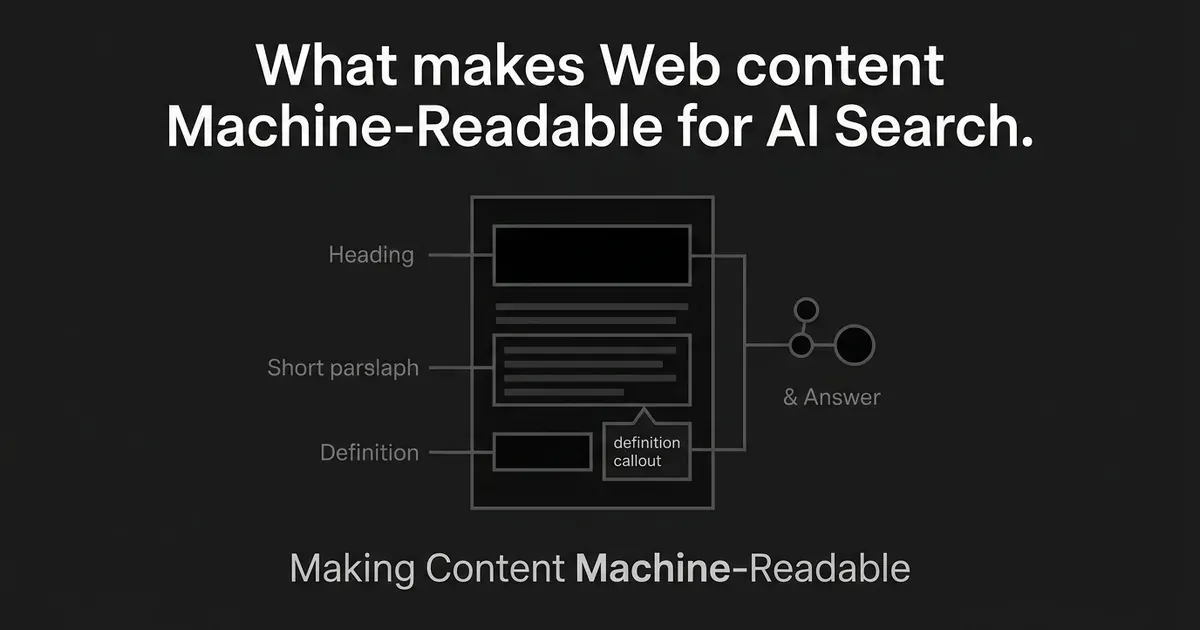
AI cites pages that give a specific, extractable answer. Lead with the answer, structure your page around buyer questions, and resolve uncertainty instead of creating it. You don't need to rewrite your whole site. Just focus on optimizing 8–12 key pages first.
Here's a rule I give all our writers: open every section with the answer in one or two sentences. AI engines scan headings and the first sentence that follows. If your opening is context-setting fluff ("The world of project management has evolved..."), the engine is gone. If it's "Yes, our product syncs with Jira," you've got a shot.
Page types that we see earn citations constantly:
- "X vs Y" comparisons with honest criteria and a clear verdict.
- "Best X for Y" lists with transparent trade-offs.
- Feature-specific Q&A pages that answer one narrow question.
- Implementation guides ("How to do Z with our tool").
Formatting that AI can actually parse:
- H2/H3 questions that sound like a human asking something.
- Bulleted lists.
- Tables for comparisons.
- A clear answer right at the top, before any of the "why."
We use a "query fan-out" approach. Take one core prompt ("best onboarding software for SaaS") and expand it into 6–10 related prompts ("best onboarding for B2B startups," "onboarding tools with Salesforce integration"). Build a small cluster of content that covers that whole territory.
Also, be relentlessly consistent with your own entity. Use the same product name, category language, and positioning on every single page. Inconsistency makes AI nervous, and when it’s nervous, it defaults to trusting your more consistent competitor.
This is another area where process matters. Building this structure into your drafts from the start keeps you from getting stuck in editing hell. A connected workflow (this is why we built the Content Studio in DeepSmith) bakes keyword coverage, structure, and linking into the creation process, so your editors can focus on substance, not repairs.
A repeatable section template writers can follow
Give this to your team tomorrow.
- Direct answer (1–2 sentences): State the answer immediately.
- Who it's for / not for (2 bullets each): Be honest about your limits.
- Proof points: Specific examples or data, not vague claims.
- Steps or checklist (if applicable): Numbered and concrete.
- Comparison or trade-offs table (when relevant): Structured data is easy to extract.
How do you earn AI mentions when competitors dominate the "trusted sources"?
Don't just ask for links. Systematically sources AI is already citing for your prompts and make it dead simple for them to add you. This is outreach, but it's surgical.
Go back to your competitive snapshot from Step 2. Every third-party URL that popped up is a target. Prioritize the pages that:
- Already cite your competitors.
- Were updated in the last 6–12 months.
- Have a clear spot where you would logically fit.
- Serve a buyer segment that you genuinely fit.
A few outreach tips that actually work:
- Reference the specific spot you're asking to be included in. No generic "check us out" emails.
- Give them the exact 1–2 sentence description you want them to use. Do the work for them.
- Include a single, concrete proof point: your G2 rating, a specific feature, a customer result.
- Make the ask frictionless. They should be able to add you in five minutes.
And don't forget about people. The YouTubers, LinkedIn creators, and podcast hosts in your niche are becoming powerful sources for AI. A mention in a popular video can be worth more than a link from an old directory.
A "mention-first" outreach template (copy/paste)
This is the exact template we use. It works because it’s short, specific, and easy.
Subject: Quick add to your [Article Title] — [Your Brand] for the [specific segment] spot
Hi [Name],
Your article on [topic] is great, and I see it’s getting picked up by AI for prompts like [prompt]. We work with [buyer type] and would be a natural fit in your [specific section].
Suggested addition: "[Your Brand] — [1–2 sentence accurate description with your key differentiator]."
For proof, we're [one concrete data point — rating, customer type, specific feature]. Happy to provide a demo or review access.
Let me know if that fits.
How do you measure AI visibility and report progress to leadership without overpromising ROI?
I know the pressure you're under to show ROI for everything. But if you promise click-based ROI from this, you'll fail. Report AI visibility as a leading indicator of influence: share of voice, sentiment accuracy, and competitor displacement.
The click-based ROI often lags for months or doesn't show up in referral data at all. The value is upstream, in the awareness that leads to a branded search later.
Here's a three-tier frame for reporting:
Leading indicators (what you measure weekly):
- Mention rate across tracked prompts
- Citation rate for your key pages
- Prompt coverage expansion
- Sentiment/descriptor accuracy shifts
Supporting indicators (what you watch monthly):
- Branded search lift in Google Search Console
- Direct traffic lift
- Qualitative feedback from sales ("heard about you from AI")
Lagging indicators (what you report when you have it):
- Pipeline influenced by AI-sourced awareness (if your CRM is good enough to track it).
Part of your job is to set honest expectations. AI citation patterns are volatile. Your numbers will go up and down. The goal is consistent presence on decision-stage prompts, not hitting some magic number and staying there.
For your monthly leadership update, keep it simple:
- What changed: A few bullet points on wins and losses.
- Why it changed: New pages we shipped, mentions we earned, a competitor move.
- What's next: Our bets for the next month.
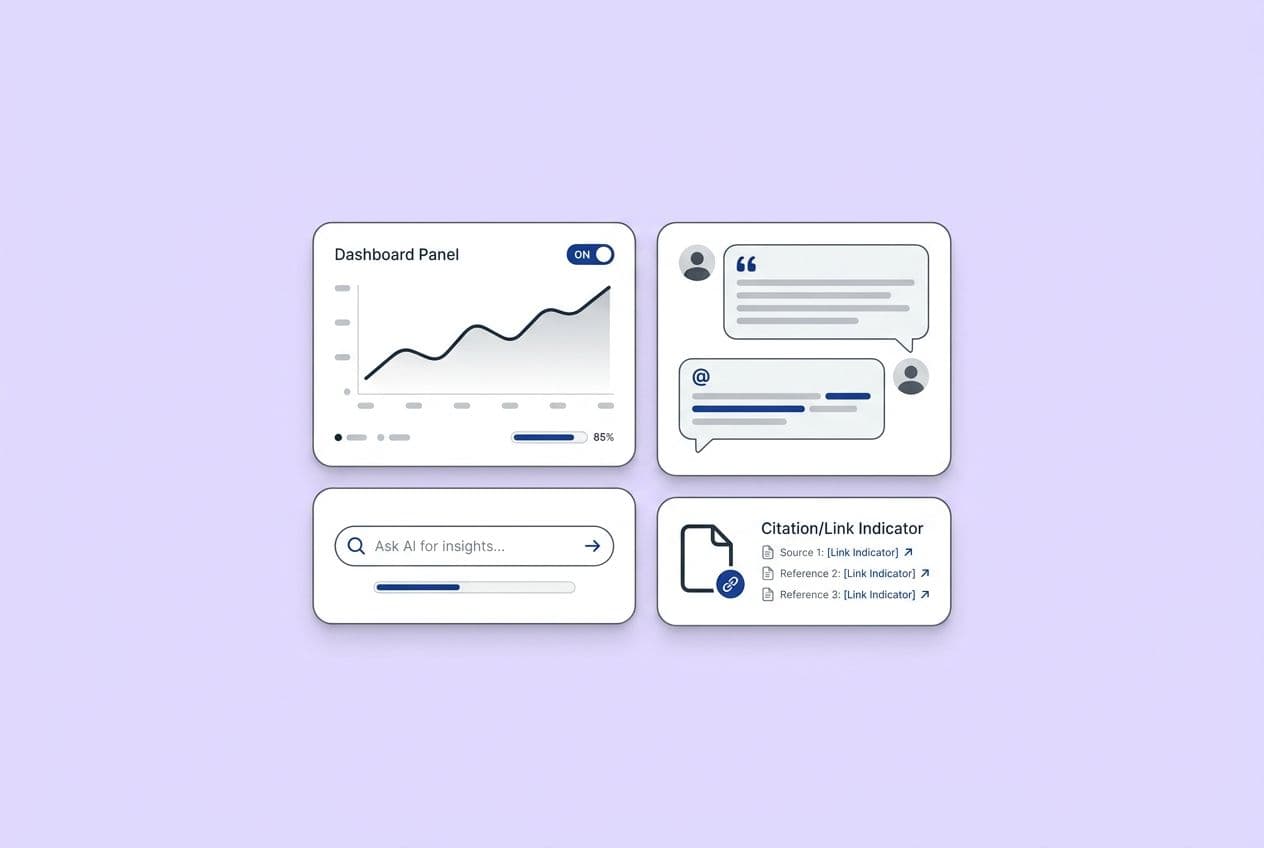
Having the charts makes these conversations so much faster. A dashboard (like the AI Visibility — Overview in DeepSmith) gives you the trends for mention rates, competitor standings, and page-level attribution all in one place. It replaces the spreadsheet and makes the story you’re telling visible.
How do you protect your brand from AI volatility, hallucinations, and negative sentiment?
This can backfire if you aren't paying attention. AI can hurt your brand if it gets things wrong, and niche brands are especially vulnerable because there isn’t as much data out there to correct a mistake. You need a monitoring loop, not just a publishing schedule.
Volatility: Treat AI citations like moving targets. Check your priority prompts every week. A page that got citations last month might get none this month. That isn't failure; it's just the nature of the beast.
Hallucinations and misattribution: The AI might say you have a feature you don't, or confuse you with someone else. Your defense is clarity:
- Use consistent, specific language on every single one of your pages.
- Add explicit statements about your limits ("Not ideal for enterprise," "Doesn't support X on the starter plan"). It feels weird, but it prevents the AI from making wrong assumptions.
- Keep your About page and product pages updated. AI treats these as high-trust sources.
Sentiment control: If you see negative words like "buggy" or "overpriced" popping up, trace them to the source. It's usually a review site or a forum thread. Go there and respond. Update comparison pages. Publish a case study that directly refutes the objection.
Here's our simple crisis-lite process: if you find a major error, fix your own pages first (you control them), then contact the third-party source. Keep checking the prompt weekly until it clears. Don’t ring the alarm internally unless sales says it's killing deals.