You typed your own core question into ChatGPT, the way you do every few weeks, and this time you weren't there. A competitor was. Maybe your AI visibility dropped across two engines at once, or maybe your citations disappeared from ChatGPT while Perplexity still names you. Either way, the page that used to get pulled into answers has gone quiet, and you're staring at the screen trying to figure out what changed.
Take a breath. This is fixable, and more often than not it is fixable faster than you'd guess.
Lost AI citations feel personal, but they almost always trace back to one of four plain causes: something changed on your own page, a competitor got sharper, a bot can no longer reach you, or your content simply went stale. This playbook walks you through diagnosing which one hit you and running the recovery sequence in the right order. It is written for a marketing lead who watched a real AI citation decline and needs a plan, not a panic. We'll go one step at a time.
A quick scope note so you don't waste effort: this is for a general or gradual decline. If your drop lined up exactly with a named model or engine update, that is a different diagnosis. And if you were never cited in the first place, you need a build playbook, not a recovery one. This is for the "I had it, now I don't" case.
Step 1: Confirm the decline is real before you act
The first move is the one everyone skips. Before you rewrite a single page, prove the drop is real.
AI answers are noisy. Ask the same engine the same question twice in one afternoon and you can get two different source lists. A single brand's citation share can swing by a third or more week to week on the exact same prompt, with zero changes on your side. If you rebuild a page in response to one bad Tuesday, you're chasing static.
So gather evidence first. Take your top 20 to 50 buyer prompts, the real questions your customers ask, and run them across ChatGPT, Perplexity, Gemini, Claude, and Google AI Mode. Do it weekly for about four weeks. You're looking for a pattern, not a snapshot.
How to tell it's done: you can point to a decline that holds for three or more weeks across two or more engines. That is a real signal. One engine wobbling for one week is not, and this is exactly the kind of citation volatility that fools teams into over-reacting.
Where people go wrong: they diagnose off a single manual search. The answer looked bad once, so they assume the worst. Give it the four-week window. If the drop is real, it will still be there. If it was noise, you just saved yourself a week of pointless rewriting.
This is also where a tracking system earns its keep. Running fifty prompts across five engines by hand, every week, is the kind of chore that quietly falls off your list by week two. DeepSmith's AI Visibility module runs your tracked prompts on a schedule and reports mention rate, citation rate, and share of voice over time, so a real AI citation decline shows up as a trend line instead of a gut feeling. However you track it, the rule holds: confirm before you act.
Step 2: Find the page that took your spot
Once you know the drop is real, get specific. For each prompt where you lost ground, look at the answer and find the URL that now sits where yours used to. Someone is getting cited instead of you. That page is your single best clue.
Pull the replacement source up next to your page and compare them honestly on a few axes:
- Recency: when was it published, and when was it last updated?
- Structure: does it lead with a clean, liftable answer, clear headings, an FAQ block?
- Authority: is it a higher-authority domain, or does it have third-party mentions you don't?
- Depth: more primary sources, original data, specific numbers?
The axis where they clearly beat you is your fix. You are not guessing anymore. If they won on freshness, your problem is freshness. If they lead with a crisp answer and you buried yours, that's your problem. Let the comparison tell you where to spend your effort.
How to tell it's done: for each lost prompt, you can name the page that replaced you and write one sentence on why it's winning.
Where people go wrong: assuming it must be your fault. Sometimes your page never changed and you still lost the citation, because a competitor published a stronger piece or earned a placement that shifted the signal. That is still useful information. It just points your fix outward, toward out-competing them, rather than inward. Watching which competitor pages win your prompts is exactly what DeepSmith's competitor citation view is built to surface, so you can see who replaced you and on which page without hand-checking every engine.
Step 3: Check that AI bots can still reach your page
Here's the cause teams almost never suspect, and it's the quietest one: the model wants to cite you, but it can't fetch your page. If a bot can't retrieve the content, nothing else you do matters. That's why this check comes before any writing.
The usual culprits are simple once you look:
- A blanket AI-bot block in robots.txt, often added back in 2023 or 2024 to keep training crawlers out, now quietly blocking retrieval bots too.
- A WAF or CDN rule (Cloudflare, Akamai) challenging or blocking AI bot user agents.
- Critical content rendered only in JavaScript, invisible to crawlers that don't run it.
- Server errors, empty page bodies, or a login wall that trips for bot user agents.
A key distinction trips up a lot of smart people here. Blocking a training bot is not the same as blocking a retrieval bot. Shutting out GPTBot does not shut out OAI-SearchBot. Blocking Google-Extended does not affect Googlebot or your appearance in AI answers. They are separate user agents with separate jobs, and you can welcome one while refusing the other.
How to tell it's done: fetch your key URLs using the user agents of the retrieval bots (OAI-SearchBot, PerplexityBot, Claude-SearchBot, Googlebot, and friends). Each should return a full page, not an error, an empty body, or a challenge. Then watch your server logs: within about a week you should see those bots hitting the pages and getting clean responses.
Common mistake: treating fetchability as a one-time audit. Bot user-agent lists and behaviors change, and a WAF vendor can ship a new default rule that blocks a crawler overnight. Re-check this every quarter, not just when something breaks.
If this step is your whole problem, good news: it's often the fastest recovery of all. You didn't lose quality. You lost access, and access is a settings fix.
Step 4: Diff your page against the version that used to get cited
If the bots can reach you and you still lost the citation, look at what changed on the page itself. This is the most common cause of a sudden drop, and the good news is that changes leave a trail.
Pull the page's history. Use your CMS revision log, your version control, or the Wayback Machine to find the last version that was getting cited, and compare it line by line against what's live now. You are hunting for a specific list of regressions:
- A direct answer that used to sit at the top and got rewritten into flowing prose.
- A definition, stat block, or list that became a paragraph with nothing quotable in it.
- Schema markup stripped out during a theme change, migration, or plugin update.
- A URL that changed without a clean permanent redirect, or a redirect chain.
- A stray noindex tag or a canonical pointing at the wrong page, added in some deploy nobody flagged.
Any one of these can end a citation. A rewrite that reads better to a human can read worse to a model, because you smoothed away the exact sentence it used to lift.
How to tell it's done: you have a dated list of what changed between the cited version and the current one, tied to the deploy or edit that caused it.
Where people go wrong: over-pruning. Teams delete "underperforming" pages based on organic clicks and accidentally kill URLs that were quietly earning AI citations. A page can pull in dozens of AI citations a month while sending almost no clicks from Google. Those are not the same content, and a redesign or a content-pruning sweep is one of the most common ways lost AI citations happen. If you recently ran a migration, that is the first place to look.
Step 5: Rebuild the answer block AI can lift
Now you start fixing. And if you only do one thing from this entire playbook, do this one.
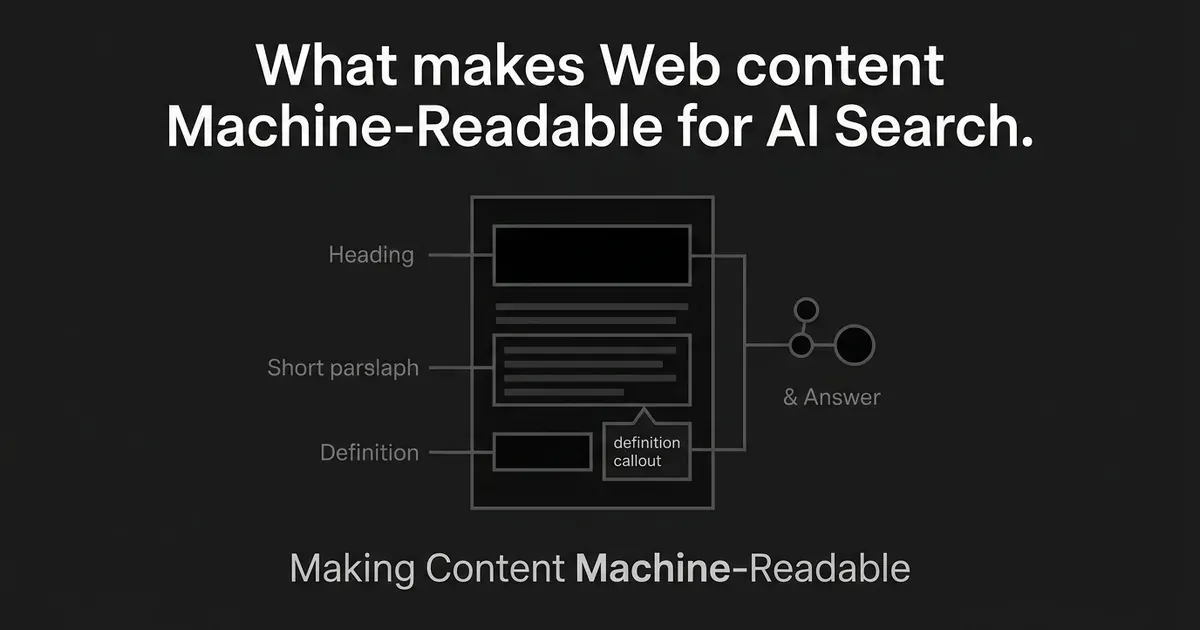
Models extract the first clean, declarative answer they find on your page. If that answer is missing, buried below the fold, hidden inside an accordion, or dissolved into narrative, extraction fails and the citation goes elsewhere. So give it back what it needs.
Near the top of the page, before any video or table of contents, write a two to four sentence passage that:
- Directly answers the exact question a buyer would type.
- Says it as a plain, quotable, declarative sentence, not a wind-up.
- Sits above the fold, visible without scrolling.
- Is followed by 150 to 300 words of supporting detail with named specifics and real numbers.
That's it. This answer-first structure is the single highest-leverage move to recover AI citations, because it maps directly to how extraction works. You are not writing more, you are writing the liftable part first.
How to tell it's done: open the page in a text-only browser, or just disable JavaScript. The answer to your target prompt should be right there in the first 200 words, no scrolling, no clicking. If you have to hunt for it, so does the model.
Where people go wrong: writing the answer for a search snippet instead of for the buyer's real question. Mirror the words your buyer actually uses. If they ask "how do I recover lost AI citations," your heading and your opening sentence should sound like that, not like an SEO title from 2019.
Step 6: Restore structure, schema, and freshness signals
With the core answer back, rebuild the supporting signals around it. Think of this step as making the whole page easy to parse and obviously current.
On structure, add back the scaffolding that helps a model navigate:
- A short key-takeaways block up top.
- Headings that mirror how buyers phrase the question.
- An FAQ block of four to six real questions, worded the way people actually ask them.
- Inline citations to primary sources: named studies, original data, expert quotes. Research on generative-engine optimization has found that adding real inline citations and specific statistics measurably lifts how often content gets pulled into answers.
A word on schema, because it gets oversold. Add or repair your Article, FAQPage, and Organization markup so parsers read your entities correctly. But be honest about what it does. A controlled study of nearly 1,900 pages that added structured data found essentially no direct citation lift. Schema is hygiene, not a lever. Fix it because broken markup can confuse entity relationships, not because it will win the citation back on its own.
On freshness, the signal is stronger than most teams expect. A large share of AI citations point to content published or updated within the last few months, and freshness-biased engines like Perplexity lean hard on recency. So refresh with intent: update the visible "last updated" stamp, update dateModified in your schema, swap stale statistics and old-year references for current ones, add a short "what changed" note, and resubmit your sitemap.
How to tell it's done: your page validates in a rich-results checker, shows a current-year updated stamp, carries a dateModified within the last month or two, and has at least one genuinely new fact or example.
Pro tip: don't fake freshness by bumping the date on a page you didn't actually touch. Engines get better at spotting empty updates, and your buyer notices too. A real refresh changes the content, not just the timestamp.
This is the step where doing it by hand gets painful across a backlog, and where a production engine helps. DeepSmith can identify which of your pages are actually cited and worth refreshing, then produce the rewrite with the answer block, structure, and metadata already built in, so the fix ships as a finished page rather than another item stuck in your queue.
Step 7: Out-cite the page that replaced you
Sometimes your page is clean, fast, fresh, and well-structured, and you're still losing. That means the competition simply out-earned you, and now you compete on the exact axis they won on. Go back to the comparison you made in Step 2 and answer it move for move.
- They won on recency? You just refreshed, so keep a real update cadence rather than a one-time fix.
- They won on structure? You restructured in Steps 5 and 6, so match and beat their answer clarity.
- They won on authority? This is the longer game, and it happens off your own page.
That off-page work matters more than most content teams admit. A large majority of AI citations come from earned media, not brand blogs, and the engines lean on third-party corroboration to decide whom to trust. Wikipedia alone accounts for a huge slice of ChatGPT's most-cited factual sources. So building external signal is not vanity, it is retrieval fuel:
- Earn placements in high-authority outlets your buyers actually read.
- Establish a clean entity presence (Wikipedia, Wikidata) for your brand and category where it's warranted.
- Show up in the communities engines cite heavily, like relevant Reddit threads and industry roundups.
How to tell it's done: run the lost prompts again two to four weeks after your fixes. Watch for your URL re-entering the cited set. Track referring-domain growth and citation share over four to eight weeks for the off-page work.
Where people go wrong: expecting it to be instant. It is not. A fetchability fix or an on-page refresh can move in a couple of weeks. Earned-media and entity work takes longer, sometimes a month or two. Set that expectation now so you don't abandon a working recovery three days in because the answer hasn't flipped yet.
Step 8: Set up a tracking loop so the next drop is caught early
You did the hard part. Don't let the next decline sneak up on you the same way.
The teams that stay cited are not the ones that never slip. They're the ones that catch a slip in days instead of discovering it months later by accident. So close the loop. Keep running your prompt set on a weekly or bi-weekly cadence, keep a simple dashboard with history, and make one person on the team responsible for glancing at it.
How to tell it's done: you have a living record with at least four weeks of history, and a named owner who reviews it. When something moves, you'll know which prompt, which engine, and roughly when, which turns your next diagnosis from a week of detective work into an afternoon.
Where people go wrong: treating recovery as a project with an end date. AI visibility is a channel now, not a task. Pages decay, competitors publish, engines shift. A standing measurement loop is what turns "we lost citations again" into "we caught it Tuesday and fixed it Thursday." This is the difference between reacting to an AI citation decline and getting ahead of it.
What to do next
The day your AI visibility dropped, it probably felt like a crisis. It isn't. You don't have to run all eight steps this week. Start where the evidence points: confirm the drop is real, find the page that replaced you, and check that bots can still reach you. Those three alone will tell you 80 percent of what you need to know, and one of them is very often the whole answer.
Then fix in order: access first, answer block second, structure and freshness third, out-cite last. Momentum matters more than perfection here. One page brought back is proof the playbook works, and proof you can do this at scale.
If running this across a whole backlog sounds like more than your team can carry by hand, that's exactly the gap DeepSmith was built to close: it tracks where you show up in AI answers across engines, shows you which pages you lost and to whom, and produces the on-brand refresh to win them back, from the same data. You can start a free trial and see your real citation picture before you commit to anything.
You were getting cited before. You can get cited again. Let's go win it back.