AirOps pairs keyword research, SERP analysis and AI visibility data with its content workflows, while Writer is an enterprise agent platform with a thin native SEO toolset and no dedicated AI visibility tracker. AirOps suits SEO teams that want to build and tune workflows, and Writer suits large organizations that want governed AI across many teams. DeepSmith is a strong alternative that builds the plan from topic clusters: Content Map puts your site and competitors on one taxonomy, so the gaps feed Opportunity Agents and the Writer.
AirOps vs Writer AI comes down to what you want the platform to know about search. AirOps starts from search data, so keyword research, SERP analysis and AI visibility tracking sit next to the tools that write and publish. Writer starts from the enterprise, so its agent, playbooks and company knowledge handle many kinds of work, and SEO content is one of them. If you are choosing between them for an enterprise team producing SEO content, the sections below cover pricing, features and a verdict. DeepSmith is a third option that tracks AI answers and produces the content in one platform.
AirOps vs Writer: the short answer
- Choose DeepSmith if you want one self-serve platform that tracks how AI engines answer, finds topic gaps against competitors in Content Map, and produces publish-ready articles, starting at $99 a month with a 7-day free trial.
- Choose AirOps if you have an SEO team that will build and tune workflows, and you want keyword research, SERP analysis and daily AI visibility tracking in the same system as content production.
- Choose Writer if you are a large organization that wants governed AI agents across marketing and revenue work, with strong brand voice controls and enterprise security, and you can supply SEO data through a Semrush connector.
| Criterion | DeepSmith | AirOps | Writer |
|---|---|---|---|
| Entry price (monthly) | $99/mo (Pro) | Not published | Not published |
| Annual price | $80/mo billed yearly (Pro) | Not published | Not published |
| Volume at entry tier | 20 articles/mo | 35,000 tasks/mo (Solo) | Credit-metered, amount not published |
| Free trial | 7 days | 14 days | 14 days, no credit card |
| Keyword research with volume and difficulty | - | Yes, via third-party data | Partial, via Semrush connector |
| SERP analysis of top-ranking pages | - | Yes | Not listed |
| Competitor topic gap analysis | Yes | Yes | Partial |
| Topic clusters and content plans | Yes | Partial | Partial |
| Internal linking | Yes | Yes | Partial |
| Scheduled write and publish | Yes | Yes | Partial |
| AI visibility tracking | Yes | Yes | Partial |
| Short-form copy | Partial | Partial | Yes |
| SOC 2 report | Yes | Yes, Type II | Yes, Type II |
| Review rating | 4.8/5 on G2 | 4.7/5 on G2 | 4.4/5 on G2 |
Pricing and features as of September 2026, from each vendor's site and public reviews.
AirOps

AirOps is an AI search growth platform that tracks brand visibility in AI answers and runs agent workflows to research, write, refresh, review and publish content. It is built for marketing, SEO and content teams, mostly at mid-market and enterprise brands, that want visibility data and a configurable production system in one place. The product is organized into Insights, Actions and Context. Insights tracks mention rate, share of voice, citations and sentiment daily, and Page360 joins AI citations with Search Console and GA4 for each URL. Actions covers Quill, Playbooks, a visual Workflow builder and Grids for bulk runs, and Brand Kits and Knowledge Bases supply brand context.
The standout is that visibility data and content execution sit in one system. Opportunities and Campaigns feed the workflows that publish to a CMS, and Content Updates record what changed afterward. The real limitation is price clarity and effort. The pricing page shows Solo and Pro limits of 35,000 and 100,000 tasks a month but no monthly or annual prices, and Solo tracks ChatGPT only. AirOps also says it does not replicate a SERP term-based content score like Surfer's.
On G2, AirOps shows 4.7/5 from 133 reviews, checked on September 30, 2026. Reviewers praise customizable workflows, time savings and brand controls. They also report a learning curve, technical work for complex automations, and a need to fact-check generated statistics and product details.
Writer

WRITER is an enterprise AI platform where an agent, reusable playbooks and company knowledge produce on-brand content and automate multi-step work under IT governance. It was founded in 2020 and is based in San Francisco. It is built for large organizations, led by marketing and revenue teams, that want governed AI workflows grounded in their own data and brand rules. Content work covers briefs, long-form and short-form copy, derivative assets, translation and brand enforcement through voice profiles, style guides and terms.
The standout is governance and brand control. Writer lists SOC 2 Type II and ISO 27001, 27701 and 42001, SAML SSO and SCIM on Enterprise, and a Knowledge Graph that grounds output in company files with source citations. The real limitation for SEO work is that the native toolset is thin. No keyword database, SERP analysis or SERP-based content scoring is documented, and search data comes through a Semrush connector. The plans page shows no Starter seat price, and Enterprise is quote-only and credit-metered.
On G2, Writer shows 4.4/5 from 130 reviews, and TrustRadius shows 5.7/10 from 27 ratings, both checked on September 30, 2026. Reviewers praise ease of use, faster drafting and brand voice consistency. Some describe generic output that needs editing, a learning curve and uneven application of writing rules.
DeepSmith: the alternative that plans from topic clusters and writes
AirOps and Writer each leave a gap for a team that wants to know what to write before it writes. AirOps gets there through keyword research, SERP analysis and AI visibility data, which feed Opportunities and Campaigns that you then turn into work. Writer can produce a content plan and a gap analysis, but you build them yourself as agent or playbook work, and its record shows no topic cluster or topical map feature.
DeepSmith builds the plan from topic clusters. Content Map crawls your site and your competitors' sites and puts every page onto one taxonomy of topics and funnel stages, which are Awareness, Consideration and Decision. Your site defines the taxonomy and competitors are mapped onto it, so comparisons are like for like. Coverage gaps show topics where you publish but a competitor publishes more, and untapped topics show topics where a competitor publishes and you have nothing at all. Sitemaps are re-checked every 24 hours, so the map stays current without a re-import.

Those gaps do not stay in a report. Opportunity Agents read your AI visibility data and your Content Map and return ideas with the data point that justifies each one attached, so you can defend the backlog instead of guessing at it. Ideas move into Planned Content, where giving an idea a date plans it, and the Writer turns each one into a finished article that is researched, internally and externally linked, and delivered with a cover image and publish-ready metadata. Autowrite can write it on the scheduled date with no one in the app. Deep IQ stores your company, persona, voice and content type once, so every draft is grounded in the same context.

Tracking sits in the same platform. DeepSmith checks the prompts you set on up to ten AI engines, starting with ChatGPT on Pro and covering all ten on Enterprise, and it reports mention rate, citation rate and share of voice along with which of your pages get cited. Plans are Pro at $99 a month, Grow at $199 and Scale at $399, or $80, $160 and $299 a month billed annually, with 20, 40 and 90 articles a month. Enterprise is custom. There is a 7-day free trial and there are no long-term contracts. DeepSmith is rated 4.8/5 on G2 and is SOC 2, GDPR and ISO certified.
SEO research and optimization
AirOps wins on SEO research and optimization. Its record shows keyword research, SERP analysis of top-ranking pages, content gap analysis and on-page recommendations, where Writer has a thin native toolset.
AirOps gets keyword data from third-party sources, with DataForSEO and Moz on all plans and Semrush and Ahrefs integrations on Pro and Enterprise. Its workflows can analyze top-ranking pages before upgrading content, it suggests and inserts internal links, and Page360 flags pages that are losing AI visibility or rankings. Writer has no keyword database of its own. Its Semrush connector pulls keyword data and search volume into agent workflows and requires a Semrush account, and no SERP analysis feature is described. Magic links, its internal link suggestions, exist only in the legacy doc Editor, which the help center says is no longer available after migration. For Writer AI vs AirOps on SEO tasks, the gap is real for a team that wants this built in.
What DeepSmith does: SEO coverage is part of the writing pipeline. Keyword coverage, heading structure, schema markup, internal linking and metadata are built in as each article is written, and Content Map picks the topic by comparing your coverage with your competitors' on one taxonomy.
AI visibility tracking
AirOps wins on AI visibility tracking. It runs a dedicated tracker, and Writer describes monitoring as a use case you build yourself.
AirOps tracks mention rate, share of voice, average position, citations and sentiment, and it runs each tracked prompt daily across the platforms, regions and personas you set. ChatGPT is the only engine on Solo, and Pro and Enterprise add more. The pricing page says Pro covers 7+ answer engines while the billing and API docs name six, so it is worth asking which engines your plan includes. Claude is on by default only for Enterprise. Writer's marketing page lists scheduled visibility monitoring across ChatGPT, Claude and Perplexity as something you build with agents and playbooks. It documents no dedicated tracker, prompt volumes or collection method, so it is hard to treat as a reporting source.
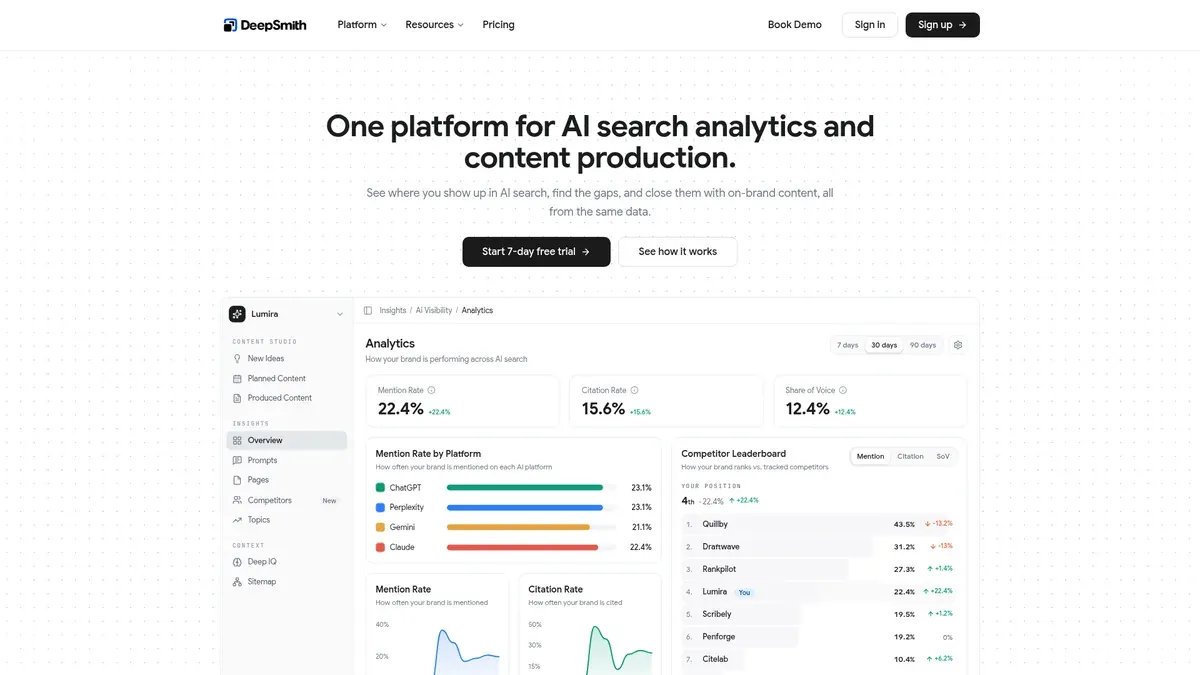
What DeepSmith does: DeepSmith checks the prompts you define on a schedule and reports mention rate, citation rate, share of voice and sentiment, with a per-platform breakdown and a competitor leaderboard. The Pages view shows which of your pages AI cites and the prompts driving those citations, and Discover Prompts generates a starter set from your product, persona and buyer-stage context.
Writing, brand control and governance
Writer wins on writing breadth, brand enforcement and security governance, while AirOps is stronger on bulk article production.
Writer's record shows short-form copy, an in-app editor with AI assistance, 100+ prebuilt agents for emails, ads, social posts and product descriptions, and generation in 73 listed languages. Voice profiles link to style guides and term banks and apply in Chrome, Word and Figma, though voice profiles and the app interface are English only. Governance is its deepest area, with audit logs, SAML SSO, SCIM and an MCP gateway with tool-level permissions on Enterprise. AirOps covers long-form well, with Playbooks, Workflows and Grids that run across many rows, plus versioned Brand Kits and Knowledge Bases, and it is SOC 2 Type II with SSO on Enterprise. Writer's bulk generation is partial, since playbooks can run in bulk but no bulk article feature or limits are documented. Reviews point to output quality on both sides. Writer reviewers mention generic output that needs editing, and AirOps reviewers mention fact-checking generated statistics.
What DeepSmith does: Deep IQ stores your company, product, persona, brand voice, visual guidelines and content types, and every article is written against that context, so output arrives publish-ready instead of as a draft to rescue. The Writer adds internal and external links, a cover image and metadata, and the Apps Library turns a finished article into versions for LinkedIn, X, newsletters and other channels.
Scheduling and publishing
AirOps wins on scheduled publishing. Its workflows and Grid columns can run on a schedule and include CMS publish steps, while Writer can compose the same result but does not describe it as a ready-made feature.
AirOps publishes to Webflow on Solo, and to WordPress, Contentful, Strapi and Sanity as well on Pro and Enterprise, according to its pricing grid. Its enterprise guidance defaults to draft mode with human review, so hands-off publishing is something you configure. Writer's schedule triggers run playbooks on a recurring schedule, up to three on Starter and unlimited on Enterprise, and its connectors publish to Webflow, Adobe Experience Manager and Contentful. No WordPress publishing connector is listed.
What DeepSmith does: With Autowrite you configure an article at planning time, it writes itself on the scheduled date and it lands in Produced Content. From there you review and publish straight to WordPress, Webflow, Strapi, Sanity or Contentful, or to your own webhooks, and Autowrite can take it all the way to published hands-off.
Pricing and value
In AirOps vs Writer AI pricing, this is a tie on transparency, because neither vendor publishes self-serve prices, though the units you would ask about differ.
The AirOps pricing page shows Solo at 35,000 tasks a month and Pro at 100,000, with no monthly or annual price and a Solo overage of $0.025 per task. Usage is metered in tasks, and each tracked answer draws from the same balance, with Claude answers costing four units. Its pricing FAQ describes a 14-day free trial. The Writer plans page shows Starter for up to five users with fixed credit limits per seat and no published amount, and Enterprise is custom, with a credit package set per contract. Writer does publish model rates, such as Palmyra X6 at $2 per million input tokens and $8 per million output tokens, but those are metered usage rates and not included subscription usage. Starter has a 14-day free trial with no credit card. For either one, get a written quote that covers allowances, overages and renewal terms.
What DeepSmith does: The prices are published and the unit is articles. Pro is $99 a month for 20 articles, 50 tracked prompts and 5 seats, Grow is $199 for 40 articles, 100 prompts and 7 seats, and Scale is $399 for 90 articles, 200 prompts and 10 seats. Annual billing brings those to $80, $160 and $299 a month. There is a 7-day free trial and no long-term contracts, so you can see real data and real drafts before you pay.
From insight to action
AirOps wins on turning insight into action, because it connects visibility data to content work in one system.
AirOps Opportunities recommend creation, refresh, outreach and community work, Campaigns connect an opportunity to briefs, Action rows and measurement, and Content Updates record what changed so you can compare it with later visibility. Writer's gap and opportunity analysis exists as agent or playbook work that synthesizes visibility data into dashboards with recommended actions, and you build and maintain it. Writer can do many of the steps, but the connection between them is yours to build. AirOps has the connection in the product, though reviewers say complex multi-step automations can take technical work, so it takes setup too.
What DeepSmith does: The loop is built in. Tracking shows where AI answers cite competitors instead of you, Content Map shows the topics where a competitor publishes more, Opportunity Agents turn both into ideas with the evidence attached, and the Writer produces the articles. Onboarding takes you from signup to a working workspace in minutes, with your brand brief, competitors, starter tracking prompts and first batch of ideas populated before you pay.
Which should you choose
Whether it is AirOps or Writer AI, the right pick depends on who will run the work.
- DeepSmith fits marketing leads who want to know what to write, produce it at volume and see whether AI answers cite it, on one self-serve plan with published prices and without building workflows first.
- AirOps fits SEO and content teams at mid-market and enterprise brands that want keyword data, SERP analysis, AI visibility tracking and a configurable workflow system, and that have the time to set it up.
- Writer fits large organizations that want one governed AI platform for marketing, sales and support content, with enterprise security and brand voice enforcement, and that will build SEO and AI visibility work on top with a Semrush connector and playbooks.
You can see the topic map and a first batch of ideas for your own site by starting a DeepSmith free trial.