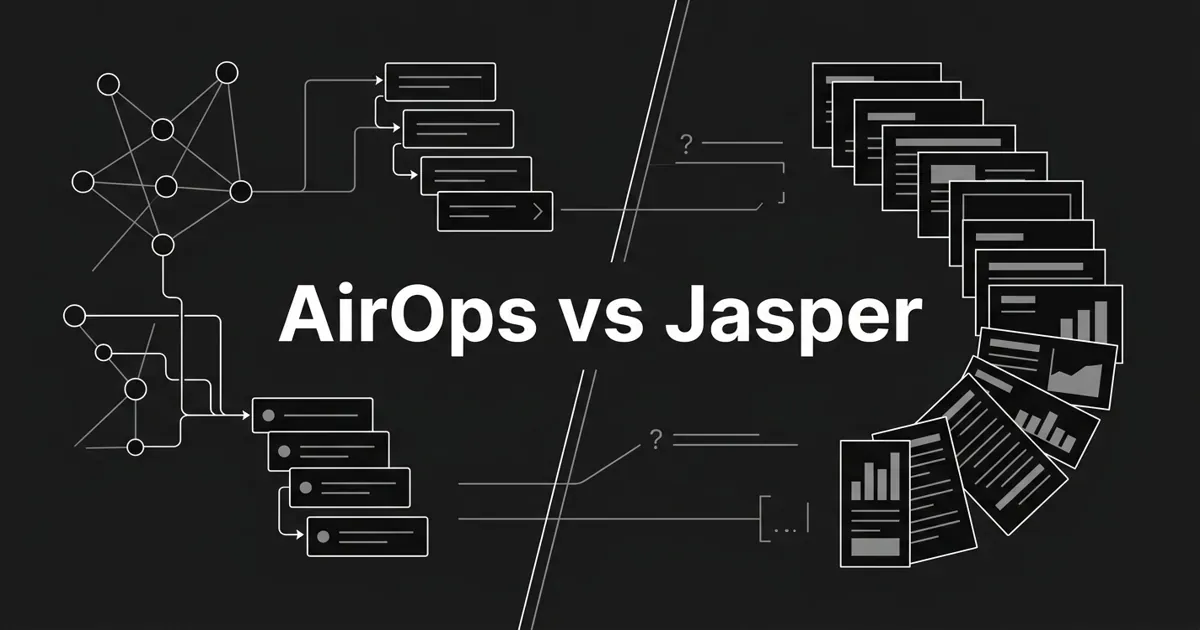
The choice between AirOps vs Jasper is less a feature contest than a question of what a content operation is actually built to do. AirOps is engineered around AI-search visibility and repeatable production workflows. Jasper is engineered around marketing copy at volume, governed by brand voice controls. Both generate text. They disagree about which part of the job is hard.
That disagreement determines fit. A team whose bottleneck is knowing which of its pages AI engines cite, and then rebuilding those pages on a schedule, will find AirOps closer to the problem. A team whose bottleneck is producing dozens of on-brand assets a week across blog, ad, email, and social formats will find Jasper closer to it. Selecting the wrong AI content platform for the shape of an operation tends to produce a familiar outcome: a capable tool no one opens after the first month.
This comparison examines both platforms on pricing, AI-search tracking, workflow depth, brand context, and publishing, drawing on what each vendor documents and what third-party sources report. DeepSmith publishes this page, and every competitor fact in it comes from those sources rather than from us.
AirOps vs Jasper at a Glance
| Criterion | AirOps | Jasper | DeepSmith |
|---|---|---|---|
| Primary focus | AI-search visibility plus content engineering | Marketing copy production across formats | AI-search analytics plus publish-ready production |
| AEO tracking | Core surface: share of voice across ChatGPT, Perplexity, Gemini, Claude, Google AI Mode | Framed as GEO; one capability among many | Core surface: mention rate, citation rate, share of voice, sentiment, visibility trend |
| Engine coverage by tier | ChatGPT on free and Solo; multi-engine on Pro and above | Not tiered as a tracking product | ChatGPT on Pro, plus Perplexity on Grow, plus Gemini on Scale, all ten on Enterprise |
| Published entry price | Free Insights tier; Solo reported near $199 per month by third parties | $59 per seat per month billed annually, $69 monthly | $99 per month, or $80 per month billed annually |
| Seats at entry paid tier | Single user on Solo | One seat included, priced per seat | Five seats on Pro |
| Free access | Free Insights plan plus 14-day trial | No free tier; 7-day trial | No free tier; 7-day trial |
| Production model | Playbooks and Grids workflow builder, task-metered | Canvas, Grid, Content Pipelines, Jasper Agents | Writer and Autowrite, article-metered |
| Brand context layer | Knowledge Base and Brand Kits | Brand Voice, Jasper IQ, Knowledge assets | Deep IQ, covering company, products, personas, voice, visuals, content types |
| Publishing | Native CMS connectors including Webflow and WordPress | Webflow plus a broad martech and automation stack | WordPress, Webflow, Strapi, Sanity, Contentful, webhooks, plus Markdown and HTML export |
| Best-fit operator | Technical content and SEO operators who build workflows | Writers, designers, and marketing PMs | Lean content teams and agencies that publish on a cadence |
The pattern in that table is worth naming before the detail arrives. AirOps and DeepSmith both treat AI-search measurement as the primary surface and production as the response to it. Jasper treats production as the primary surface and treats generative-search optimization as one capability inside a broader marketing platform. Teams weighing airops or jasper are, in practice, weighing whether measurement should drive the editorial queue or sit beside it.
AirOps: Content Engineering Around AI-Search Visibility

AirOps organizes its product into three pillars: Insights, Actions, and Pages. Insights tracks brand and topic visibility across ChatGPT, Perplexity, Gemini, Claude, and Google AI Mode, reporting share of voice, the prompts a brand appears in, the pages AI engines cite, and how much of the category competitors hold. Actions is a visual workflow builder, using Playbooks and Grids, that lets teams assemble repeatable generation pipelines with AI agent steps, structured inputs and outputs, and human-in-the-loop review. Pages is the surface where long-form content is created or refreshed, frequently fed by data that Insights and Actions produce.
The genuine strength here is that AirOps was built for AI-search visibility rather than retrofitted onto a general writing tool, and the workflow model suits programmatic SEO and refresh-heavy operations. Keyword clusters, page audits, and internal-link suggestions are built in rather than imported, so the data that should shape a brief is available in the same surface where the brief runs. Page-level citation analysis is the sharpest part of the offering: it identifies which specific URLs AI engines reward, a harder question than whether a brand is mentioned at all. AirOps names customers including Webflow, Ramp, Carta, LegalZoom, Monday.com, Gong, Klaviyo, Sprout Social, Commvault, Chime, Zola, and Glean.
The limits are structural rather than incidental. Production is metered in tasks, every workflow run consumes a defined number of them, and that metering is difficult to model in advance, which matters for any team planning heavy programmatic use. Onboarding requires defining workflows, prompts, and brand context before output stabilizes, so the time to a first useful article is longer than a template tool would require. The free Insights plan covers tracking only. The Solo plan restricts access to a single user, which pushes any collaborating team toward Pro. Public documentation on per-engine AEO methodology is thinner than what established rank-tracking vendors publish, so accuracy is best validated during the 14-day trial rather than assumed.
Jasper: Marketing Copy at Volume With Brand Governance

Jasper positions itself as a platform purpose-built for marketing, and its product surfaces reflect that scope. Canvas handles long-form drafting and editing. Grid generates many copy variants at once in a tabular layout, which is the right shape for ad sets and product descriptions. Content Pipelines make multi-step production repeatable. Jasper Agents execute defined marketing tasks end to end, and Jasper markets more than one hundred specialized agents. Jasper IQ supplies the intelligence layer through Brand IQ, Marketing IQ, Knowledge, and Governance, while AI Studio gives power users a prompt-development surface and MCP provides programmatic access. Image Pipelines and Image APIs make visual generation a first-class step rather than an afterthought.
Jasper's advantages are real and specific. Brand voice control and knowledge grounding are mature, bulk generation through Grid handles volumes a document editor cannot, and the integration surface is unusually broad: Webflow, Google Drive, Slack, Salesforce, Microsoft Word, Sheets, Docs, Chrome, Monday, Asana, Semrush, Box, Zapier, Make, and Pabbly. SEO Mode is included from Pro upward and provides Surfer-style optimization without a separate Surfer subscription, removing a line item most content stacks otherwise carry. The Business tier adds the governance larger organizations require: SSO, advanced admin controls, API access, custom workflows and agents, and a custom AI brand model. Jasper also supports more than thirty languages.
The constraints cluster around economics and scope. Pricing is per seat, so cost scales with headcount rather than with output, and a growing content team becomes expensive at a rate unrelated to how much it publishes. Pro caps Brand Voices at two and Audiences at three, which is a hard ceiling for multi-brand or heavily segmented programs; those teams reach Business immediately, where pricing is custom. AI-search share of voice is available under Jasper's GEO framing, but it is one capability inside a marketing platform rather than the central instrument, so a team buying primarily for measurement is buying a broad product to use a narrow part of it. Content Pipelines and custom agents require implementation effort of their own, and Brand IQ and Marketing IQ need ongoing curation to stay accurate. Multi-language output is supported, with quality that varies by language.
DeepSmith: Tracking and Publish-Ready Production in One Platform

DeepSmith occupies the same conceptual position as AirOps, measurement driving production, and resolves it differently at the output end. AEO tracking reports mention rate, citation rate, share of voice, sentiment, and visibility trend, with a competitor leaderboard and the pages AI actually cites. Content Map puts your own site and unlimited competitor sites on one topic taxonomy, re-checked every 24 hours, so coverage gaps and untapped topics are measured rather than guessed at, and Opportunity Agents read that data to return ideas with the justifying data point attached to each one. Content Studio moves those ideas from New Ideas to Planned Content to Produced Content, with the Writer in the middle producing a researched, internally and externally linked article with a cover image and publish-ready metadata. Autowrite runs that pipeline on a scheduled date with no one in the application.

The stance DeepSmith takes is that the expensive part of content operations is not the draft; it is the last stretch between a draft and a published page. Research, internal linking, metadata, cover images, and publishing sit inside the writing pipeline rather than after it. Produced Content allows review, revision, cover regeneration, and publishing straight to WordPress, Webflow, Strapi, Sanity, Contentful, or your own webhooks, with Markdown and HTML export as a fallback. The Apps Library converts a finished article into platform-native versions for LinkedIn, X, Medium, Substack, newsletter and nurture email, Reddit, and other channels.

Pricing is published rather than quoted. Pro is $99 per month, Grow is $199, and Scale is $399, or $80, $160, and $299 respectively when billed annually, with custom Enterprise terms. Those tiers include twenty, forty, and ninety articles per month, fifty, one hundred, and two hundred tracked prompts, and five, seven, and ten seats. Engine coverage rises with the tier: ChatGPT on Pro, Perplexity added on Grow, Gemini added on Scale, and all ten engines on Enterprise. A 7-day free trial runs on real data and real drafts, and there are no long-term contracts or cancellation fees. In a Jasper alternative comparison, the distinction that matters most is metering: DeepSmith prices articles and tracked prompts, so cost follows publishing volume rather than headcount.
Pricing and Packaging Compared
Pricing transparency differs sharply, and the difference is itself a decision input. Jasper publishes its entry price: $59 per seat per month billed annually, or $69 monthly, with Business quoted on request. AirOps publishes a free Insights plan and packages its paid tiers by tracked prompts, engine coverage, report cadence, and production tasks, but does not list Solo or Pro prices publicly. Third-party sources place Solo near $199 per month and Pro near $1,999 or $2,000 per month, figures indicative enough to plan around and uncertain enough to confirm with the vendor.
Read as jasper vs airops, the entry-level comparison favors Jasper on headline cost and AirOps on entry-level access. Jasper is cheaper to start for one person. AirOps is free to start for anyone who only wants the tracking layer, which is a genuinely useful way to evaluate AI-search measurement without a purchase decision. The counterweight in each direction is the same fact viewed from opposite ends: Jasper's low entry price is per seat, so a five-person content team pays five times it before adding a single article, while AirOps' free tier excludes production entirely, so the workflow capability that distinguishes the platform is not part of what the free plan demonstrates.
DeepSmith sits between those models. Its 7-day trial runs on a workspace already populated with a brand brief, competitors, starter tracking prompts, and generated ideas, so the evaluation is of finished output rather than of a tracking dashboard alone. Pro at $99 per month includes five seats and twenty articles, which places it above Jasper's single-seat entry price and below the point where Jasper's per-seat model reaches a small team.
AI-Search Tracking Compared
AirOps tracks visibility across five engines: ChatGPT, Perplexity, Gemini, Claude, and Google AI Mode. DeepSmith covers those five and five more, adding Google AI Overviews, Grok, Meta AI, Microsoft Copilot, and DeepSeek for ten in total. Both report share of voice and identify which pages earn citations. Jasper addresses the same territory under the GEO label; the underlying capability overlaps, but the terminology and the emphasis differ, and measurement is not the surface Jasper leads with.
Coverage is tiered in both AI-first platforms. AirOps limits its free and Solo plans to ChatGPT insights, with multi-engine coverage arriving at Pro, the tier third parties price near $1,999 per month. DeepSmith's Pro tier at $99 tracks ChatGPT only, adds Perplexity at Grow, adds Gemini at Scale, and covers all ten engines at Enterprise. Multi-engine tracking therefore starts at $199 on one side against that $1,999 tier on the other, and the ceiling is ten engines against five. For most mid-market programs the operative question is not how many engines a vendor can name, but how many are reachable inside the budget the program actually has.
One caveat applies across the category: public documentation of per-engine measurement methodology is limited. Prompt-level results vary with how a query is issued, so any tracked figure is a directional signal rather than a precise ranking. Validating data quality during a trial, against prompts the team already knows the answer to, is more informative than comparing feature lists.
Workflow Depth Against Setup Cost
AirOps offers the most configurable production model of the three. Playbooks compose multi-step generation with agent steps and human review, Grids handle batch operations and bulk publishing, and more than thirty AI models sit behind the builder alongside ten or more third-party data sources. For programmatic SEO, large-scale refresh programs, and any workflow where SERP data or an internal-link graph must be woven into generation, that configurability is the product.
The cost of configurability is that someone has to configure it. AirOps' documented onboarding path requires defining workflows, prompts, and brand context before output quality stabilizes, which presumes a technical operator on the team. Jasper's Content Pipelines and custom agents carry a lighter but comparable requirement. This is the axis where a jasper vs airops evaluation most often mispredicts itself: teams choose the deeper builder, then find that the person who would have built the workflows is the person who was already the production bottleneck.
DeepSmith takes the opposite trade deliberately. The pipeline is fixed rather than composable, so a team with genuinely unusual production requirements will find AirOps more accommodating. What the fixed pipeline buys is that configuration happens once, during onboarding from the website, after which Autowrite produces publish-ready articles on a schedule with no one assembling a run. For teams whose requirement is a reliable publishing cadence rather than bespoke automation, that removes the setup work that most often stalls a rollout.
Brand Context, Integrations, and Publishing
All three platforms solve brand consistency by storing context rather than briefing per article, and they differ in how much is stored and how it is gated. AirOps uses a Knowledge Base and Brand Kits, with one Brand Kit on Solo and Pro and unlimited kits at Enterprise. Jasper allows two Brand Voices and three Audiences on Pro and removes those caps on Business, with Brand IQ and Marketing IQ providing the knowledge layer. DeepSmith's Deep IQ stores company positioning, a profile per product, personas, brand voice, visual guidelines, and content types, and every module reads from it.
Integration breadth is Jasper's clearest advantage over both alternatives. Salesforce, Slack, Google Drive, Microsoft Office, Asana, Monday, Semrush, Zapier, Make, and Pabbly place Jasper output inside existing martech routing, which matters for teams whose copy flows into ad platforms and CRM sequences rather than only onto a blog. The bounding fact is that this breadth serves the distribution of copy, not the publication of articles: for a program whose output is long-form pages, the connector that matters is the CMS one, and AirOps publishes natively to Webflow and WordPress while DeepSmith publishes to WordPress, Webflow, Strapi, Sanity, Contentful, or a webhook.
Which Should You Choose
Choose AirOps when AI-search share of voice is the primary use case, the content operation runs on repeatable programmatic or refresh-heavy workflows, and there is a technical operator available to build and maintain them. Teams that need SERP data, page audits, and internal-link graphs woven directly into generation will not find that depth elsewhere at the same level of configurability. Budget for the Pro tier if multi-engine tracking or more than one seat is required.
Choose Jasper when the requirement is high-volume, on-brand copy across many formats and the team is composed of writers, designers, and marketing PMs rather than workflow engineers. Multi-brand programs that need SSO, admin controls, and a custom brand model belong on Business. Teams already routing content through Salesforce, Zapier, or Make will get more from Jasper's integration surface than from either alternative.
Choose DeepSmith when the constraint is publishing cadence and the gap to close sits between a draft and a live page. The fit is strongest for lean teams and agencies that need finished articles on a schedule, with research, internal linking, metadata, and cover images already inside the pipeline, and with AI-search tracking pointing at what to write next rather than living in a separate report. Teams that require a composable workflow builder should choose AirOps; teams that need short-form ad and email variants at volume should choose Jasper.
The decision between airops or jasper resolves cleanly once the bottleneck is named honestly. Measurement-driven, workflow-heavy operations point toward AirOps. Format-heavy, brand-governed copy operations point toward Jasper. Operations that measure and publish but cannot afford either the seat count or the setup point toward a platform that does both on published pricing.
Content teams evaluating an AI content platform against a real publishing cadence can start a DeepSmith free trial and see tracked prompts and finished articles from their own brand context before paying.