You asked ChatGPT about your category, and there it was: your brand name, right in the answer. That feels like a win. Take a breath before you celebrate, though, because the fact that the engine used your name is only half the story.
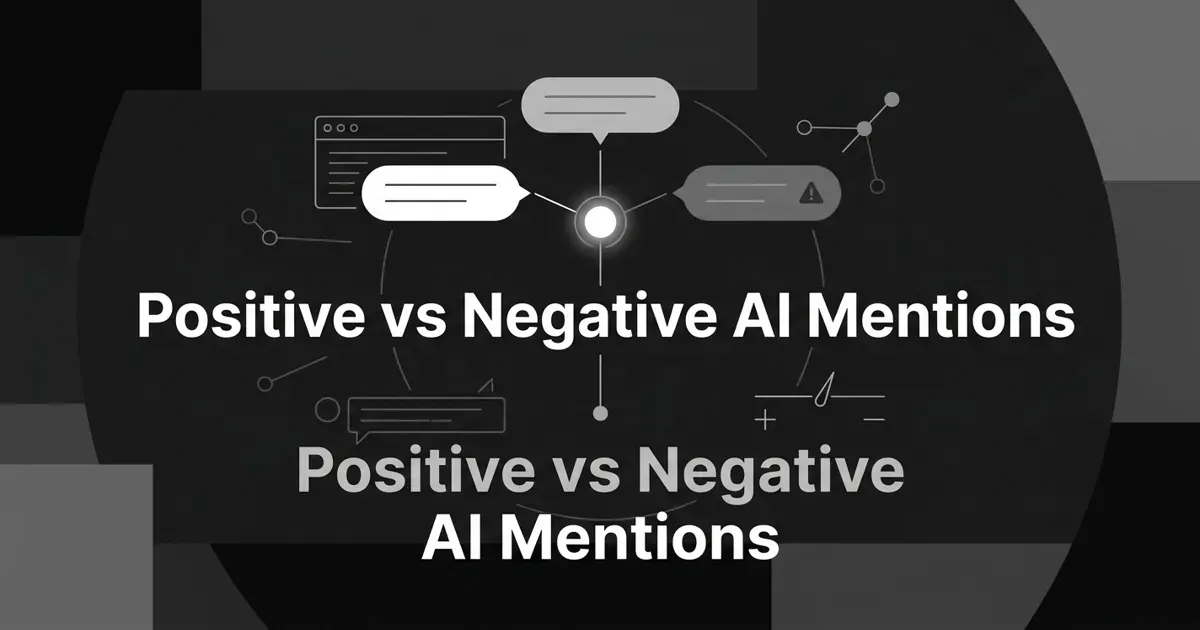
The other half is how it used your name. The same mention can read as a warm recommendation, a flat listing, or a quiet warning. That gap is what positive vs negative AI mentions are really about, and it is why is being mentioned by AI always good is the wrong question to stop on.
Here is what you will walk away with. By the end, you will be able to open an AI answer about your brand and judge it by its framing, not just by the presence of your name. You will know the three shapes a mention can take, how to read which one you got, and why the difference changes real buying decisions. Let's get into it.
Is being mentioned by AI always good?
No. A mention is only a win when the engine is vouching for you.
Think of it this way. Two brands can have the exact same mention rate, the same number of AI answers naming them, and land in completely opposite places commercially. One is being recommended. The other is being cautioned against. The count is identical. The outcome is not.
So the raw number of mentions tells you that AI knows you exist. It does not tell you whether AI is helping you or hurting you. For that, you have to look at the words around your name. That layer is ai mention sentiment, and it is the part most dashboards skip right past.
Good news: reading sentiment is a skill you can pick up in one sitting. Let's build it.
The three ways an AI can frame your brand
Every AI mention falls into one of three buckets: recommended, hedged, or criticized. Read the words next to your brand name and you can sort almost any mention in a few seconds.
Positive: the engine volunteers reasons to choose you
A positive mention is the engine acting as your advocate. It hands the reader reasons to pick you without being asked.
It sounds like this: "widely considered one of the best CRMs for small businesses." Or: "known for transparent pricing and responsive customer support." Or: "frequently recommended for startups due to their proven track record."
Notice the pattern. The engine reaches for trust-bearing words ("trusted," "leading," "highly recommended"), volunteers benefits you did not have to earn in that sentence, and treats you as a category default. When AI does this, the mention is genuinely working for you.
Neutral: the engine lists you but does not vouch
A neutral mention is the shrug. You are on the list, but not on the podium.
It sounds like this: "Apex Digital is a digital marketing agency that offers SEO, PPC, and content marketing services. Pricing is available upon request." Accurate. Complete. Cold.
Watch for hedge language too: "among other options," "some users say," "mixed reviews," "an emerging player." These are the engine doing the minimum to answer the question. You are present, but the engine is not spending any credibility on you. Neutral is not a disaster, but it is not the win it looks like at a glance.
Negative: the engine volunteers reasons to hesitate
A negative mention is the engine attaching a caveat to your name, often in the same breath it introduces you.
It sounds like this: "has been criticized for aggressive upselling and can become expensive as you scale." Or: "reporting features are limited compared to enterprise alternatives." Or: "faced complaints about hidden fees at checkout and slow refund processing."
The tell is a warning the buyer never asked for. The engine surfaces a weakness, questions whether your price is justified, or places you as the risky alternative to a category leader. This is a negative brand mention ChatGPT or any other engine can produce, and it lands with the weight of a neutral third party, not a competitor. That is exactly what makes it sting.
A simple shorthand to keep in your pocket: positive means AI gives reasons to choose you, neutral means AI lists you among others, negative means AI gives reasons to pause.
One more wrinkle worth knowing. The framing is not fixed by industry either. In apparel, ChatGPT runs about three times more negative than Google, pushed by product-evaluation questions like "is this fabric durable." In education, Google runs nearly twice as negative as ChatGPT, driven by institutional and political scrutiny. So your ai mention sentiment can depend as much on your category as on your brand. Know which engine tends to be tough on your space, and you know where to look first.
How to read the sentiment of an AI brand mention
Want a repeatable way to score any answer? Run it through four quick questions. This is how you read the sentiment of an AI brand mention without a tool in front of you.
First, the bucket. Recommended, hedged, or criticized? Read the four or five words wrapped around your name and you usually have your answer.
Second, the caveat. Did the engine volunteer a tradeoff, a complaint, or a price warning that the user never asked about? An unprompted caveat is the clearest signal you have slipped toward negative.
Third, the position. Are you on the shortlist at the top of the answer, buried in a long list, or missing from the first paragraph where the real recommendation lives? Placement is sentiment too.
Fourth, the source tone. If the engine cited its sources, are those sources favorable or critical? Ask yourself whether the framing would flip if the sources flipped. It usually would.
Answer those four for any mention and you are no longer guessing. You are reading. And once you can read one answer, you can spot the pattern across many, which matters more than any single response.
If you like a number, you can grade the sentiment of AI brand mention answers on a simple scale. Some teams use a plain negative, neutral, positive score of minus one, zero, or plus one. Others stretch it to a range, say minus one hundred to plus one hundred, to capture how strongly the engine leans. The scale barely matters. What matters is that you are scoring the sentiment of AI brand mention responses at all, because a single tracked number turns a vague sense of "AI seems to like us" into something you can watch move. Just know that off-the-shelf sentiment tools stumble here. Sarcasm, nuance, and category context trip up generic classifiers, so read the answers yourself before you trust an automated score.
How often do AI mentions actually go negative?
Less often than you fear, but in the places that hurt most. Across billions of searches studied, the clearly negative share of brand mentions is small: roughly 2.3% in Google AI Overviews and about 1.6% in ChatGPT.
If you just exhaled, hold on for one more beat. That small percentage is not spread evenly. It clusters exactly where buying decisions get made, and the two big engines behave like two very different reviewers.
Google acts like an investigative reporter. It is around 4.5 times more likely than ChatGPT to surface negativity tied to news, controversy, lawsuits, or recalls, and it concentrates that negativity early: about 85% of its negative mentions land during top-of-funnel, informational queries.
ChatGPT acts more like a product advisor. It is roughly three times more likely to go negative on product-evaluation questions ("is this worth it," "what are the limitations"). And it spreads its criticism deeper into the funnel: close to 19% of its negative mentions show up during the consideration-to-purchase stage. In plain terms, ChatGPT is about 13 times more likely than Google to go negative right at the point of purchase.
That is why a negative brand mention ChatGPT surfaces can cost more than the 1.6% figure suggests. It reaches a high-intent buyer at the worst possible moment. The percentage is small. The timing is brutal.
The engines do not even agree on who deserves the criticism. When both go negative on overlapping questions, they disagree about three-quarters of the time on which brand to warn against. So checking one engine and assuming the rest match it is a mistake. Your framing in ChatGPT can look nothing like your framing in Google, and both count.
Where does the negativity even come from? Across the mentions studied, brand controversies and legal issues drove about a third of it, followed by product limitations and compatibility, then safety and recalls. Much of it traces back to real, durable reputation, not a random model hiccup.
Why AI mention sentiment matters for your pipeline
Because more of your buyers are starting here than you think. Around half of consumers now use AI-powered search, and the traffic curve is steep: AI referral visits reached over a billion in a single month in 2025, up more than 350% year over year. Gartner expects traditional organic search traffic to fall by half by 2028 as AI answers absorb the click.
Sit with what that means. A growing share of buyers form their first impression of you inside an AI answer, before they ever reach your site. If that answer frames you as recommended, you start the relationship ahead. If it frames you as risky, you start behind, and you may never learn why the demo request never came.
This is the real reason ai mention sentiment deserves a spot on your dashboard next to mention rate. Mention rate tells you AI is talking about you. Sentiment tells you whether that conversation is helping. One without the other is half a picture. And of the two, sentiment is the half that moves the buyer.
Why engines go negative in the first place
An engine is not inventing an opinion about you. It is reflecting one. Understanding the mechanism takes the mystery, and some of the panic, out of it.
Three inputs shape the framing. The first is training-data association: if your brand shows up more often in critical coverage than in praise, the model leans cautious when it composes an answer. The second is retrieved sources: for engines that browse, the top few sources for a query set the tone, so if those pages are critical, the engine inherits their mood. The third is conversational context: because these models build each sentence on the last, a user who opens with "I'm worried about X" gets a more cautious framing than one who opens with "I'm comparing options."
Two consequences are worth sitting with. Your brand can be highly visible and still be framed into the loser position in the same answer. And the same brand, in the same category, can read as recommended to one buyer and risky to another, purely based on the path they took to ask.
There is a real-world reminder of how heavy this framing can get. In Moffatt v. Air Canada, an airline's own chatbot confidently described a bereavement-fare refund policy that did not exist. A grieving customer relied on it, booked a full-fare ticket, and was denied the discount. A tribunal held the airline liable, rejecting its argument that the chatbot was a separate entity. The lesson lands hard: an AI system can produce a confident, consequential statement about a brand, and the brand owns the fallout. Framing is not decoration. It is a claim the world acts on.
Isn't any mention good publicity?
It is a fair pushback, and there is a kernel of truth in it. A critical mention is still a mention. It can drive curiosity, and a certain kind of buyer, the skeptic, the deal-hunter, actually trusts a frank, imperfect writeup more than glowing praise. Being talked about is the precondition to being recommended. That part is real.
Here is the honest counter, though. Most buyers do not take the AI's word and stop. In one 2026 report, 86% of U.S. online shoppers who used AI for product research verified the recommendation through another source before buying, and search engines were the most common place they went to check. So a negative frame does not just float by. It becomes the buyer's working hypothesis, the thing they go hunting to confirm or disprove. That is a very different starting line than a positive recommendation.
Layer on the two facts from earlier. ChatGPT concentrates its negativity near the point of purchase, and roughly a third of negative mentions trace to genuine controversy or legal trouble rather than a model quirk. Put together, the picture is clear. A negative mention is not worth zero. But it is nowhere near equal to a positive one. The right move is not to celebrate every mention or panic at every criticism. It is to count mentions, then weight them by sentiment.
What to do with all this
Start smaller than you think. You do not need to overhaul anything this week. You need to look.
Open ChatGPT and Perplexity, ask the handful of questions your buyers actually ask, and run each answer through the four-question lens above. Bucket, caveat, position, source tone. Do it for ten prompts and you will have a rough sentiment read on your brand that most of your competitors have never bothered to get.
One caution as you go. A single answer is noisy. AI responses shift with phrasing, personalization, and model updates, so do not overreact to one bad reply. Look for the pattern across many prompts and over time. That is the signal. One answer is weather. The trend is climate.
If you want the pattern tracked for you instead of checked by hand, that is the kind of thing a platform like DeepSmith is built to do: it watches how AI engines describe your brand across ChatGPT, Gemini, Perplexity, Claude, and Google AI Mode, and flags where you are invisible, misdescribed, or losing to a competitor, so you can see the framing shift before it costs you. You can try it free for seven days and read your own answers with real data. The point either way is the same. Once you can see the sentiment, you can act on it.
And acting on it is its own body of work: monitoring framing over time, correcting the public sources that feed the engines, and building the trust signals that earn you the positive frame in the first place. That is a deeper cluster than this one piece. Start here by learning to read the mention. Then go do something about it.
A mention is the engine's quiet vote on what your brand is worth in that moment. The vote is the framing. So read the framing, and you will always know whether the mention was really a win.