You search your core use case in ChatGPT. A competitor shows up. You don't. And now leadership is asking questions you don't have answers for, and your "we're working on it" is starting to sound thin.
I've been there. What makes this so frustrating is that most of the advice you find is basically "check if you show up and track sentiment." That isn't a measurement system. That's a spot check, and it won't help you. It doesn't tell you why you're invisible, what to fix first, or how to prove you're making progress to the people who sign the checks.
Here's a different way to think about it. AI brand trust is measurable, diagnosable, and you can absolutely improve it. But you have to treat it like an operating system, not a vanity metric. We're talking about inputs like your sources and brand facts, outputs like mentions and citations, and the results that actually matter, like pipeline and brand health.
Build that system once, run it weekly, and you'll finally know what's working, what's broken, and what your team should publish next.
What does it mean for an AI search system to "trust" your brand?
"Trust" here isn't about feelings or whether buyers like you. It's much simpler. Does an AI system choose to cite you, mention you, and describe you accurately when a buyer asks a relevant question? That's an observable behavior. And if it's observable, you can measure it.
Trust vs visibility vs reputation: what you're actually measuring
I see teams trip over these terms all the time, so let's get clear on what we're talking about.
Visibility is just presence. Does your brand show up in an AI answer at all? It's a simple yes or no, which doesn't tell you much by itself.
Trust, for our purposes, is whether AI systems see your brand as a reliable source worth citing. A brand with high trust gets mentioned and linked. A brand with low trust might get a passing mention but is basically treated like background noise.
Reputation is how the AI frames you when you are mentioned. Is it positive, negative, neutral? Does it connect you to the right use cases? This is about sentiment and how you're positioned in the market.
You need all three, but they each require different fixes and have different timelines. Mixing them up is how you end up spinning your wheels optimizing the wrong thing.
Why Google rankings don't equal AI trust (and when they still matter)
Having high Google rankings is great. It definitely helps. AI models are trained on the web, and a page that ranks well is more likely to have been in the training mix. But that's where the two paths start to split.
Google rewards pages that satisfy a searcher's intent and get backlinks. AI systems, on the other hand, reward content they can extract clean information from. They're looking for structured answers, clear facts, and consistent descriptions of who you are. I've seen pages that are number one in Google get completely ignored by AI because the key information was buried in three paragraphs of flowery prose.
The other big difference is that Google is mostly about your page. AI is about your entity, which is the sum of everything the internet says about you. This includes third-party review sites, industry articles, your Wikipedia entry, and a bunch of aggregator sites you've probably never even thought about. If those sources are out of date or contradict each other, your AI answers will be a mess.
Which metrics actually prove AI trust (and what each one reveals)
This is where you need to stop picking one signal and calling it your "AI visibility" score. To really understand what's going on, you need the full set. Here's what I track.
Mention rate: "Do we show up at all?"
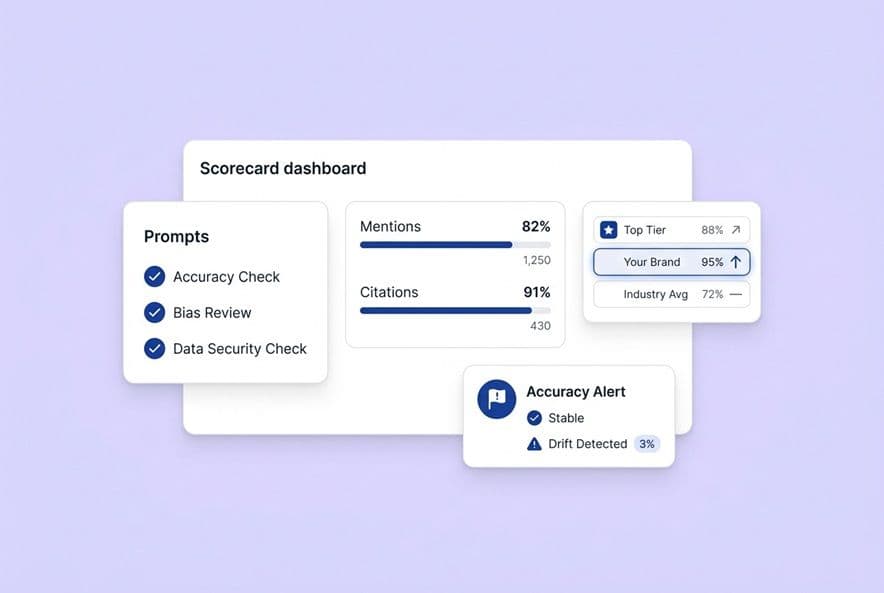
Mention rate is the percentage of relevant queries where your brand appears in the AI answer. Let's say you define 50 prompts your buyers would ask across the funnel. If your brand shows up in 18 of them, your mention rate is 36%.
This is your starting point. Without this baseline, you have no idea if you're getting better, worse, or just stuck. Track it every week. And make sure to segment it by funnel stage. It's normal for problem-aware queries to have lower mention rates than comparison queries.
What mention rate doesn't tell you is if the mention is any good. That's why you need the other metrics.
Citation rate: "Do they back up the mention with a source?"
A citation is when the AI links to your content or explicitly credits you as the source. This is a much, much stronger signal of trust than a simple mention.
When an AI mentions your brand, it might just be repeating what it's heard. When it cites you, it's holding up your content as the authority for a specific claim. It's the difference between being part of the noise and being the source of truth.
You have to track this separately from mentions. If you have a high mention rate but a low citation rate, that's a huge clue. It means the model knows you exist but doesn't trust your content enough to use it as a source. That's usually a content formatting problem, not a brand awareness problem.
Sentiment and sentiment drift: "Are we being framed correctly?"
Looking at sentiment for AI outputs is more than just a positive or negative score. The real enemy here is misrepresentation. This is when the AI says your product does something it doesn't, puts you in the wrong category, or links you to a feature you got rid of a year ago. It's a nightmare.
I track sentiment across three areas:
- Tone: Is it positive, neutral, or negative?
- Accuracy: Is what it's saying factually correct?
- Category fit: Are we being described in the right competitive space?
Sentiment drift is another one to watch. This is when your framing slowly shifts over weeks for no obvious reason. It's often the first sign that some third-party source updated their content and it's poisoning your results. If you catch it early, you can trace it back to the source.
Comparative position: "Are we preferred over competitors?"
When a buyer asks "which tool is best for X," the AI almost always makes a choice. It recommends, ranks, or frames the options against each other. Your comparative position is where you show up in that stack ranking.
This is what your sales team is screaming about. If you're always mentioned fourth in a two-product race, you have a problem. If you're not mentioned at all when a direct competitor is named, you have a crisis.
You have to track this on a per-prompt, per-platform basis. Don't average it into a single score, or you'll lose all the important details.
Thematic framing: "What are we associated with in AI answers?"
Beyond just good or bad, you need to know what the AI connects you to. When your brand is mentioned, what words and concepts show up alongside it? Security? Compliance? Enterprise scale? Or is it associating you with a use case from two product generations ago?
Thematic analysis is about pulling out these keywords and contexts. Compare that map to your actual positioning. The gaps tell you exactly what messaging you need to reinforce in your content.
Volatility: "How stable is our AI visibility week to week?"
AI answers are not set in stone. Models get updated. Sources change. A competitor publishes one good blog post and can shift how an entire topic is framed. I've seen visibility drop 30% in two weeks without a single change on our own site.
Track the week-over-week change in your mention and citation rates. High volatility means your visibility is fragile. It's probably dependent on just a few sources. Stable-but-low usually points to a structural problem with your content. And a sudden drop is an all-hands-on-deck signal to go figure out what source changed.
How to set up a measurement system you can run every week (not random spot checks)
The difference between a one-off spot check and a real measurement system is one word: repeatability. Here's how to build one that lasts.
Build your "prompt portfolio" by buyer stage (problem → comparison → shortlist)
Your prompt portfolio, the list of queries you track, is the most important decision you'll make. If you pick prompts that don't reflect how your buyers actually think and search, you'll be measuring noise.
I build ours in three layers:
- Problem-aware prompts: Things like, "How do I improve my team's content output?" These are for early-stage buyers, and your mention rates will probably be lower. That's okay.
- Comparison prompts: "What's the difference between [your category] tools?" or "How does [your product] compare to [competitor]?" This is where the competitive fights happen.
- Shortlist prompts: "Best [your category] tool for [a specific buyer]." A mention here is pure gold. It's worth ten mentions at the top of the funnel.
Start with a list of 30 to 50 prompts. You can expand it every quarter as you learn more about the questions your buyers are asking.
Decide what you're measuring across platforms (and how to handle platform variance)
ChatGPT, Gemini, Perplexity, Claude, and Google's AI all behave differently. Some are great at citing sources, others aren't. Some update quickly, others lag by months. And visibility can change depending on industry or region.
The only practical way to handle this is to run the same set of prompts across all platforms and track the metrics for each one separately. Don't blend them into an average. If you're showing up in Perplexity but not Gemini, that's a clue about recency and the types of sources each model prefers.
Don't drive yourself crazy trying to make it all perfectly comparable. Just accept the variance as more information and look for the overall trends.
Create a simple scorecard (core KPIs + diagnostic KPIs)
Your weekly scorecard doesn't need to be some monster spreadsheet. Here's a simple structure that works:
| Metric | Tracking frequency | Owner |
|---|---|---|
| Mention rate (by funnel stage) | Weekly | Content lead |
| Citation rate (overall + by platform) | Weekly | Content lead |
| Comparative position (shortlist prompts) | Weekly | Content lead |
| Sentiment / accuracy flags | Weekly (spot check sample) | Content lead |
| Thematic framing shifts | Monthly | Content lead |
| Volatility (week-over-week change) | Weekly | Content lead |
The execs just need to see the monthly summary. The weekly data is for you and your team to figure out where to focus next.
What to track at the page level vs the brand level
Brand-level metrics tell you how you're doing. Page-level metrics tell you why.
If your citation rate suddenly drops, a page-level view can show you which URLs stopped getting cited. That often points to a competitor who published a better page or a simple content format issue. You should also watch your citation share concentration. If 80% of your citations come from a single page, you're in a fragile position. This is where tools like DeepSmith's AI Visibility — Pages feature are so helpful, because they can show you which pages are doing the work and how concentrated that risk is.
How teams operationalize prompt-level and page-level tracking
Let's be honest. Manually prompting 50 queries across five AI platforms and logging the results in a spreadsheet is a system that will fail. I've tried it. It lasts maybe two weeks before everyone is too busy to keep it up.
What you need is a defined list of prompts and a consistent, automated way to query platforms and record what they say. This is exactly why we built the AI Visibility — Prompts feature in DeepSmith. You define your buyer prompts once, and it tracks mention and citation rates across all the major AIs, so you can see trends without having to do the manual work every week.
If AI systems aren't citing you, how do you diagnose the cause (beyond "write better content")?
"Publish better content" is not a diagnosis. It's what people say when they don't know the real answer. Here's the actual troubleshooting workflow I use.
Source coverage gaps: AI can't cite what doesn't exist (or isn't accessible)
Always start here. If you're not getting cited, the first question is: do you even have a credible page on this topic? Some common gaps I see are:
- No authoritative page that directly answers the buyer's question.
- Thin pages that mention a topic but don't have enough depth.
- Poorly structured pages with no clear headings or direct answers.
- No third-party sources to back up your claims.
Look at your prompt portfolio. For every prompt where you're not cited, ask yourself honestly: do we have a page that directly answers this question? Not one that just touches on it. One that answers it.
Conflicting facts: how contradictions reduce trust and distort answers
AI models synthesize information from many sources. When your own website, your partners, and third-party review sites all say different things about your product, the model gets confused. It will either hedge, get it wrong, or just skip you entirely.
Here are the contradictions to hunt down:
- Old product or feature names on forgotten pages.
- Outdated pricing on comparison sites.
- Different use case claims on your homepage versus your blog versus your G2 profile.
Every one of these contradictions is a leak in your trust bucket. Fix them.
Weak "entity clarity": when AI can't confidently describe who you are
An AI builds a mental model of your brand as an "entity." Who are you, what category are you in, what do you do? If the signals it gets are weak or inconsistent, it can't confidently summarize you.
You need to standardize your entity signals:
- Have a consistent company description across your site, LinkedIn, Crunchbase, and press mentions.
- Use clear category language. The words on your homepage should match your About page and your partner listings.
- Be consistent with your use case claims. Don't be "the all-in-one solution" in one place and "the best tool for startups" somewhere else.
This isn't about gaming the system. It's about basic branding hygiene to make it easy for AIs to describe you accurately.
Not citation-ready: when your content is hard for AI to extract cleanly
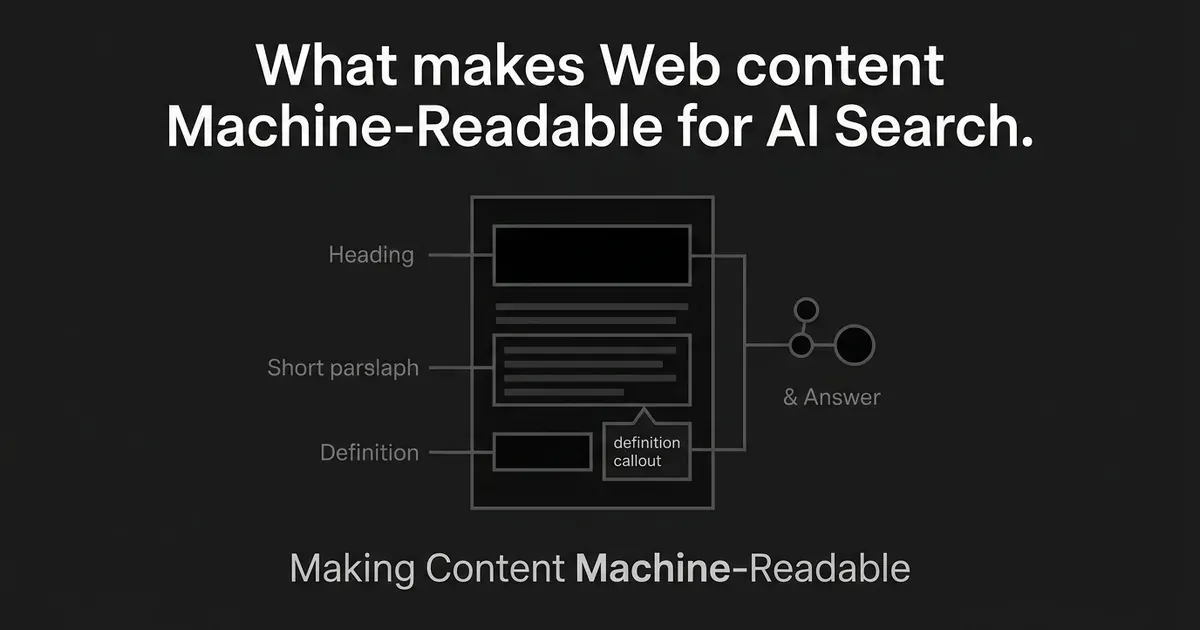
AI systems prefer content they can pull structured answers from. They're lazy, just like us. The things that make them give up are:
- No direct answer in the first couple of paragraphs.
- Answers buried in long, narrative blocks of text.
- Comparison content that isn't in a table or clear list.
- Vague FAQ pages.
Go look at your most important pages. Can a machine pull a clean answer from this page without having to read the whole thing? If not, you have some restructuring to do.
Third-party gravity: when aggregators/competitors outrank you as "the source"
Sometimes, the problem isn't you. It's that a Reddit thread, a G2 page, or a competitor's blog post has become the main source of truth for your category. When that happens, fixing your own site is not enough.
How to correct third-party sources AI relies on (the fastest lever most teams ignore)
Your own site is just one data point. The AIs are looking at dozens. Fixing inaccuracies on the sources they actually rely on can move the needle faster than publishing a dozen new blog posts.
How to find which third-party sources are shaping your brand answers
Run your prompts and see which sources get cited. That's your external source inventory. You'll probably see a lot of:
- G2, Capterra, and TrustRadius for software.
- Industry publications and review sites.
- Comparison pages on other sites.
- Your Wikipedia or Wikidata page.
- Crunchbase, LinkedIn, etc.
For each source, check if the information is accurate and current. The ones that get cited most often are your highest-priority targets.
Prioritization: which inaccuracies are worth fixing first
You can't fix everything at once. Here's my order of operations:
- Factual errors about the product: Wrong feature names, old pricing. This is critical.
- Category misclassification: Being put in the wrong competitive set.
- Use case mismatch: Being linked to problems you don't solve.
- Outdated social proof: Old customer counts or funding info.
Minor stuff can wait. Get the big structural facts right first.
Correction playbook: update requests, partnerships, and "reinforcement content"
For sites you can edit, like G2 or Wikipedia, submit corrections with links to official sources. If you can't edit it directly, look for support channels.
For sites that won't change, you have two moves. First, publish "reinforcement content" on your own site, an authoritative page that makes the correct claim so clearly that the AI has a better source to choose from. Second, get the correct information into other high-authority sources like industry publications or partner sites.
What to do when you can't change the source
Some sources, like old Reddit threads, are forever. You can't fix them. When that happens, your only option is to outpublish them. Create enough accurate, well-structured content with the correct facts that the volume of good signals drowns out the bad ones. It takes time, but it's the only move you have left.
How to connect AI trust metrics to marketing KPIs and ROI (so leadership funds it)
This is where most AI visibility programs die. They generate interesting data but never connect it to the outcomes your leadership team actually cares about. Here's how to build that bridge.
The measurement model: inputs → AI outputs → downstream outcomes
I frame this as a simple causal chain when I talk to our board:
Inputs (what we control): Our content, our site structure, the accuracy of third-party sources.
AI Outputs (what we measure): Mention rate, citation rate, comparative position, sentiment.
Downstream Outcomes (what they care about): Brand search volume, direct traffic, pipeline, win rates.
This framing shows that the metrics aren't just vanity numbers. They are leading indicators for real business outcomes. It lets you form a hypothesis like, "If we improve citation rate by 20%, we expect to see brand search and competitive win rates go up."
Practical ROI approaches when AI reduces clicks (leading + lagging indicators)
Yes, AI answers reduce clicks. That's a feature, not a bug. It means we have to measure influence in a new way.
Leading indicators (these move fast):
- Mention rate growth on comparison and shortlist prompts.
- Citation rate trends.
- Fewer misrepresentation flags.
Lagging indicators (these take longer but are tied to money):
- Brand search volume (people who see you in an AI often Google you next).
- Pipeline from an "AI/research" source (add it to your forms!).
- Sales team feedback. Are prospects more familiar with you on the first call?
Reporting examples: what to show in a monthly exec update
Keep it simple. I show them three things:
- Trend: Here's our mention and citation rate versus last month and last quarter. One number, one direction.
- Competitive standing: Are we gaining or losing ground? Here's one specific prompt where we moved up.
- Action and expected result: "We corrected our G2 profile. We expect citation rate for this topic to improve in the next 30 days."
This is a credible, action-oriented update, not a vanity report. It gives leadership something they can actually work with.
What to optimize for next: a prioritized roadmap to increase AI trust without sacrificing authenticity
Measurement tells you where you are. Now, what do you do about it?
Governance to prevent brand drift (especially with AI-assisted production)
As you scale up content, especially with AI help, it's easy for your brand voice and messaging to drift. Different writers, different tools, different briefs all create slightly different versions of your company. The AIs notice this inconsistency.
You need to build governance into your process. This means a central, structured source of truth for your product claims and positioning. And it means you need to review AI-assisted drafts for factual accuracy, not just style.
Content formats AI tends to cite (and how to structure them)
AI systems love content they can parse easily. I've found these formats earn the most citations:
- Direct answer paragraphs right at the top of a section.
- Comparison tables with clear criteria.
- Numbered or bulleted lists for workflows.
- Definition sections (term -> what it is -> why it matters).
- FAQ sections that mirror real questions.
Avoid long, narrative intros and burying the answer at the end. Get to the point.
Competitive catch-up: how to use competitor citation wins to guide your backlog
When a competitor gets cited instead of you, don't get mad. Get curious. Which of their pages is winning, and why? Once you find the URL, you can analyze its format, depth, and claims, then go build a better version.
| Competitor approach | Your response |
|---|---|
| A big comparison page | Build your own that's more current and accurate |
| A deep dive on a use case | Publish a more authoritative version with direct answers |
| A simple feature page | Counter with your own clear, documentation-quality content |
| Third-party coverage | Target the same publications with your story |
This is where a tool like DeepSmith's AI Visibility — Competitors is a game-changer. It shows you which competitor pages are getting citations so you can respond intelligently instead of guessing.
Ethical boundaries: what not to do to "game" AI trust
Please don't do these things. They will backfire.
- Don't create fake reviews or content. Models are getting better at spotting this, and it can get you penalized.
- Don't stuff keywords or descriptions unnaturally. Repeating the same phrase on 40 pages looks like what it is: manipulation.
- Don't misrepresent what you do. If an AI cites an inflated claim and a buyer finds out it's not true, you've lost their trust forever.
The right way to think about this is: make it genuinely easy for AI to find and share the truth about you.
Closing the loop from insights to publishing cadence
A measurement system is useless if it doesn't feed your content machine. The loop is simple: find citation gaps, prioritize topics, and publish citation-ready content. Speed matters. A gap you publish against in two weeks is better than one that sits in a backlog for three months.
DeepSmith's Topics and Content Studio were designed to close this loop. You can go from identifying a gap to researching, briefing, and drafting a structured piece in one connected pipeline. For a small team, that's how you compete without burning everyone out.
Build your AI visibility scorecard (and keep it updated automatically)
Here's your starting point. Define your prompt portfolio. Pick 30 real questions your buyers would ask at the problem, comparison, and shortlist stages. Run them across the AI platforms they use. Log the mention rate and citation rate for each one. Then do it again next week.
That's your baseline. Everything else, from diagnosing problems to fixing sources to benchmarking competitors, flows from that simple, repeatable foundation.
If you'd rather not live in a world of spreadsheets and manual data entry, DeepSmith's AI Visibility suite was built to run this exact playbook. It gives you prompt and page-level tracking across all the major AIs, with competitive data that updates automatically. Your team can spend its energy fixing what the data reveals, not building the report from scratch every week.
It all starts with the prompts. That's the one lever that moves everything else.