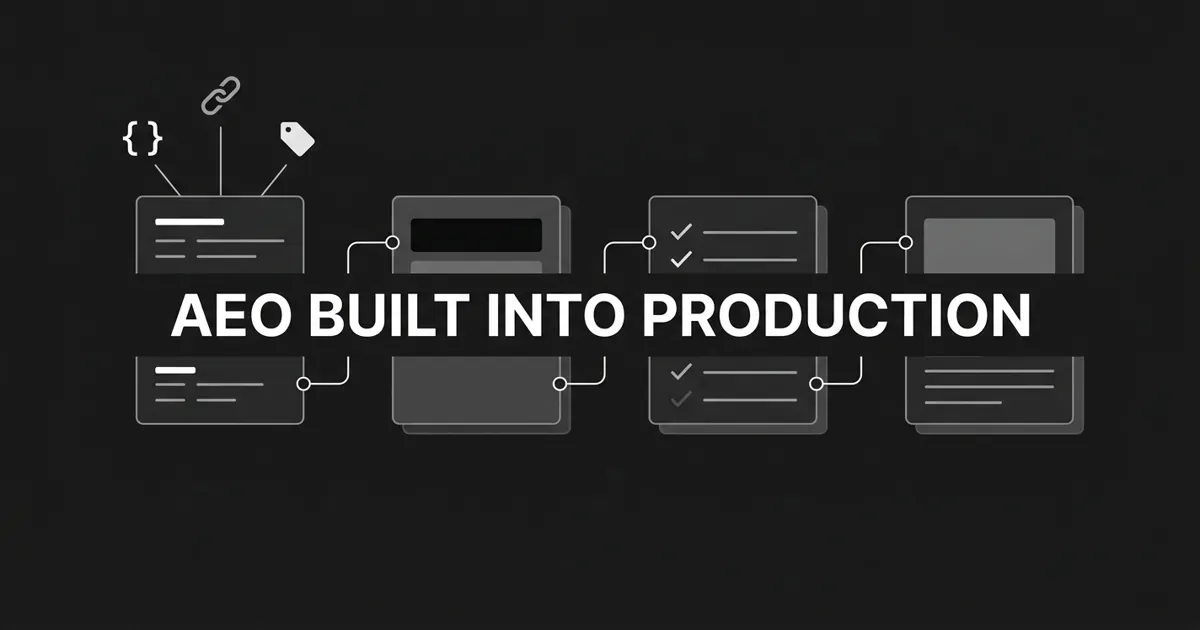
Your article gets written, edited, and approved. Then someone goes back in to fix the headings, chase a source, insert the links, check the schema, and rewrite the opening so it actually answers the question. That repair pass is the most expensive part of AEO content production, and you can design it out.
Here is the short answer. A page becomes citation-ready content when you decide its buyer question, direct answer, evidence, entities, schema, and links in the brief, then check each one before you publish. Nothing gets bolted on later because nothing was left out.
Answer engine optimization, or AEO, means building a useful, people-first page an answer system can understand: what it covers, what the complete answer is, who and what is involved, and where the claims came from. No secret formula, no hidden ranking switch.
If you already run briefs, drafts, and a review, you are closer than you think. You are adding fields to stages you already have, not adding stages.
1. Start with one buyer question and one page job
Pick the question your reader actually asks at a specific point in their journey. Group the close variants by the answer a reader needs, not by how similar the keywords look. Then write the intended answer in one sentence, before anyone drafts a word.
Your brief needs seven things here: the primary buyer question, the reader and funnel stage, the outcome they want, the decision or misconception the page addresses, the sub-questions it can absorb, the existing pages that cover part of it, and the distinctive evidence you will add.
Say it in plain language: after reading this page, this audience will understand or do X, because the page answers Y and supplies Z evidence.
How you know it is done. A second writer can tell what the page is for without asking you to interpret a keyword list. One question, one answer, one audience, one stage.
Where teams go wrong. Treating a keyword list as an editorial brief. Spinning up a thin page for every wording variation of the same question. Letting one page serve awareness, comparison, and purchase intent. Google warns against creating many pages for every possible query variation to manipulate rankings or AI responses, so cluster the genuine variants and split only when the audience, task, or answer is materially different.
2. Pick the page from evidence, not from a brainstorm
Before the idea gets a slot on the calendar, check what you already have. Is this a real coverage gap, a missing funnel stage, or a page that exists but answers the question halfway? Those three need different responses.
Then collect a small evidence packet: the problem that justifies the page, the internal pages to strengthen or avoid duplicating, the product or legal facts that need an owner's sign-off, and the original contribution this page will make.
This is where a topic map earns its keep. DeepSmith's Content Map turns your site and your competitors' sites into one shared topic and funnel-stage map, so coverage gaps and untapped topics are a measurement instead of a hunch, and sitemaps are rechecked every 24 hours so new pages fold in without a re-import. Opportunity Agents read that data and return ideas with the evidence attached, which is the difference between an idea you brainstormed and one you can defend.
How you know it is done. The idea has a named audience, question, stage, evidence packet, source owner, and original contribution. You can say out loud why it belongs in the queue.
Where teams go wrong. Turning a competitor's outline into your article. Treating a gap as permission to publish something generic. Asking a writer to discover the goal, the audience, and the evidence while they draft.
3. Freeze the AEO brief before anyone drafts
This step does the most work, so give it the most care. Put the AEO requirements in the same brief that already holds the audience, format, and keyword requirements. Do not create a separate AEO pass. A separate pass is the thing you are trying to delete.
Five field groups belong in the brief.
Page purpose and answer. Primary question, one-sentence direct answer, reader and stage, page type, what is in and out of scope, and the unique angle or first-hand input.
Section architecture. An H1 that describes the page honestly, the H2 sequence in reader order, the question each H2 answers, the answer that should sit at the top of each section, and any list, table, or step block that genuinely helps comprehension.
Evidence and claims. A source list with what each source supports and the date or version that matters, the first-hand facts and who checks them, the claims to soften or drop, and the approved product language. Every statistic, date, price, named feature, and superlative gets a source or an accountable owner.
Entity and trust information. Canonical names for your company, product, methods, people, and alternatives. The relationships to make explicit. The author, reviewer, byline, and credentials. Publication and modification dates.
Links and schema. Internal targets with the reader reason for each, external sources with the context they will sit in, the meaning you want each anchor to carry, and the structured-data type that actually describes the visible page.
When you build AEO into workflow templates at this level of detail, drafting gets faster, not slower. The writer stops guessing.
Stored brand context does the heavy lifting here. Deep IQ holds your About Company positioning and the claims to make or avoid, your product profiles, your buyer personas, your brand voice, and reusable content types with a trusted-sources list. The writer inherits all of it instead of being re-briefed every time.
How you know it is done. A writer can draft without guessing the primary answer, the audience, the product facts, the source requirements, the link destinations, the schema type, or the voice boundaries. Confirmed facts are visibly separated from claims that still need review.
Where teams go wrong. Asking a model to "write an AEO article" without naming the question and the answer. Listing entities as keywords without saying what each one means. Leaving the byline, schema, links, and metadata for production.
4. Draft the answer first, then build the explanation around it
Put the direct answer right under the opening context. Tell the reader what to do and what to expect, then explain the reasons, conditions, evidence, and steps. Your headings should be actions, and the order should match how someone would actually work.
Use the same five-beat pattern in every major section: state the answer, explain the conditions, show how to do it, give a done check, name the failure mode.
Then make each important passage self-contained. Can it be read on its own, without the paragraph before it, and still make sense? It should name its subject, state the answer, carry the material qualifier, and avoid a vague "this" or "they" when the referent could slip. Define an acronym the first time it appears. Use a list or a table when it makes a relationship easier to parse, never because a format looks modern.
This is what it means to optimize content for AI during creation. You are not decorating a finished draft. You are choosing the answer order before the prose exists.
Common mistake: "Make it more AEO-friendly" is not an actionable edit, and your writer knows it. Replace it with something a person can do: state the answer in the opening, make every H2 answer a named sub-question, identify the subject in every important passage, and link a source for every material claim.
A production workspace helps when the brief's fields carry through. In DeepSmith's Content Studio, an idea moves from New Ideas to Planned Content to the Writer, which produces a finished, brand-grounded article with research, internal and external links, a cover image, and publish-ready metadata. Keyword coverage, heading structure, schema markup, internal linking, and crisp answers near the top belong to the writing pipeline rather than a cleanup queue. Your review then goes to the angle and the accuracy.
How you know it is done. Read only the title, the opening answer, and the H2s. Is the promise obvious? Now read one section in isolation. Does it still identify its topic and answer a recognizable question?
Where teams go wrong. Hiding the answer behind scene-setting. Clever headings that hide what the section answers. Publishing something fluent and generic with no original analysis or source trail.
5. Write entity and trust signals into the prose
Entity work is not a technical add-on. It is mostly naming things consistently and saying what they are.
Use the same canonical name for a company, product, method, or person every time. When you introduce a product, say what it is, who it serves, and what it does on this page. If you mention alternatives, say what category each one belongs to instead of dropping bare names into a list.
Add the trust information while the facts are fresh: an accurate byline and author page, a reviewer when the topic needs one, the first-hand experience or method behind your analysis, source links with context, and real publication and modification dates.
Google's people-first guidance asks whether content offers original information or analysis, substantial coverage, clear sourcing, evident expertise, accurate authorship, and factual accuracy. It frames authorship as who, production method as how, and purpose as why. Your why should be usefulness to a person.
Entity clarity is not brand repetition. Naming your product in every sentence helps nobody, and no name mention or schema entity guarantees a citation. You are removing ambiguity, not casting a spell.
How you know it is done. A reviewer can say who made the page, what the named company and product are, which claims are first-hand, and which came from outside.
Where teams go wrong. Inconsistent names for the same thing. Superlatives like "best," "only," or "guaranteed" with no source behind them. Adding a byline after the fact and then finding nobody qualified will stand behind the claims.
6. Add accurate schema while the page is being built
Choose structured data because it describes what a reader can actually see on the page, not because your template always adds it.
For a normal editorial guide, the starting set is small: Article or BlogPosting for the article, Organization for the publisher identity, and BreadcrumbList if your site shows breadcrumbs. Anything else only when the page genuinely contains that kind of content.
Google describes structured data as a standardized format for giving explicit clues about a page's meaning, supports JSON-LD, Microdata, and RDFa, and recommends JSON-LD because it is easier to maintain. For Article markup there are no required properties, but the useful editorial fields are author with a URL that identifies them, an accurate headline, a representative crawlable image, published and modified dates in ISO 8601 format, and the publisher as an Organization.
Then run the checks: validate in development with the Rich Results Test, confirm after deployment that the rendered page carries the markup your template intended, and recheck whenever the article, author, dates, or template change.
Keep the caveat honest with your team. Structured data can make a page eligible for a rich result and does not guarantee one, and Google says no special schema is required for its generative AI search features. Schema is an accuracy layer, not a citation switch.
How you know it is done. The type matches the page, every marked-up value is accurate and visible, dates and authors are real, validation passes, and the rendered page carries the markup.
Where teams go wrong. FAQ or HowTo markup on content that is not visibly an FAQ or a how-to. Assuming a passing test means a search appearance. Adding schema after publication and never checking what the CMS renders.
7. Place internal and external links inside the draft
Link while you write. The emergency linking pass at the end is where most of the wasted hours live, and it is the easiest one to retire.
Build a small link map: destination, the reader reason, the meaning the anchor should carry, and the sentence it belongs in.
For internal links, point to the most relevant existing guide, glossary, or next step, use visible anchor text that is descriptive and relevant to both pages, and give the link a sentence of context. After publishing, make sure the new page receives at least one internal link from somewhere else. Google says every important page should have a link from at least one other page, and that there is no magical ideal number of links on a page, so stop counting and start matching.
For external links, go to the original or most authoritative source when a claim depends on it, tell the reader what that source contains, and use it to support your explanation rather than outsource it.
Then check the mechanics. Crawlers generally follow an anchor element with an href attribute, and other link-like patterns may not be parsed reliably, so confirm destinations resolve and that JavaScript-generated links appear in rendered HTML. Read each anchor on its own. If it says "click here," it is not doing explanatory work.
How you know it is done. Every link has a destination and a reader reason. Anchors describe where they go. A rendered-page check confirms they are real crawlable anchors.
Where teams go wrong. Treating internal linking as a final chore. Linking a weak summary when the primary source was one click away. Forgetting the incoming link to the page you just published.
8. Run one citation-ready prepublish gate
One gate, not four review rounds. It covers the reader experience, the evidence, the entities, the schema, the links, and the technical setup. This is where citation-ready content gets confirmed rather than assumed, and it exists so you review strategy instead of rebuilding structure.
Reader and answer. Does the opening answer the primary question? Does each H2 state a task or an answerable question? Can a reader understand each key section without hunting elsewhere for its subject or conclusion?
Evidence and trust. Is every statistic, date, price, feature, and superlative sourced or owned? Does the page add original value? Are the claims inside your approved product and brand boundaries? Is the author identifiable, and is a reviewer needed?
Entity and schema. Are company, product, method, author, and publisher names consistent? Does the schema describe the visible page? Are dates, images, and identity links correct? Did validation and the rendered-page review pass?
Links and technical. Do destinations resolve, and are anchors present in the rendered HTML? Is the page accidentally set to noindex or blocked from crawling? Are the title, metadata, canonical setup, and image alt text correct?
How you know it is done. A reviewer who did not write the piece can explain its answer, its source trail, its entities, and the reader's next step. Nothing is waiting in an AEO repair queue, because the work to optimize content for AI during creation already happened upstream.
Where teams go wrong. Treating "AI-ready" as a vibe with no checklist. Checking the schema but not the prose it describes. Reviewing in the editor and never on the rendered page.
9. Turn the checklist into a repeatable production gate
You have a process now. Make it survive contact with a busy month.
Turn the brief and the gate into templates in whatever system you plan in. Make the required fields visible. Assign an owner to the source and fact check. Define exactly what moves an idea from planned to produced. Keep the AEO fields stable across article types, and let the answer, schema type, evidence, and links change per page.
A workable model for AEO content production has six states: idea (question, audience, stage, evidence), brief ready (answer, section map, entity sheet, sources, links, schema, author, claim boundaries), draft ready (answer-first with section-level done checks), technical ready (schema, links, metadata, rendered-page and crawlability checks), editorial ready (human approval of accuracy, angle, voice, and claims), and published (live, internally linked, with a refresh owner).
Scheduling keeps it alive. In DeepSmith, giving an idea a date moves it into Planned Content, and Autowrite can generate the article on that date and land it in Produced Content, where you review, edit, and publish to your CMS. The schedule keeps the pipeline moving during the weeks you cannot get to it. It does not replace the human review your gate requires.
How you know it is done. A new writer or freelancer can follow the same fields and checks without you rebuilding the process in a meeting. When a page stalls, you can see exactly where: unclear question, missing evidence, incomplete draft, broken schema, missing links, or unresolved claims.
Where teams go wrong. Automating the schedule before defining the quality gate. Letting the template grow so heavy that writers quietly skip it. Making AEO an extra form instead of part of the normal brief.
What to do next
Do not roll out all nine steps at once. Take the brief template from step 3 and the gate from step 8, put them in a shared doc, and use them on your very next article. One piece. See what breaks, fix the template, then make it the default.
An AEO writing process is not a new discipline stacked on top of everything else. It is your existing process with the answer, the evidence, the entities, the schema, and the links moved from the end to the beginning. That is the whole trick, and it is why teams who build AEO into workflow templates stop running repair passes.
If you want those brief fields and that gate to live in one system instead of a doc nobody opens, that is what DeepSmith is built for: stored brand context, evidence-backed ideas, and a production workflow that carries research, structure, links, and metadata through to publish. You can start a free trial and run one real article through it before you commit.