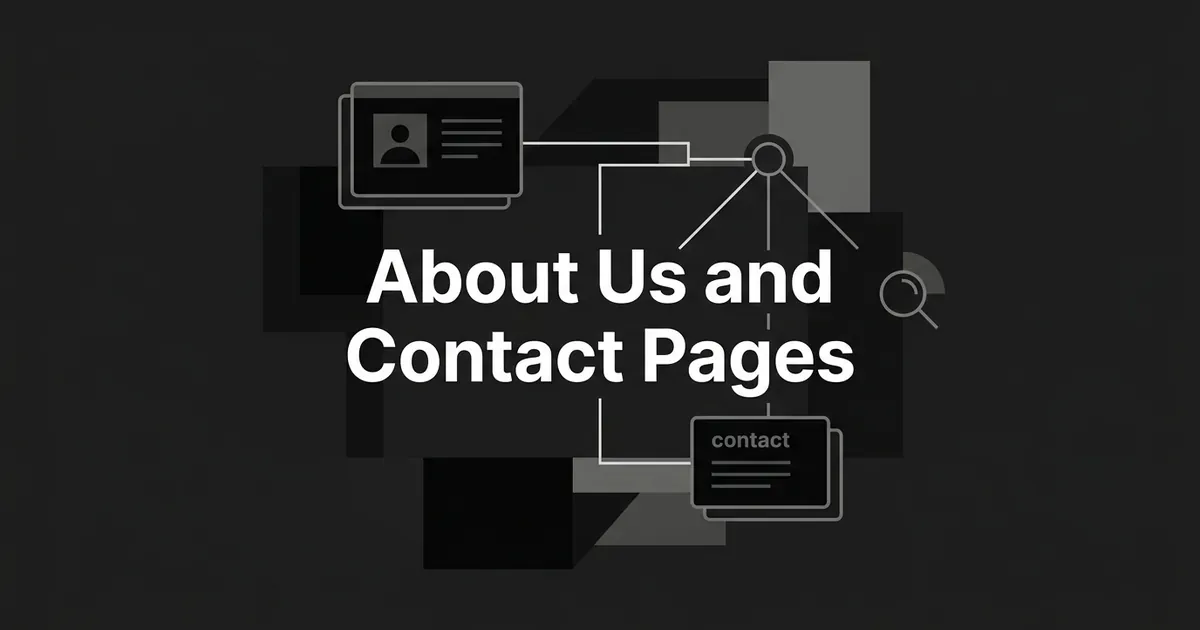
If you have ever wondered about about us page SEO or contact page SEO, here is the short answer: Google has never said these two pages are a ranking requirement. There is no rule that says add an About page and a Contact page and your site climbs. But that is not the same as saying the pages do nothing. They help a visitor understand who runs the site and how to reach someone, and for certain kinds of sites, Google's own guidance treats that as something worth having. The value is real. It just is not a ranking checkbox.
That distinction matters more than it sounds like it should, because a lot of SEO advice collapses the two ideas into one. Either "these pages are a proven ranking factor, go add them today" or "Google doesn't care, skip them." Neither one holds up once you look at what Google has actually published.
What Google has actually said about these pages
In March 2024, Search Engine Journal reported that Google's John Mueller was asked directly whether About Us and Contact pages were a Google "make or break" requirement. His answer, as reported: he could think of good reasons for some sites to have these kinds of pages, but after checking, there was nothing in Google's search developer documentation that said they were needed.
Read that carefully, because it gets misquoted a lot. Mueller did not say the pages are useless or that they hurt a site. He rejected the idea that developer documentation requires them. Those are different claims, and the difference is the whole point of this article. A page can be genuinely useful to readers and still not be something Google's documentation lists as a requirement.
That single quote is usually where the "About pages don't matter for SEO" take comes from, and it is also usually the point where people stop reading. There is more to the story once you look at where Google does talk about these pages.
Where the confusion comes from: raters are not the algorithm
Google publishes Search Quality Rater Guidelines, a long document that trains the human raters who evaluate search results and help Google understand whether its systems are working the way it intends. The version dated September 2025 has a section, 2.5.3, titled "Finding About Us, Contact Information, and Customer Service Information." It tells raters what to look for and says the type and amount of contact information a site needs depends on the website. A site handling money, like a store or a bank, gets more scrutiny here because raters are told that contact and customer-service information is extremely important for those sites. A personal blog or a humor site does not carry the same expectation.
Here is the part that gets lost: a rater guideline is not the same thing as a ranking factor. Google explained back in October 2021 that rater ratings do not directly impact how a page or site appears in search results. Raters help Google measure whether its ranking systems are working well over time. They are not sitting there manually deciding where your page lands. So when someone tells you "Google's quality raters check for a Contact page, so it must help your rankings," that skips a step. It shows you what Google considers part of a trustworthy, useful site. It does not prove a missing Contact page causes a ranking drop.
That is really the whole tension in one paragraph. Google clearly thinks these pages matter to the human experience of a site. Google has not said adding them moves your rankings.
What an About page is actually for
Google's Search Central guidance on helpful, people-first content asks site owners to think about whether their content shows real signs of trustworthiness, including background about the author or the site publishing it, and gives a link to an About page as one example of how a reader might find that background. That is a specific, named example. It is not a claim that having an About page earns points.
The guidance also says something that gets skipped in a lot of SEO writing: E-E-A-T (experience, expertise, authoritativeness, trustworthiness) is not itself a specific ranking factor. Google uses a mix of signals that can pick up on aspects of it, and trust is described as the most important piece of that mix. An About page can support that picture by giving a reader context on who is behind the site. It does not replace accurate information about who actually wrote a given article, which is a separate question about author bios rather than the company as a whole.
So the honest way to describe an About page's job: it resolves a reader's uncertainty about who they are dealing with. That is a trust function, aimed at a person reading the page, not a mechanical SEO lever. If a visitor lands on your site from a search result and cannot tell who runs it or whether the company is real, an About page answers that question before it becomes a reason to leave.
What a Contact page is actually for
A Contact page answers a narrower question than an About page: if something goes wrong, is there a way to reach someone? Google's rater guidelines are specific here. They tell raters to look for a contact or customer-service link, and if there is no dedicated Contact Us page, to look elsewhere on the site, including a corporate page or an official social account. The point raters are checking is whether the information a visitor would reasonably need is findable somewhere, not whether a page with a specific label and URL exists.
This is also where the "does contact page seo actually matter" question gets a more useful answer than a flat yes or no. The rater guidelines are explicit that the appropriate amount of contact detail depends on the site. An online store or a bank faces higher expectations because customers may need help with an order, a payment, or an account problem. A personal site or a small blog does not carry the same bar, and Google's own guidance recognizes legitimate reasons someone might not want to publish a home address or a personal phone number. Contact information can take more than one form: an email address, a form, a general inquiry channel. None of that requires a public phone line.
When these pages carry more weight
The common thread across everything Google has published is that expectations scale with what the site actually does. A site that handles money sits in a different category than a site that mostly publishes articles.
Google's Merchant Center guidance, which governs product listings rather than ordinary organic search, asks merchants for verifiable business information and a working site that shows current contact details. Its misrepresentation policy disallows a false business name, a fake identity, or misleading contact information. Those are real requirements, but they apply to Merchant Center's own program for product listings. They are not a general statement that every website needs a Contact page to rank in ordinary search results, and it is a mistake to generalize a merchant policy into an algorithm-wide rule.
Outside of ecommerce, the practical read is simpler. If your site takes payments, handles sensitive requests, or is the kind of business a reader might need to escalate a problem to, put real effort into making contact and support information easy to find. If your site is a personal project or a small blog with nothing transactional happening, a lighter touch is reasonable, and Google's own rater guidance backs that up.
Think of it as a sliding scale rather than a pass or fail test. A humor blog and an online bank are the two ends of that scale, and most sites sit somewhere in the middle. A SaaS company with a free tool, a services business that takes bookings, a newsletter with a paid tier: each of those has a different answer to "what does a reader reasonably need to be able to do here if something goes wrong." The rater guidelines do not hand you a formula for where your site lands. They ask you to think about your own visitors and what they would actually need, which is a more useful exercise than hunting for a universal checklist anyway.
Can these pages actually hurt your SEO?
The reviewed guidance does not identify simply having, or not having, an About page or a Contact page as a problem on its own. The risk shows up somewhere else: when a page exists but is designed to obscure who is actually responsible for the site. Google's rater guidelines instruct raters to look at a page's true purpose, and a page built to deceive people about who runs it or what it is for gets the lowest possible quality rating in that framework. That is a judgment about deceptive intent, not about the mere absence of a two-page setup.
The flip side matters too. Nothing in Google's guidance asks a small creator to publish a home address or a personal phone number for the sake of about us page seo. Anonymity and privacy are treated as legitimate in the rater guidelines, and a lighter contact setup is expected for sites where that fits. Chasing a checklist item at the cost of someone's actual safety or comfort is not what any of this guidance is asking for.
What to actually do about it
There is no defensible percentage to hand you here. None of the sources behind this article measure a specific ranking lift, traffic increase, or conversion gain tied to adding either page, and any number you see claiming otherwise is not coming from Google. The honest decision rule is simpler than a metric: does your site make it clear who is behind it, and is there a reasonable way for a visitor to get help if they need it? Weight that more heavily if you handle payments or the kind of requests where a reader might genuinely need support. Weight it less if you run a personal or informational site where the stakes are lower.
Treat these pages as something you build for the person reading your site, not as two boxes to check for a ranking algorithm. If you already write with real transparency about who your company is and how to reach it, you are covering what this guidance actually asks for. If you have been putting off a real About page because it felt like busywork, this is the case for doing it anyway: not because it moves rankings on its own, but because it answers a question your reader is actually asking.
None of this requires a big project. A clear paragraph about who runs the site, a findable way to get in touch, and accurate information about who wrote what you publish covers the substance of what Google has described here. The rest is a matter of how much effort your specific site and its readers reasonably call for.
It also helps to separate this from a different question that gets confused with it: who wrote the specific article you are reading. An About page tells a visitor about the company or the publication as a whole. It is not a substitute for accurate byline information on individual posts, and Google's guidance treats those as related but separate signals of trust. A strong About page next to unclear or missing authorship on your articles still leaves a gap, and it is usually the smaller of the two pages that gets neglected first.