When Bing's AI features answer a question and show you a list of sources underneath, it is easy to assume that list is just the top search results with links attached. It isn't. Bing and Copilot pull from the same crawl, index, and ranking system that ordinary Bing search uses, but generating an AI answer adds a separate layer on top of it. Microsoft calls this Bing AI search grounding, and it asks a different question than ranking does. Ranking asks which pages a person should visit. Grounding asks which information an AI system can responsibly use to build an answer.
That distinction matters if you publish content and want to understand why a page can get cited without being the top result, or rank well and still get skipped for an AI answer. This piece stays on the mechanism itself: what grounding is, how a prompt turns into retrieved content, what makes a page eligible to be pulled in, and what Microsoft has and hasn't told us about how Bing chooses sources for a generated answer.
The shared search foundation
Bing's AI features are not a separate search engine running on a separate index. Microsoft has said plainly that Bing and Copilot use the same core crawling, indexing, and ranking foundation. Before any page can show up in an AI-generated answer, it has to clear the same basic bar that ordinary search results clear.
That foundation works in three broad stages. Bingbot discovers and crawls webpages. Bing builds an index of what it finds and analyzes the content. Then algorithms and machine learning match a query against that index and rank the results. This is the layer everything else sits on top of, and it's worth remembering because a page that never gets crawled or indexed has no path into an AI answer either.
On top of that foundation, Bing's documented ranking considerations include a handful of broad categories. Relevance covers how closely a page matches the intent behind a query, including the actual words used, synonyms, and related terms. Quality and credibility cover whether a site has a clear purpose, is usable, and reports firsthand information rather than just republishing someone else's. Freshness covers whether the content is current, and Microsoft has said Bing generally favors fresh content over stale content. User interaction signals, like what people click and how quickly they bounce back to search, matter too. Microsoft is clear that the relative weight of these factors shifts by query and changes over time, so none of them work as a fixed formula.
These are documented as normal Bing search considerations, not as a published Copilot citation formula. They explain the retrieval foundation an AI answer draws from. They don't tell you exactly how a citation gets chosen once a set of candidate pages exists.
From prompt to Bing query
Here's where the mechanism starts to differ from plain search. For Microsoft Copilot Chat and agents, Microsoft has documented a specific step: Copilot takes what you typed and turns it into a shorter Bing query, then sends that shorter query to Bing. It might use just a few words from your prompt, or from a file you uploaded. Your full question usually isn't sent to Bing verbatim unless it was already short to begin with.
This matters because it means the retrieval step isn't working from your exact words. It's working from Copilot's interpretation of what you were asking, condensed into something closer to a normal search query. When web search is turned on, you can actually see this happen: Copilot has a Sources control that shows you the query it sent to Bing and the Bing Copilot sources it used to build the answer. That's one of the few places where part of this process is visible instead of hidden behind the final response.
This short-query workflow is specifically documented for Copilot Chat and agents. It shouldn't be assumed to describe every Bing AI surface the same way. Bing's broader description of its generative answers is simply that they're based on search results and include references to the source websites, without the same level of detail about how the query gets built.
From ranked pages to groundable evidence
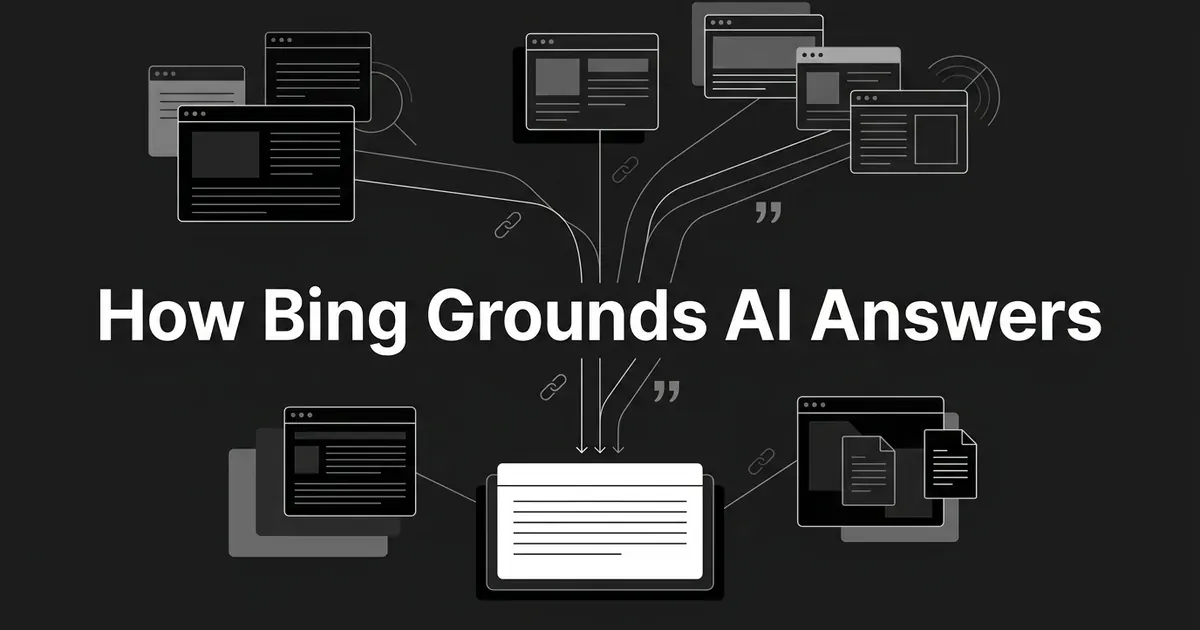
Once Bing retrieves a set of candidate pages, something more specific than ranking has to happen before that content ends up supporting an AI answer, and this is where the Bing grounding mechanics actually differ from a normal search result page. Microsoft describes the unit of value here as "groundable information": discrete facts that can be traced back to where they came from.
That standard adds requirements a normal search result never had to meet. The page's content has to be interpreted accurately enough that its meaning survives being pulled into an index (factual fidelity). The system has to be able to point back to where a claim came from (provenance). Not every piece of indexed content carries equal weight as evidence for a specific claim (evidence strength). Stale information becomes a misleading answer rather than just a lower-ranked result, so freshness matters more here than it does for a plain search listing. When sources disagree, the system can't just treat them as interchangeable. And when the evidence is missing, outdated, or contradictory, declining to answer fully is treated as a legitimate outcome, not a failure.
Microsoft also describes grounding retrieval as something that can work iteratively: refining a search, asking a follow-up, pulling from multiple sources, and reevaluating when confidence is low. That's a design description of what the system is built to do, not a step-by-step account of what happens on every single query. The practical takeaway is simpler than the mechanism sounds. A page can be relevant to a topic without being usable as evidence for a specific claim. And a page can end up cited without having been the single highest-ranked result in the traditional sense.
What makes a page eligible in the first place
Microsoft's Webmaster Guidelines connect ordinary search eligibility to Copilot and grounding eligibility directly, and the list of what they cover reads like an extension of normal SEO practice rather than something separate. Bingbot needs to be able to crawl and render the important content on the page. The URL needs clear canonical signals so Bing knows which version of a page is the real one. Internal links need to be crawlable, and sitemaps need to reflect what's actually there and when it changed. Content needs a clear structure, a single primary topic instead of a mix of unrelated subjects, and information that's accurate, original, and independently verifiable. Authority and trust signals matter, and duplicate URLs that dilute those signals work against a page rather than helping it.
None of this guarantees a citation. Microsoft is explicit that SEO doesn't guarantee rankings or traffic, and the AI-search equivalent doesn't guarantee grounding or citations either. What these guidelines describe is eligibility, the floor a page needs to clear to even be considered, not a formula for winning the selection once it clears that floor.
Content owners also have direct controls over whether a page can be used this way at all. Robots.txt controls whether Bingbot can crawl a page in the first place. A NOINDEX tag keeps a URL out of Bing search, Copilot, and grounding API results entirely. NOARCHIVE blocks Copilot and grounding from using the page even if it's indexed. NOCACHE limits what Copilot can use to just the URL, title, and snippet, which narrows how deeply that page's content can support an answer. Practices like cloaking, artificial link schemes, scraping, keyword stuffing, misleading structured data, and low-quality automated content can suppress visibility or lead to delisting. Structured data can help Bing interpret a page more accurately, but Microsoft is clear it isn't a switch that turns visibility or grounding on.
What a citation does and does not prove
In February 2026, Microsoft introduced AI Performance in Bing Webmaster Tools, a public-preview reporting layer that shows which of your pages became Bing Copilot sources across Microsoft Copilot, Bing's AI-generated summaries, and select partner AI integrations. It's the closest thing publishers currently have to visibility into this process, and it's worth being precise about what it actually measures.
AI Performance reports total citations, the number of unique pages cited on a given day, page-level citation counts, and something called grounding queries: short, grouped phrases representing the language the AI system used when retrieving content that later got cited. One grounding query phrase can map to several pages, and one page can map to several phrases, so this isn't a clean one-query-to-one-page table. It's worth being careful here too: grounding queries are not the same as the full question a user typed. They're aggregated representations of retrieval language, not a transcript of user prompts.
What the report does not tell you is just as important. It doesn't measure ranking position, authority, traffic, clicks, or engagement. A citation means your content was visibly referenced or shown as a source in an AI-generated answer. It says nothing about where that page sat in the underlying search ranking, how much of the answer's substance it actually contributed, or whether anyone clicked through afterward. The data itself has limits too: it's a sample of total citation activity refreshed daily, not a complete log of every time your content may have influenced an answer, and low-frequency activity may not show up at all.
What Bing has not disclosed
Put all of this together and the honest answer to how Bing chooses sources is a layered mechanism with public principles, not a published rule. Microsoft has told us a lot: the shared foundation with traditional search, the broad categories of ranking signal, the specific short-query workflow for Copilot Chat and agents, the requirements grounding adds on top of relevance, and a reporting layer that shows which pages got cited without showing why.
What Microsoft has not published is the exact weighting between relevance, quality, authority, freshness, and engagement for AI citations specifically. It hasn't said how many candidate pages get retrieved before an answer is generated, whether every citation traces back to the top traditional search results, or the model and ranking stack behind each individual Bing and Copilot surface. It hasn't explained when a page gets cited because it supports one specific claim versus because it adds general context, or how conflicting sources get resolved in an actual answer rather than in the abstract description of the system. None of that is published, and treating any of it as settled, whether the claim is "domain authority decides everything" or "the top search result always gets cited," goes further than what Microsoft has actually said.
That gap is not a flaw in the explanation, it's just where the public documentation currently ends. Understanding the Bing grounding mechanics as far as they're disclosed, crawl and index eligibility, the query-rewriting step, the grounding requirements layered on top of ranking, and what a citation in AI Performance does and doesn't confirm, is the most accurate picture available right now.

If you're trying to see how your own content performs across AI search platforms rather than reverse-engineering the mechanism page by page, DeepSmith tracks mention and citation rates across ten AI engines including Microsoft Copilot, so you can see which of your pages are actually showing up instead of guessing from the outside.