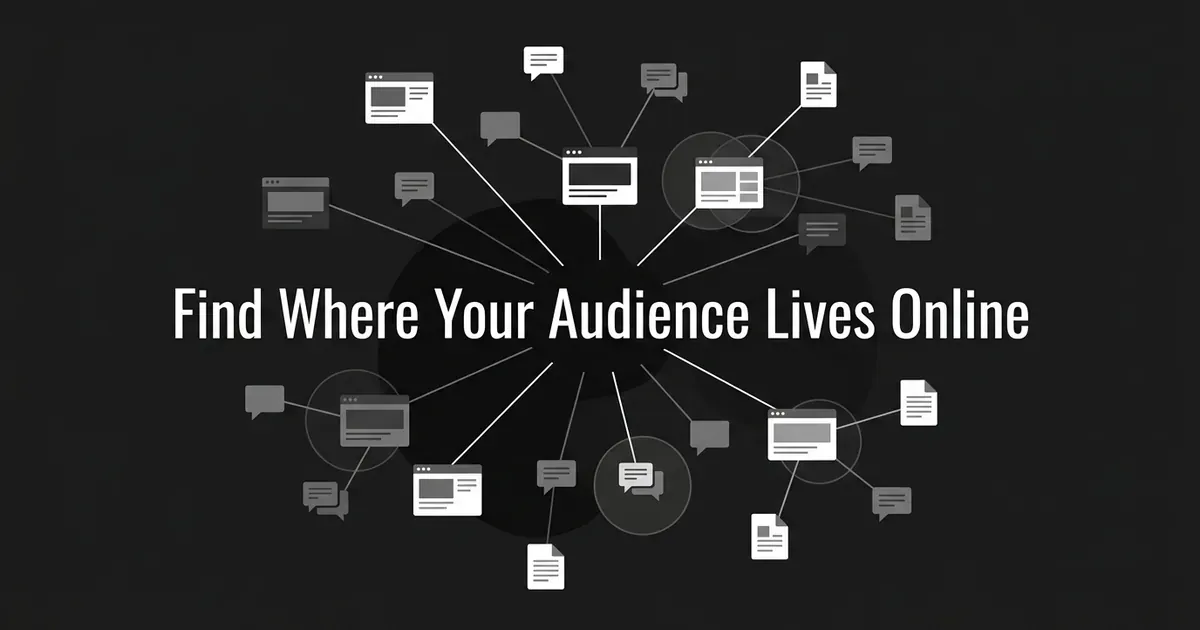
You want to place a guest article, start a newsletter swap, or show up in the right subreddit, but you are guessing at which sites and communities actually matter. A popular website is not the same as a website your readers use, and a site that looks like a good audience match is not always a place that will let you contribute. This guide walks you through audience destination research, the process of going from a rough sense of who you are trying to reach to a short, defensible list of the specific sites, publications, and communities worth your time, using the tools built for exactly this job.
By the end you will have a repeatable answer to where does my audience spend time online, a way to tell a real overlap signal from a vanity metric, and a shortlist you can actually act on for guest posts, partnerships, and community participation.
Step 1: Pick a seed that actually represents your audience
Start with one narrow thing: a website your intended readers already use, or a search topic tied directly to the problem your content solves. This seed is the input the rest of the process runs on, so it needs to be specific. A site owned by a competitor or an adjacent company works fine as a seed. You are not benchmarking its traffic, you are using it as a known point your audience already touches.
Write down the geography you care about and the format you can actually deliver: an expert guest article, a newsletter collaboration, or a useful answer in a forum thread. If you serve more than one distinct readership, for example enterprise buyers and solo freelancers, treat them as separate research runs rather than blending them into one seed.
In SparkToro, you can define an audience by a keyword people search for or a website they visit, and its documentation also covers searching by words people use in their public profiles. Similarweb works the other direction, starting from a domain you already know. Both are inputs for finding destinations, not proof that every visitor to your seed matches your audience.
You are done with this step when you can explain, in one sentence, why each seed connects to the audience you are trying to reach, and you have written down the geography to check later. If your seed is a broad, famous site with only a loose connection to your topic, expect the next step to return a list full of generic, general-interest destinations that are not worth pursuing.
Step 2: Build a list of candidate sites, publications, and communities
Run each seed through SparkToro and pull results from its Websites, Press, and Subreddits views. Look past the first few well-known names. SparkToro's Press view draws on website behavior plus social sharing, engagement, and following, so a publication can turn up there that never appeared in Websites. Keep podcasts and YouTube channels on the list only if those formats are genuinely part of your distribution plan.
For each candidate, record its name, the type of destination it is, which seed produced it, and the reported association with your audience. Use SparkToro's Lists feature to collect the strongest candidates in one place, along with any contact details it surfaces, though contact availability is never guaranteed.
You are done here when you have a deduplicated list of named destinations, not a vague conclusion like "our audience is active on social media." This is the step where most of the work to find sites your audience visits actually happens, so give it more time than the others. Watch for the opposite failure too: treating an affinity ranking or a followed-publication badge as a headcount of confirmed readers for your proposed post. These are candidates to check, not confirmed placements.
Step 3: Check which sites share visitors with your seed
This step is what audience destination research really means in practice. You are testing whether a candidate site's readers actually overlap with your seed's readers, rather than just looking similar on paper. In Similarweb, open Website Analysis for your seed domain, go to Audience Interests, and look at the other sites its audience visits. Set your time period, country, and device scope (desktop, mobile web, or both) before you compare anything, because those settings change the numbers. You can add up to four more sites for a side-by-side comparison.
For your strongest finalists, open Audience Overlap and compare the seed against selected candidate domains. If your team already has Semrush, its own Audience Overlap dashboard inside Traffic & Market answers a similar question and can serve as a second check.
Write down two things every time, which report you used and what it is actually measuring. Similarweb's Audience Interests reports same-day cross-browsing, the share of your seed's unique visitors who also visited a candidate site on the same day. Its separate Audience Overlap view reports monthly shared unique visitors instead, is limited to the 1,000 most relevant sites for a given website and country, and only covers desktop traffic. Confusing the two, or reading "X% of our seed's visitors also visited Y" as "X% of Y's visitors are our audience," will send you after the wrong sites. Similarweb's Similar Sites affinity score is a different measure again: it blends shared keywords, links, and content similarity, not just visitors, so do not treat it as an overlap percentage.
Common mistake: ranking candidates purely by total traffic or by one impressive-looking overlap number. A large general-interest site can be hard to get published on and indifferent to your topic, while a smaller publication with an engaged, relevant readership and an open contributor process is often the better choice. Judge reach, topic relevance, and access separately, because a site can score well on one and fail badly on the other two.
You are done with this step when every shortlisted site either has an overlap figure recorded, with its settings noted, or is explicitly marked "overlap unavailable." A missing number is not evidence of zero shared audience, it just means you have not measured it yet.
Step 4: Confirm communities are active and open to outsiders
A subreddit or forum with a large member count can still be the wrong destination if nobody is talking about your topic, or if the community rules block anything that looks like promotion. For a promising subreddit, use Reddit Pro's Trends tool to track a topic keyword, then check its Communities and Conversations views. Record the subscriber count, how often your keyword comes up in the period you chose, and a couple of examples of recent, on-topic discussion.
Then open the community itself and read its rules directly. Check whether promotional links are allowed, whether expert answers are welcome, and whether there is any path for a partnership approach. Apply the same manual read to any other forum or Slack group or Discord you are considering, since none of Reddit's specific rules or metrics carry over automatically.
Reddit says there is currently no limit on how many keywords you can track in Trends, but the data does not capture every relevant conversation, currently aggregates English-language discussion, and leaves out chats, private messages, mod mail, and deleted content. Keep that in mind before you treat a quiet Trends result as proof that nobody is discussing your topic there.
You are finished with a community when you have examples of recent, relevant exchanges plus a documented, rule-compliant way to participate, or you have marked it unsuitable and moved on. Do not equate subscriber count with active readership, keyword mentions with buying intent, or membership with permission to post a link.
Step 5: Turn your longlist into a shortlist
For every destination that survived Steps 3 and 4, record the same set of facts: the audience signal and where it came from, topic and format fit, evidence of recent activity, geography, the overlap or reach figure with its exact definition attached, the site's contributor or sponsorship rules, a contact or application route if one exists, and the likely effort or cost. Keep a clear line between what you observed and what you are judging, so a colleague reviewing the list later can tell the two apart.
A simple worksheet helps here: rate each destination on three dimensions, audience fit, observable activity, and legitimate access, as strong, uncertain, or weak. This is your own editorial judgment call, not a published benchmark or a score any tool hands you. A destination with strong fit but no permissible way in belongs on a watchlist, not your immediate outreach plan. A destination with broad reach but weak topic fit should not win a slot just because it is large.
You are done when you can say, for each of your top few destinations, exactly why it deserves a pitch or a participation effort, and why the rest are on hold. Do not assume an audience-overlap number implies a willingness to accept guest posts. Check editorial guidelines, look for examples of outside contributors, and read sponsorship pages directly. Where none of that is public, mark access as unconfirmed rather than assumed.
Step 6: Match each destination to the right kind of pitch
Different destinations call for different asks. Propose a genuinely useful guest article to a publication that clearly accepts outside contributors. Suggest a co-created resource or a newsletter swap to a relevant partner with a comparable audience. Answer an existing, relevant question inside a community where the rules allow it. In every case, reference specific material or discussion that shows you actually looked at the destination rather than sending a form pitch. Agree on format, placement, link policy, disclosure, and timing before anything goes live, and decide up front how you will track the result.
Audience research tools can point you to a promising destination and, in some cases, a contact, but the relationship work is still yours: a reported visit overlap does not guarantee an editor replies to your email.
Once you have selected a destination and know what you are contributing, DeepSmith's Content Studio can turn the approved idea into a researched, on-brand article, and Repurpose and the Apps Library can adapt that same piece into the format each channel actually expects, whether that is a LinkedIn post, a newsletter section, or a Reddit-appropriate write-up. That is production help after you have made the call, not a shortcut around Steps 1 through 5: DeepSmith does not discover audience-overlap destinations, identify individual visitors, negotiate a partnership, or place a post inside someone else's community for you.

Step 7: Measure what each placement actually does
Before you place anything, establish a baseline of the referrals you already get. In GA4, open Reports, then Acquisition, then Traffic acquisition, and look at the Session source / medium dimension for any referring sites you can already identify. Where the destination allows it, give each partnership or placement its own campaign-tagged link and note the date it went live. Compare the resulting visits and any key events against the effort or cost involved, and write down outcomes a click cannot capture too, like a new editorial relationship or a genuine response inside a community.
GA4's Traffic acquisition report only shows traffic that actually reached your site. It cannot tell you everything your target audience reads elsewhere, and it will not attribute every later visit back to one placement. A destination that shows zero recorded referrals might still carry real audience value, and a solid community answer that contains no link at all can still be worth doing.
If you are tracking DeepSmith's AI visibility reporting separately, treat it as a different measurement entirely: it shows brand mentions and citations for the prompts you track, subject to your plan's engine coverage, and it is not a substitute for checking whether a specific guest post or partnership actually sent readers your way.
You are finished with a placement when you have recorded what actually happened and made a clear call: repeat it, adjust it, or stop. Resist the urge to credit or blame a single placement for a traffic shift without checking your attribution first, and resist writing off an untracked placement as a failure just because nothing showed up in a report.

What to do next
You do not need a perfect answer to where does my audience spend time online before you start. Pick one audience seed you can defend today, run it through Steps 1 through 4, and get a shortlist of five to ten real destinations. Reach out to two or three of them with a specific, well-matched pitch, and measure what happens before you scale the process up. Once you know where your audience actually spends time online, DeepSmith's Content Studio can help you turn each approved idea into a publish-ready article, and Repurpose can adapt it for the exact channel you are pitching, so the production side keeps pace with the destinations you have already earned. Start a free trial to see how that works with your own backlog of ideas.