You opened your AI visibility dashboard, saw a competitor cited instead of you, and then went back to your normal week. Sound familiar? That gap between seeing the problem and fixing it is why most teams start shopping for LLMpulse alternatives.
LLM Pulse does the seeing part well. It watches five core engines on every plan and reports what they say about you. The trouble starts after the report. Someone still has to decide what to write, write it, link it, publish it, and repurpose it.
So the alternatives to LLMpulse below are not just "cheaper trackers." They are eight AI search visibility platforms sorted by how far they carry you past the dashboard. Some are pure measurement. Some measure and then help you act. One does both in a single workflow.
Take a breath. You do not need all eight. You need the one that matches the job your team actually struggles with.
What you are replacing when you leave LLM Pulse
LLM Pulse is the baseline here, not an entry on the list. Its public pricing page lists five core engines on every plan: ChatGPT, Perplexity, Gemini, Google AI Mode, and Google AI Overviews. Optional models include Claude, Copilot, Grok, DeepSeek, and Alexa for Shopping.
LLMpulse pricing is public, which makes the comparison easier than it usually is. Plans run from €49 per month for Starter up to €1,199 for Scale++, with Growth at €99 and Scale at €299 in between. The USD display shows those as roughly $60, $121, $365, $730, and $1,460 per month. Allowances scale from 50 to 2,400 tracked prompts and from one to 15 projects. Weekly Starter, Growth, and Scale plans include a 14-day trial with a payment method on file.
That is a real product with real coverage. The replacement question is rarely "which tracker is cheaper?" It is closer to this: which platform gives you the visibility you need, and does it stop at reporting, or does it help you produce the content that closes the gap?
Hold that question. It sorts this whole list, and it matters more than LLMpulse pricing does.
How we ranked these LLMpulse alternatives
Rankings without criteria are just opinions with confidence. Here is what we weighted, in order:
- Prompt-level visibility and citation data. Not a vanity score. Per-prompt mention rates, citation rates, and answer history.
- Competitor and source analysis. Who wins your prompts, on which exact pages.
- Ability to turn insight into action, especially publishable content.
- Engine and geographic breadth, checked per tier rather than per marketing page.
- Workflow support: API, CMS, BI, agency and white-label features.
- Transparent pricing and allowances you can actually use.
- Fit for a marketing lead who needs more output without more manual operations.
One honest note before the list. This is an editorial ranking, not a claim that one tool wins every situation. Four of the eight below are the better buy for specific teams, and we say exactly which teams in each entry.
The 8 best LLMpulse alternatives at a glance
| Rank | Platform | Best fit | Public entry price | Coverage or allowance | Content production bundled? |
|---|---|---|---|---|---|
| 1 | DeepSmith | Teams that want track-to-publish in one workflow | $99/mo Pro | 50 prompts, 20 articles/mo, 5 seats | Yes, full production |
| 2 | Profound | Enterprise AEO programs and agencies | $99/mo Starter billed yearly | 50 prompts, 1,500 responses/mo | Yes, via agents and CMS publishing |
| 3 | AthenaHQ | Broad model coverage plus BI and revenue data | Free Essential, $295/mo Starter | 3,600 credits, 10 models on Starter | Optimization agents and recommendations |
| 4 | Scrunch | Enterprise site and AI-agent readiness | $250/mo Core | 125 prompts, 5 audits/mo, 4 LLMs | Optimization and delivery, not full production |
| 5 | LLMrefs | Cost-conscious teams wanting breadth | $79/mo, limited time | 500 prompts, unlimited projects | Recommendations only |
| 6 | Rankscale | Agencies needing volume and white-label | $20/mo Essentials, $99/mo Pro | Pro: 1,200 credits, 4,800 answers | Optimization insights only |
| 7 | Goodie | Running AEO as a structured program | $399/mo Explorer | 100 prompts, 3,000 responses/mo | Yes, writer and blog generation |
| 8 | Otterly | Solo marketers wanting daily monitoring | $29/mo Lite | 15 prompts, 4 engines, daily | Recommendations and audits |
Prices are the public figures captured for this research and they change. Prompts, credits, responses, and tracked answers are not the same unit, so compare them carefully rather than lining up the numbers.
1. DeepSmith
Best for: marketing leads and content teams whose real problem is not "we cannot see our AI visibility" but "we can see the gaps and still cannot publish enough to close them."
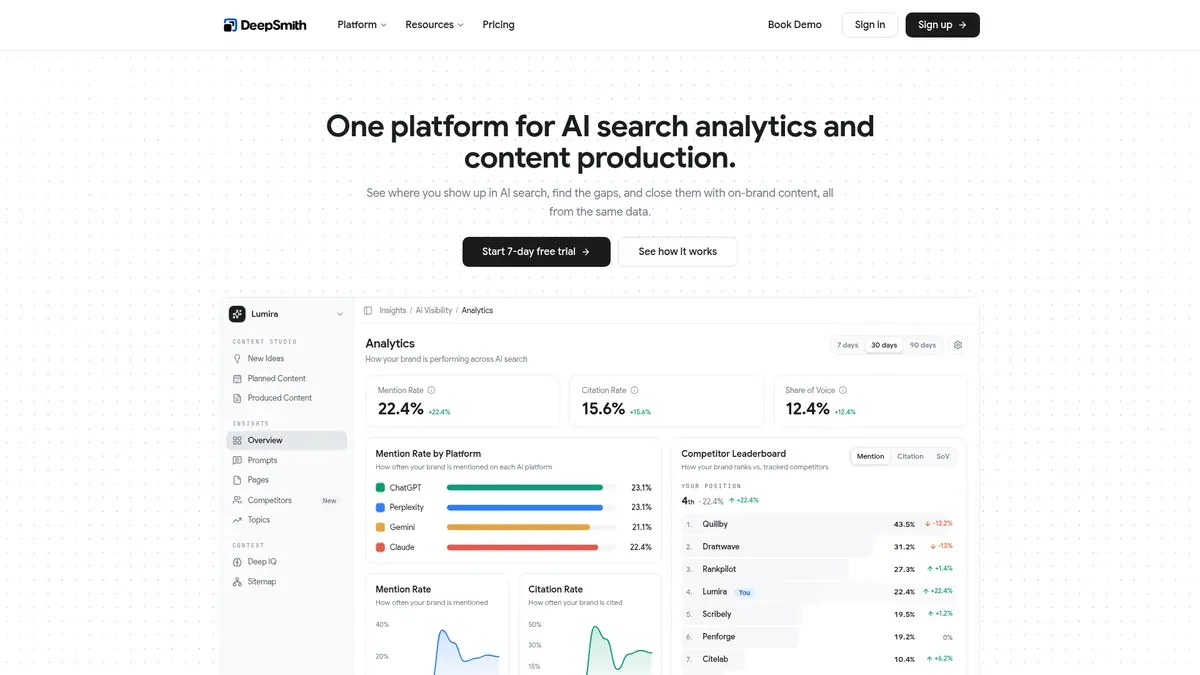
DeepSmith is AI search analytics and content production in one platform. It tracks how AI engines answer questions about your brand, finds where you are invisible or losing, and produces the on-brand content that closes those gaps, all from the same data. It is a production engine, not a writing assistant. The output is a finished article you review, not a first draft you rescue.
Start with the measurement, because that half has to be good or the rest is decoration. The AEO area reports Mention Rate, Citation Rate, and Share of Voice with trends, a per-platform breakdown, a competitor leaderboard, and the sources AI cites most. Every prompt you track carries its own mention and citation rate plus full answer history. Pages shows which of your URLs AI actually cites and the prompts driving them. Competitor citations shows who wins your prompts and on which exact pages.

Ten engines are covered: ChatGPT, Gemini, Perplexity, Claude, Google AI Overviews, Google AI Mode, Grok, Meta AI, Microsoft Copilot, and DeepSeek. Coverage rises by tier. Pro tracks ChatGPT, Grow adds Perplexity, Scale adds Gemini, and Enterprise or Custom covers all ten.
Now the part that separates this entry from the rest of the list.
Content Map crawls your site and your competitors' sites and classifies every page onto one shared topic taxonomy and a funnel stage. You get coverage gaps, untapped topics, and per-topic depth, so you can see whether a topic is thin, top-heavy, or missing its decision-stage pages entirely. Sitemaps re-check every 24 hours, so it stays current without a re-import.
Opportunity Agents then read that data and hand you ideas with the evidence attached. Get cited for a tracked prompt. Turn mentions into citations. Take a competitor's citations. Close the decision-stage gap against up to four competitors at once. Each idea travels with the data point that justifies it, which means you can defend your backlog in a planning meeting instead of guessing.
Content Studio moves those ideas through New Ideas, Planned Content, and Produced Content. Giving an idea a date is what plans it. The Writer turns one planned idea into a finished, brand-grounded article: researched, internally and externally linked, with a cover image and publish-ready metadata. Autowrite takes it further and writes on the scheduled date with nobody in the app. Publishing goes straight to WordPress, Webflow, Strapi, Sanity, or Contentful, or to your own webhooks.

Deep IQ is the layer that keeps all of it sounding like you. Your company positioning, products, personas, brand voice, visual guidelines, and reusable content types are stored once and used by every module. That is what removes the re-briefing tax at volume.
Repurpose and the Apps Library turn each finished article into LinkedIn, X, Medium, Substack, newsletter, Reddit, and more, in the same voice. Distribution stops being the thing that falls off.
Pricing: Pro is $99/mo (50 prompts, 20 articles, 5 seats), Grow is $199/mo (100 prompts, 40 articles, 7 seats), Scale is $399/mo (200 prompts, 90 articles, 10 seats), and Enterprise is custom with all ten engines, 1:1 onboarding, and a dedicated account manager. There is a 7-day free trial, no long-term contracts, and no cancellation fees.
One honest limitation: the lower tiers do not give you all ten engines on day one. If you must monitor every named engine immediately, Pro will feel narrow. The path is explicit rather than hidden: Grow adds Perplexity, Scale adds Gemini, Enterprise and Custom cover all ten. For most teams leaving LLM Pulse, the first real bottleneck is publishing, not engine count, and that is the bottleneck this platform is built to clear.
2. Profound
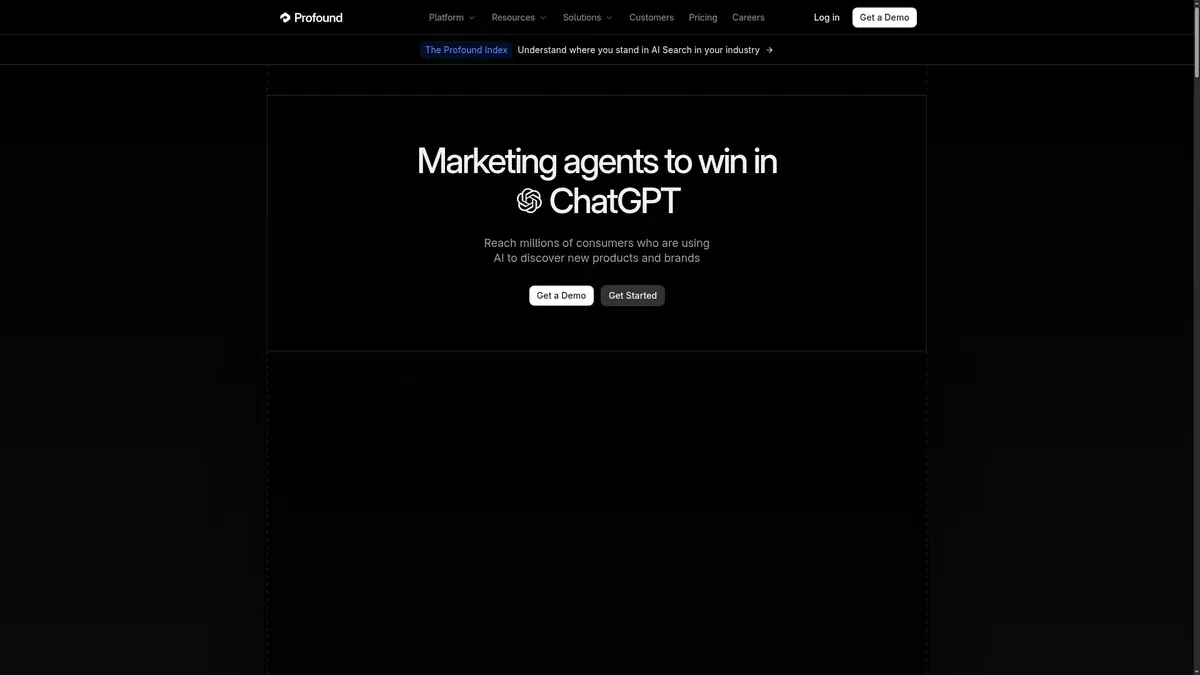
Best for: enterprise marketing teams and agencies that need structured AI visibility data, prompt-demand intelligence, agents, and governance.
Profound monitors ChatGPT, Gemini, Claude, Perplexity, Grok, Microsoft Copilot, DeepSeek, and Google AI Overviews. Answer Engine Insights shows how AI represents your brand. Prompt Volumes shows what large numbers of people actually ask AI, which is genuinely useful for aligning strategy with demand rather than with your own assumptions.
Key features: AI Visibility, Source Citations, Brand Sentiment, and Content AEO reporting. Marketing agents include a Demand Gen Agent, Brand Agent, and Content Agent, plus an FAQ agent for AEO-optimized landing-page FAQs. Agent Analytics tracks how AI platforms crawl and interpret your site. CMS Integration Agents publish approved content without manual transfers, and an API lets developers work with platform data directly.
Pricing: Starter is $99/month billed yearly with ChatGPT only, 50 prompts, 1,500 responses per month, and one seat. Growth is $399/month billed yearly with three answer engines, 100 prompts, 9,000 responses, three seats, and CSV and JSON exports. Enterprise is custom, adds up to nine answer engines, and brings SSO/SAML, SOC2, dedicated Slack support, and API access.
Honest limitation: Starter is much narrower than the broad multi-engine positioning suggests. It tracks ChatGPT only, gives you one seat, and does not include API access or exports. Growth is the plan that matches the pitch, and it is $399/month on annual billing. Enterprise limits and price need a sales conversation.
Pick Profound when prompt-demand data and enterprise governance matter more to you than transparent, self-serve scale.
3. AthenaHQ
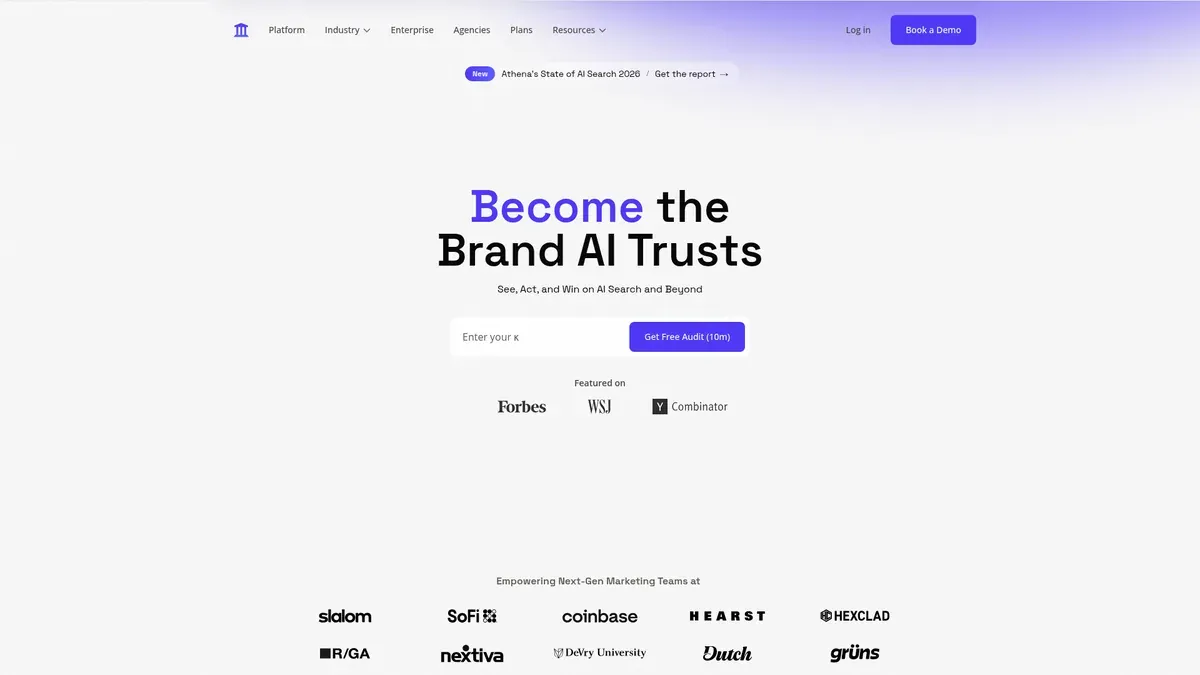
Best for: teams that want broad model coverage tied to analytics, commerce, and BI systems.
AthenaHQ covers prompt and response analysis, source and competitor insights, citation intelligence, real-time brand sentiment, content recommendations, and an Athena AI agent. Starter lists visibility across ten models: ChatGPT, Perplexity, Google AI Overviews, Google AI Mode, Gemini, Claude, Copilot, Grok, DeepSeek, and Meta AI, with more available on request.
Key features: the integration story is the standout. Google Analytics 4 connects AI visibility to traffic and conversions. Search Console lets you compare SEO and AEO side by side. Shopify supports AEO-optimized publishing and AI-search revenue attribution, and Webflow and Framer are documented too. Enterprise adds claim review, discrepancy detection, the Athena Citation Engine, SAML and OIDC SSO, audit logs, multi-region and multilingual support, and executive dashboards through Tableau, Power BI, and Looker.
Pricing: Essential is free with 300 credits, a $25 free credit, and unlimited members. Starter is $295/month with 3,600 credits and 10 models. Enterprise is custom. One credit equals one AI response.
Honest limitation: Starter's headline price does not include API access or extra credits, which are paid add-ons. The credit model also means you should model expected response volume before comparing it to prompt-priced tools. No trial duration is published.
Choose AthenaHQ when proving revenue impact to a leadership team is the assignment, not just proving visibility.
4. Scrunch
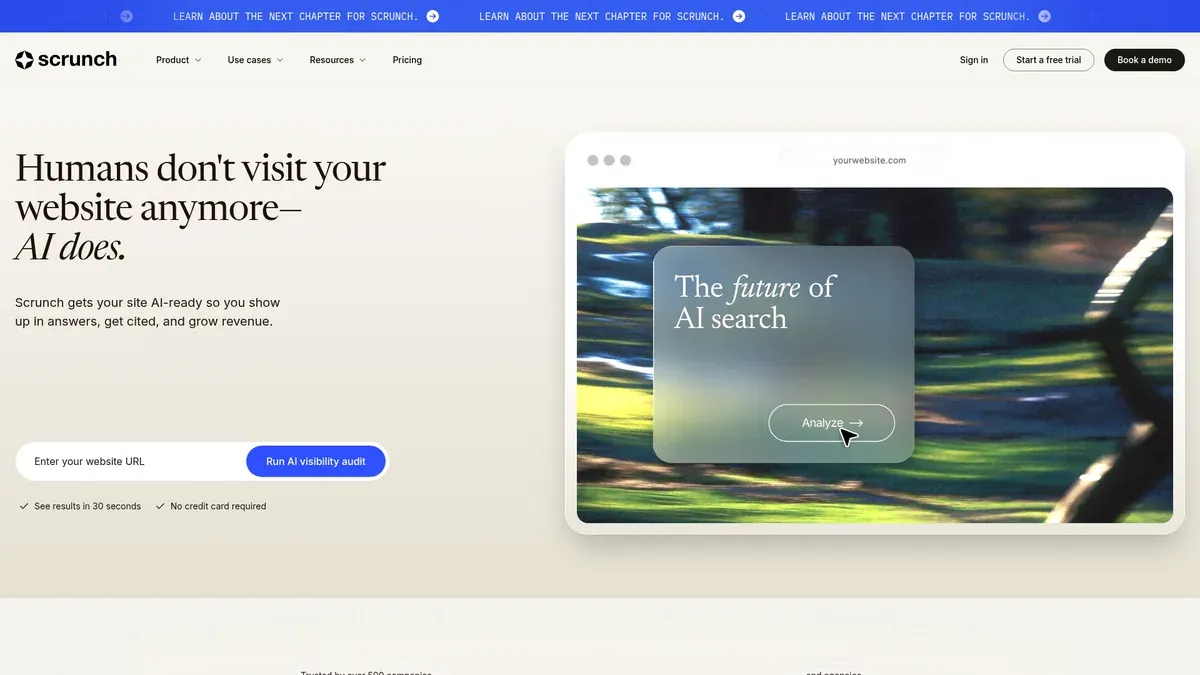
Best for: enterprise brands and agencies where the website itself, not only the content, is part of the problem.
Scrunch calls itself an Agent Experience Platform, and that framing is accurate. It spans AI visibility monitoring, website auditing, content optimization, and content delivery designed to give AI agents what they need to understand and recommend your brand.
Key features: monitoring covers prompts, citations, AI search trends, topic discovery, and benchmarked topic share, plus signals that flag changes and explain why they matter. The platform observes what agents say and do both on AI platforms and on your own site. Enterprise materials list SOC2 Type II, role-based access, SAML and OAuth SSO, global deployment, a data API, white-glove onboarding, and a forward-deployed engineer.
Pricing: Core is $250/month with 125 unique prompts, five site audits per month, one brand workspace, five user licenses, and four LLMs (ChatGPT, Perplexity, Google AI Overviews, Copilot), plus a 7-day free trial. Enterprise is custom and covers nine LLMs with custom prompts, workspaces, licenses, API access, SSO, and a dedicated account team.
Scrunch reports over 500 companies and agencies, more than 6 million citations weekly, and more than 1.5 million prompts weekly. It also displays a 364% increase in brand presence for non-branded prompts. Those are Scrunch's own figures, not independent benchmarks.
Honest limitation: Core gives you one workspace, five licenses, 125 prompts, and four LLMs. Nine-engine coverage, API access, SSO, and enterprise support all move you to custom packaging. The documented strengths are monitoring, audits, optimization, and agent-facing delivery, not a scheduled article-production pipeline.
5. LLMrefs
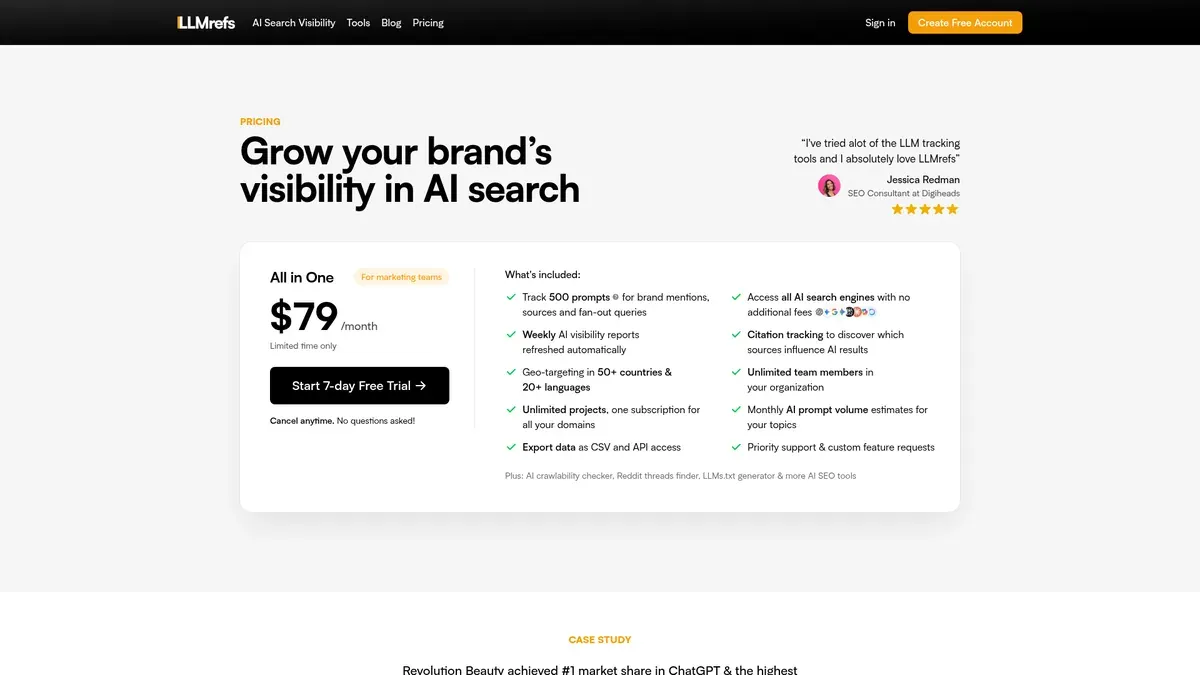
Best for: cost-conscious teams, SEO specialists, and agencies that want breadth without an enterprise invoice.
LLMrefs is an AI search analytics and brand-visibility tracker. It handles prompt tracking, brand visibility monitoring, competitor benchmarking, source and citation tracking, monthly AI prompt-volume estimates, and content-opportunity discovery.
Key features: the pricing page lists ChatGPT, Google AI Overviews, Google AI Mode, Gemini, Perplexity, Claude, Copilot, and Meta AI with no extra engine fee, which is unusual at this price. Coverage spans 50-plus countries and 20-plus languages. Weekly visibility reports refresh automatically, data exports to CSV, and an API is available. Extra tools include an AI crawlability checker, a Reddit threads finder, and an LLMs.txt generator.
Pricing: one plan, All in One, at $79/month with 500 prompts, unlimited projects, and unlimited team members. There is a 7-day free trial and you can cancel anytime.
Honest limitation: that $79 is marked limited time, and no annual price, overage price, or keyword allowance is published. Refresh is weekly, which is slower than the daily collection some rivals offer. LLMrefs is an analytics and opportunity tool. There is no documented brand-context production pipeline, content calendar, automatic publishing, or distribution library.
If your budget is tight and your bottleneck is genuinely visibility into many engines and markets, this is the best value on the list.
6. Rankscale
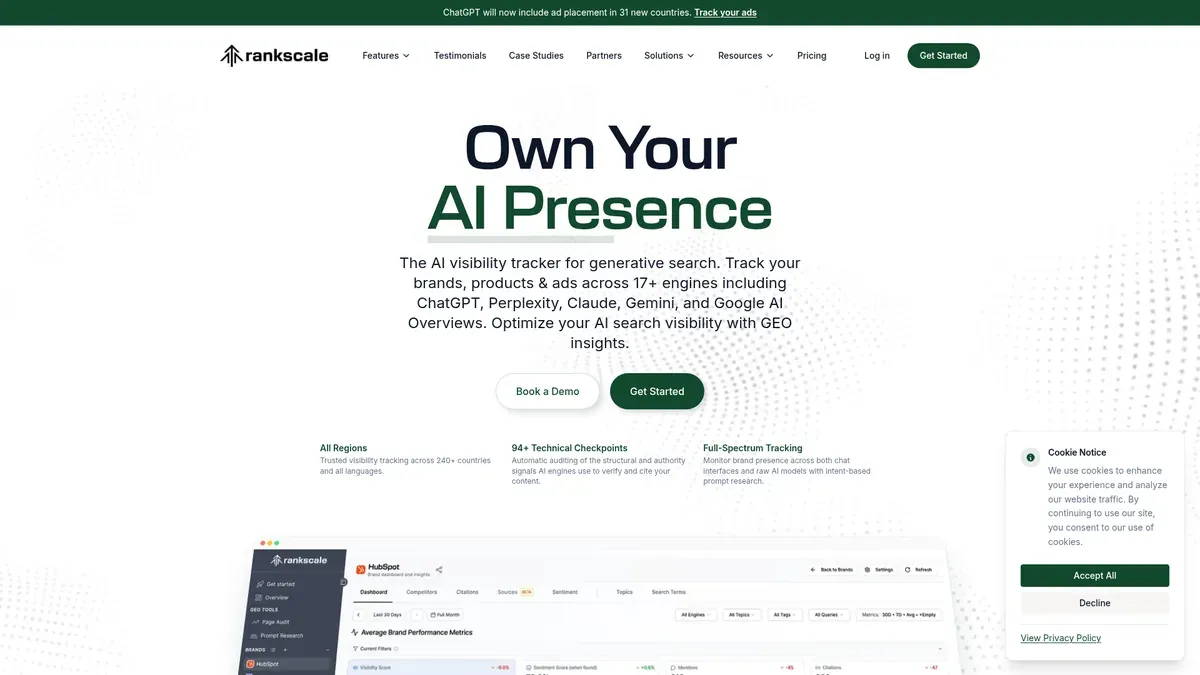
Best for: agencies, multi-brand operators, and anyone who needs volume, dashboards, and client-facing reporting.
Rankscale positions itself as an integrated AI SEO suite for brand monitoring and AI search optimization, tracking brands, products, and ads across 17-plus engines including ChatGPT, Perplexity, Claude, Gemini, and Google AI Overviews.
Key features: AI visibility tracking, GEO insights, brand dashboards, page audits, unlimited search terms on every plan, all regions, public share links, white-label reporting, and REST API access. For an agency that has to hand a client something on the first of the month, the public share links and white-label options do real work.
Pricing: Essentials starts at $20/month. Pro is $99/month with 1,200 credits, up to 4,800 tracked answers, 10 dashboards, 50 page audits per month, and a 7-day free trial with no charge until day seven. Growth is $385/month with 5,500 credits and up to 22,000 answers. Enterprise is $780/month with 12,000 credits and up to 48,000 answers.
Honest limitation: read the Essentials row carefully. It lists zero credits, zero tracked answers, zero dashboards, and zero audits, so the $20 headline is not a monitoring plan. Pro at $99 is the real entry point. The documented strengths are measurement, volume, dashboards, audits, API, and reporting, not article production or multi-channel repurposing.
7. Goodie
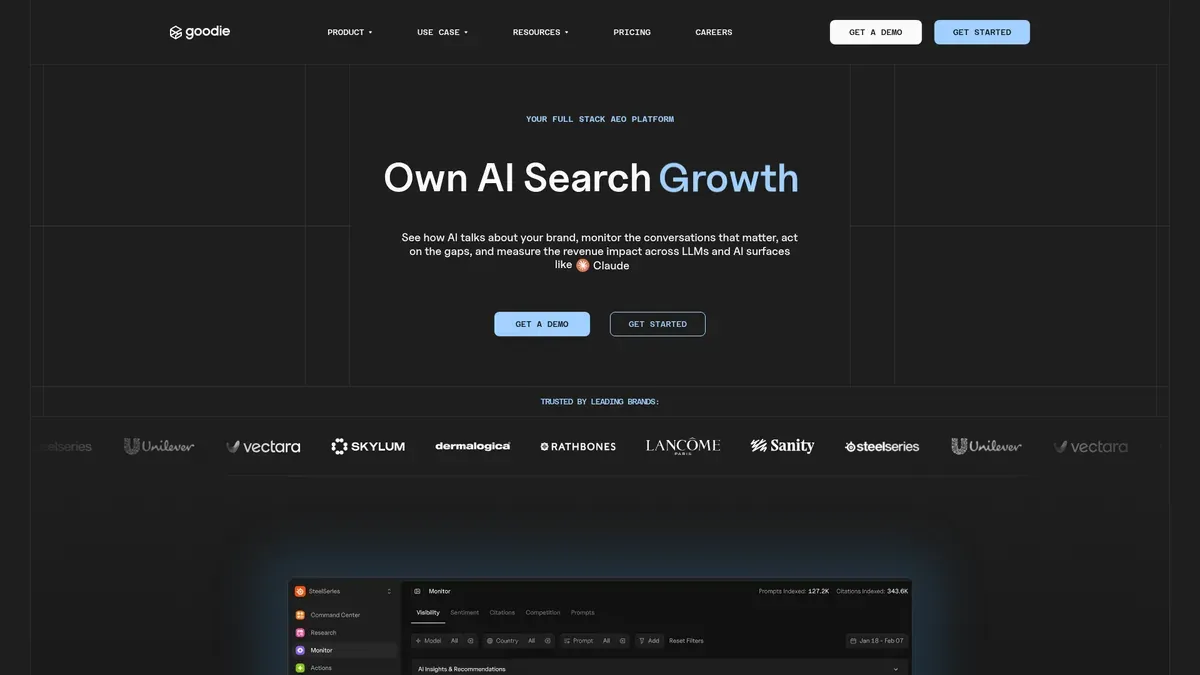
Best for: teams that want to run AEO as a structured program rather than a monitoring habit.
Goodie organizes around four stages: Research, Monitor, Optimize, and Measure. Research surfaces high-intent AI prompts, search-volume patterns, and trending topics. Monitoring covers mentions, competitor and industry benchmarking, brand sentiment, and daily collection.
Key features: the Optimize stage is where Goodie goes further than a pure tracker. It includes an AEO Content Writer, content optimization, blog generation, outreach, technical LLM.txt and sitemap repair, and a social agent. Measurement adds a visibility dashboard, traffic attribution, agent and crawler analytics, Google Analytics revenue attribution, and custom revenue modeling higher up. Documented connections include Google Analytics, Search Console, Bing Webmaster Tools, Vercel, WordPress, and Cloudflare, with MCP server access and full API at higher packaging levels.
Pricing: Explorer is $399/month with 100 prompts, 3,000 AI responses per month, 10 optimization actions per month, three seats, one brand, two countries, two languages, three core engines, and a 7-day trial. Pro adds Gemini, Copilot, and Rufus with 250 prompts and 30 actions. Enterprise reaches 500-plus prompts and up to 11 models.
Honest limitation: $399/month buys three core engines and one brand on Explorer, and Pro pricing is not published, so you cannot compare full program cost from the public page. Its content features sit inside optimization actions with a monthly cap, which is a different shape from a scheduled production and CMS publishing workflow.
8. Otterly
Best for: solo marketers and small teams that want daily monitoring at the lowest usable price.
Otterly tracks brand presence, visibility, sentiment, competitors, links, and cited URLs across AI search experiences. Brand Sentiment measures how positively or negatively AI engines talk about you, and the product includes GEO audits and recommendations.
Key features: daily tracking on every plan, unlimited team members even on the cheapest tier, and GEO URL audits at real volume. Standard and Premium add API access, MCP access, and Agent Analytics. Otterly is also available as an app in the Semrush App Center, though that version has a reduced feature set.
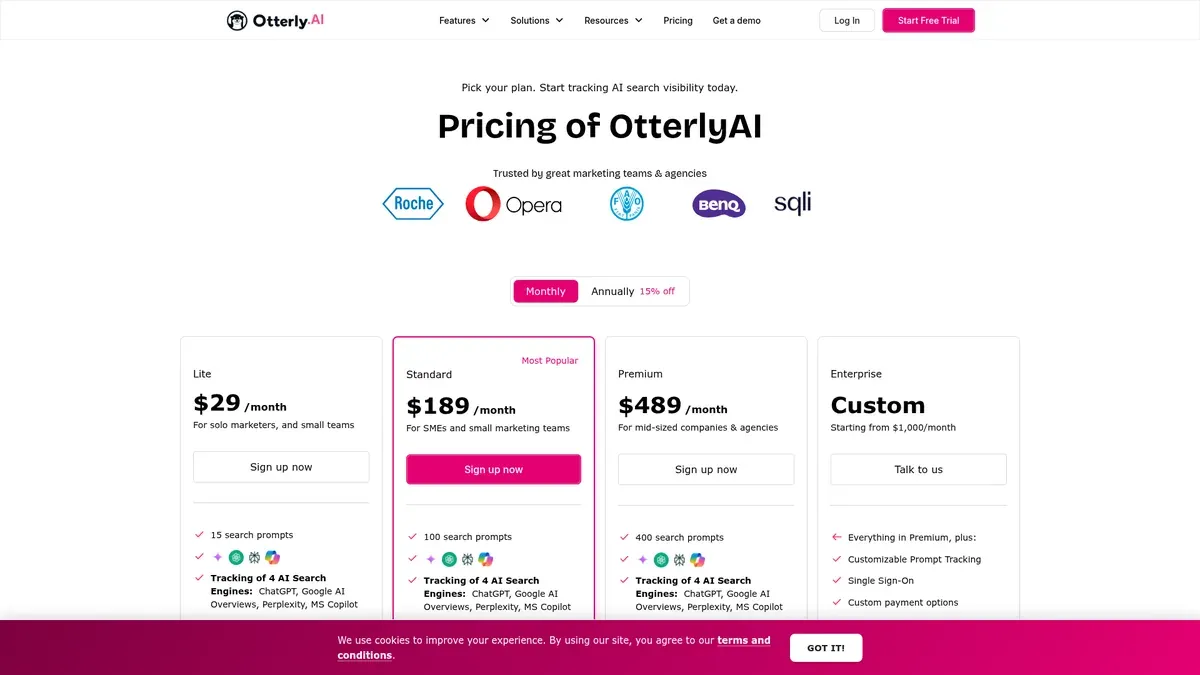
Pricing: Lite is $29/month ($25 annually) with 15 prompts, four core engines, one workspace, three recommendations per week, and 1,000 GEO audits per month. Standard is $189/month with 100 prompts, unlimited workspaces, and 5,000 audits. Premium is $489/month with 400 prompts. Enterprise starts from $1,000/month.
Honest limitation: the four core engines are ChatGPT, Google AI Overviews, Perplexity, and Copilot. Google AI Mode and Gemini are add-ons at $9 to $149 monthly depending on tier, and Claude is another add-on at $29 to $439. Lite cannot add prompts at all. The $29 entry price is real, but it is not the price of broad coverage.
How to choose the right LLMpulse alternative for your team
Not sure which one? Answer one question: what breaks first in your week?
If the visibility gap has to become published content, choose DeepSmith. This is the fit when the same team owns visibility, planning, production, optimization, publishing, and distribution, and when the honest bottleneck is that you are editing too much, adding internal links by hand, and never getting to the repurposing.
If you need enterprise insight and agents, choose Profound. Prompt-volume data, broad answer-engine coverage, CMS publishing agents, API, SSO/SAML, and dedicated support. Budget for Growth or a custom package, because ChatGPT-only Starter will not carry an enterprise program.
If analytics and revenue proof are central, choose AthenaHQ. GA4 attribution, Search Console comparison, Shopify revenue data, and enterprise BI connections. Model your credit usage first.
If your site and agent experience are the problem, choose Scrunch. Visibility plus website audits, site diagnostics, agent behavior, and content delivery, with enterprise onboarding behind it.
If cost and breadth are the priority, choose LLMrefs. 500 prompts, unlimited projects and members, broad engines, 50-plus countries, CSV and API at $79/month. Check whether the limited-time price still holds and whether weekly refresh is fast enough for you.
If you run an agency, look hard at Rankscale. Many dashboards, high answer volume, public share links, white-label reporting, and REST API. Skip Essentials and start at Pro.
If you want a managed AEO program, choose Goodie. Prompt discovery, daily monitoring, optimization actions, technical agents, social output, and GA revenue attribution in one place. Ask for Pro pricing before you commit.
If you need an inexpensive daily starting point, choose Otterly. 15 prompts and four core engines at $29/month is a genuine on-ramp. Recalculate once you add engines or prompts.
One more filter on every alternative to LLMpulse here, and it is the one people skip. Compare units, not headline prices. Prompts, credits, monthly responses, and tracked answers are four different things, and engine count means little until you check which engines your specific tier includes.
Ready to see the gaps and close them?
Here is the good news: you already know your visibility problem exists, which is further than most teams get. The next step is small. Start a DeepSmith free trial and get real data and real drafts before you pay. Seven days, no long-term contract, no cancellation fee.