Profound and Evertune both track how AI engines talk about your brand, but they send you down different paths afterward. Profound's agents write content and publish it to a CMS, while Evertune ties its repeatedly sampled data to affiliate placements and ChatGPT and programmatic ads behind a demo. DeepSmith is a strong alternative if you want to close gaps with published content: it tracks and produces in one platform, with plans priced publicly from $99 a month.
Choosing between Profound or Evertune mostly comes down to what you plan to do once you can see where your brand is missing from AI answers. If you already buy affiliate and programmatic media, Evertune's data feeds that spending directly. If you would rather fix the gaps with content, Profound's agents are built for that. DeepSmith sits on the content side too, with a public price.
Profound vs Evertune: the short answer
- Choose DeepSmith if you want to track AI answers and publish articles that close the gaps from one platform, starting with a 7-day free trial and a $99 Pro plan that includes 20 articles a month.
- Choose Profound if you want deep tracking plus agents that draft content and publish it to a CMS, and you can buy through a sales-led, credit-based Enterprise package.
- Choose Evertune if you buy affiliate or programmatic media and want repeatedly sampled visibility data to point those placements, and you are fine going through a demo.
Side-by-side comparison
| DeepSmith | Profound | Evertune | |
|---|---|---|---|
| Entry price (monthly) | $99/mo (Pro) | Not published (free Trial, custom Enterprise) | $800/mo (Pro, behind a demo request) |
| Annual price | $80/mo billed yearly | Custom | Not listed |
| Prompts at entry tier | 50 | 50 (7-day Trial) | 100,000 |
| Engines at entry tier | 1 (ChatGPT) | 3 (ChatGPT, Gemini, Google AI Overviews) | 11 AI models listed |
| Most engines on any plan | 10 (Enterprise) | Up to 9 (Enterprise) | 11 listed on Pro |
| Free trial | Yes, 7 days | Yes, 7 days | No |
| Citation tracking | Yes | Yes | Yes |
| Competitor benchmarking | Yes | Yes | Yes |
| Content generation | Yes | Yes | Yes |
| CMS publishing | Yes | Yes | No |
| Ad and affiliate activation | - | Partial (ChatGPT Ads Studio, private beta) | Yes (ChatGPT ads in beta, affiliate and programmatic partners) |
| API | Yes (read-only) | Yes, Enterprise only | Not listed |
| Security certifications | SOC 2, GDPR and ISO | SOC 2 Type II | No SOC 2 report yet |
| Review rating | 4.8/5 on G2 | 4.5/5 on G2 | Unrated on G2 |
Pricing and features as of September 2026, from each vendor's site and public reviews.
Profound

Profound is an AI marketing platform that tracks how ChatGPT, Google AI Overviews and AI Mode, Gemini, Perplexity, Claude and other engines mention and cite a brand. It was founded in 2024 in New York and has raised $334.5 million, so it is the larger of the two companies by a wide margin. It is built for enterprise and mid-market marketing, SEO, content and brand teams, and for agencies.
The standout is how much it covers around tracking. You get visibility score and rank, share of voice, URL-level citations, sentiment, query fan-outs, demand data from Prompt Volumes, and server-log tracking of AI crawlers. Its AI Marketer and Agents then draft briefs and full articles from your brand context, and publish approved drafts to CMSs such as WordPress, Sanity, Contentful and Webflow. Reviewers on G2 praise the visibility, citation and competitor analytics.
The real limitation is buying it. Paid pricing is not public, the free Trial runs seven days with 50 prompts you cannot customize, and seven of the nine listed engines sit on Enterprise only. Agent runs use credits, and Profound says overage billing is optional but gives no rate. G2 reviewers often call it expensive, and some report a learning curve. The G2 rating is 4.5/5 from 1,130 reviews as of late September 2026.
Evertune

Evertune is a New York AI search marketing platform founded in 2024 by early team members of The Trade Desk. It measures how AI models mention and rank a brand against competitors, then connects the gaps to content, site fixes, affiliate placements and ChatGPT and programmatic ads. It is aimed at mid-market and enterprise brands and the agencies that serve them, especially teams that already buy affiliate or programmatic media.
The standout is its measurement method. Evertune asks each prompt 100 times per model and says the margin of error is about 1 point overall and 2 points at topic level. That is a vendor claim, though the research did not find it contradicted. It also keeps base-model answers collected through provider APIs separate from consumer-app answers. On the action side, Partner Connect maps cited sources to affiliate networks like impact.com and PartnerStack, and to programmatic platforms like The Trade Desk and Index Exchange.
The limits are about how much is documented. Pro is listed at $800 a month, but both plans say Request a demo, and there is no free trial. The pricing page does not define what counts as one of the 100,000 prompts. Its Ads Manager and AI Retargeting are in beta, there is no CMS connector, no SOC 2 report yet, and G2 showed zero reviews on September 30, 2026. So most proof points are Evertune's own case studies.
DeepSmith: the alternative that tracks and publishes on public terms

Profound and Evertune each do part of what a brand needs after it finds a visibility gap. Profound's content agents publish to a CMS, but they work on credits under a custom contract, and Profound describes the output as drafts with an approval step. Evertune writes blog drafts too, up to 25 a month on Pro, but its content leaves as a Markdown or HTML download. Neither one shows a price a content team can plan around before talking to sales.
DeepSmith closes the gap with earned visibility, meaning articles that other sites and AI engines can cite. It tracks and produces in one platform. The AEO module reports mention rate, citation rate and share of voice across ten engines on the right plan, and it shows the pages AI actually cites for your prompts. Content Map shows where competitors cover topics you do not. Opportunity Agents then turn that data into ideas, each with the data point that justifies it.
From there the Writer turns a planned idea into a finished article, with internal and external links, a cover image and publish-ready metadata. All of it is grounded in Deep IQ, where your brand voice, personas and products are stored once. Autowrite can run the whole thing on a set date with no one in the app, and Produced Content publishes straight to WordPress, Webflow, Strapi, Sanity or Contentful. DeepSmith's plans don't include paid ad placements, so the work here is the content side, and the result stays in your own library.
The product figure below is demo data, not a customer result. It shows DeepSmith listing the domains and pages AI cites most for a set of tracked prompts, with the brand's own domain flagged in the ranking.
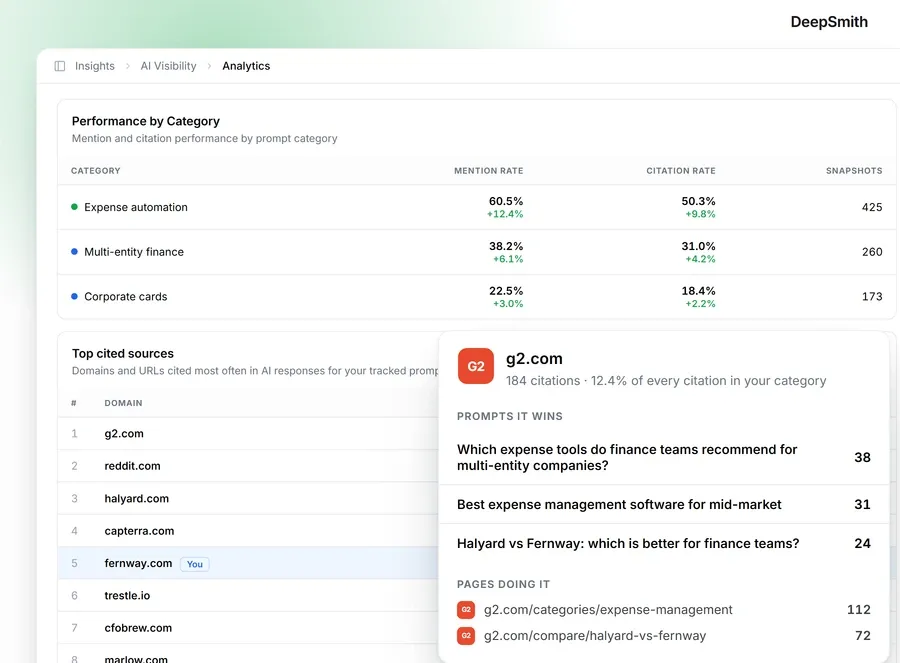
On cost, Pro is $99 a month ($80 billed annually) with 20 articles, 50 tracked prompts and 5 seats. Grow is $199, Scale is $399, and Enterprise is custom with all ten engines. Every plan starts with a 7-day free trial and there are no long-term contracts, so you can try it with your own data before any sales call.

The second figure, also demo data, shows a finished article waiting in Produced Content with its cover image, word count and link counts, ready to publish in one action. DeepSmith is rated 4.8/5 on G2 and is SOC 2, GDPR and ISO certified.
Engine coverage and data method
Evertune has the wider engine list on paper, and Profound is clearer about querying the consumer interfaces for the engines it tracks. Evertune lists 11 AI models on Pro, but the help center says Claude, Meta AI and DeepSeek are sampled only as base models through APIs, not in their consumer chat apps. Perplexity and Copilot are consumer-app only. Profound says it queries the front-end consumer experience of the engines it covers, on up to nine engines, but only three (ChatGPT, Gemini and Google AI Overviews) are on the free Trial.
The data method is where the two really differ. Evertune's 100 samples per prompt are meant to smooth out the fact that AI answers vary from run to run. Profound runs each tracked prompt daily by default and keeps the full answer text over time. If you care most about a stable number, Evertune's approach is attractive. If you care about reading what the engines actually said, Profound documents that more clearly.
What DeepSmith does: DeepSmith tracks ten named engines (ChatGPT, Gemini, Perplexity, Claude, Google AI Overviews, Google AI Mode, Grok, Meta AI, Microsoft Copilot and DeepSeek), with coverage rising by plan from ChatGPT on Pro to all ten on Enterprise. Each prompt keeps its answer history, so you can read what an engine said and how it described you.
Competitor and citation analysis
Profound has the deeper citation analysis of the two, mainly because its records document more. Profound shows every cited URL per prompt, groups sources into owned, competitor, earned media, PR wire, social and institution, and watches individual pages over time. Evertune's Content Analytics also lists cited domains and URLs and goes a step further by scoring each on topic relevance, brand relevance and sentiment, then sorting them into Owned, Strength and Opportunity URLs. Both benchmark competitors on the same prompts.
Evertune's Opportunity URLs matter for this reader, because they are the list that feeds Partner Connect. The same list of cited sources that tells a content team where to publish tells a media buyer where to place ads. That is a real strength if media buying is part of your job.
What DeepSmith does: DeepSmith's competitor citations view shows who wins citations for your prompts, on which exact pages, and how each competitor does by platform. Its Pages view shows which of your own pages AI cites, each page's share of your citations, and the prompts driving them.
Pricing and value
Evertune is the only one of the two with a number on its pricing page, while Profound is easier to start with because of its free Trial. Evertune lists Pro at $800 a month with 100,000 tracked prompts and 25 articles a month, but it is behind a demo request and the annual price, billing period and seat count are not shown. The terms also allow per-prompt fees, overages and an Ads Manager fee based on a percentage of ChatGPT ad spend, with the rates set on the order page.
Profound publishes no paid price. You get a free seven-day Trial, then a custom Enterprise package in which agent use consumes credits. That makes spend hard to forecast, and Profound's own FAQ pages still mention older Starter and Growth plans that its pricing page no longer sells. If a third-party report says Profound costs $99 or $399 somewhere, treat it as unverified, since the current pricing page does not show it.
For a team that needs a budget before a call, neither is easy to plan around. Evertune gives you a starting figure and Profound gives you a trial, so the comparison depends on whether you would rather see a number or try the product first.
What DeepSmith does: DeepSmith prints every plan: $99, $199 and $399 a month, or $80, $160 and $299 billed annually, with articles, prompts and seats listed for each. You can try it free for 7 days before talking to anyone.
Security and data access
Profound is ahead here. It has a SOC 2 Type II report with HIPAA coverage, SSO through SAML and OIDC, a REST API, an MCP server that is an official Anthropic connector, and connectors for Looker, Tableau and Google Analytics. Most of that sits on Enterprise.
Evertune's own January 2026 comparison page says SOC 2 Type II is in progress, and the research found no newer statement. SSO is Enterprise only. No customer API, MCP server, analytics connector or alerting is described in the records. If your procurement team asks for a SOC 2 report this quarter, that is a plain difference between the two.
From insight to action
This is the axis that matters for a brand that buys media, and it is where the two split most clearly. Evertune wins on paid activation. Its Insights Agent suggests next steps each week, Partner Connect maps cited sources to affiliate and programmatic platforms, AI Search Intent places ads on the sources buyers click through from AI answers, and the ChatGPT Ads Manager builds campaigns from visibility gaps. The ads modules are in beta, and the ChatGPT Ads Manager charges a usage fee based on ad spend.
Profound wins on content execution. Agents draft briefs and articles, refresh old pages and publish approved drafts to ten named CMSs, and Context Manager and Brand Kits ground the output in your brand. Its Ads Studio is a private beta for ChatGPT Ads, and its pages describe pulling your OpenAI Ads and Google Ads performance into agents. The records show no affiliate or programmatic placement module.
What DeepSmith does: DeepSmith runs the content loop from start to finish. Opportunity Agents return evidence-backed ideas, New Ideas and Planned Content hold the backlog, the Writer produces the article, Autowrite does it hands-off on schedule, and Produced Content publishes to your CMS. Apps Library then turns each article into versions for LinkedIn, X, newsletters and more. The result is a growing library of published pages that AI engines can cite.
Which should you choose
- DeepSmith fits marketing leads and content teams who want to see where AI answers miss their brand and publish the articles that fix it, on a plan with a printed price, a free trial and no long-term contract.
- Profound fits larger marketing, SEO and brand teams that want the broadest analytics plus content agents, and have the budget and the patience for a sales-led, credit-based package.
- Evertune fits brands that already run affiliate and programmatic media and want sampled AI visibility data to guide those placements, and can accept a demo, beta ad modules and no SOC 2 report yet.
Profound vs Evertune for brands buying AI ads is a fair question if your plan includes paid media, and the honest split is that Evertune leans toward ads and Profound leans toward content. If your plan is content, you can start with DeepSmith's free trial at https://app.deepsmith.ai/auth/sign-up and see what your own tracking data turns into.